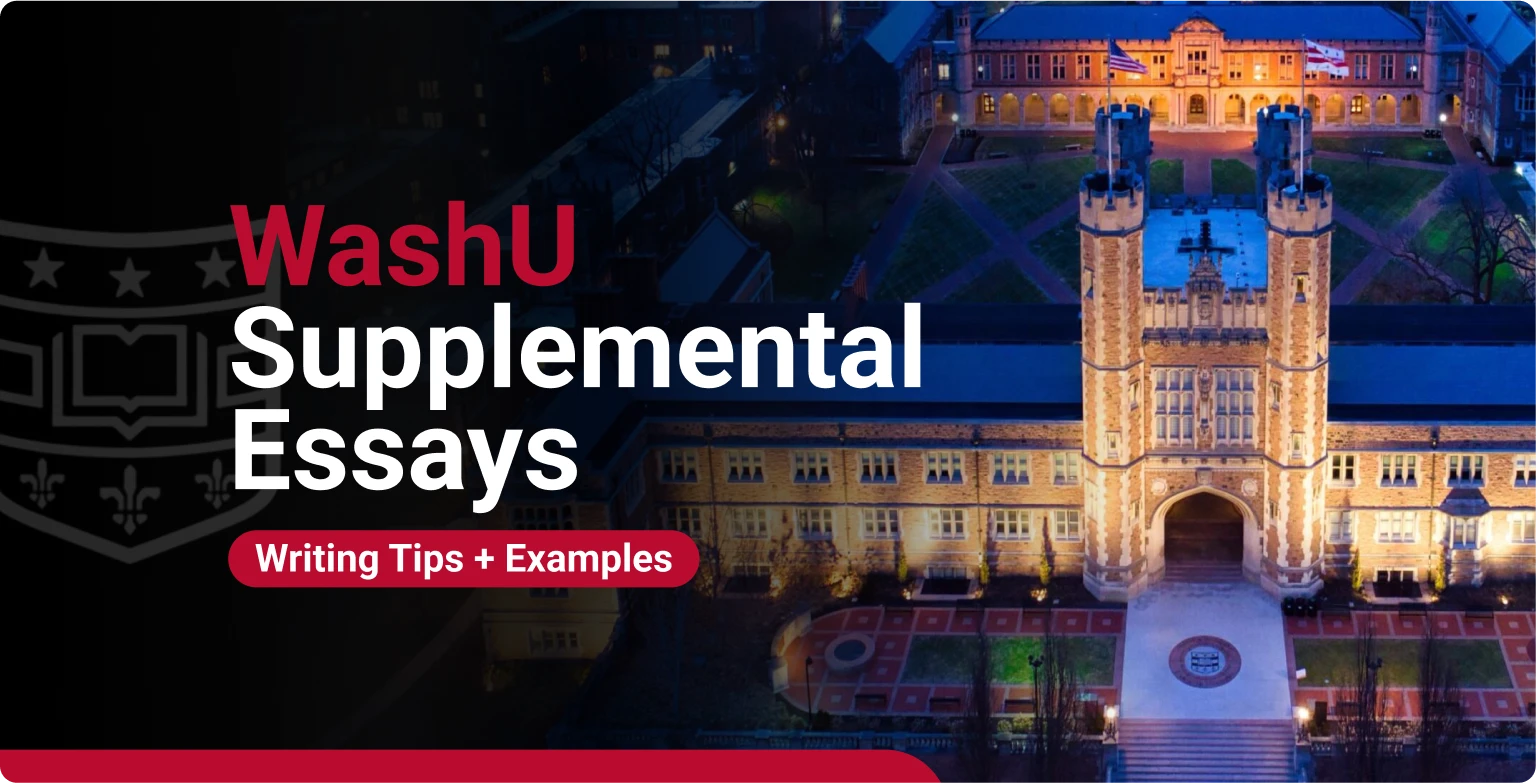
Washington University in St. Louis requires one supplemental essay to be answered in 200. It’s short, but they do a lot of heavy lifting in telling the admissions officers who you are beyond your grades, which is important, especially with WashU’s acceptance rate of 12%.
This guide breaks down what WashU is actually asking, how to choose a clear angle, and how to write responses that feel specific, intentional, and memorable.
- WashU Supplemental Essay Prompts
- How to Write the “Why Major” WashU Supplemental Essay
- Writing WashU Supplemental Essays That Work
- Frequently Asked Questions
- Takeaways
WashU Supplemental Essay Prompts
WashU accepts applications through the Common App or Coalition. Aside from the personal statement, you also have one WashU-specific question.
| Prompt |
| Please tell us what you are interested in studying at college and why. Undecided about your academic interest(s)? Don’t worry—tell us what excites you about the academic division you selected. Remember that all of our first-year students enter officially “undeclared” and work closely with their team of academic advisors to discover their academic passions. You can explore all of our majors and programs on our website. (200 words) |
It’s also worth noting that WashU has an optional video supplement. Unlike many schools that rely solely on written essays, WashU offers applicants the opportunity to introduce themselves through a short, personal video.
How to Write the “Why Major” WashU Supplemental Essay
| Prompt |
| Please tell us what you are interested in studying at college and why. Undecided about your academic interest(s)? Don’t worry—tell us what excites you about the academic division you selected. Remember that all of our first-year students enter officially “undeclared” and work closely with their team of academic advisors to discover their academic passions. You can explore all of our majors and programs on our website. (200 words) |
This prompt is testing academic fit. WashU wants to know what you plan to study and whether your interest is grounded in lived experiences rather than vague curiosity. Mention a specific major or division, connect it to coursework or projects, and name WashU resources (programs, labs, courses) that match your goals.
| WashU “Why Major” Supplemental Essay Example |
| The drivetrain died twelve seconds into the finals at the VEX Robotics World Championship in Houston. Wheels locked, LEDs blinking, I dropped to the carpet with a Fluke multimeter and traced a brownout to scorched traces on an Arduino Uno I had rewired at 1 a.m. The failure was not in our path-planning code, but in power delivery.
That’s why I plan to study the BS Computer Engineering (ESE) program at the McKelvey School of Engineering. In AP Physics C and AP Computer Science A, I learned to chase errors back to first principles. For Regeneron ISEF, I built a low-power FPGA scheduler on a Xilinx Artix-7 for portable diagnostic devices used in Engineers Without Borders clinics. I volunteered during field trials, logging power drops and aborted scans as clinicians worked around shared generators, then restructured clock domains and memory access patterns so scans finished before shutdown. I’m especially excited for CSE 4608: Introduction to Quantum Computing because it treats computation as physics, where superposition and decoherence act as engineering limits. Studying information loss at the quantum level will guide how I design efficient, secure systems for hospitals and power grids that cannot afford failure. (196 words) |
Essay analysis and tips
The prompt asks what you want to study in college and why, but you must also show personal experiences that support that decision. The example above immediately anchors the academic interest in a technical moment that shows hands-on experience and sets up a clear intellectual problem and interest that the writer wants to pursue: power delivery and system reliability
The writer reveals that they want to major in Computer Engineering, then discusses other technical experiences that solidified their interest and demonstrated their initiative to learn more: studying AP Physics C and AP Computer Science A, expanding into the more advanced project of building a low-power FPGA scheduler for Regeneron ISEF, and volunteering during field trials.
After that, the writer highlights a specific course as a next step once they enter WashU. Then, they end with what goal their academic path leads to.
If you’d like to see another response to this prompt, take a look at the one below.
| WashU Supplemental Essay Example |
| I remember the first time I felt the weight of a number. It was fourth grade, and my local library was hosting a penny drive to fight hunger in our city. I watched a volunteer weigh our donation jars; mine was lighter than most. On the way home, I kept wondering how a handful of coins could possibly matter in the face of something so enormous.
Fast-forward to high school, and I found myself running the fundraising side of our community garden. Budgeting, projecting costs, convincing local businesses to donate—it all felt like a puzzle I couldn’t stop solving. But the more I learned, the more questions started piling up. Why do some neighborhoods have thriving food systems while others rely on weekly donations? Why do resources seem to pool in some places and run dry in others? That’s what draws me to study Economics at WashU, with classes like ECONOMICS 382: Socio-Economic Perspectives on Inequality. I’m fascinated by how policies, incentives, and market structures shape access to food, housing, healthcare, and education. I want to understand the systems behind the numbers, so that one day, I can help design smarter solutions to the inequalities I saw as a kid. (200 words) |
Writing WashU Supplemental Essays That Work
Across WashU’s three required prompts, the common thread is intentionality. These essays are not asking you to repeat your resume. They are asking you to show academic direction, community impact, and personal depth in a way that feels specific and grounded. The strongest responses usually start with a concrete moment, then build outward into clear reasoning, meaningful reflection, and a forward-looking sense of fit.
For the academic interest prompt, focus on what drives your curiosity and how you have already explored it through coursework, projects, or research. For the “Contribution to Community” prompt, WashU wants proof that you contribute to a community through genuine responsibility rather than surface-level involvement. For the “Life Story” prompt, they are looking for the personal experiences that shaped your mindset, values, and long-term direction.
Because these essays are short, every detail matters. The best WashU supplements start with something concrete, stay specific throughout, and make it apparent what you will bring to campus.
That’s exactly where expert guidance can make a difference. Our Senior Editor College Application Program offers comprehensive support across essays, strategy, and the full application, developed by admissions experts who know what top schools like WashU are actually looking for. We’ve edited and refined 10,000+ essays, and 75% of our students earn acceptance to an Ivy League or Top 10 school. If you’re serious about your WashU application, we’re ready to help you get it right.
Frequently Asked Questions
1. Does WashU require supplemental essays?
Yes. In addition to the Common App personal statement, WashU requires one supplemental essay.
2. How many supplemental essays does WashU have?
WashU requires one supplemental essay.
3. What’s the word limit for WashU supplemental essays?
WashU’s word limits is 200 words.
Takeaways
- WashU requires one supplemental essay. It evaluates academic fit, community contribution, and personal story.
- Strong responses lead with a concrete moment, then connect it to clear motivation or impact.
- The best essays show what you did, why it mattered, and how it shaped your direction.
- If you want expert support, our consultants can help you craft WashU essays that are specific, polished, and authentically yours.