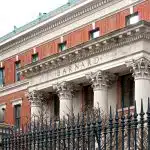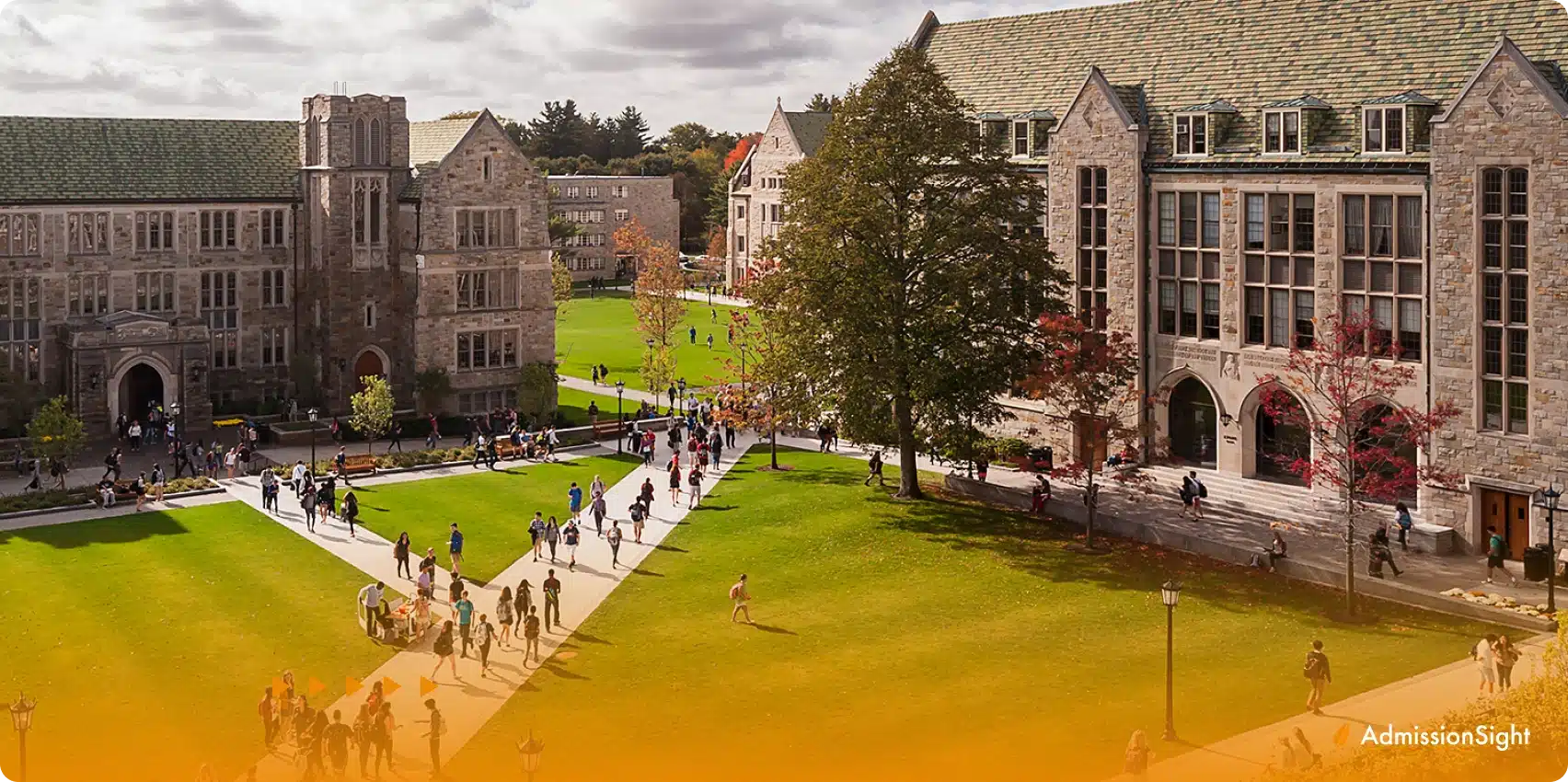
Boston College is a Jesuit, Catholic research university chartered in 1863 and originally situated in Boston’s South End. In 1907, president Thomas I. Gasson, S.J., bought 31 acres of the former Lawrence Farm in Chestnut Hill, Massachusetts, and broke ground in 1909 on what would become the main campus, nicknamed “the Heights” for its hilltop position above the Chestnut Hill Reservoir.
The Chestnut Hill neighborhood of Newton, Massachusetts, is approximately six miles west of downtown Boston. This guide covers what the campus looks like, how each additional site fits in, how to get there, and what the surrounding area is like for students.
- Boston College Campus Location
- Getting to Boston College
- Living Near Boston College
- Why You Should Visit Boston College’s Campus
- Frequently Asked Questions
- Takeaways
Boston College Campus Location
The main gate address for navigation purposes is 140 Commonwealth Avenue, Chestnut Hill, MA 02467. The main campus covers approximately 240 acres, set on a hillside with long views toward downtown Boston on clear days.
The architectural character of the campus is distinctly English Collegiate Gothic, a style chosen as appropriate both for the topography and for an academic institution with a strong religious foundation. The result is a cohesive ensemble of stone towers, arched windows, and quadrangles that gives the Heights a coherent visual identity.
The campus is organized into three sections: Upper Campus at the top of the hill, Middle Campus at the historic core, and Lower Campus closer to the reservoir, where most of the athletic and recreational facilities are concentrated.
Main campus landmarks
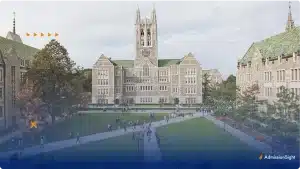
Boston College has several iconic landmarks on campus. Gasson Hall is the defining structure of Middle Campus and the oldest building on the Chestnut Hill site. Its tower houses four bells, each named after a prominent Jesuit, that chime on the quarter hour. The rotunda on the first floor, surrounded by murals of notable Jesuits and statues of four Jesuit saints, contains a white marble statue of the Archangel Michael overcoming Lucifer.
Directly adjacent is Bapst Library, which functions as the art library and one of the most visually striking study spaces on campus. Gargan Hall on its fourth floor features a lofty ceiling, stained glass windows, and wood paneling that make it one of the most photographed interiors at BC. The main research library is O’Neill Library, which sits at the center of campus activity. The plaza in front of O’Neill Library is bordered by Gasson, Devlin, and St. Mary’s Halls and serves as a major crossroad and central gathering place.
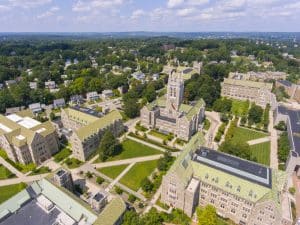
For sciences, Higgins Hall and the 245 Beacon Street Science Building are the primary academic facilities. Opened in 2022, 245 Beacon Street represents the centerpiece of Boston College’s $300 million strategic investment in the sciences. Stokes Hall, completed in 2013, houses the humanities departments and is frequently cited as one of the most architecturally notable recent additions to campus.
For recreation and fitness, the Margot Connell Recreation Center, opened in 2019, is the main recreation hub and offers a 244,000-square-foot facility with an aquatic center, fitness areas, and multipurpose courts.
Boston College’s other campuses and affiliated sites
One mile west of the Chestnut Hill Campus, the Newton Campus is home to BC Law School, athletic fields, and several freshman residence halls. The BC Law Library’s address is 885 Centre Street, Newton, Massachusetts 02459. First-year undergraduates assigned to Newton live there and commute to Middle Campus via a university shuttle.
Across Commonwealth Avenue from the Chestnut Hill Campus, the Brighton Campus houses the School of Theology and Ministry, the McMullen Museum of Art, administrative offices, and several athletics fields. Brighton is a 65-acre site, and BC has invested significantly in its development over the past two decades.
The university also maintains the Connors Family Retreat and Conference Center in Dover, Massachusetts, and the Weston Observatory in Weston, Massachusetts, among several other properties. The Weston Observatory is a seismological research facility operated by BC’s Earth and Environmental Sciences department and is not a regular student site.
Getting to Boston College
Every transit option converges on Commonwealth Avenue, which runs directly through campus. First-time visitors should be aware that navigation apps and rideshare services can route you to the wrong location: simply typing “Boston College” into Apple Maps or Siri may not bring you to the main campus; use “140 Commonwealth Avenue, Chestnut Hill, MA” instead. For Uber or Lyft, use 140 Beacon Street, Chestnut Hill, MA 02467 for drop-off at Cushing or Fulton Halls.
Public transportation options
If you are arriving by public transportation, Boston College is located at the end of the “B” line branch of the MBTA’s Green Line. One-way fares are $2.75, and travel time from downtown Boston outbound to Boston College is approximately 45 minutes. Once you exit the T, cross Commonwealth Avenue and walk uphill to the right to reach the Main Gate.
From Logan Airport, take the SL1 Silver Line bus to South Station, transfer to the Red Line toward Alewife to Park Street, then take the “B” Boston College Line of the Green Line outbound to the last stop.
A university shuttle connects the Chestnut Hill Campus to the Newton Campus and runs directly to BC Law. This is the primary way students and visitors move between the two main academic sites.
Getting there by car or other means
If you are arriving by car, take the Massachusetts Turnpike (Route 90) to Exit 17 from points west, then right onto Centre Street, and left onto Commonwealth Avenue; follow it 1.5 miles to Boston College. From points north or south, take Interstate 95 (Route 128) to Exit 24, then east on Route 30 (Commonwealth Avenue) for about five miles.
For visitor parking, use 2004 Campanella Way, Chestnut Hill, MA 02467 to navigate to the Commonwealth Avenue Garage. Visitors may park on floors 3 through 6. Parking is limited on Middle Campus itself, so the garages are the practical choice.
Living Near Boston College
The area around Boston College has the feel of a well-established residential neighborhood. Commonwealth Avenue links the campus to Brighton and Cleveland Circle to the east, and deeper into Newton to the west. Students who want the full Boston experience commute in via the Green Line; those who prefer a quieter daily routine tend to stay closer to campus.
The neighborhood itself is an assortment of longtime residents, BC-affiliated housing, and independent businesses along the main commercial corridors. It is suburban in character and considerably quieter than student neighborhoods like Allston, which lies a short ride away on the B Line.
Places to check out near Boston College
The area around Boston College has plenty to explore. For daily coffee and food on campus, the Hillside Café in Maloney Hall is a student staple. Just off campus along the B Line corridor, Cleveland Circle has a cluster of student-friendly spots including Eagle’s Deli for burgers and sandwiches, and Cityside Bar for a more social setting.
Shopping is concentrated at The Street at Chestnut Hill and The Shops at Chestnut Hill, both just minutes from campus and featuring retail stores, restaurants, and cafés with outdoor seating.
For green space beyond the reservoir, Hammond Pond Reservation offers wooded trails and rock formations, and Webster Woods, directly connected to Hammond Pond, provides additional quiet hiking trails. Both are in Newton, within a short drive or bike ride.
Broader Boston is accessible in about 45 minutes by T. The Museum of Fine Arts, Fenway Park, the Isabella Stewart Gardner Museum, and the whole of downtown Boston are practical day-trip or evening destinations for students throughout the year.
Why You Should Visit Boston College’s Campus
No guide fully captures what it feels like to stand on Middle Campus while the Gasson Hall tower bells ring, or to take in the hilltop view toward Boston from the quad. Chestnut Hill’s suburban, residential character suits some students well and doesn’t suit others at all. A campus visit makes that clear far faster than any amount of research.

BC’s Eagle Eye Campus Visit is a two-hour program with an information session and student-led campus tour. Virtual visit programs are also available for those who cannot visit in person.
Once you have a clear sense of whether Boston College is a strong fit, the next step is making sure your application reflects that. AdmissionSight’s Senior Editor College Application Program helps students build a well-researched college list and develop a competitive overall application, so the strategic work is done before you’re choosing between acceptances.
Frequently Asked Questions
1. What is Boston College’s address?
The main gate address is 140 Commonwealth Avenue, Chestnut Hill, MA 02467. For GPS navigation, always include “Chestnut Hill, MA” to avoid being routed to the city of Boston instead. BC Law School is located at 885 Centre Street, Newton, MA 02459, and the Brighton Campus is at 2101 Commonwealth Avenue, Brighton, MA 02135.
2. How big is Boston College?
The main Chestnut Hill Campus is approximately 240 acres. The university also operates a 40-acre Newton Campus (BC Law School and freshman housing) and a 65-acre Brighton Campus (School of Theology and Ministry and the McMullen Museum of Art), bringing the total university footprint to over 300 acres across three contiguous sites.
3. Can I visit Boston College before applying?
Yes. The Eagle Eye Campus Visit is a two-hour program that includes an information session with current students and a student-led campus tour. Virtual options are available year-round.
4. Is parking available at Boston College?
Visitor parking is available in the Commonwealth Avenue Garage (use 2004 Campanella Way for navigation) and the Beacon Street Garage. Visitors should park on floors 3 through 6 in either garage. Parking directly on Middle Campus is extremely limited.
5. What landmarks are near Boston College?
The Chestnut Hill Reservoir and adjacent Pine Tree Preserve are directly next to campus. Hammond Pond Reservation and Webster Woods are nearby for hiking. The Street at Chestnut Hill and The Shops at Chestnut Hill are the main commercial destinations within a few minutes of campus. Downtown Boston is about 45 minutes by Green Line.
Takeaways
- Boston College is in Chestnut Hill, Newton, MA, six miles west of downtown Boston. Use 140 Commonwealth Avenue, Chestnut Hill, MA 02467 for navigation.
- The 240-acre main campus is defined by English Collegiate Gothic architecture, with Gasson Hall and Bapst Library as its most iconic buildings.
- BC operates three sites: Chestnut Hill (main campus), Newton (BC Law and freshman housing), and Brighton (School of Theology and Ministry).
- The MBTA Green Line “B” branch ends at the main campus gate, putting downtown Boston about 45 minutes away.
- Building a strong application to Boston College starts with the right strategy. Consider working with a college admissions expert to develop a competitive college list and application.