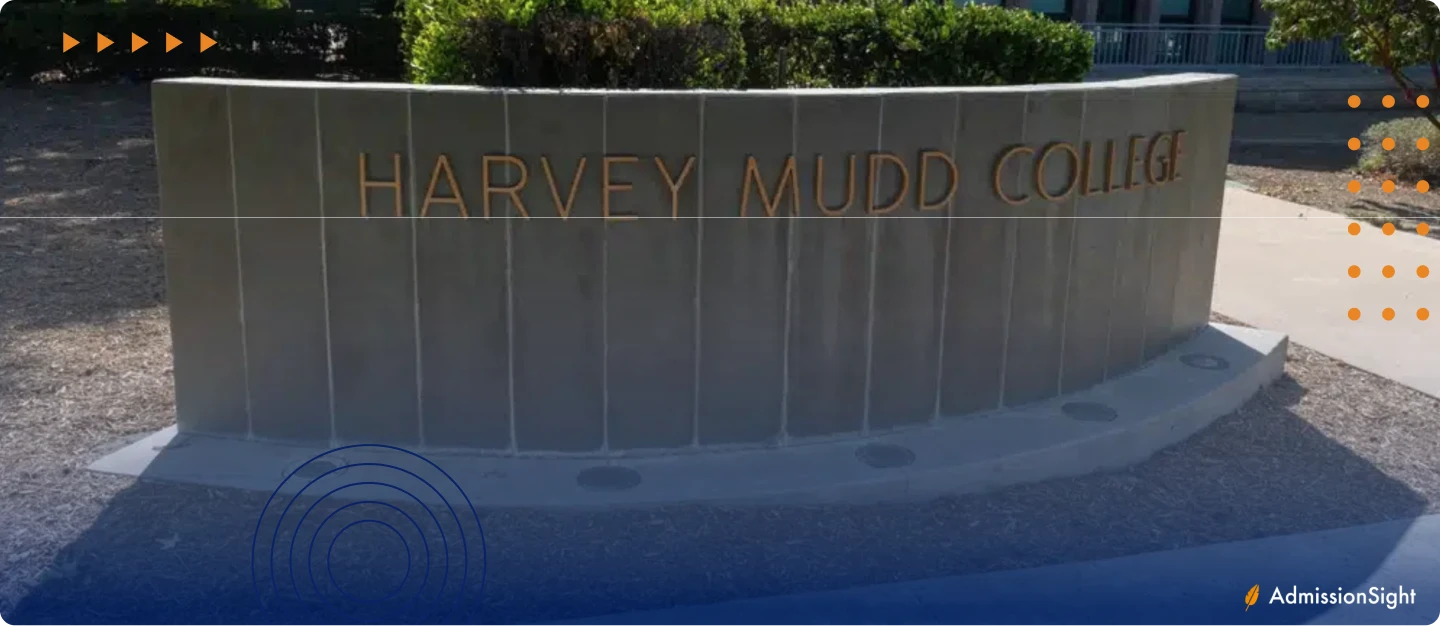
Founded in 1955, Harvey Mudd College (HMC) is a private liberal arts college of engineering, science, and mathematics located in Claremont, California. As one of the seven Claremont Colleges, its compact 33-acre campus sits shoulder-to-shoulder with neighboring schools, giving students both an intimate STEM-focused home and access to a broader learning community.
This guide explores Harvey Mudd’s’s campus setting, nearby spots, transportation options, and what living in Claremont is really like.
- Harvey Mudd College Campus Location
- Getting to Harvey Mudd College
- Living Near Harvey Mudd College
- Why You Should Visit Harvey Mudd College’s Campus
- Frequently Asked Questions
- Takeaways
Harvey Mudd College Campus Location
Set across about 33 acres at the northern edge of The Claremont Colleges, Harvey Mudd College is located at 301 Platt Blvd, Claremont, California.
HMC’s campus has a look unlike any other: its original buildings, designed by Edward Durell Stone in a New Formalist style, are clad in concrete blocks covered in knobby protrusions that students affectionately call “warts,” so beloved they inspired the college’s unofficial mascot, Wally the Wart.
The central spine of campus, known as the Great Mall, runs between these squat, symmetrical buildings and opens into outdoor courtyards that take full advantage of the mild Southern California climate. Newer additions like the Shanahan Center for Teaching and Learning nod to the original aesthetic while bringing a more contemporary sensibility.
HMC shares its campus with the other Claremont Colleges, such as Pomona, Scripps, Claremont McKenna, and Pitzer, alongside consortium landmarks like the Honnold/Mudd Library and shared dining and health services. Nearly all HMC students live on campus across the college’s nine dormitories, making the tight-knit residential experience a defining part of life at Mudd.
Main campus landmarks
Harvey Mudd centers on the Great Mall, a 2,000-foot-long open corridor that serves as the spine of campus life, flanked by the college’s signature wart-covered concrete buildings and opening into shaded courtyards along the way.
At its western end, Hixon Court anchors the axis with a geometric reflection pool, one of the few ornamental touches on an otherwise starkly modernist campus. The oldest building on campus, Mildred E. Mudd Hall (1957), universally known as “East Dorm,” was the very first structure built, and remains a piece of living institutional history.
Academic life is spread across a compact cluster of buildings orbiting the Mall. The F.W. Olin Science Center and W.M. Keck Laboratories anchor the sciences, while the R. Michael Shanahan Center for Teaching and Learning (“Shan”), opened in 2013, serves as the college’s most architecturally ambitious building, a contemporary reimagining of the wart-block aesthetic, built with a novel reinforced concrete slab system.
The newest addition, the Scott A. McGregor Computer Science Center (“Greg”), opened in 2021. Research and library resources for the consortium live at the Honnold/Mudd Library, a shared facility just off HMC’s campus.
Student life converges at the Joseph B. Platt Campus Center, the social heart of campus, alongside the Hoch-Shanahan Dining Commons, which serves as a gathering point for the tight-knit residential community.
Athletics are anchored by the Ronald and Maxine Linde Activities Center (the “LAC”) on HMC’s own grounds, which houses a gym, weight room, and courts. Broader CMS Athletics facilities, including the Sallie Tiernan Field House at Scripps and Robert’s Pavilion at Claremont McKenna, are shared across the consortium and a short walk away.
Harvey Mudd College’s other campuses and affiliated sites
Beyond its compact 33-acre home, Harvey Mudd’s academic footprint extends significantly through its membership in The Claremont Colleges consortium. The five undergraduate colleges and two graduate institutions, including Claremont Graduate University and Keck Graduate Institute of Applied Life Sciences, share a contiguous campus covering less than a square mile.
In practice, this means HMC students have walking access to thousands of courses, four fitness centers, five swimming pools, seven dining halls, and a shared library system that would be unimaginable at a standalone college of 900 students.
One of HMC’s most distinctive academic extensions is the Clinic Program, which since 1963 has embedded junior and senior teams directly inside companies, national laboratories, and government agencies to solve real-world technical problems. Unlike a study-abroad semester or a summer internship, Clinic projects unfold year-long, placing students in active collaboration with sponsors that have included Fortune 500 companies and institutions like Lawrence Livermore National Laboratory.
HMC also extends its reach through specialized centers rooted on campus but oriented outward. The Hixon Center for Climate and the Environment drives research partnerships and field opportunities across the region, including active air quality monitoring in the greater Los Angeles area.
While HMC does not operate satellite campuses in the way larger research universities do, the Claremont Colleges consortium effectively functions as its extended university. Most resources are a 15-minute walk from HMC’s northern end of campus.

Getting to Harvey Mudd College
Getting to Harvey Mudd College is fairly intuitive once you know it sits at the northern edge of the Claremont Colleges campus, tucked between the 210 Freeway and Interstate 10. Most visitors driving in will arrive via Foothill Boulevard or Platt Boulevard, which runs directly along the southern border of campus. From there, the compact scale of the Claremont Colleges means you’re almost always a short walk from wherever you need to be.
Public transportation options
Public transit in Claremont is functional but limited compared to a major urban campus; this is suburban Southern California, after all. Foothill Transit operates local bus routes along Foothill Boulevard, with stops near the edge of campus, providing connections to surrounding cities in the San Gabriel Valley.
For regional travel, the Claremont Metrolink station on the San Bernardino Line sits about a mile south of campus, a walkable distance or a quick ride-share away. From there, commuter rail connects directly to downtown Los Angeles (Union Station) in roughly an hour, opening up the broader LA Metro network and making car-free regional travel genuinely feasible.
HMC does not operate its own shuttle service, and there is no institutional equivalent of a university transit pass. For most day-to-day movement across the Claremont Colleges consortium, students walk; the five undergraduate colleges span less than a square mile and are comfortably navigable on foot or by bike.
For anything further, a car, ride-share, or the Metrolink are the practical options. Visitors flying in will find Ontario International Airport (ONT) the most convenient gateway, just about 10 miles and 20 minutes from campus, while LAX is a viable but considerably longer alternative depending on traffic.
Getting there by car or other means
Harvey Mudd’s campus is accessible from both the 210 Freeway (exit at Baseline/Padua) and Interstate 10 (exit at Indian Hill Boulevard), converging on Foothill Boulevard and Platt Boulevard along the campus edge.
That said, on-campus parking is tightly managed and mostly reserved for HMC faculty, staff, and upperclass students. First-year students are generally not permitted to bring cars to campus. Visitors can find limited public street parking along Platt Boulevard and Foothill Boulevard, and the college coordinates auxiliary lot access during large events.
Ride-share services like Uber and Lyft are widely used by students for off-campus errands, trips to the airport, or evenings in the Claremont Village. The compact, walkable scale of The Claremont Colleges means a bike or a good pair of sneakers handles most of daily life, with the entire consortium crossable on foot in about 15 minutes.

Living Near Harvey Mudd College
The area around Harvey Mudd has a distinctly Southern California college-town feel, set at the foot of the San Gabriel Mountains in Claremont. Tree-shaded residential streets, Craftsman bungalows, and a mix of students, professors, and long-rooted locals give the city a quietly charming, unhurried character that stands in contrast to the intensity of life on campus.
Student life spills naturally into the Claremont Village, the walkable commercial center a short distance south of the colleges, with sidewalk cafes, boutique shops, and restaurants ranging from casual to sit-down. It’s the go-to for an off-campus meal or an afternoon away from the books. The broader 5C community amplifies this further with concerts, lectures, art shows, and events spread across the neighboring college campuses; there’s nearly always something on within a 15-minute walk.
Green spaces and outdoor escapes are easy to come by. The Claremont Hills Wilderness Park sits just above campus with hiking trails and panoramic views of the valley, and Mount Baldy is a short drive for more serious outdoor adventure. For those drawn to a bigger urban pulse, downtown Los Angeles is about an hour away and offers everything the city has to offer.
Places to check out near Harvey Mudd College
Near Harvey Mudd, students have easy access to a solid mix of local spots, all within walking distance or a short ride. The college’s own local attractions guide offers a helpful rundown of nearby dining, outdoor activities, and things to do around Claremont and the greater region.
For dining and cafes, the Claremont Village is the main draw, a walkable stretch of restaurants and coffee shops a short distance south of the colleges. Student favorites include The Back Abbey for burgers and Belgian beers, Euro Café for a cozy European-style bite, and Saca’s Mediterranean for reliable, quick meals. The historic Claremont Packing House anchors a cluster of additional spots in a converted landmark building.
For arts and culture, the Raymond M. Alf Museum of Paleontology sits directly on the Webb Schools campus, adjacent to the Claremont Colleges, one of the few accredited paleontology museums on a secondary school campus in the country. The Claremont Lewis Museum of Art and Bridges Auditorium at Pomona College round out the consortium’s cultural offerings, with public exhibitions and major performances throughout the year.
Outdoor escapes are one of Claremont’s genuine strengths. The Claremont Hills Wilderness Park is practically on campus, offering hiking trails with sweeping views of the valley, while Mount Baldy is a short drive north for more serious elevation. Southern California beaches are about an hour away, and Joshua Tree National Park is a popular overnight trip.
Downtown Los Angeles is roughly an hour by car or Metrolink, giving students access to world-class museums, music venues, and neighborhoods whenever the pull of the city strikes.
Why You Should Visit Harvey Mudd College’s Campus
Seeing Harvey Mudd in person gives you a far clearer sense of fit than any guide can. The compact, wart-covered campus, the intensity of the academic culture, and the peculiar magic of belonging to a consortium of five colleges often land very differently when experienced firsthand. That clarity is especially valuable when deciding on a college plan.
Harvey Mudd offers a campus tour and information session as an opportunity to explore the campus and learn about the academic experience, campus landmarks, residential life, dining, and HMC’s history and traditions. Overnight visit options are also available for admitted students, giving a real taste of what day-to-day life at Mudd actually looks like.
For a more strategic approach, AdmissionSight’s Senior Editor College Application Program helps you build a well-researched college list and a competitive application, so by the time you visit, you already know exactly where Harvey Mudd fits in your plan. Learn more or schedule a consultation to get started.
Frequently Asked Questions
1. Where is Harvey Mudd located?
Harvey Mudd College is located at 301 Platt Blvd, Claremont, California, about 35 miles east of Los Angeles at the foot of the San Gabriel Mountains.
2. How big is Harvey Mudd College?
HMC’s campus spans 33 acres and enrolls around 913 undergraduate students.
3. Can I visit Harvey Mudd College before applying?
Yes. Harvey Mudd offers campus tours and information sessions for prospective students.
4. Is parking available at Harvey Mudd College?
Limited visitor parking is available along Platt Boulevard and Foothill Boulevard. On-campus parking is largely reserved for HMC faculty, staff, and upperclass students.
5. What landmarks are near Harvey Mudd College?
The Claremont Village is a short walk south of campus. Nearby highlights include the Raymond M. Alf Museum of Paleontology, the California Botanic Garden, Bridges Auditorium at Pomona College, and the Claremont Hills Wilderness Park. The other four undergraduate Claremont Colleges, Pomona, Scripps, Claremont McKenna, and Pitzer, are all within a 15-minute walk.

Takeaways
- Harvey Mudd College is located at 301 Platt Blvd, Claremont, California, about 35 miles east of Los Angeles at the foot of the San Gabriel Mountains.
- Harvey Mudd’s campus spans 33 acres and features a distinctive New Formalist architectural style designed by Edward Durell Stone, defined by the iconic concrete “wart” blocks that students have made into a beloved piece of campus identity.
- Harvey Mudd sits within the Claremont Colleges consortium, sharing a contiguous campus with Pomona, Scripps, Claremont McKenna, and Pitzer Colleges.
- Transportation is manageable but car-dependent beyond the consortium; the Metrolink station is about a mile away, Ontario International Airport is 20 minutes out, and most day-to-day movement across the five colleges happens entirely on foot.
- If you want to make the most of your understanding of where Harvey Mudd is located for competitive college admissions, working with a college admissions expert can help. We’ll guide you in linking HMC’s Claremont setting, STEM-focused academic environment, and surrounding opportunities to your goals, showing how location strengthens your fit, interests, and college plans.