

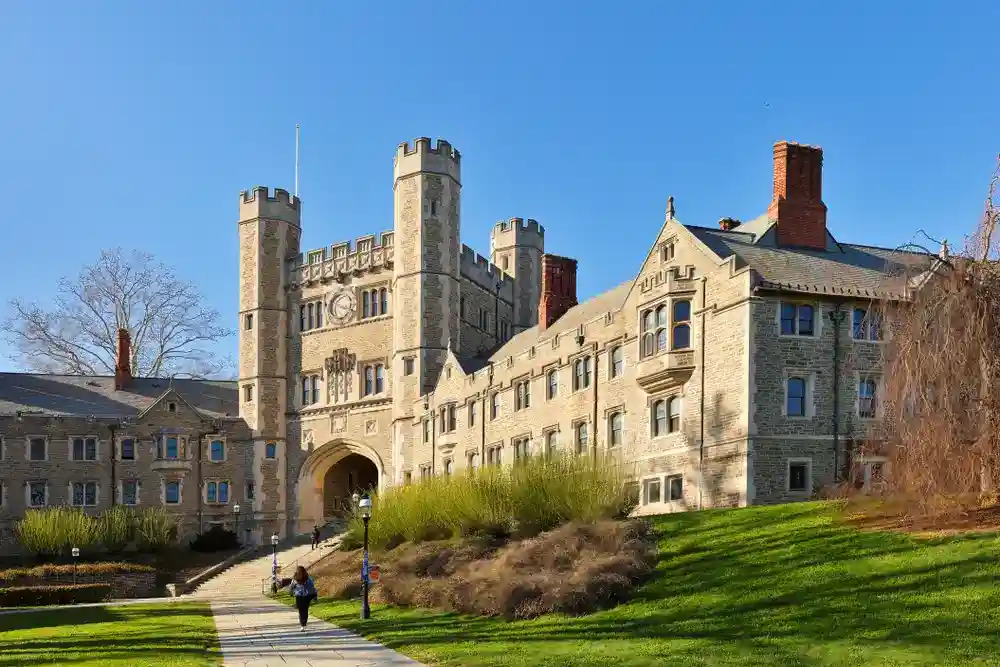
Princeton University is a private Ivy League institution founded in 1746 and based at its current campus in Princeton. Located at 1 Nassau Street in the heart of a classic college town, the campus combines historic Gothic architecture with a walkable, suburban setting just outside major cities.
This guide covers Princeton’s campus layout and highlights, nearby sites, transportation options, and what daily life looks like living in and around Princeton.
- Princeton University Campus Location
- Getting to Princeton University
- Living Near Princeton University
- Why You Should Visit Princeton University’s Campus
- Frequently Asked Questions
- Takeaways
Princeton University Campus Location
Princeton University sits on a 500-acre main campus in Princeton, with 190 buildings concentrated in a compact, walkable core anchored by Nassau Street.
The campus is best known for its Collegiate Gothic architecture, modeled after Oxford and Cambridge, with stone dorms, archways, and quadrangles organized around central greens. This design was formalized in the late 19th and early 20th centuries and still shapes how new buildings are constructed today. Unlike many universities that sprawl outward, Princeton’s layout is tightly integrated, so academic buildings, libraries, and residential colleges are all within a short walk of each other.
The physical layout centers on Nassau Hall, the university’s original building from 1756, with the campus expanding south and east into clearly defined residential and academic zones. Major student hubs like the Frist Campus Center sit near the middle of campus, while libraries and departmental buildings cluster nearby.
Housing is almost entirely controlled by the university. Princeton guarantees on-campus housing for all four years, with the majority of students living in its residential college system, which keeps student life concentrated within campus boundaries.
Immediately outside the campus, Nassau Street connects directly to downtown Princeton, where students have access to restaurants, bookstores, and shops within minutes on foot. The surrounding area is a true college town of about 30,000 residents, with easy access by train to Philadelphia and New York City, each about 55 miles away.
Main campus landmarks
The landmark most visitors notice first is Nassau Hall, the university’s oldest building. It was built in 1756 to house the College of New Jersey, was the largest stone building in the American colonies, and later served as the seat of the Continental Congress in 1783. Today it is still the symbolic center of campus. Just outside it, FitzRandolph Gate marks the university’s official entrance from Nassau Street.
For research and study, the key building is Firestone Library, Princeton’s main library. It is the primary library for humanities and social sciences and also houses Special Collections, the Cotsen Children’s Library, the Center for Digital Humanities, and other major research services.

For student life, the central gathering place is Frist Campus Center. The center is a hub for campus life, and that is exactly how it functions: dining options, lounges, program centers, lecture and multipurpose rooms, and a steady flow of student traffic throughout the day.
The most prominent ceremonial building is Princeton University Chapel, completed in 1928. It serves as the university’s religious and ceremonial center, hosts the formal opening and closing of the academic year, and sits directly on the main campus next to Firestone Library and Washington Road.
For performances and major events, Richardson Auditorium in Alexander Hall is one of the campus’s most recognizable indoor landmarks. Alexander Hall was completed in 1894, houses Richardson Auditorium, and stands out as the last High Victorian Gothic building constructed at Princeton.
For athletic facilities, Jadwin Gym is Princeton’s flagship arena. It is a 250,000-square-foot multipurpose facility dedicated in 1969 and remains one of the university’s main competition venues. Dillon Gym is the everyday recreation anchor, serving as the headquarters for intramural sports and physical education and housing major fitness and court space.
For the arts, Princeton now has a newly reopened Princeton University Art Museum at the heart of campus. Its new building opened to the public on October 31, 2025, and it roughly doubles the space for exhibition, conservation, study, and interpretation while placing the museum directly in the daily path of campus foot traffic.
On the south edge of campus, the Lewis Arts complex adds another major arts landmark, housing Princeton’s programs in dance, theater, music theater, and the Princeton Atelier, with the Forum serving as a 15,000-square-foot gathering and informal performance space.
Princeton University’s other campuses and affiliated sites
Beyond the main academic campus, the most important off-core university site is the Forrestal Campus in Plainsboro, a 600-acre research and administrative complex that houses Princeton’s School of Public and International Affairs, major environmental research centers, and energy and climate-focused institutes.
Another affiliated site is the Princeton Plasma Physics Laboratory (PPPL), a U.S. Department of Energy national laboratory managed by Princeton University. It is not part of the undergraduate campus tour route, but it is one of the university’s biggest research-affiliated sites and a major part of Princeton’s science footprint beyond the main campus.
A newer expansion area is the Meadows Neighborhood in West Windsor, formerly referred to as the Lake Campus. Princeton Facilities describes it as a mixed-use extension of campus with space for graduate student housing, academic partnerships, varsity athletics, recreation, and parking. The graduate housing component is Meadows Apartments, which includes 604 beds in 379 housing units at 311 Court Drive.

The Meadows is also where Princeton has added major new athletic and recreation space. The Racquet and Recreation Fieldhouse is located there, and the facility supports athletics and recreation in West Windsor. The Wilkinson Fitness Center, squash courts, and tennis courts in the fieldhouse are open to Princeton students and Rec members, with regular shuttle service from central campus to Meadows.
For graduate students, another important site is the Graduate College on College Road West. It is the traditional center of graduate student life, with nearly 430 students living there, plus annex housing nearby. It is part of the university proper, but it sits outside the main undergraduate core and functions as a distinct residential cluster.
Getting to Princeton University
For most visitors, the simplest route is rail. Princeton’s main campus is served by Princeton Station on Alexander Street at the south end of campus. Travelers can reach campus via the Northeast Corridor, get off at Princeton Junction, and transfer to the NJ TRANSIT shuttle train known as the Dinky for the five-minute ride to Princeton Station. The Newark Liberty International Airport is the closest and most convenient international airport for campus visits.
If you are coming for an admissions visit, there’s second rail-to-campus option: instead of taking the Dinky from Princeton Junction, you can board the free northbound #4 TigerTransit bus to the Admission Information Center/University Store.
Public transportation options
The key rail link is the Princeton Station to Princeton Junction connection. From Princeton Junction, northbound NJ TRANSIT trains provide direct service to New York City and Newark Liberty International Airport. For Philadelphia, travelers can go south to Trenton and transfer to SEPTA’s Trenton Line. Amtrak serves Princeton Junction, which gives the university a broader link to cities such as Washington, D.C. and Boston.
For local bus service, there are three especially useful NJ TRANSIT routes:
- Route 600 connects Trenton, Lawrence, Clarksville, and East Windsor to Princeton Junction, where riders can continue to campus on TigerTransit.
- Route 605 stops at Princeton Station, University Place, and Nassau Street.
- Route 606 stops at Palmer Square, directly across from FitzRandolph Gate, which is one of the most convenient drop-off points for the center of campus.
Once you are in Princeton, the university’s own bus system fills in the last mile. TigerTransit is free for all, not just students, and its routes connect the main campus with Princeton Station, Princeton Junction Station, the Forrestal campus, PPPL, and several grocery stores. The system runs on fixed routes, with weekday service listed from 7 a.m. to 10 p.m., plus weekend and night service from 10 p.m. to midnight.

For getting around on foot or by bike after you arrive, much of campus is accessible in a 10-minute walk or 5-minute bike ride, and the university has built more than 60 miles of roads and pathways across campus.
Getting there by car or other means
If you are driving, the historic main campus sits about one mile west of U.S. Route 1. For visitors on weekdays between 7 a.m. and 4 p.m., the standard parking location is Stadium Drive Garage, and frequent TigerTransit service runs from that garage to stops on Washington Road, Nassau Street, and University Place. Visitors need to register for a daily visitor permit for weekday parking there.
After 4 p.m. on weekdays and on weekends, Princeton allows visitors to park in additional numbered, non-restricted lots, including Theater Drive Garage, Prospect Avenue Garage, and Stadium Drive Garage. Elm Drive is closed to unauthorized vehicles outside move-in and move-out periods, so visitors should not expect to drive through the middle of campus.
For air travel, Newark Liberty International Airport is the best airport for most visitors. From there, the Northeast Corridor rail line provides access toward Princeton Junction, after which visitors can transfer to the Dinky or use TigerTransit.
Rideshare and biking are both practical once you are in town, but for a first-time visitor, the most straightforward options are still train plus Dinky, or car plus visitor parking garage.
Living Near Princeton University
Princeton feels like a true college town. Nassau Street and Palmer Square are the main off-campus commercial center, with shops and restaurants directly next to campus. Students do not need to leave town for basic weekend plans, coffee runs, casual meals, or errands.
Daily life stays physically close to campus. Princeton’s undergraduate experience is heavily residential, and the university guarantees housing, so most students live on or right next to the main campus. Once they step off campus, the transition is immediate: FitzRandolph Gate opens onto Nassau Street, and downtown Princeton begins right there.
The environment outside the classroom also has more green space than many peer schools. Lake Carnegie bounds the south end of campus, and it is one of the university’s most open natural spaces. Just beside it, the Delaware and Raritan Canal State Park towpath gives students easy access to walking, running, and biking routes without leaving the immediate campus area.
Why You Should Visit Princeton University’s Campus
Princeton is one of those campuses that only fully clicks in person. You can see how the Collegiate Gothic buildings cluster around Nassau Hall, how close academic buildings are to the residential colleges, and how quickly campus transitions into Nassau Street.
A campus visit also answers questions you cannot resolve online. How long does it actually take to get from a dorm to class? Does the campus feel compact or spread out when you are walking it? How active is Nassau Street during a typical weekday? Spending a few hours on campus gives you concrete answers to all of these.
Princeton’s quieter college town setting, its residential college system, and how tightly campus life is centered within a single area all become immediately tangible once you are there. That kind of clarity makes it much easier to compare Princeton with other schools on your list.
For personalized guidance, AdmissionSight’s Senior Editor College Application Program can help you plan your visits with purpose, identify what to look for on each campus, and turn those observations into a stronger, more targeted application strategy. Learn more about the program or schedule a consultation to get started.
Frequently Asked Questions
1. What is Princeton University’s address?
Princeton University’s main address is 1 Nassau Street, Princeton, NJ 08544, USA. This places the campus directly in downtown Princeton, with Nassau Street serving as the main entry point.
2. How big is Princeton University?
Princeton’s main campus spans 500 acres with 190 buildings, but most undergraduate classes, housing, and student facilities are concentrated in a compact, walkable core.
3. Can I visit Princeton before applying?
Yes. Princeton offers campus tours, information sessions, and self-guided visits. You can book these through the university’s official admissions website, which provides updated schedules and availability.
4. Is parking available at Princeton University?
Yes, but it is regulated. Visitors typically park at Stadium Drive Garage during weekdays and use TigerTransit to reach central campus. Additional visitor parking is available in select garages and lots after 4 p.m. and on weekends.
5. What landmarks are near Princeton University?
Right outside campus, you’ll find Nassau Street and Palmer Square, which are the main dining and shopping areas. Within walking distance, there are outdoor spaces like Lake Carnegie and the Delaware and Raritan Canal towpath.
Takeaways
- Princeton University is located at 1 Nassau Street in Princeton, New Jersey, directly connected to a walkable college town.
- The campus spans 500 acres but is highly compact, with classes, housing, and student life all within a short walk.
- Major landmarks like Nassau Hall, Firestone Library, and Frist Campus Center anchor both academic and daily student life.
- Getting to Princeton is straightforward via NJ TRANSIT (Princeton Junction + Dinky), TigerTransit buses, or visitor parking garages.
- From narrowing your college list to planning effective visits, a college admissions expert can help you make more informed choices and strengthen your application.










