Stanford University is a private research university founded in 1885, located at the corner of El Camino Real and Serra Street in Stanford, California, an unincorporated community in Santa Clara County roughly 35 miles south of San Francisco and 20 miles northwest of San Jose. The university sits at the heart of Silicon Valley, bordered by Palo Alto to the east and Menlo Park to the north.
This guide covers Stanford’s 8,180-acre main campus, nearby points of interest, how to get there, and what the surrounding area looks like for students living on or off campus.
- Stanford University Campus Location
- Getting to Stanford University
- Living Near Stanford University
- Why You Should Visit Stanford University’s Campus
- Frequently Asked Questions
- Takeaways
Stanford University Campus Location
Stanford’s 8,180-acre campus sits on the San Francisco Peninsula in unincorporated Santa Clara County, spanning seven governmental jurisdictions. About 60% of the land remains undeveloped.
The central campus is bounded by El Camino Real to the east, Stanford Avenue to the north, Junipero Serra Boulevard to the west, and Sand Hill Road to the south. Some university land, including the Stanford Shopping Center and Stanford Research Park, falls within Palo Alto city limits, while other parcels extend into unincorporated San Mateo County.
The campus was designed by landscape architect Frederick Law Olmsted and the architectural firm Shepley, Rutan and Coolidge, whose plan called for a Mission Revival and Richardsonian Romanesque style throughout.
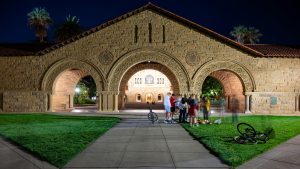
The core consists of twelve Mission Revival-style buildings linked by a strong axial plan, with the mile-long Palm Drive forming the main northern entrance and culminating at Memorial Court. That visual logic, buff-colored sandstone walls, red tile roofs, and continuous arcades, has carried forward through most subsequent construction and gives Stanford one of the most recognizable campus aesthetics in the country.
The campus spans seven different governmental jurisdictions and includes 49 miles of roads, two open water reservoirs, and 88 miles of water mains. Getting from one end of campus to the other on foot takes time, which is part of why Stanford has over 10,400 bikes on campus on a typical weekday and has earned four consecutive Platinum Bicycle Friendly University designations from 2011 through 2027.
Main campus landmarks
As for campus landmarks, the heart of campus is the Main Quad, a connected complex of 26 sandstone buildings organized around a large inner courtyard. The Quad holds Stanford’s 12 original classrooms from the university’s opening in 1891 and today houses the School of Humanities and Sciences. The buildings are connected by covered arcades on all sides, a design choice that was unusual among American universities at the time and remains one of the Quad’s defining features.
At the center of the Quad sits Memorial Church, completed in 1903 and built by Jane Stanford as a memorial to her late husband. The cruciform structure is 190 feet long and 150 feet wide, with a clock and bell tower; it was heavily damaged in the 1906 earthquake and not fully restored until 1917. The church’s mosaic facade and vaulted interior make it one of the most visited sites on campus.
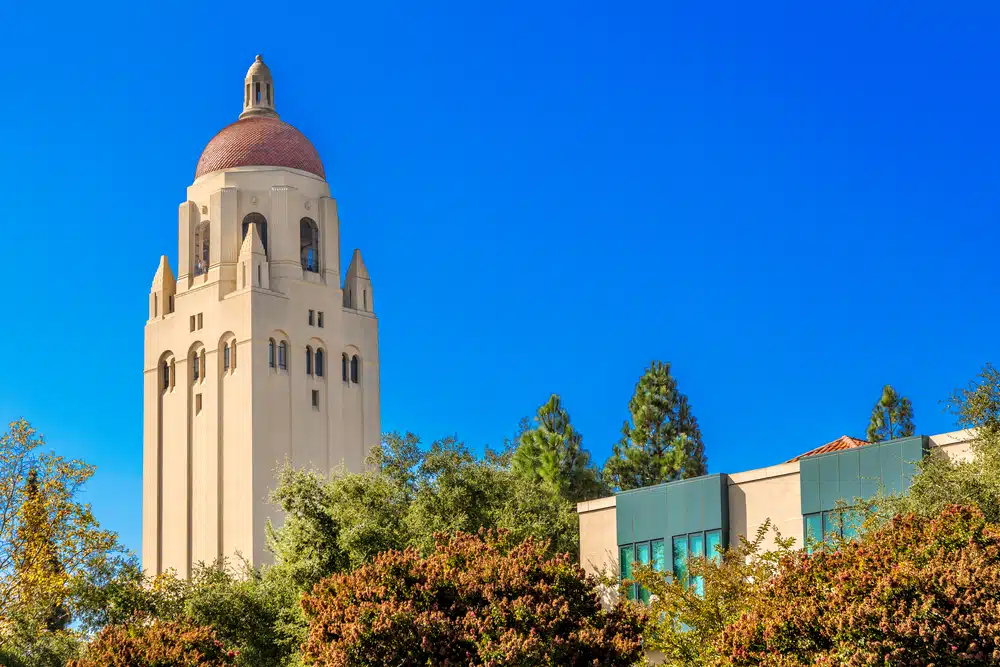
Hoover Tower is a 285-foot structure completed in 1941 for Stanford’s 50th anniversary, designed by architect Arthur Brown Jr. and inspired by the tower at the New Cathedral of Salamanca. It houses the Hoover Institution Library and Archives, and its observation deck at 250 feet offers views across campus and, on clear days, to San Francisco. The tower’s observation deck is open daily from 10 a.m. to 4 p.m., except during academic breaks and finals.
Cecil H. Green Library, the university’s main library, sits at the western end of the central campus axis. Completed in 1919, it houses approximately 4 million volumes focused on the humanities and social sciences, with specialized collections in government documents, rare books, maps, and university archives.
Other notable landmarks include the Cantor Center for Visual Arts, which houses a collection that includes one of the largest outdoor Rodin sculpture gardens outside of Paris; the Arizona Cactus Garden, which dates to the 1880s; and The Dish, a 150-foot radio telescope in the Stanford foothills that also serves as the endpoint of a popular 3.5-mile public hiking trail.
Stanford University’s other campuses and affiliated sites
Stanford operates several facilities beyond its main campus that students in specific programs will access directly:
Stanford University Medical Center sits at the north end of the main campus at 300 and 500 Pasteur Drive. Stanford Health Care is located at 500 Pasteur Drive, with the main hospital building and Hoover Pavilion within Palo Alto city limits. The medical school, hospital, and Lucile Packard Children’s Hospital are all clustered in this area and are accessible from the central academic campus on foot or by the free Marguerite shuttle.
Stanford Redwood City is a 35-acre administrative campus located about five miles north of the main campus. It opened in March 2019 and houses over 1,500 staff members, freeing up the main campus for teaching and research functions.
SLAC National Accelerator Laboratory lies just west of the central campus in unincorporated San Mateo County. It is operated by Stanford for the Department of Energy and contains the longest linear particle accelerator in the world, stretching two miles across 426 acres.
Jasper Ridge Biological Preserve is a 1,200-acre natural reserve on Stanford-owned land used by wildlife biologists for ecological research. It is not open to the general public but is used regularly by students and faculty in biology and environmental science programs.

Hopkins Marine Station is located 90 miles south of campus in Pacific Grove on the Monterey Peninsula. Founded in 1892, it is the oldest marine laboratory on the U.S. Pacific Coast and is home to ten research laboratories. Students in marine biology, ecology, and related fields spend time there for coursework and research.
Stanford in Washington operates out of the Anne T. and Robert M. Bass Center at 2661 Connecticut Avenue NW in Washington, D.C. The program offers undergraduates a semester in the capital with access to government agencies, think tanks, and policy organizations, with housing and classes based at the center.
Getting to Stanford University
Stanford’s location in the middle of the San Francisco Peninsula makes it accessible from multiple directions, but it is not walkable from any major transit hub without a connection. The most practical entry point for first-time visitors and incoming students is the Palo Alto Caltrain station, which sits about two miles from the main campus entrance on Palm Drive and connects directly to Stanford’s free campus shuttle system.
Because the campus itself is enormous and driving adds the complication of paid parking, most students rely on a combination of transit and biking to get around once they arrive.
Public transportation options
Caltrain is the primary rail connection to campus. The Palo Alto Caltrain Station is located close to the main entrance to campus at the intersection of Palm Drive, University Avenue, and El Camino Real. A one-way trip from San Francisco takes approximately one hour, and a one-way trip from San Jose takes approximately 40 minutes. From the station, commuters can transfer to a free Marguerite shuttle or bike or walk to their Stanford destination.
The Marguerite Shuttle is Stanford’s own free campus transit system and the most important service for students moving around campus. It serves as a first-mile and last-mile connector between the Palo Alto Transit Center and various locations on campus, and all routes are free and open to the public.
The main shuttle lines run Monday through Friday, with a Shopping Express route also operating Friday through Sunday for off-campus stores and restaurants. All Marguerite buses are wheelchair accessible and equipped with bike racks.
The X and Y lines are the core campus circulation routes, and both run every 15 minutes during midday to help commuters connect with Caltrain. Live bus locations and arrival times are available through the ETA SPOT app and at transportation.stanford.edu.
BART and connecting services are useful for students coming from the East Bay. Stanford riders can transfer from the Fremont BART station to the Line U bus, which runs directly to campus and is free with a Stanford ID. The Dumbarton Express Line DB travels from the Union City BART station to the Stanford Oval, with stops at Menlo Park, the Palo Alto Caltrain station, and Stanford Medical Center.

SamTrans connects the campus to San Mateo County and San Francisco International Airport. SamTrans extended Route 281, which now provides a direct route from East Palo Alto to the Stanford Oval and Stanford Medical Center.
VTA serves students coming from the South Bay. VTA operates four express buses from the South Bay and provides a connection to and from the California Avenue Caltrain station via VTA Route 89.
Getting there by car or other means
If you are planning to get there by car, the campus sits between the Bayshore Freeway (U.S. 101) and the Junipero Serra Freeway (I-280). From 101, use the Embarcadero Road exit and follow the signs to Stanford. From 280, take the Sand Hill Road or Page Mill Road exits. Traffic on both freeways is heavy during weekday commute hours, and 280 is generally the faster option when coming from the south.
Parking on campus is paid and managed through the ParkMobile app. Visitor parking is enforced Monday through Friday, 8 a.m. to 4 p.m., and is free after 4 p.m. and on weekends. All visitor parking payments are contactless and managed through ParkMobile; zone numbers are posted on green signs throughout visitor parking areas. Note that first-year students are not permitted to bring cars to campus.
If you intend to travel by air, three airports serve the Stanford area. San Jose International Airport is the nearest at about 18 miles southwest of campus. San Francisco International Airport is approximately 28 miles north, and Oakland International Airport is approximately 30 miles to the northeast.
From SFO, the fastest transit option is BART to Millbrae, then Caltrain south to Palo Alto, then the Marguerite to campus, a trip of roughly 70 to 75 minutes. From SJC, Caltrain connections are available via the Santa Clara station. Rideshare services operate at all three airports and are a straightforward, if more expensive, door-to-door option.
Living Near Stanford University
With over 8,000 acres and most undergraduate housing located on campus, daily life at Stanford is largely contained within the university itself. Nearly all undergraduates and about 72% of graduate students reside in 81 undergraduate student residences and 151 graduate on-campus residences. Students typically bike between classes, residences, dining halls, and libraries.
Immediately east of campus is Palo Alto, which functions as Stanford’s primary off-campus extension. Palm Drive runs from the center of campus to University Avenue, placing students within a short bike ride of the city’s main commercial corridor. This is where students go for restaurants, coffee shops, and basic services that are not available on campus.

Palo Alto is not a traditional college town built around student nightlife or dense retail clusters. It is a high-income residential and commercial city shaped by the technology industry. Office spaces, venture capital firms, and startup infrastructure sit alongside everyday businesses, and that proximity influences how students engage with internships, networking, and part-time work.
Places to check out near Stanford University
The closest off-campus destination is downtown Palo Alto, especially along University Avenue, which serves as the main route to Stanford and a central district for shopping, dining, and entertainment. It is the most convenient nearby area for meals, coffee runs, casual meetups, and errands without needing to go far from campus.
For retail and restaurants, Stanford Shopping Center is another major nearby option. It is an open-air shopping and dining destination in Palo Alto with more than 140 stores and a wide range of dining options, including well-known spots like True Food Kitchen, Pacific Catch, and The Melt, making it useful for both quick meals and longer off-campus outings beyond a short trip to downtown.
For arts and culture, the Palo Alto Art Center is one of the most relevant nearby stops. It is owned and operated by the City of Palo Alto and gives students access to exhibitions, public programs, and community arts events without needing to travel into San Francisco or San Jose.
For families visiting with younger siblings or for students looking for a lighter weekend stop, the Palo Alto Junior Museum & Zoo is another nearby city-run destination. The city describes it as offering science experiences and programs for children, which makes it less of a student hangout than downtown Palo Alto, but still part of the immediate area’s cultural scene.
Why You Should Visit Stanford University’s Campus
You can read about Stanford’s size, its architecture, and its Silicon Valley location, but none of that captures how it actually functions day to day. The layout becomes clear when you see how the Main Quad connects to residential areas, labs, and open space, and even a short bike ride across campus shows how students move through it.
A campus visit makes that structure tangible in a way maps and descriptions cannot. Stanford’s official campus tour page outlines student-led tours, self-guided routes, and up-to-date schedules, so you can experience how the campus works firsthand.
If you want to approach campus visits more strategically, AdmissionSight’s Senior Editor College Application Program can help you evaluate schools like Stanford with a clear framework, so you are not just visiting campuses but making informed decisions.

Frequently Asked Questions
1. What is Stanford University’s address?
Stanford University’s main address is 450 Serra Mall, Stanford, CA 94305. The campus is located at the corner of El Camino Real and Serra Street in an unincorporated area of Santa Clara County, next to Palo Alto.
2. How big is Stanford University?
Stanford’s campus spans 8,180 acres, making it one of the largest university campuses in the United States.
3. Can I visit Stanford University before applying?
Yes, Stanford offers student-led campus tours, self-guided tour routes, and virtual visit options.
4. Is parking available at Stanford University?
Yes, but parking is paid and managed through the ParkMobile app. Visitor parking is enforced Monday through Friday from 8 a.m. to 4 p.m. and is typically free after 4 p.m. and on weekends. First-year students are not allowed to bring cars to campus.
5. What landmarks are near Stanford University?
Near Stanford, the most accessible landmarks are in Palo Alto, especially along University Avenue, which offers restaurants, cafés, and shops. The Stanford Shopping Center is also nearby for retail and dining. For outdoor spaces, students can visit the Dish hiking trail in the foothills or explore areas closer to the San Francisco Bay, all within a short distance of campus.
Takeaways
- Stanford University is located in Stanford, California, an unincorporated area in Santa Clara County, directly next to Palo Alto in the heart of Silicon Valley.
- The campus spans 8,180 acres, making it one of the largest in the U.S., which is why biking and shuttles are central to daily student life.
- Most of Stanford feels self-contained, but downtown Palo Alto, especially University Avenue, provides the closest off-campus access to restaurants, cafés, and services.
- Getting to Stanford is straightforward via Caltrain, major highways like U.S. 101 and I-280, or nearby airports such as San Jose International and San Francisco International.
- For personalized guidance, a college admissions expert can help you evaluate Stanford’s fit, plan your visit, and build a stronger application strategy.