


The University of Texas at Austin (UT Austin) is a public research university founded in 1883 and the flagship institution of the University of Texas System. Its main campus is located at 110 Inner Campus Drive, north of downtown Austin and roughly a mile from the Texas State Capitol.
Originally built on a 40-acre site still known today as the “Forty Acres,” UT Austin has expanded into a 431-acre campus in the center of one of the fastest-growing cities in the United States. The university is known for combining a major research environment with Austin’s music scene, tech industry, outdoor culture, and active student life.
In this guide, we’ll cover where UT Austin is located, what the campus looks like, how students typically get around, and what life in Austin is like as a Longhorn.
- UT Austin Campus Location
- Getting to UT Austin
- Living Near UT Austin
- Why You Should Visit UT Austin
- Frequently Asked Questions
- Takeaways
UT Austin Campus Location
UT Austin is located in central Austin, with its 431-acre campus sitting just north of downtown. The university is positioned between Austin’s student neighborhoods and the city’s governmental center, with the Texas State Capitol visible from parts of campus. That proximity plays a major role in programs connected to government, law, policy, and public affairs.
UT Austin is known for its Spanish Renaissance architecture, designed by architect Cass Gilbert in the early 20th century. Limestone buildings, red-tile roofs, arches, and colonnaded walkways give much of the campus a consistent visual style, even alongside newer facilities. That combination of historic architecture and large green spaces helped earn UT Austin a spot on Condé Nast Traveler’s 2025 list of the Most Beautiful College Campuses in the United States.
The campus is organized around two main green corridors: the Main Mall, which runs south from the UT Tower toward the Texas State Capitol, and the East Mall, which extends east across campus. These corridors connect many of the university’s main academic and student areas and are central to daily campus life, traditions, and events. Most academic buildings, and student spaces are clustered within a walkable central core despite the university’s large size.
Residential life is also a major part of the UT Austin experience. While students aren’t required to live on campus, first-year students are encouraged to consider university housing. UT Austin operates 15 residence halls along with nearby apartment options. The university also offers Living Learning Communities (LLCs), where students with shared academic interests live together and participate in programs to build connections both inside and outside the classroom.
Main campus landmarks
UT Austin is home to several iconic campus destinations that are closely tied to student life, university traditions, athletics, and the school’s identity. Here are some of the most recognizable landmarks across campus:
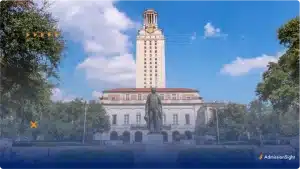
The UT Tower, formally known as the Main Building, is the most recognizable landmark at UT Austin. Designed by architect Paul Cret, the Tower was completed in 1937 and became the centerpiece of the university’s campus master plan. Standing more than 300 feet tall, it remains one of the most recognizable structures in both Austin and Texas higher education.
Located at the north end of the Main Mall, the Tower overlooks both campus and downtown Austin. Its observation deck offers panoramic views of the city, and one of the best-known Longhorn traditions involves lighting the Tower burnt orange after major university achievements and national championships.
Stretching south from the Tower is the Main Mall, which is lined with academic buildings, public art, and gathering areas used for student events and campus traditions. The Mall also creates a direct visual axis toward the Texas State Capitol.
Nearby, the Harry Ransom Center houses major literary and cultural collections, including a Gutenberg Bible, historic photography collections, and manuscripts from writers such as James Joyce and Edgar Allan Poe. Admission to the museum and exhibitions is free.
UT Austin is also home to the Blanton Museum of Art, the largest university art museum in the U.S., and the LBJ Presidential Library, which preserves the archives and history of President Lyndon B. Johnson. Both are located near the eastern side of campus.
Athletics are centered around Darrell K Royal–Texas Memorial Stadium, home of Texas Longhorns football and a memorial honoring Texans who served in WWI. Nearby, the Moody Center hosts basketball games, concerts, and major entertainment events throughout the year.
UT Austin’s affiliated sites
While UT Austin primarily operates from its single central campus in Austin, the university also manages several affiliated research centers, medical facilities, and field stations across Texas.
One of the university’s newest additions is the Dell Medical School, located on the southeastern edge of the main campus beside Dell Seton Medical Center. Opened in 2016, Dell Med became UT Austin’s first medical school and continues to expand alongside new healthcare and research initiatives in Austin.
Northwest of the main campus is the J.J. Pickle Research Campus, a major research complex home to facilities such as the Texas Advanced Computing Center (TACC), engineering labs, and applied science programs. The campus supports many of UT Austin’s large-scale research and technology projects.
UT Austin also operates specialized research sites across the state. These include the Lady Bird Johnson Wildflower Center in southwest Austin, the McDonald Observatory in West Texas, and the Marine Science Institute on the Texas Gulf Coast. Together, these facilities support research in astronomy, ecology, marine science, conservation, and environmental studies.
Getting to UT Austin
UT Austin’s main campus is centrally located in Austin, making it accessible by bus, rail, car, rideshare, and plane. Austin is a fast-growing city with an expanding transit system, and through UT Austin’s partnership with Capital Metropolitan Transportation Authority (CapMetro), students have multiple ways to navigate both the campus and the city without needing a car.
Below, we’ll cover public transportation options, parking and driving information, nearby airports, and how students typically navigate both campus and the city of Austin.
Public transportation options
UT Austin operates one of the largest university shuttle systems in the country, with 7 routes carrying over 3 million passengers annually. The system includes multiple shuttle routes serving residence halls, academic buildings, parking areas, and nearby student neighborhoods. UT students, faculty, and staff can ride the shuttles for free with a valid university ID.
UT Austin students can also ride the full CapMetro bus and rail network free of charge, significantly reducing the need for a car. Several high-frequency bus routes run directly through or beside campus, including Rapid Routes 801 and 803, which connect UT Austin with downtown Austin and major neighborhoods across the city.
CapMetro Rail also provides commuter rail service that extends 32 miles between downtown Austin and northern suburbs such as Leander. Students commuting to the university can exit at the MLK Station and transfer to Route 465 for direct service to campus or use Route 18, which runs along Martin Luther King Jr. Boulevard and serves the north side of UT Austin.
Getting there by car or other means
The primary airport serving UT Austin is Austin-Bergstrom International Airport (AUS), located roughly 10 miles southeast of campus. The airport offers nonstop service to major U.S. cities along with a growing number of international destinations. Under normal traffic conditions, the drive between the airport and campus typically takes around 20 to 30 minutes.
Rideshare services such as Uber and Lyft are widely used by students for airport transportation, errands, and travel around Austin. UT Austin also partners with Zipcar, allowing students to rent vehicles for short-term use without owning a car.
Parking near UT Austin can be competitive because of the large number of students and visitors accessing campus daily. The university manages fewer than 17,000 parking spaces across garages and lots, including the San Antonio Garage, Trinity Garage, and Guadalupe Garage.
Beyond driving, cycling and walking are also common ways to get around campus. Austin has dedicated bike lanes near the university, while MetroBike offers bike-share stations and discounted memberships for UT students. Because the Forty Acres is highly pedestrian-friendly, walking is often the easiest way to navigate the university’s central academic areas.

Living Near UT Austin
Life in Austin is a major part of the student experience at UT Austin. Austin is known for its live music scene, technology industry, outdoor culture, and fast-growing economy, giving students an environment that blends a major public research university with the pace and culture of a large urban center.
Student life on campus is equally active. UT Austin has more than 1,000 registered student organizations, along with a strong Greek life presence and Division I athletics in the Southeastern Conference (SEC). Texas Longhorns football games at Darrell K Royal–Texas Memorial Stadium are among the university’s biggest traditions and play a major role in campus culture throughout the fall semester.
UT Austin students also benefit from strong career resources and direct access to Austin’s growing economy. U.S. News & World Report ranked Austin as the nation’s fastest-growing job market, giving students opportunities to connect with major employers, startups, and tech companies throughout Central Texas. Students interested in government and public service also benefit from the university’s close proximity to local, state, and federal offices throughout Austin.
Outside the classroom, many students who live off campus stay in the nearby West Campus neighborhood, one of the most student-populated areas in Austin. Along the western edge of campus is Guadalupe Street, commonly known as “The Drag,” where students spend much of their time studying, eating, shopping, and socializing between classes.
Because downtown Austin is located less than a mile south of campus, students also have easy access to the city’s restaurants, entertainment venues, parks, and cultural events. That combination of a walkable campus and a major city environment is a large part of what makes student life at UT Austin distinct from many other public universities.
Places to check out near UT Austin
There are plenty of things to do near UT Austin, from live music venues and local restaurants to museums, parks, and outdoor recreation areas around the city.
As mentioned earlier, The Drag is filled with restaurants, coffee shops, bookstores, and longtime student hangouts. Popular spots include Dirty Martin’s Place, a burger restaurant that has operated near campus since 1926, the University Co-op for Longhorn merchandise and textbooks, and Hole in the Wall, a longtime live music venue along Guadalupe Street.
For outdoor recreation, many students spend time around Lady Bird Lake and the surrounding Ann and Roy Butler Hike-and-Bike Trail, which are popular for running, biking, kayaking, and walking. Nearby Zilker Park hosts major events such as the Austin City Limits Music Festival and is home to Barton Springs Pool, one of Austin’s best-known outdoor swimming spots.
Students interested in arts, culture, and history often visit the Harry Ransom Center and the Blanton Museum of Art, both located directly on the UT Austin campus, along with the nearby Bullock Texas State History Museum. For scenic views, Mount Bonnell is a popular destination overlooking the Colorado River and Texas Hill Country.
Austin’s live music culture is also a major part of student life. Downtown areas such as Sixth Street, South Congress, and East Austin are filled with music venues, restaurants, and nightlife destinations regularly visited by UT students throughout the year.
Why You Should Visit UT Austin’s Campus
A school as large and fast-moving as UT Austin can feel very different in person than it does online. Visiting campus gives you a clearer sense of how the university’s size, energy, and location shape daily life both on campus and throughout Austin.
UT Austin offers official campus tours, information sessions, self-guided visit options, and virtual resources for prospective students and families. You can explore current visit options through the official UT Austin Visit Campus page.
Still deciding which universities belong on your final college list? Visiting campuses alongside a clear admissions strategy can make the process much more intentional. AdmissionSight’s Senior Editor College Application Program helps students evaluate schools like UT Austin more thoughtfully while strengthening essays, extracurriculars, and overall application strategy.
If you want more personalized guidance throughout the college admissions process, you can schedule a consultation to learn more about AdmissionSight’s services and programs.
Frequently Asked Questions
1. What is UT Austin’s address?
UT Austin’s main campus is located at 110 Inner Campus Drive, Austin, TX 78705. The university sits just north of downtown Austin near the Texas State Capitol.
2. How big is UT Austin?
UT Austin’s main campus spans approximately 431 acres in central Austin. The university originally began with a 40-acre site known today as the “Forty Acres.”
3. Can I visit UT Austin before applying?
Yes. UT Austin offers official campus tours, information sessions, self-guided visits, and virtual resources for prospective students and families. You can schedule a visit through the official UT Austin website.
4. Is parking available at UT Austin?
Yes. UT Austin manages several parking garages and lots for students, faculty, staff, and visitors, including the San Antonio Garage, Trinity Garage, and Guadalupe Garage. However, because campus parking can be competitive, many students rely on public transportation, walking, biking, and rideshare services.
5. What landmarks are near UT Austin?
Popular destinations near UT Austin include Lady Bird Lake, Zilker Park, Mount Bonnell, and the Texas State Capitol. Students also spend time around Guadalupe Street, commonly known as “The Drag”, downtown Austin, and the city’s many live music venues and restaurants.
Takeaways
- UT Austin is located just north of downtown Austin, giving students a large public university campus within one of the fastest-growing cities in the United States.
- UT Austin’s campus, known as the Forty Acres, is recognized for its Spanish Renaissance architecture and major landmarks such as the UT Tower, Main Mall, and Darrell K Royal–Texas Memorial Stadium.
- Student life at UT Austin combines more than 1,000 student organizations, SEC athletics, Austin’s music and food culture, and direct access to one of the country’s fastest-growing technology and job markets.
- Visiting campus in person can help you better understand UT Austin’s atmosphere, student culture, and close connection to the city of Austin.
- Working with an admissions expert can help you evaluate schools like UT Austin more strategically while building a stronger and more balanced college list.










