Washington University in St. Louis (WashU) is a private research university founded in 1853 by St. Louis civic leaders who saw the need for a major institution of higher learning in the Midwest. For its first five decades, the university operated in downtown St. Louis. Construction on its current home began in 1900, and the campus opened for academic use in January 1905.
The main campus, known as the Danforth Campus, sits on 169 acres bordered by Forest Park and the cities of St. Louis, Clayton, and University City. This guide covers the Danforth Campus and its landmarks, WashU’s additional sites, how to get there, and what it’s like to live near campus.
- WashU Campus Location
- Getting to WashU
- Living Near WashU
- Why You Should Visit WashU’s Campus
- Frequently Asked Questions
- Takeaways
WashU Campus Location
WashU’s Danforth Campus sits at 1 Brookings Drive, St. Louis, MO 63130, at the western edge of the city proper, with the municipalities of Clayton and University City bordering it to the west and north.
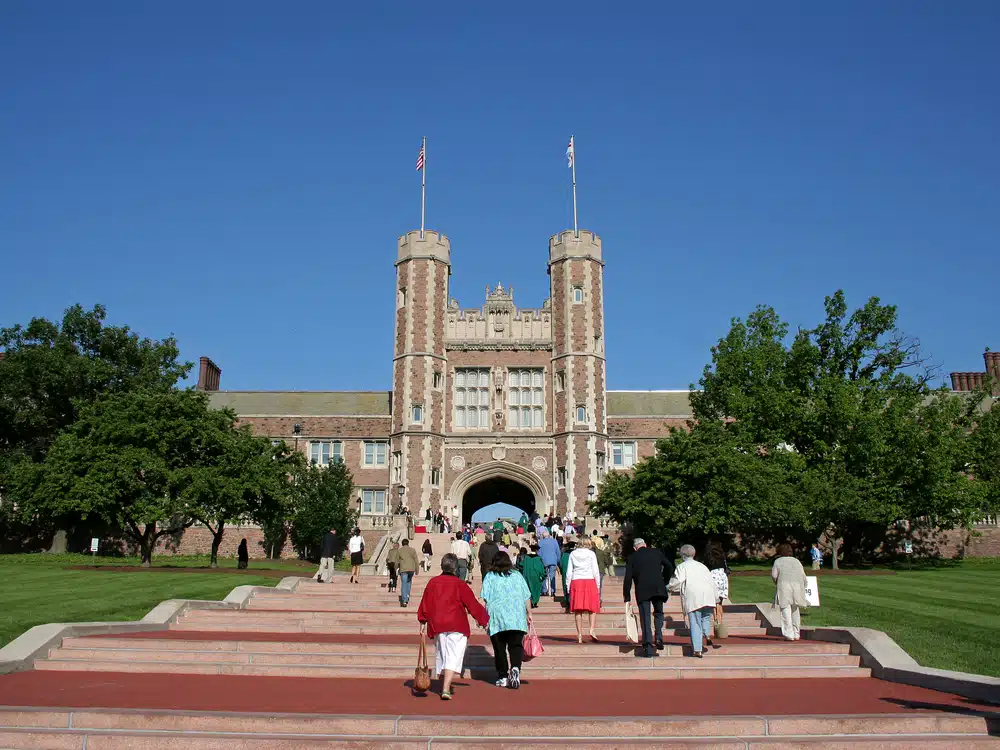
The campus is defined by Collegiate Gothic architecture. Designed by Cope & Stewardson in 1899, its red granite and limestone buildings feature pointed arches, intricate stonework, and soaring towers, with Brookings Hall as the centerpiece. Site plans for the Danforth Campus were originally prepared in 1895 by the firm of Olmsted, Olmsted and Eliot, the same firm that designed New York City’s Central Park. Nineteen buildings contribute to the Danforth Campus Historic District, listed in the National Register of Historic Places in 1979.
The 169-acre footprint is walkable end-to-end in about twenty minutes. Academic buildings, dining, libraries, a recreation center, and student housing are all contained within or immediately adjacent to the main campus, meaning most students have little reason to leave on a normal day. The compact campus also helps foster a strong sense of community, with students regularly participating in clubs, traditions, and WashU sororities and fraternities.
Main campus landmarks
WashU is home to many notable campus landmarks, but the most recognizable is Brookings Hall, the formal eastern gateway to the Danforth Campus. It houses administrative offices, and walking through its arch into Brookings Quadrangle puts you at the center of the academic core.
Just beyond the quad, Olin Library sits at the geographic heart of campus. The John M. Olin Library is the central library of the WashU Libraries system, housing general-interest materials and collections in the humanities, sciences, and engineering. It spans five floors and includes Whispers Café on the ground level, a data and visual exploration lab, and a rare copy of the Declaration of Independence on permanent display.
Behind Brookings Quad, Graham Chapel anchors the western end of the academic buildings. The Gothic Revival structure is used for concerts, lectures, and university ceremonies. Adjacent to it is Mudd Field, the main open lawn on campus, where students gather between classes, play intramural sports, and attend the biannual WILD outdoor concerts.
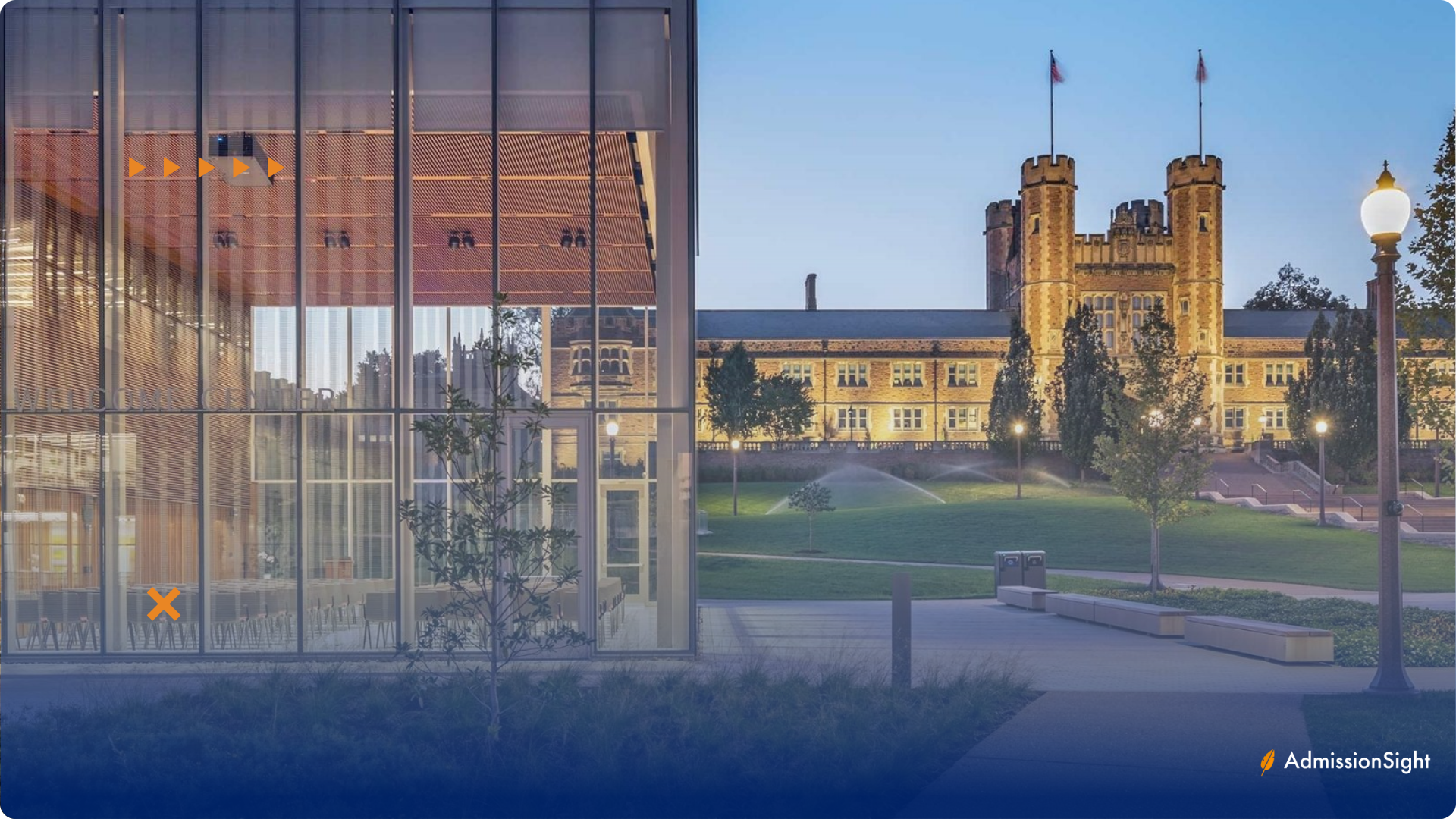
The Danforth University Center (the DUC), on the south side of Mudd Field, is the primary student center, with dining options, meeting rooms, and student organization offices. On the opposite end of campus, the Sumers Recreation Center anchors the west side with fitness equipment, swimming pools, and courts for various sports. The main recreational area was renovated in 2016.
One landmark worth knowing for historical context is Francis Field. In 1900, construction began on the first buildings: Busch Hall, University Hall (now known as Brookings Hall), Cupples I, and Cupples II. When completed, the buildings were leased to the organizers of the 1904 World’s Fair, which was held concurrently with the 1904 Summer Olympics in St. Louis. Francis Field was among the venues used for Olympic events. All of those buildings resumed their academic functions when the university moved to this campus in 1905.
Rounding out the campus, the Mildred Lane Kemper Art Museum, housed in Steinberg Hall, is one of the oldest art museums in the country west of the Mississippi and is free and open to students and the public.
WashU’s other campuses and affiliated sites
Beyond the Danforth Campus, WashU operates several additional sites across St. Louis. The most significant is the Medical Campus. Spreading across 17 city blocks and 164 acres, the Medical Campus is home to the WashU School of Medicine and its affiliated hospitals, clinics, patient care centers, and research facilities, located in St. Louis’s Central West End.
Corporate partners of the Medical Campus include Barnes-Jewish Hospital, BJC HealthCare, St. Louis Children’s Hospital, and WashU Medicine, and the campus is also home to the Siteman Cancer Center. The Medical Campus address is 660 S. Euclid Ave., St. Louis, MO 63110.
WashU also operates a West Campus in Clayton, which houses administrative offices and the West Campus Library, including the University Archives. The North Campus serves additional administrative functions, and the South Campus is used primarily for intramural and club sports.
Further out, the Tyson Research Center, located 25 miles southwest of the Danforth Campus, is a 2,000-acre outdoor laboratory for learning and research, used mainly by students and faculty in the biological and environmental sciences.
Getting to WashU
WashU’s Danforth Campus is accessible by light rail, bus, car, and bike. Most first-time visitors arrive either by MetroLink from the airport or by driving.
Public transportation options
If you are taking public transportation, Metrolink, St. Louis’s light rail commuter train system, has two stops serving the Danforth Campus: Skinker station at the northeast corner of Skinker Boulevard and Forest Park Parkway, and University City-Big Bend station at the northwest corner of Big Bend Boulevard and Forest Park Parkway. Both put you within a short walk of the main campus entrance.
Coming from St. Louis Lambert International Airport, the trip costs $4. Board the train toward the Forest Park-DeBaliviere station, exit there and cross the platform, then board the next westbound train one or two stops to either Skinker or University City-Big Bend.

MetroBuses also stop outside Mallinckrodt Center on Forsyth Boulevard. Current schedules and route maps are at metrostlouis.org. WashU also runs its own Campus2Home shuttle from 6 p.m. to 4 a.m., dropping students at off-campus residences in designated areas around Skinker-DeBaliviere and the Delmar Loop. All shuttle routes can be tracked in real time through the WashU mobile app.
Biking is practical for students who live nearby. There are dedicated bike paths on and around the Danforth Campus, and bikes are permitted on both MetroBuses and MetroLink trains. WashU has also contracted with Lime for a dockless bike-share system accessible through the Lime app.
Getting there by car or other means
If you prefer to travel by private transportation, use 1 Brookings Drive, St. Louis, MO 63130. Visitor parking is available in the East End Garage, entered from Forsyth Boulevard or Forest Park Parkway.
Lambert International Airport is about 14 miles from campus and is the most convenient option for students flying in. MetroLink is the most straightforward connection from the airport. Rideshare services operate throughout St. Louis without issue, and cab fare from the airport runs approximately $40 each way. Students arriving by Amtrak will land at St. Louis Union Station, about 6 miles from campus, reachable by MetroLink or rideshare.
Living Near WashU
WashU’s Danforth Campus sits at the edge of several distinct St. Louis neighborhoods, which means students have easy access to different environments depending on which direction they head. The area has an assorted character: part residential, part college town, and immediately adjacent to several of the city’s most important cultural assets.
Students who live off campus tend to settle in University City, Skinker-DeBaliviere, or the neighborhoods just south of the Loop, all of which offer walkable access to campus and relatively affordable rents by national standards.
Places to check out near WashU
St. Louis provides an array of attractions beyond campus:
- Forest Park is the starting point. Walk or bike the 1,300 acres, visit the Saint Louis Zoo, and catch a summer performance at The Muny. The park’s trails connect directly to the eastern edge of the Danforth Campus, making it a practical place to run or decompress on any given afternoon.
- The Delmar Loop is the neighborhood most students explore first. Beyond the restaurants, there is the Tivoli Theatre for independent film, Pin-up Bowl for bowling, and the St. Louis Walk of Fame embedded in the sidewalk along Delmar Boulevard.
- The Hill, St. Louis’s historic Italian neighborhood a few miles south of campus, is worth the trip for toasted ravioli and traditional Italian food. Anthonino’s Taverna and Charlie Gitto’s are both well regarded locally.
- Soulard, southeast of campus, hosts the largest Mardi Gras celebration outside New Orleans each February, drawing hundreds of thousands of attendees and giving students a sense of how St. Louis shows up for its own traditions.
Why You Should Visit WashU’s Campus
Reading about WashU’s Collegiate Gothic buildings and Forest Park location gives you an accurate picture, but it doesn’t tell you how the campus feels. Most students who end up at WashU say the campus visit was the moment the school became a serious contender on their list.
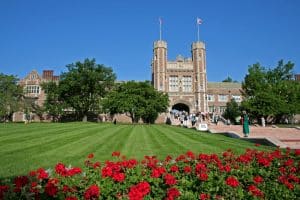
WashU offers campus tours, information sessions, and school-specific Academic Theme Days throughout the year. These on-campus visits offer in-depth insight into each academic school and life at WashU, including a campus tour, an Admissions and Aid group information session, and specialized programming. A virtual tour is also available for students who cannot make the trip in person.
Before you visit, it helps to know where WashU fits in your broader college list so you’re evaluating the campus with your actual goals in mind. AdmissionSight’s Senior Editor College Application Program helps students build a competitive, well-researched application from the ground up, including figuring out how to position schools like WashU strategically.
Frequently Asked Questions
1. What is WashU’s address?
The Danforth Campus address is 1 Brookings Drive, St. Louis, MO 63130. Visitors should use the Sumers Welcome Center at 1 Wrighton Way, St. Louis, MO 63105, on the east end of campus, as their arrival point. The Medical Campus address for WashU Medicine is 660 S. Euclid Ave., St. Louis, MO 63110.
2. How big is WashU?
The Danforth Campus is 169 acres, bordered by Forest Park and the cities of St. Louis, Clayton, and University City. The Medical Campus spreads across 17 city blocks and 164 acres. Tyson Research Center adds another 2,000 acres 25 miles southwest of the Danforth Campus, used for field-based research.
3. Can I visit WashU before applying?
Yes. WashU offers guided tours, information sessions, and school-specific Academic Theme Days throughout the year. Tours depart from the Sumers Welcome Center Monday through Friday, 8:30 a.m. to 5 p.m., and on select Saturdays until 1:30 p.m.
4. Is parking available at WashU?
Yes. Visitor parking is available in the East End Garage, entered from Forsyth Boulevard or Forest Park Parkway.
5. What landmarks are near WashU?
Forest Park, immediately adjacent to the Danforth Campus, contains the Saint Louis Zoo, Saint Louis Art Museum, Missouri History Museum, Saint Louis Science Center, and The Muny. The Delmar Loop is a five-minute walk north of campus. The Central West End, with restaurants, galleries, and coffee shops, is a short MetroLink or car ride east.
Takeaways
- WashU’s Danforth Campus is at 1 Brookings Drive, St. Louis, MO 63130, a 169-acre Collegiate Gothic campus bordered by Forest Park, Clayton, and University City.
- The university was founded in 1853 in downtown St. Louis and moved to its current campus in 1905, built on plans drawn by the Olmsted firm in 1895 and designed by Cope & Stewardson in 1899.
- WashU operates six campuses in and around St. Louis, including the 164-acre Medical Campus in the Central West End and Tyson Research Center, 2,000 acres of outdoor laboratory space 25 miles southwest.
- MetroLink’s Skinker and University City-Big Bend stations serve the Danforth Campus directly, with a $4 light rail connection from Lambert International Airport.
- Working with a college admissions expert before you visit gives you a clearer sense of where WashU fits in your broader college list.