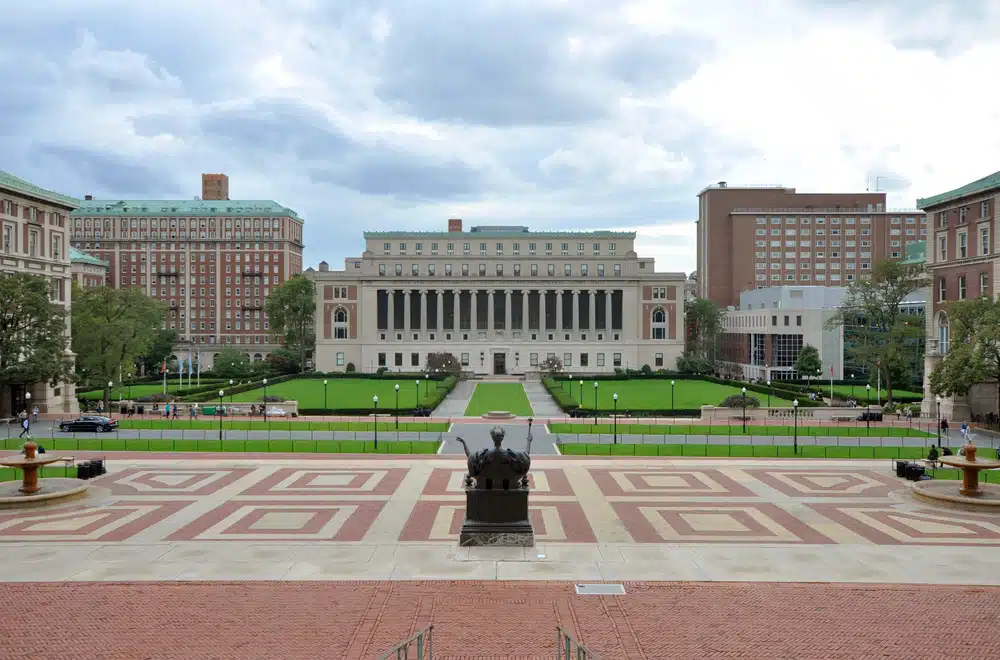
Every December, Columbia lights a Yule Log that traces back to before the Revolutionary War. Somewhere on the Alma Mater statue outside Low Library, there’s a small bronze owl, and campus legend says that if you find it as an incoming student, you’ll graduate valedictorian. These details are fun to know. They’re also more useful than most applicants realize.
Columbia’s admissions committee reads thousands of essays every cycle, and a lot of them lean on the same handful of facts: the Core Curriculum, the city location, the Ivy League name. Those things are true, but they’re not specific to you. Knowing about Columbia traditions, like the Bad Poetry Contest or the Night Market, gives you something concrete to connect to your own interests, and that specificity is what separates an essay a reader skims from one a reader remembers.
This guide covers both halves of that idea. First, we’ll list 15 Columbia traditions worth knowing. Then, a practical method for turning one of them into material for your application, especially the short “Why Columbia” essay.
- Top 15 Columbia Traditions
- How to Use Columbia Traditions in Your Application
- Take the Next Step in Your Columbia Application
- Frequently Asked Questions
- Takeaways
Top 15 Columbia Traditions
Columbia University is known for its academic rigor and Ivy League status. However, when you get accepted and enroll, it’s the daily life and traditions that will also directly shape your student experience, so it’s worth knowing what to look forward to. Let’s explore Columbia University’s unique traditions that every student should know, from long-standing events to quirky campus customs that make the university feel like home.
1. The owl and Alma Mater legend
You’re walking through Low Plaza, and hidden somewhere on the famous Alma Mater statue is a small owl. The legend says that the first student from the incoming class to find the owl will be crowned the class valedictorian.
Some early Columbia students, predominantly men (since the College only admitted men until 1983), joked that whoever discovered the owl would marry a Barnard student. Others believed that the first freshman to find it would be guaranteed the title of valedictorian four years later.
Several historical explanations emerged. Dwight C. Miner, a Columbia History professor in the 1950s, speculated that the owl might have been a nod to French’s connection with the Psi Upsilon fraternity, whose symbol was an owl.
Others, however, pointed to more symbolic interpretations. In 1953, French’s daughter, Margaret French Cresson, clarified the owl’s meaning in a letter to The New York Times. She explained that the owl was a timeless symbol of wisdom, incorporated by French to convey the idea that, in the pursuit of knowledge, students might discover wisdom.
This quirky Columbia tradition connects you to the university’s rich history while giving you a fun incentive to explore the campus!
2. Night Carnival
Every fall, Columbia students gather on the South Lawn for a lively event known as Night Carnival or RHLO Send Off. It’s a fantastic way to kickstart the academic year, as undergraduates from Columbia College, Columbia Engineering, and Barnard College come together to enjoy carnival games, food, music, and inflatables.
This Columbia tradition is a great opportunity to meet new people, unwind, and embrace the campus community vibe.
3. World Leaders Forum
One of the most prestigious Columbia University traditions, the World Leaders Forum brings global figures to campus to engage with students. Hosted every year during the General Assembly of the United Nations in New York City, this series invites influential world leaders to discuss major international issues.
With over 300 dignitaries from more than 85 countries attending since 2003, it’s a unique opportunity for you to hear from and interact with some of the most influential voices shaping global policy.
In 2023, Columbia University hosted its 20th World Leaders Forum, marking the first under the leadership of University President Minouche Shafik. The event, which coincided with the United Nations General Assembly, featured a distinguished lineup of global leaders, including:
- Luis Abinader Corona, President of the Dominican Republic
- Roberta Metsola, President of the European Parliament
- Klaus Werner Iohannis, President of Romania
- Santiago Peña Palacios, SIPA ’03, President of Paraguay
4. Morningside Lights
Morningside Lights is a magical fall tradition where students and community members join together to create stunning lanterns during public workshops. These lanterns are then carried in a procession through the Morningside Heights neighborhood, celebrating the arrival of autumn.
The workshops are free and open to everyone, making it a fantastic way to engage with the Columbia community while celebrating art and the changing seasons in a meaningful, reflective way.
A co-production of the Arts Initiative and Miller Theatre, each year’s theme is conceived and directed by Alex Kahn and Sophia Michahelles of Processional Arts Workshop. Workshop participants learn the artistic techniques of Kahn and Michahelles, bringing a fleet of dozens of illuminated lanterns to life with an evocative theme each year.
5. Homecoming
Columbia’s Homecoming weekend in October is a celebration of alumni returning to campus for a weekend of festivities. Thousands of alumni, family, and students gather on Morningside Heights to celebrate Columbia’s rich history. The highlight of the weekend is the football game, where Columbia’s Lions take on an Ivy League rival.
With fall festivals, reunions, and a sense of nostalgia in the air, Homecoming is an important tradition for reconnecting with the Columbia community.
6. Night Market
If you’re craving a taste of the vibrant street markets of Asia, Columbia’s Night Market is the place to be. Hosted by the Chinese Students Club, this event transforms Low Steps into a dazzling market with colorful tents and hundreds of lights.
In 2023, the Night Market centered around the theme “Crossroads: East Meets West.” Asian affinity groups on campus showcased a variety of delicious offerings, such as bao, boba, fried ice cream, chai, handmade sushi, dumplings, pork buns, and even portraits. These delicacies were sold with purchases made via online food tickets.
The bustling market also featured a makeshift stage where Columbia’s arts groups entertained the crowd with a dynamic array of performances. The lineup included CU Lion Dance, Mālama Hawai‘i, Columbia China Dance, Columbia Taekwondo, Columbia Bhangra, CU Chinese Acapella, Columbia Taiko, Columbia Wushu, CU Raas, CU Raqs Sharqi, and Columbia Taal.
Additionally, Mālama Hawai‘i sold Krispy Kreme donuts as part of a fundraising effort to support Maui fire relief organizations, in response to the devastating wildfires in Hawaii. This annual tradition highlights the university’s celebration of cultural diversity and community engagement.
7. Charter Day
Every October 31, Columbia University marks Charter Day, commemorating the 1754 granting of a charter by New York Governor James De Lancey on behalf of King George II, which established King’s College (later renamed Columbia College in 1784).
While significant anniversaries of Charter Day are often celebrated with grandeur, the 200th anniversary in 1954 stands out as a particularly remarkable occasion. Queen Elizabeth the Queen Mother attended a special Charter Day dinner at the Waldorf-Astoria on October 30, where she was the guest of honor.
The following day, she accepted an honorary degree from Columbia, recognizing the royal family’s role in the founding of King’s College.
This historic event remains a cherished part of Columbia University traditions, reflecting the university’s deep ties to its founding history and its ongoing commitment to education and public service.
8. Bad Poetry Contest
One of the most unique Columbia University traditions is the annual Bad Poetry Contest, organized by the Philolexian Society since 1986. This event invites students to write and present intentionally awful poems for a panel of judges.
With over a hundred students competing for the title of “Poet Laureate,” the contest is filled with laughter and creativity. It’s a fun and lighthearted way to showcase your worst poetic skills and bond with fellow students over the absurd.
In the 2023 contest, 19 entries were presented to an enthusiastic crowd of about 60 audience members. Contestants delivered their poems from a podium, offering everything from self-deprecating soliloquies like “To Be Named For A Grouch” and “Columbia Confessions” to reimagined classics such as “This is NOT a Slam Poem” and “The Ballad of the Whoreo.”
Performances like “Ludicrous Lady Liberty” and “Reason of History” kept the crowd engaged, with waves of applause and snaps filling the room.
9. Friendsgiving at John Jay
Before heading off for the Thanksgiving break, Columbia students come together for a warm and festive “Friendsgiving” feast. Hosted by Columbia Dining, the meal is served at John Jay and Ferris Booth Commons dining halls, offering a wide variety of dishes, including vegan, vegetarian, halal, and kosher options.
With a photo booth to capture memories and a cheerful atmosphere, this tradition gives you the opportunity to celebrate the holiday with your Columbia family before going home.
10. Tree Lighting and the Yule Log Ceremony
As finals approach in early December, the Columbia community gathers for a winter celebration, starting with hot chocolate and a cappella music under the twinkling lights of College Walk. The highlight of the evening is the Tree Lighting Ceremony, followed by the Yule Log Ceremony, which dates back to the American Revolutionary War.
The Yule Log Festival, cherished among Columbia University traditions, has roots that date back to pre-Revolutionary times at King’s College, but it was revived by President Nicholas Murray Butler in 1910.
Originally called the Yule Tide ceremony, it was organized to offer a festive gathering for students who couldn’t return home for the holidays. The event brought together both undergraduate and graduate students living in the new Morningside Heights dormitories, providing them with the opportunity to meet President Butler in person.
The first Yule Log Festival took place in Hartley Hall, but in subsequent years, Wallach Hall (then known as Livingston Hall) in 1911 and Furnald Hall in 1913 also hosted the event.

11. Glass House Rocks
Glass House Rocks, a beloved Columbia University tradition, is an annual celebration that brings together students for a night of performances, games, and community spirit. Coordinated by the student councils since mid-November, the event features dance and musical performances, an arcade, free merchandise, an esports tournament, and a special Dominican Independence Day celebration.
After the event was canceled in 2024 due to a boycott by several performance groups, Glass House Rocks returned with a new twist: this time, incorporating Minecraft into the festivities.
The event’s theme, “Glass House Blocks,” paid homage to the virtual campus created by students during the pandemic, known as “LionCraft.” As students were unable to gather in person, they built a virtual Columbia in Minecraft, showcasing their creativity and resourcefulness.
The highlight of the event was the esports competition, where attendees could “chill” and play popular games like Super Smash Bros. and Mario Kart.
The Glass House Rocks tradition itself began in 2005 as a response to student dissatisfaction with the Lerner Ramps, which were typically seen as “vestiges of passage.”
12. Surf, Turf & Earth
As the school year comes to a close, Columbia Dining pulls out all the stops with the beloved Surf, Turf & Earth event. It’s a Columbia university tradition that draws students looking for a final indulgence before finals and a fantastic way to enjoy a memorable meal with friends, surrounded by the beautiful campus.
In 2022, a major highlight of the event was a special visit from Chef Robert Irvine, renowned for his appearances on Food Network shows like Dinner: Impossible, Worst Cooks In America, and Restaurant: Impossible. Irvine spent time chatting with students and taking photos with them in John Jay Hall.
To add to the excitement, Columbia Dining hosted a raffle offering students the chance to win a surfboard signed by Irvine or a Bose SoundTouch speaker.
13. Bacchanal
Bacchanal is Columbia’s annual spring music festival, a day-long event where you can blow off steam before finals. Past headliners have included major artists like Snoop Dogg, The Chainsmokers, Ty Dolla $ign, and even Columbia alumni Vampire Weekend.
Bacchanal is also a platform for students to showcase their talents, with a student performer opening the event. It’s a celebration of music, fun, and school spirit, bringing together students for a day of relaxation and entertainment before the stress of exams sets in.
14. King’s Crown Shakespeare Troupe
At the end of the spring semester, you can enjoy free, outdoor performances by the King’s Crown Shakespeare Troupe, a student-run group that’s been performing for over 20 years. These shows, staged all around Columbia’s Morningside Heights campus, are a great way to unwind and enjoy the beauty of Shakespeare’s work in a fun, casual atmosphere.
April 23 holds a special place in the hearts of many, especially members of the King’s Crown Shakespeare Troupe and Shakespeare enthusiasts worldwide. It marks both the day Shakespeare passed away and the day we celebrate his birth—a date rich with literary significance.
15. Varsity Show
The Varsity Show is Columbia’s oldest student-run production, entertaining the campus with its annual satirical take on life at the university. Since 1894, this tradition has showcased student creativity, humor, and talent. The show often includes funny skits, songs, and performances that poke fun at Columbia’s academic and social life and the US at large.
How to Use Columbia Traditions in Your Application
Columbia has a 150-word “Why Columbia” prompt, specifically: “Why are you interested in attending Columbia University? We encourage you to consider the aspect(s) that you find unique and compelling about Columbia.”
At 150 words, you don’t have space to walk through several traditions, explain the Core Curriculum, and mention the city. You have space for one idea, developed well. So the real task is choosing the single detail that does the most work for you, then building the essay around it. Here’s how to do that:
1. Choose one tradition that matches your interest or experience.
Pick a tradition because it connects to something personal to you, not because it’s the one everyone’s heard of.
For instance, you might choose Morningside Lights if you have hands-on experience with art, design, or public installations, especially anything collaborative or seasonal. You might have built props for a school play, worked on a mural, or just spent a lot of time thinking about how communities mark the changing seasons.
Connecting a tradition to your own background or interests tells the reader something about you. The tradition should function as evidence for a claim about who you are. If you can swap it out for a different tradition and the essay still works, you haven’t chosen the right one yet.
2. Lean into the tradition.
Once you’ve picked a tradition, build the essay’s central point around it. Don’t save it for a closing flourish. A common mistake is treating the tradition as garnish: three sentences of general praise for Columbia, then “I’d also love to enter the Bad Poetry Contest” tacked on at the end. That sentence just proves you did five minutes of research. The tradition should instead be the thing your whole argument runs through, from the first sentence to the last.
Here’s an example of what a good response would look like:
- “In ninth grade, I joined my school’s poetry club expecting to write something profound. Every poem came out clumsy, and I nearly quit. Instead, I started writing bad poems on purpose, timing myself, forcing clashing rhymes, pushing a metaphor until it collapsed. That habit turned writing into play instead of pressure. It’s why the Philolexian Society’s Bad Poetry Contest caught my attention: a room of a hundred students competing to write as badly as possible isn’t a joke to me. It’s the writing culture I’ve been looking for, one that treats failure as part of craft instead of something to hide from.”
Now compare it to the diluted version, where a tradition gets mentioned but does no real work:
- “Columbia stands out among Ivy League schools for its rich history, world-class faculty, and unmatched location in New York City. Its Core Curriculum challenges students to think across disciplines, and traditions like Bacchanal and the Bad Poetry Contest show a campus that values fun as much as rigor. I’ve always wanted a university that combines academic excellence with a strong sense of community, and Columbia’s reputation for producing leaders fits my goals. I’m confident that Columbia’s vibrant student life would let me grow both personally and intellectually alongside curious, ambitious peers from around the world.”
The second version technically isn’t badly written, but at 150 words, generic praise has no room to hide. Nothing in it requires the writer to be a specific person. The first version can only have been written by someone who actually tried and failed at writing poetry, which is exactly the point.
If you’re struggling to find that level of specificity in your own response, our Columbia Supplemental Essays Guide walks through every prompt with real examples and practical strategies.
Take the Next Step in Your Columbia Application
Knowing Columbia’s traditions is one part of building a strong application. If you’re ready to move from campus research to full application strategy, our How to Get Into Columbia University Guide covers admissions requirements, academic benchmarks, and what the rest of your application needs to show.
If you want direct help turning your background into finished essays, AdmissionSight’s Standard College Counseling Program works with students one-on-one on strategy, drafts, and revisions across the full application.

Frequently Asked Questions
1. What are some traditions at Columbia University?
Columbia’s traditions range from the Owl and Alma Mater legend and Homecoming to smaller student-run events like the Bad Poetry Contest, the Night Market, and Morningside Lights. Fifteen of the most notable ones are covered above.
2. How do I use Columbia traditions in my “Why Columbia” essay?
Pick one tradition that connects to a specific interest or experience of yours, then build your essay around that connection instead of listing several traditions or mentioning one in passing.
3. Should I mention the Core Curriculum in my Columbia essay?
You can, but only if you tie it to something specific about your intellectual interests. On its own, it’s one of the most common references admissions officers read, so it needs a personal angle to stand out.
4. How long is Columbia’s “Why Columbia” essay?
For the 2025–26 admissions cycle, it’s capped at 150 words.
5. What’s a common mistake applicants make when writing about Columbia traditions?
Naming a well-known tradition, like the Alma Mater owl or Bacchanal, without connecting it to anything specific about themselves. The tradition ends up reading as research rather than genuine interest.
Takeaways
- Examples of Columbia’s traditions include the Owl and Alma Mater legend, Homecoming, the Bad Poetry Contest, the Night Market, and Morningside Lights.
- Knowing Columbia’s traditions can help you make supplemental essays that feel more lived-in and personal instead of generic.
- With a 150-word limit on the “Why Columbia” essay, pick one tradition, not several, and build your whole answer around it. The tradition should carry the essay’s main point, not sit at the end as a name-drop. If you can remove it without changing the essay, it isn’t doing its job.
- Want help turning your own experiences into a standout Columbia application? Our Private Consulting Program offers one-on-one guidance from admissions experts to help you get there.