Being good at drawing helps, but it’s not the only thing that matters on the AP Drawing Exam. In 2024, only 15.1% of students earned a 5. Most portfolios landed in the 3 or 4 range, and 83.8% of students passed with a score of 3 or higher. Out of 22,882 test takers, the average score was 3.42.
If you’re prepping for the AP Drawing Exam, you’ve come to the right spot. This blog walks you through everything you need to know: how it works, what’s required, how to study effectively, and how to submit a portfolio that stands out.
- AP Drawing Course and Exam Description
- AP Drawing Exam Format
- AP Drawing Exam Sample Portfolio
- How to Build a High-Scoring AP Drawing Portfolio
- AP Drawing Portfolio Submission Deadline
- Is the AP Drawing Exam Hard?
- Frequently Asked Questions
- Takeaways
AP Drawing Course and Exam Description
The AP Drawing Exam course is centered on creating original artwork that shows your understanding of drawing skills and techniques. You’ll explore how to use materials, processes, and ideas to communicate visually through media like pencil, charcoal, ink, digital drawing, painting, or mixed media.
You’ll learn how to develop a sustained artistic investigation guided by a central idea or inquiry. You’ll also work on applying drawing concepts such as mark-making, line quality, shading, texture, proportion, and perspective. In your written work, you’ll describe your decision-making process, material choices, and how your ideas evolved through experimentation and revision.
The course is modeled on a college-level foundation drawing or studio art class. Most students who take it are juniors or seniors who have some prior experience with drawing or visual art. The College Board recommends students be familiar with the elements and principles of art before enrolling, but there are no official prerequisites.
There’s no written test for the AP Drawing Exam. Instead, you’ll produce a portfolio that includes both a series of works exploring a single theme (Sustained Investigation) and five high-quality finished pieces (Selected Works) that demonstrate technical skill and drawing-based thinking.
AP Drawing Exam skill areas
The AP Drawing Exam assesses your ability to demonstrate drawing skills and sustain creative development over time. These six skill categories are at the heart of both the course and the portfolio you’ll submit:
| Skill Area | Description |
| Inquiry and Investigation | You’ll identify a central idea or visual question to explore across multiple works. This skill focuses on developing a meaningful theme through drawing. |
| Material Use | You’ll handle drawing materials with purpose—whether it’s pencil, charcoal, ink, or digital tools. Show control, intent, and thoughtful experimentation. |
| Process and Revision | You’ll demonstrate how your drawings improve over time through sketching, trial and error, feedback, and reworking. This shows growth and problem-solving. |
| Composition and Drawing Skills | You’ll apply drawing concepts like proportion, line quality, light/shadow, mark-making, and space. Strong work shows technical skill and visual awareness. |
| Artistic Intent and Communication | You’ll make visual choices that clearly express your ideas. This includes symbolism, visual metaphors, and compositional decisions that support your message. |
| Written Evidence | You’ll briefly explain your process, materials, and intent. These short statements matter because your ability to describe your work helps readers understand your thinking. |
Each of these skill areas appears in both the Sustained Investigation and Selected Works sections of the AP Drawing Exam portfolio. Your best shot at a 4 or 5 comes from showing strong execution, skill development, and clear communication across all six.
AP Drawing Exam Format
The AP Drawing Exam has no multiple-choice or timed written sections. Instead, the exam is a digital portfolio submitted through the AP Digital Portfolio platform. The portfolio has two sections, and each one makes up part of your total score:
Section I – Sustained Investigation
- 15 images total
- Includes written responses
- 60% of your score
This section asks you to explore a question or theme through a body of related works. You’ll submit 15 digital images that show your ideas evolving over time. Some images will be finished drawings. Others can include sketches, mark-making experiments, revisions, or close-ups that show process work and how your ideas developed.
You’ll also write short responses about your investigation. These must explain:
- What central idea or question you explored
- How your materials, processes, and ideas developed over time
- What changes you made as you experimented and revised your work
This section is all about growth. Reviewers want to see how your drawing skills and concepts improved as you pushed your work further.
You’ll be scored on:
- Creative problem-solving
- Visual and conceptual development
- Use of drawing materials and mark-making techniques
- Risk-taking and refinement
- Consistency and progression across works
Section II – Selected Works
- 5 digital images (1 image per artwork)
- Includes a short commentary for each piece
- 40% of your score
This section highlights your best finished pieces. These five artworks should show off your technical drawing skills, visual fluency, and strong artistic intent. You’ll also write a short description for each one, including:
- The materials you used
- The processes or techniques applied
- The idea behind the work
This section is your chance to show what you can do at your highest level. Each piece is scored for technical quality, intention, and clarity. Your five pieces can be related to your sustained investigation or stand completely on their own.
You’ll be evaluated on:
- Skillful use of materials
- Clear communication of ideas
- Control of composition and drawing technique
- Originality and effectiveness
No matter what style or media you use, the key is to show growth, skill, and clear intent. If your drawings are thoughtful, well-executed, and backed by strong written explanations, your portfolio will stand out.
AP Drawing Exam Sample Portfolio
To understand what a top-scoring AP Drawing Exam portfolio looks like, let’s check out a real example from 2024. This student earned a score of 5 by showing strong visual ideas, technical drawing skills, and depth of concept across all five selected works.

|

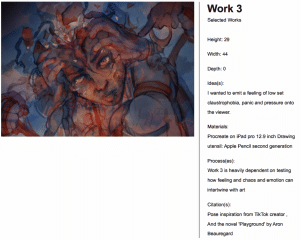


Let’s walk through why this portfolio earned a 5. This AP Drawing Exam submission excelled in three key areas:
1. Advanced drawing skills and visual intention
Each piece shows confident technical ability and control of drawing principles like composition, value, layering, and spatial depth. For example:
- Work 1 uses bold, exaggerated color and shape to convey personal identity and cultural symbolism through a dynamic composition.
- Work 3 combines intense figure distortion with chaotic mark-making to express emotional pressure and a sense of panic.
- Work 5 demonstrates control of light and texture, using overlapping faces and expressive lighting to create visual tension and layered meaning.
Throughout all five works, the student makes intentional design choices to support the overall narrative. The portfolio balances expressive risk-taking with refined execution, showing strong control of drawing as a medium for both structure and emotion.
2. Synthesis of materials, processes, and ideas
Each piece thoughtfully connects theme, technique, and medium. The artist uses digital tools not just for technical polish but to support deeper conceptual aims. Examples include:
- Work 2 explores the conflict between heaven and hell through a vibrant, layered spectrum of color, echoing themes of duality in nature.
- Work 4 integrates cultural language and historical references, blending traditional portraiture with symbolism and text to explore identity.
- Work 5 reflects on racial erasure through the distortion of facial features and fragmentation of form, with light used as both subject and design element.
The student synthesizes these elements to communicate nuanced, often personal themes. Their process choices directly support the ideas they’re exploring, resulting in a portfolio that feels cohesive and intentional.
3. Specific and purposeful written evidence
Each written response clearly identifies the materials, ideas, and techniques behind the work. The student references inspirations, explains technical experimentation, and shows awareness of how their decisions impact the viewer.
For example, statements about “testing how feeling and chaos and emotion can intertwine with art” and “experimenting on adding my cultural language ‘Algonquin’” show thoughtful reflection on artistic choices. These short responses are focused and meaningful, adding clarity to the visual work.
This kind of writing helps readers understand what the artist was aiming to do and why. It demonstrates critical thinking and strengthens the portfolio as a whole.
How to Build a High-Scoring AP Drawing Portfolio
The AP Drawing Exam does not include any timed sections or multiple-choice questions. Instead, you will submit a digital portfolio that demonstrates confident mark-making, observational skill, conceptual depth, and artistic growth. This exam rewards intentional choices and clear development over time.
Your score is based on how well your portfolio meets the following criteria: Inquiry and Investigation, Making Through Practice, Experimentation and Revision, and Communication of Ideas. Here’s how to meet the scoring criteria and stand out:
1. Use the Course and Exam Description (CED) as your foundation.
The AP Drawing CED outlines the specific drawing skills and expectations. Use it to guide your creative process from start to finish.

- Practice the drawing skills outlined in the CED. These include line quality, value, space, light, mark-making, and surface.
- Choose a clear inquiry question. Your Sustained Investigation should focus on a consistent idea or theme across all works.
- Use the rubric to reflect on your progress. Check if your pieces show thoughtful choices, risk-taking, and creative direction.
- Make intentional decisions. Let your ideas lead your technique. Your work should say something, not just show skill.
- Explain your thinking. In your commentary, describe how your work changed over time and what guided your revisions.
2. Show growth and thoughtful experimentation.
The Sustained Investigation section rewards revision, process, and transformation. You do not need to present only polished pieces. You need to present a journey.
- Include evidence of process. Show early sketches, corrections, and reworked ideas that help viewers see your development.
- Experiment with tools and materials. Vary your use of line, texture, layering, or surface to test different ideas.
- Avoid repetition. Make sure each image adds something new to your overall body of work.
- Write about your process. Let reviewers know what changed, why you changed it, and how feedback shaped the outcome.
3. Choose refined drawings for your Selected Works.
Your Selected Works section should highlight your strongest pieces. These drawings should show control, confidence, and intention.
- Pick pieces that reflect spatial awareness and design. Strong works demonstrate careful composition and thoughtful use of space.
- Avoid drawings that feel too similar. Each one should contribute something distinct to your portfolio.
- Use clear, well-lit photography. Good lighting and clean presentation help reviewers see your technique.
- Be specific in your commentary. Describe how your materials and methods support the ideas in the piece.
- Explain the “why” behind your choices. Go beyond describing what you did and talk about why you made those decisions.
4. Learn from real portfolios and scoring commentary.
The College Board provides real samples with detailed commentary. Use these examples to understand what strong portfolios do well.
- Study portfolios that scored a 4 or 5. Notice how they combine technique with meaningful content.
- Read the student commentary. Pay attention to how students explain their process and creative thinking.
- Compare strong and weak samples. Understand what makes one portfolio stand out and another fall short.
- Look for variety and unity. Top portfolios explore different techniques while still feeling cohesive overall.
5. Plan your timeline and pace your work.
A great portfolio takes time. Set a schedule that allows for experimentation, revision, and careful documentation.

- Break your project into phases. Start with idea generation, then move through drafts, revisions, and final pieces.
- Ask for feedback. Teachers and peers can help you clarify your intent and spot areas for improvement.
- Track your progress. Know how many works are complete, what still needs work, and what is ready to upload.
- Allow enough time for documentation. Take your final photos early so you are not rushing at the last minute.
- Submit before the deadline. For 2026, all materials must be submitted by Friday, May 8, 2026, at 8 p.m. ET.
6. Treat your Sustained Investigation as a creative study.
Your portfolio should explore a meaningful idea through drawing. Each experiment, revision, and reflection contributes to your investigation.
- Build your Sustained Investigation around a concept. Start with a question, not just a technique.
- Let your ideas evolve. Your body of work should show how your understanding deepened over time.
- Include process materials. Sketches, studies, and revisions show growth and help explain your decisions.
7. Maintain consistency in your visual voice.
Even if you use different drawing tools or techniques, your portfolio should still feel unified.
- Use consistent stylistic choices. Try to keep your mark-making, surface treatment, and compositional approach aligned.
- Avoid works that feel disconnected. A unified voice helps the portfolio feel intentional and complete.
- Explain how your pieces connect. Use your writing to show how everything fits into your overall vision.
8. Strengthen your written evidence.
Your writing helps explain your ideas, clarify your decisions, and support your artistic intent.
- Treat your commentary like an extension of your art. Use it to explain, not just describe.
- Be specific. Connect your choices to what viewers see in the piece.
- Avoid vague phrasing. Say more than “I wanted to express myself.” Be clear about what you hoped to achieve.
- Reveal the unseen. If something important is not obvious in the drawing, explain it in your commentary.
A high-scoring AP Drawing portfolio goes beyond technical ability. It demonstrates creative thinking, personal voice, and clear intent. When your drawings are both skillful and purposeful, your portfolio will leave a lasting impression.
AP Drawing Portfolio Submission Deadline
The final deadline to submit your AP Drawing portfolio is Friday, May 8, 2026, at 8:00 PM Eastern Time. All three components—Sustained Investigation, Selected Works, and Written Evidence—must be uploaded and marked as final in the AP Digital Portfolio by that time.
Make sure to give yourself enough time before the deadline. Incomplete uploads, last-minute technical issues, or simple errors can prevent your portfolio from being scored.
To view the full AP exam calendar and registration info, check out our comprehensive guide.
AP Drawing score release date
For 2026, AP Drawing scores are expected to be released in early to mid-July. While the College Board has not confirmed the exact date, scores usually become available around the same time each year. For reference, 2025 scores were released on July 7.
Log in to your College Board account starting in early July so you don’t miss your score report.
Is the AP Drawing Exam Hard?
The AP Drawing Exam does not involve multiple-choice questions or written prompts. Instead, you’ll submit a portfolio of original two-dimensional artwork that demonstrates your ability to use drawing techniques and mark-making with clarity, control, and intention.
The strongest portfolios show evidence of risk-taking, a consistent visual voice, and an evolution of ideas across all three components: Sustained Investigation, Selected Works, and Written Evidence.
If you’re wondering how students performed in 2024, here’s the official score breakdown:
| Score | Percentage of Students |
| 5 | 15.1% |
| 4 | 31.1% |
| 3 | 37.6% |
| 2 | 13.5% |
| 1 | 2.7% |
| Total Passing (3+) | 83.8% |
In 2024, 83.8% of students earned a passing score of 3 or higher. The mean score was 3.42. While most students performed well, top scores required more than technical skill. To stand out, your portfolio should demonstrate thoughtful artistic decisions, a clear sense of visual development, and strong written evidence that explains your choices and process.
If you want expert feedback on your portfolio or help refining your ideas, our AP tutorial services can support you with detailed guidance and strategic coaching.
Frequently Asked Questions
1. How hard is the AP Drawing Exam?
The AP Drawing Exam had a high pass rate in 2024. About 83.8% of students earned a score of 3 or higher, and the mean score was 3.42. While the majority passed, top scores are still difficult to achieve. Portfolios that earn 4s and 5s go beyond technique by showing conceptual thinking, intentional mark-making, and clearly expressed visual decisions.
Your work is scored based on both visual quality and written evidence. That means your drawings need to show strong artistic choices and a clear evolution of ideas. Top students often explain their process thoroughly and use their commentary to support what may not be immediately visible in the artwork.
2. How many hours should you spend on your AP Drawing portfolio?
The most successful students work steadily throughout the school year. Many spend several hours each week developing their drawing skills, experimenting with different tools and surfaces, and refining their concepts. If your goal is to score a 4 or 5, it’s best to begin early and treat your Sustained Investigation like an ongoing visual inquiry.
You’ll also need time to photograph your pieces well, write thoughtful commentary, and show evidence of growth. Rushing at the end can hurt your results, so consistent pacing is key.
3. Is AP Drawing worth taking?
If you love drawing, illustration, or fine art, the AP Drawing course is a great opportunity to build a strong portfolio. It’s especially useful if you plan to apply to art, architecture, or design programs that value technical drawing and composition skills.
Even if you do not plan to major in art, the course builds creative thinking, visual storytelling, and attention to detail. These skills carry over to fields like animation, architecture, product design, and other creative industries.
4. When do AP Drawing scores come out?
For 2026, AP Drawing scores are expected to be released in early to mid-July. While the College Board has not announced the official release date, scores typically come out around the same time each year. For reference, 2025 scores were released on July 7.
To avoid delays, make sure to check your College Board account regularly in early July so you do not miss your score report.
Takeaways
The AP Drawing Exam values creativity, risk-taking, and intentional decisions across both visual and written components. Here are the key insights to remember:
- The AP Drawing Exam portfolio is built on process and growth. High scores go to students who show development over time, not just polished results. Your portfolio should feel like a creative journey.
- Strong AP Drawing portfolios combine concept and technique. From mark-making to spatial composition, every element should support a clear artistic message and demonstrate thoughtful visual choices.
- Written evidence matters just as much as the artwork. Use your commentaries to explain the intent behind your decisions and help reviewers understand your process and themes.
- Time management is critical for success on the AP Drawing Exam. Pacing your work throughout the year gives you the space to revise, experiment, and reflect without rushing near the submission deadline.
- For students aiming to excel on the AP Drawing Exam, working with a college admissions consultant can make a difference. AdmissionSight helps students build stronger portfolios, develop a clear artistic voice, and write thoughtful, effective commentary.