


In 2024, 350,257 students took the AP US Government and Politics Exam. The average score was 3.38, and 73% of test-takers earned a score of 3 or higher. That’s a solid pass rate, but just under 50% earned a 4 or 5. So while the AP US Government and Politics Exam is very doable, you’ll still need to study seriously if you’re aiming for a strong score.
This blog covers everything you need to know about the AP US Government and Politics Exam: what’s on it, how it works, and how to study in a way that actually helps.
- AP US Government and Politics Course and Exam Description
- AP US Government and Politics Exam Format
- AP US Government and Politics Exam Questions
- How to Study for the AP US Government and Politics Exam
- AP US Government and Politics Exam Test-Taking Tips
- AP US Government and Politics Exam Date
- Is the AP US Government and Politics Exam Hard?
- Frequently Asked Questions
- Takeaways
AP US Government and Politics Course and Exam Description
The AP US Government and Politics course focuses on how the American political system is structured, how it functions, and how people interact with it.
You’ll study the Constitution, checks and balances, federalism, civil liberties, political institutions, political parties, elections, public opinion, and the roles of interest groups and the media. You’ll also analyze key Supreme Court cases and foundational documents that have shaped American democracy.
The course teaches you how to apply political concepts to real-world scenarios. You’ll interpret charts, court decisions, and political texts. You’ll also be asked to compare institutions, identify cause-and-effect relationships, and defend arguments with evidence.
Most students take this course as juniors or seniors. It’s modeled on an introductory college political science class, so you’ll need to stay sharp on vocabulary, current events, and major political debates. Understanding how Congress works, how the President interacts with the courts, or how elections are funded and regulated will be part of the job.
AP US Government and Politics Exam topics
The AP US Government and Politics Exam is based on five major units. Each unit ties directly to core concepts, foundational documents, and political institutions. Here’s how the exam is usually weighted:
| Unit | Topic Area | Weighting |
| 1 | Foundations of American Democracy | 15%–22% |
| 2 | Interactions Among Branches of Government | 25%–36% |
| 3 | Civil Liberties and Civil Rights | 13%–18% |
| 4 | American Political Ideologies and Beliefs | 10%–15% |
| 5 | Political Participation | 20%–27% |
These percentages tell you how much of the exam will focus on each unit. Interactions Among Branches of Government makes up the biggest chunk, so you’ll want to understand the powers and limits of Congress, the presidency, the courts, and the bureaucracy.
Foundations of Democracy and Political Participation are also heavily tested. You’ll see questions about voting rights, political parties, interest groups, federalism, and how ideas in the Constitution continue to shape policies and institutions today.
AP US Government and Politics Exam Format
The AP US Government and Politics Exam is fully digital and taken on the College Board’s Bluebook app. The test is structured in two main sections, each worth 50% of your score:
Section I – Multiple-Choice
- 55 questions
- 80 minutes
- 50% of your score
These questions include a mix of stand-alone items and question sets based on visual or written sources. You can expect a variety of formats, including:
- Standalone questions (about 30 questions)
- Quantitative analysis sets (around 2–3 sets): charts, graphs, or data tables
- Text analysis sets (around 2 sets): excerpts from foundational documents or political commentary
- Visual analysis sets (often 1 set): political cartoons, maps, or infographics
Each question has four answer choices (A–D), and there’s no penalty for guessing. Some questions will ask you to identify a relevant concept, analyze a visual, or connect a political idea to a real-world scenario.
Section II – Free Response
- 4 questions
- 100 minutes
- 50% of your score
Free-response tasks include one of each of the following:
- Concept Application: apply political principles to a real-world scenario
- Quantitative Analysis: interpret a data source and explain its political significance
- SCOTUS Comparison: compare a required Supreme Court case to a new one
- Argument Essay: take a position on a political idea and support it with evidence
Each free-response question has its own scoring rubric. Together, the FRQs total 24 points:
- Concept Application: 4 points
- Quantitative Analysis: 4 points
- SCOTUS Comparison: 4 points
- Argument Essay: 12 points
Your job is to give clear, direct answers. The more accurately you explain your reasoning and support your claims with evidence from the course, the better your score.
How long is the AP US Government and Politics Exam?
The AP US Government and Politics Exam is three hours long, divided into two main sections. You’ll spend 80 minutes on the multiple-choice portion and 100 minutes on the free-response portion.

There’s no official reading period, but you’re encouraged to manage your time carefully in Section II. Here’s how the College Board recommends dividing your time:
- Concept Application – ~20 minutes
- Quantitative Analysis – ~20 minutes
- SCOTUS Comparison – ~20 minutes
- Argument Essay – ~40 minutes
That adds up to 100 minutes exactly. If you can stick to those time blocks, you’ll have enough time to fully answer each question. In Section I, you have about 1.5 minutes per question. If a question is taking too long, guess and move on.
Time management is everything. You’ll need to work fast, but not carelessly. Practicing under real timing conditions ahead of test day can make a big difference.
AP US Government and Politics Exam Questions
Both the multiple-choice questions (MCQs) and free-response questions (FRQs) on the AP US Government and Politics Exam test a range of skills:
- The MCQs measure your ability to recall terms, interpret visuals and texts, and apply political concepts.
- The FRQs ask you to explain, compare, and argue using real evidence and foundational documents.
Multiple-Choice Questions
You’ll have 60 minutes to complete 55 multiple-choice questions. These include individual items and sets based on text, data, or visual sources.
The College Board does not release actual MCQs from the AP US Government and Politics Exam. This policy protects the integrity of their question bank. Teachers can access official practice questions via AP Classroom, but students won’t find them publicly online.
That said, here’s an example of the kind of question you might encounter:
| A president issues an executive order in response to a national emergency. Congress disagrees but does not have enough votes to override the order. Which of the following best illustrates the scenario? A. It demonstrates checks and balances. |
The correct answer is D. Executive orders are a classic example of informal presidential power. They are not explicitly listed in Article II of the Constitution, but they allow the president to direct the federal bureaucracy without needing Congress. In this case, the president takes unilateral action during a crisis, and Congress cannot override it due to a lack of votes.
This response highlights how informal powers can be powerful tools, especially when formal legislative routes are blocked. It’s a high-scoring answer because it correctly identifies the nature of the power and connects it to the structural limits of Congress in this scenario.
Free-Response Questions
The FRQ section is 90 minutes long and includes four required questions, each focusing on a different skill:
- Concept application
- Quantitative analysis
- SCOTUS comparison
- Argument essay
Below are real free-response questions from Set 1 of the 2024 AP US Government and Politics Exam:
Question 1: Concept Application
| In 1970, the Environmental Protection Agency (EPA) was established in order to more effectively enforce federal environmental protection laws. As an independent agency within the federal bureaucracy, the EPA’s mission is “to protect human health and the environment.” Throughout its history, the EPA has supported the executive branch by enforcing legislation intended to regulate automobile emissions, increase household recycling, and ban the use of harmful pesticides.
Americans have debated how much flexibility the EPA should have to enforce and interpret existing law. Some prefer the EPA to have more flexibility in implementing laws so that it can better protect common interests like clean water and biodiversity. On the other hand, others claim that the EPA has too much flexibility in implementing laws, allowing the agency to impose unnecessary and burdensome regulations that hurt business, and that its flexibility in implementing policy should be limited. Recent actions are consistent with this debate. For example, under one administration, the EPA interpreted existing environmental laws in new ways, further limiting toxic emissions from automobiles and power plants. However, under the following administration, the EPA implemented a narrower interpretation, which led to the rollback of recent restrictions in the name of free enterprise and limited government. After reading the scenario, please respond to A, B, and C below. (A) Describe the power that the EPA used in the scenario to change how it implemented environmental laws under different administrations. (B) Explain how the power described in part A could be affected by the president. (C) Explain how Congress could attempt to influence the actions of the bureaucratic agency in the scenario. |
Let’s break down what high-scoring responses would look like:
(A) The EPA used discretionary authority to interpret how environmental laws were implemented.
This shows a correct understanding of bureaucratic behavior—discretionary authority is the ability of agencies to choose how to enforce laws passed by Congress. It’s a key feature of the administrative state.
(B) The president could affect this power by issuing executive orders that shape how the EPA enforces policy or by appointing new leadership that prioritizes different environmental goals.
This links presidential powers (appointments and executive orders) to how agencies carry out the law. The explanation shows a clear understanding of how the executive branch manages the bureaucracy.
(C) Congress could pass new legislation that limits the EPA’s discretion, change the agency’s funding, or conduct oversight hearings.
This provides multiple valid methods Congress uses to check bureaucratic agencies. The explanation is grounded in real constitutional powers.
Question 2: Quantitative Analysis
| Use the line graph to answer the questions.
(A) Identify the type of spending that comprised the greatest percentage of the federal budget in 2016. (B) Describe the difference in the trends in mandatory versus discretionary spending as illustrated in the graph. (C) Draw a conclusion about Congress’s budgetary choices based on trends in the data. (D) Explain how an interest group might respond to trends shown in the graph. |
Here is the line graph:
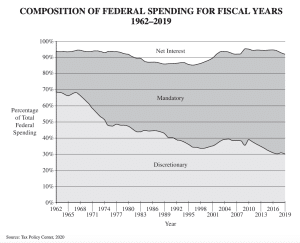
Now, here’s how a strong response might be written:
(A) Mandatory spending comprised the greatest percentage in 2016. This is a direct, data-based observation that correctly reads the graph.
(B) Mandatory spending increased over time, while discretionary spending declined. This shows clear trend analysis and compares the two types accurately.
(C) Congress appears to prioritize entitlement programs, which are part of mandatory spending, possibly due to political pressure to maintain benefits like Social Security and Medicare. This is a strong response because it uses data to make a logical inference about policy-making priorities. It connects the trend to legislative decision-making.
(D) Interest groups advocating for discretionary programs might lobby Congress to increase funding or resist cuts, especially in areas like education or defense. This is a strong answer because this demonstrates how interest groups engage with budget data to pursue policy goals.
Question 3: SCOTUS Comparison
| This question requires you to compare a Supreme Court case you studied in class with one you have not studied in class. A summary of the Supreme Court case you did not study in class is presented below and provides all of the information you need to know about this case to answer the prompts.
Katzenbach v. McClung (1964) Beginning in 1927, the McClung family owned a restaurant that served barbecue and other foods to patrons. Their restaurant was located about eleven blocks from an interstate highway and obtained about half of its supplies from out of state. Even though the restaurant had an indoor seating capacity of over 200, it refused to seat African Americans and restricted them to take-out orders. Congress passed the Civil Rights Act of 1964, which prohibited discrimination in places of public accommodation. It was passed based on economic activity, given the travel of African Americans between states. However, the McClungs sued to prevent the enforcement of the Civil Rights Act. They argued that because the restaurant purchased half of its food from an in-state supplier, Congress could not regulate it because its activities were local in nature. After a district court ruled in favor of the restaurant, the federal government appealed to the Supreme Court. The Supreme Court, in a unanimous decision, held that the Civil Rights Act of 1964 was constitutional, upholding Congress’ power to prohibit discrimination when it poses a significant burden to interstate commerce. The Court reasoned that because the restaurant purchased about half of its food from an out-of-state supplier and because Congress sought to resolve the problem of discrimination that was a national issue, Congress had the power to enact the legislation that regulated the restaurant. A. Identify the constitutional clause that is common to both United States v. Lopez (1995) and Katzenbach v. McClung (1964). B. Explain how the facts in United States v. Lopez and Katzenbach v. McClung resulted in different holdings. C. Explain how the decision in Katzenbach v. McClung reflects the democratic ideal of natural rights. |
Let’s break down what a strong, credit-worthy answer would look like:
A. The constitutional clause that is common to both United States v. Lopez and Katzenbach v. McClung is the commerce clause, which is found in Article I, Section 8 of the United States Constitution. This clause grants Congress the authority to regulate interstate commerce.
This answer correctly identifies the specific constitutional clause that both cases interpret. High-scoring responses use accurate terminology and clearly connect the clause to the broader context of the question.
B. In United States v. Lopez, the Supreme Court ruled that Congress overstepped its authority under the commerce clause when it passed the Gun-Free School Zones Act. The Court held that carrying a gun in a school zone was not sufficiently related to interstate commerce and therefore could not be federally regulated.
In contrast, in Katzenbach v. McClung, the Court upheld Congress’s authority to enforce the Civil Rights Act of 1964 through the commerce clause. The restaurant’s purchase of goods from out-of-state suppliers and its location near an interstate highway established a clear connection to interstate commerce.
The Court ruled that racial discrimination in public accommodations, even at the local level, had a substantial effect on interstate commerce and could be federally regulated.
This response clearly outlines how the facts of each case led to different outcomes. It demonstrates a strong grasp of the legal reasoning behind each decision and shows how differing interpretations of the commerce clause affect the scope of congressional power. High-scoring answers explain not just what happened, but why.
C. The decision in Katzenbach v. McClung reflects the democratic ideal of natural rights by ensuring that all individuals have access to public services regardless of race. The Court’s decision protected the inherent rights of African Americans to be treated equally and with dignity in public establishments.
These protections uphold core natural rights ideals such as liberty and equality. By reinforcing federal legislation that bans discrimination, the Court affirmed that the government has a duty to safeguard individuals’ unalienable rights.
This answer connects the legal outcome of the case to the foundational principles of American democracy. It shows an understanding of how Supreme Court rulings can enforce and protect natural rights, and it explicitly ties these rights to the actions of the government and the Court.
High-scoring responses go beyond surface-level definitions and apply abstract concepts in concrete ways.
Question 4: Argument Essay
| Over time, there has been conflict between the president and Congress over their roles in domestic policy making. Develop an argument as to whether the president or Congress should have more power over domestic policy making.
Use at least one piece of evidence from one of the following foundational documents:
In your response, you should do the following:
|
Here’s what a top-scoring response might look like:
The president should have more power over domestic policy making because the executive branch is more capable of swift, unified action. According to Federalist No. 70, an energetic executive is essential for effective governance. Unlike Congress, which is slow and often divided, the president can respond quickly to national challenges.
For example, executive orders allow the president to act without needing immediate legislative support. This was seen during crises like the COVID-19 pandemic. Article II also grants the president the power to appoint agency leaders who shape domestic policy implementation.
Opponents argue that Congress, as the legislative body, should lead domestic policy. But in practice, gridlock often prevents effective lawmaking. The president’s ability to act decisively makes them a more effective driver of policy.
Why does this earn credit? The response has a clear thesis, uses foundational documents and real-world examples as evidence, explains how that evidence supports the argument, and addresses a counterargument. It reflects strong argumentative reasoning and understanding of the US system.
Strong FRQ answers are focused, specific, and supported by evidence from foundational documents, Supreme Court cases, or course concepts. If you want to get better at the free-response section, check out past AP United States Government and Politics student responses and scoring guidelines.
Reading real examples shows you what earns points and helps you learn how to write clear, well-supported arguments.
How to Study for the AP US Government and Politics Exam
The AP US Government and Politics Exam tests your understanding of the Constitution, key institutions, foundational documents, civil liberties, political behavior, and policy-making. You’ll need to know how the government works at the national level and be able to apply that knowledge to real-world political scenarios.
Doing well means understanding course content, recognizing how institutions interact, and practicing both multiple-choice and free-response writing under time pressure.
1. Review the AP US Government and Politics course outline.
The AP US Government and Politics Course and Exam Description (CED) breaks down everything you’ll be tested on. It lists the five units, shows how much each one is weighted, and outlines the essential concepts and skills.
For example, if the Constitution and foundational principles make up 15 to 22 percent of your score, you’ll need to understand federalism, checks and balances, separation of powers, and how those ideas play out in real Supreme Court cases and legislation.
Let the course outline guide your study time so you can focus on what matters most.
2. Use AP US Government and Politics practice tests.
Taking practice tests helps you get used to the pacing and question types. You’ll build endurance, improve time management, and learn how the College Board frames both MCQs and FRQs.

After each test, take time to:
- Identify weak areas. If you keep missing questions about civil liberties or political participation, focus more on those units.
- Understand your mistakes. Maybe you confused civil rights with civil liberties or misread the role of the bureaucracy. Go back and review those concepts.
- Improve timing. You’ll have 60 minutes for 55 multiple-choice questions and 100 minutes for four FRQs. Practice writing one FRQ in 20–25 minutes to simulate real test conditions.
Use released FRQs, AP Classroom, and materials from your teacher. AP review books and online quizzes can also help build your test-taking stamina.
3. Know your foundational documents and SCOTUS cases.
To succeed on the AP US Government Exam, you must know the required documents and Supreme Court cases inside and out. They appear frequently in FRQs and sometimes in MCQs.
To study efficiently:
- Make flashcards for all nine required documents and fifteen Supreme Court cases. Include summaries, key principles, and why each one matters.
- Create comparison charts. For example, line up Federalist No. 10, Brutus No. 1, and Federalist No. 51 to see how they reflect different views on democracy and the role of government.
- Tie cases to concepts. Know that Tinker v. Des Moines connects to free speech in schools, while Baker v. Carr involves equal protection and representation. Use the constitutional clause associated with each case (like the commerce clause or due process) to frame your explanations.
The stronger your understanding of the documents and cases, the easier it will be to apply them under time pressure.
4. Strengthen your free-response writing.
Rather than testing rote memorization, the FRQs evaluate your ability to apply political knowledge in context. Many students lose points because their answers are too vague, incomplete, or disorganized.
To boost your FRQ skills:
- Write in complete sentences. Avoid listing facts or giving one-word responses.
- Label your answers. Use A, B, C, and D to make it easy for graders to follow your points.
- Define your terms. If you mention checks and balances, say what it means in the context of your example.
- Use specific evidence. Reference documents, institutions, or cases by name. Avoid phrases like “the government” or “a court case.”
- Explain your logic. Don’t just state a fact. Say why it matters. For instance, explain how the facts of a case support your claim about civil liberties.
- Stick to time limits. Write practice responses under timed conditions to simulate test day. You’ll have four FRQs to complete in 100 minutes.
5. Practice with data, graphs, and visuals.
On the exam, you’ll see quantitative and visual analysis FRQs that ask you to interpret graphs, charts, or maps. These questions test how well you can draw political conclusions from data.

To improve that skill:
- Work on graph reading. Practice identifying patterns, trends, and outliers. Focus on what they imply about policy or voter behavior.
- Use past Quantitative Analysis FRQs. These help you get familiar with how the College Board expects you to describe, explain, and apply data.
- Connect data to course concepts.For example, if voter turnout drops among young voters, connect it to political participation or barriers to voting instead of just stating the numbers.
Avoid simply describing the data. You need to explain what it means in a political context.
6. Use real student samples and scoring notes.
One of the best ways to understand how the College Board scores the AP US Government and Politics Exam is to study actual student responses. Every year, the College Board releases free-response questions with student samples and detailed scoring guidelines.
Start by reading the high-scoring examples. Look at how they reference specific clauses, connect evidence to democratic principles, and fully answer each part of the prompt. Pay close attention to how they incorporate documents or cases like McCulloch v. Maryland or Federalist No. 10.
Then study the lower-scoring samples. These show you what loses points, like vague phrasing, unsupported claims, or failure to answer all parts of the question.
Once you’ve reviewed a few, try writing your own practice FRQ. Compare your response to the samples and use the scoring guidelines to see where you stand.
Studying real examples will help you recognize what works, what doesn’t, and how to clearly earn every possible point on test day.
AP US Government and Politics Exam Test-Taking Tips
Studying the material is essential, but how you approach the test on exam day can make just as much of a difference. Many students lose points not because they didn’t study, but because they misread the prompts, ran out of time, or wrote responses that were too vague or incomplete.
Here are practical strategies you can use during the actual exam to stay focused and score higher.
1. Use your time strategically.
The AP US Government and Politics Exam gives you 3 hours total:
- 80 minutes for 55 multiple-choice questions
- 100 minutes for 4 free-response questions
Here’s how you can split your time for the FRQs:
- Concept Application – around 20 minutes
- Quantitative Analysis – around 20 minutes
- SCOTUS Comparison – around 25 minutes
- Argument Essay – around 35 minutes
The multiple-choice section gives you less than 1.5 minutes per question. Don’t get stuck! If you’re unsure, guess and move on. You can return if there’s time left.
2. Read every word of the prompt.
Each FRQ typically has multiple parts, and missing just one subpart can mean losing a valuable point. Careful reading ensures that you understand exactly what each part is asking.

- Underline key verbs like “define,” “explain,” or “identify.” These tell you the task you need to complete. Ignoring them can lead to incomplete answers even if the content is correct.
- Circle any specific phrases tied to institutions, time periods, or policies. For example, if the question references Congress or executive orders, your response should be focused on those areas.
- Watch for prompts that ask you to do more than one task. If it says “describe and explain,” you must do both to earn full credit. Doing only one will cost you points.
- Check that you’ve addressed every labeled part. If the question has A through D, make sure each one is answered clearly and separately. Skipping even one part guarantees a deduction.
3. Use elimination strategies on multiple-choice questions.
Even if you’re not totally sure about a question, you can often get closer to the correct answer just by eliminating poor choices. A good strategy is to work backwards from the obviously wrong answers.
- Eliminate answers that are too extreme or obviously incorrect. Words like “always,” “never,” or “only” often indicate a wrong answer in AP Government questions. These choices tend to oversimplify how institutions and policies actually work.
- Rule out anything that contradicts the Constitution or fundamental government principles. If an answer doesn’t make sense based on how power is divided or how rights are protected, you can safely ignore it.
- Pick the answer that most closely aligns with the facts or scenario given. Often, more than one answer might seem correct, but only one fits precisely with what the question is asking. Trust the evidence presented and choose the best-supported response.
- Guess when you’re unsure, but do so wisely. There’s no penalty for wrong answers, so a smart guess is always better than leaving it blank. Use your process of elimination to increase your odds.
4. Be strategic in your FRQ writing.
Free-response questions are about answering clearly, directly, and with the right evidence.
- Label each part of your response using A, B, C, and D. This makes it easy for the grader to see that you’ve addressed everything required. It also helps you stay organized and avoid skipping parts.
- Use accurate course terms and definitions. Don’t just say “a law” or “a group.” Instead, refer to specific items like “The War Powers Resolution” or “interest groups such as the NRA.”
- Support your answers with real examples from the course. If a question is about checks and balances, mention a specific event like the president vetoing a bill passed by Congress. Vague answers don’t earn credit.
- Avoid restating the question or going off-topic. Focus only on what the prompt is asking. Staying direct and precise helps you stay within the time limit and gets you more points.
5. Review core documents and Supreme Court cases.
The College Board has a required list of foundational documents and Supreme Court cases that show up across multiple questions. You need to know how to use them, not just what they say.

- Review the key principles in the required documents. Know how documents like Federalist No. 10, Brutus No. 1, and the Constitution connect to concepts like democracy, federalism, or separation of powers. Be ready to apply these ideas, not just name them.
- Understand what each Supreme Court case is about and what it decided. Focus on the reasoning behind the decision and how it relates to topics like civil liberties or federalism. For instance, you should know why Gideon v. Wainwright expanded rights to counsel.
- Be able to apply these sources in real scenarios. If the question presents a conflict between states and federal power, use McCulloch v. Maryland to support your answer. Using the right case or document in context can be the difference between getting the point or not.
6. Structure your argument essay carefully.
The argument essay asks you to make a claim and support it using specific, course-related evidence. This task is not about writing a long essay. Instead, it focuses on being clear, organized, and persuasive.
Follow this approach:
- Make a clear claim. Choose a side and state it directly in your opening.
- Use at least two pieces of evidence. These can come from course documents, SCOTUS cases, or real government actions.
- Explain how your evidence supports your claim. Don’t just list examples.
- Add a brief counterargument. One sentence showing you understand the opposing view can earn you extra credit.
Keep your writing organized and focused. You don’t need long paragraphs, but every point should support your argument.
Using these tips can help you stay confident and in control on test day. When your answers are clear, specific, and grounded in course knowledge, you give yourself the best chance at a high score.
AP US Government and Politics Exam Date
The 2026 AP US Government and Politics Exam is scheduled for Tuesday, May 5, 2026, at 12:00 PM (local time). Be sure to arrive early at your testing location. Most schools require students to check in by 11:30 AM or earlier. You cannot take this test at a different time unless your school arranges an official makeup exam.
To check other AP test dates or registration details, visit our comprehensive guide.
AP US Government and Politics Exam score release date
For 2026, AP US Government and Politics Exam scores are expected to be released in early to mid-July. For reference, the 2025 exam scores were released on July 7.
Although the exact 2026 release date has not been announced, students will likely be able to view their Subject Score Reports through their College Board accounts around the same time. To avoid missing your scores, log in to your College Board account regularly starting in early July.
Is the AP US Government and Politics Exam Hard?
The AP US Government and Politics Exam tests your ability to analyze founding documents, interpret data, explain political processes, and craft arguments using course concepts. To succeed, you’ll need to connect real examples to foundational principles and explain why they matter.
If you’re wondering how tough it actually is, here’s the 2024 score breakdown:
| Score | Percentage of Students |
| 5 | 24.3% |
| 4 | 25.0% |
| 3 | 23.7% |
| 2 | 18.1% |
| 1 | 8.9% |
| Total Passing (3+) | 73.0% |
With a mean score of 3.38, AP US Government and Politics had one of the higher pass rates among AP social science exams in 2024. Nearly three-quarters of test takers scored a 3 or above, and nearly half earned a 4 or 5.
For comparison, AP Comparative Government and Politics had a mean score of 3.18 with a 73.0% pass rate, while AP Psychology had a mean score of 2.97 and a 61.7% pass rate.
Still, this exam requires more than surface-level understanding. You’ll be asked to apply key concepts like checks and balances, federalism, and political participation. You’ll also need to interpret graphs, compare institutions, and write short but well-structured responses.
If you’re aiming for a top score, success comes from regular practice with official materials, mastering the course’s foundational documents, and building confidence in writing clear, evidence-based responses.
If you want structured support, check out our AP tutorial services. We offer targeted help with foundational documents, Supreme Court cases, and FRQ strategies that are specific to AP US Government and Politics.
Frequently Asked Questions
1. How hard is the AP US Government and Politics Exam?
In 2024, about 73% of students earned a score of 3 or higher on the AP US Government and Politics Exam, and 24.3% scored a 5. That’s a strong pass rate, but getting a top score requires careful preparation. You’ll need to know key foundational documents, important Supreme Court cases, and the structure and functions of American government.
Compared to other social science exams, AP US Government and Politics is less data-heavy than AP Psychology but demands more depth of analysis and application. It’s a strong choice if you’re interested in political science, law, public policy, or civic leadership.
2. How many hours should you study for the AP US Government Exam?
That depends on your comfort with civics and political systems, but most students spend between 60 and 100 hours preparing. If you’re aiming for a score of 4 or 5, try to study around 3 to 5 hours per week over two to three months. Include time for reviewing your required case list, foundational documents, and practicing free-response questions like the argument essay and SCOTUS comparison.
3. Do you need to memorize everything for the AP US Government Exam?
Not everything, but you do need to memorize key terms, institutions, Supreme Court cases, and foundational documents. The exam is about applying what you’ve memorized to real-world political scenarios and explaining relationships between ideas.
Focus your review on understanding the Constitution, separation of powers, checks and balances, the Bill of Rights, political behavior, and how policies are made. You’ll also need to know how different actors—like interest groups, the media, and federal agencies—interact with each other.
4. Is AP US Government and Politics worth taking?
Yes. Whether or not you plan to major in political science or law, this course teaches core civic knowledge and sharpens your critical thinking. It’s highly respected on college applications and helps fulfill general education requirements in social science.
You’ll gain a deeper understanding of how the US government works and how citizens influence policy, which is useful for students planning careers in law, public policy, journalism, or nonprofit work.
5. When do AP US Government scores come out?
For 2026, AP US Government and Politics scores are expected to be released in early to mid-July. While the College Board hasn’t confirmed an exact date yet, that’s typically the time frame each year. In 2025, scores came out on July 7.
You can view your scores through your College Board account. If you’re sending scores to colleges, be sure to request them by the College Board’s June deadline to ensure they arrive on time.
Takeaways
If you’re preparing for the AP US Government and Politics Exam, here are the key points to keep in mind:
- The AP US Government and Politics Exam had a 73% pass rate in 2024, with a mean score of 3.38. That means most students passed, but nearly half scored below a 4, so aiming high takes serious preparation.
- Foundational documents and required Supreme Court cases are central to the AP US Government and Politics Exam. You must be able to reference them accurately and apply them to political scenarios and FRQs.
- Time management matters just as much as content knowledge on the AP US Government and Politics Exam. With 100 minutes for four FRQs, you’ll need to stick to recommended time blocks for each task.
- Practicing with real free-response questions and sample student answers is one of the best ways to improve. This helps you understand what earns points and how to structure a complete, evidence-based response.
- Struggling to prepare for the AP US Government and Politics Exam on your own? A college admissions consultant can offer targeted support with foundational documents, Supreme Court case analysis, and FRQ strategies tailored specifically for this exam.










