
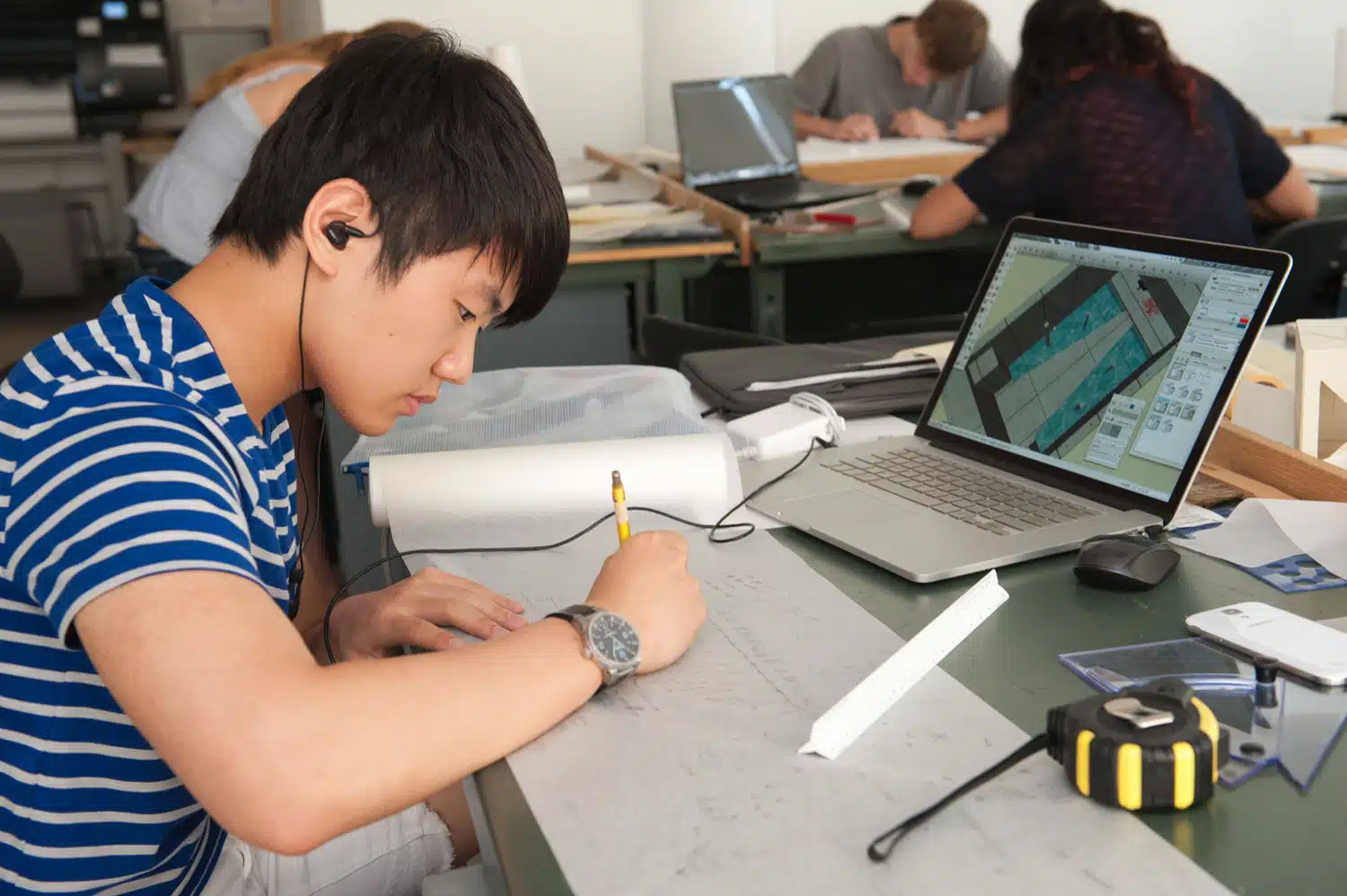
Curious about how buildings and cities come to life? Architecture internships for high school students allow you to step inside real studios, tackle hands-on projects, explore construction sites, and experiment with tools like CAD and model-making. They also make your college applications stronger by showcasing your initiative and passion, which can improve your chances of getting into top architecture schools like Rice and Cornell.
Below, we outline the 10 best architecture internships for high school students—including competitive fellowships, paid internships, and community-driven design programs.
- Best Architecture Internships for High School Students
- Chicago Architecture Center — Teen Fellows
- Sasaki Foundation — SEED (Summer Exploratory Experience in Design)
- NOMA Project Pipeline
- Fallingwater Institute Residencies
- Boston Society for Architecture — Architecture/Design High School Internships
- Miller Hull — Seattle Summer Internship
- Milwaukee Institute of Art and Design — Design Internship Program
- District Architecture Center — Design in Action
- YouthBuild Boston — Designery Program
- Beam Center — Work Readiness Program
- Frequently Asked Questions
- Takeaways
Best Architecture Internships for High School Students
The best architecture internships for high school students are the ones that let you actually get your hands dirty—sketching, model-building, experimenting with CAD tools, and working on real design challenges. Great programs pair you with architects who mentor you, help you create portfolio-worthy projects, and give you a behind-the-scenes look at how buildings and cities take shape.
Whether you’re into sustainable design, urban planning, fabrication, or landscape architecture, there are awesome opportunities across the country that check all the boxes.
The table below highlights each program’s location, schedule, and format.
|
Rank |
Program Name | Location |
Program Dates |
|
1 |
Chicago Architecture Center — Teen Fellows | Chicago, Illinois | June 22, 2026 – May 8, 2027 |
| 2 | Sasaki Foundation — Summer Exploratory Experience in Design (SEED) | Boston & Metro North Region, Massachusetts |
Early July – Mid-August 2026 (6 weeks) |
|
3 |
NOMA Project Pipeline | 30+ U.S. Cities | June–August (Varies by city) |
| 4 | Fallingwater Institute High School Residencies | Mill Run, Pennsylvania |
June 29 – August 7, 2026 (Multiple one-week sessions) |
|
5 |
Boston Society for Architecture — Architecture/Design High School Internships | Boston, Massachusetts | July 6 – August 14, 2026 |
| 6 | Miller Hull — Open Studio Internship | Seattle, Washington |
July 27, 2026 – August 21, 2026 |
|
7 |
Milwaukee Institute of Art and Design — Design Internship Program | Milwaukee, Wisconsin | February 2026 – April 2027 (year-long program) |
| 8 | District Architecture Center (DAC) — Design in Action | Washington, D.C. |
Spring Break 2026 |
|
9 |
YouthBuild Boston — Designery Program | Boston, Massachusetts | Summer 2026 |
| 10 | Beam Center — Work Readiness Program | New York City, New York |
Fall & Spring semesters |
Let’s discuss each architecture internship one by one.
1. Chicago Architecture Center — Teen Fellows
- Dates: June 22, 2026 – May 8, 2027
- Location: Harold Washington College, Chicago, IL
- Benefits: College credit, paid internship pathway, firm visits, portfolio development, software training
The Chicago Architecture Center’s Teen Fellows program is a 15-month program where you’ll study the built environment, complete design projects, and earn college credit while developing a solid portfolio.
As a Teen Fellow, you’ll take college-level classes at Harold Washington College and work on studio assignments, critiques, and field activities. You’ll also gain experience with professional design tools such as SketchUp, AutoCAD, Rhino, Revit, Illustrator, InDesign, and Photoshop, along with model-making, architectural drawing, and spatial design.
The program includes visits to major architecture firms, tours of significant Chicago buildings, and direct mentorship from industry professionals. It concludes with a 4–6 week paid internship at firms like Gensler, Goettsch Partners, or Ghafari.
To apply to this architecture internship for high school students, you must be an incoming sophomore, junior, or senior in the Chicago area who can commit to the full program. Selected applicants will complete an interview before acceptance.
If you’re planning to join the 2026–2027 Teen Fellows program, make sure to submit your application by March 31, 2026.
2. Sasaki Foundation — Summer Exploratory Experience in Design (SEED)
- Dates: Early July – Mid-August 2026 (6 weeks)
- Location: Boston & Metro North Region, Massachusetts
- Benefits: Paid internship, collaborative design project, professional mentorship, exposure to multiple design fields
The Sasaki Foundation’s SEED internship is a six-week paid summer program designed for high school students who want a hands-on introduction to architecture, interior design, urban planning, and landscape architecture. This is a community-centered architecture internship for high school students that shows you how buildings, parks, and public spaces are designed—and how design can make communities better.
As a SEED intern, you’ll work on a team-based design project guided by architects, planners, and landscape architects at Sasaki. You’ll learn essential skills such as hand sketching, digital drawing, model-making, and visual communication, while also participating in design charrettes and workshops with professionals. Past interns have developed conceptual plans for local nonprofits, public parks, food forest sites, and community spaces.
The program is open to students in grades 9–12 who live in Boston or the Metro North region, with priority given to cities such as Cambridge, Chelsea, Everett, Malden, Medford, Revere, and Somerville. Interns are paid $16.25 per hour for up to 27.5 hours per week. Applications for the Summer 2026 SEED internship will open in spring 2026.
3. NOMA Project Pipeline
- Dates: June–August (Varies by city)
- Location: 30+ cities nationwide
- Benefits: Hands-on design experience, mentorship, community-focused projects, nationwide network
The NOMA Project Pipeline internship is for students of color who want early exposure to architecture, planning, and community-centered design. Created to increase representation in the field, Project Pipeline gives 6th–12th grade students the chance to learn design fundamentals while working directly with architects, planners, and college-level volunteers who “look like them.”
During this architecture internship for high school students, you’ll explore the built environment through hands-on activities such as sketching, physical and digital model-making, diagramming, research, interviews, and site visits. By the end, you’ll present a fully developed project addressing a real need in your city.

Project Pipeline is offered in more than 30 cities, including Chicago, Atlanta, and Los Angeles. Camps typically run for several days to a week and are led by local NOMA chapters. Most programs are low-cost or free, with financial assistance available.
4. Fallingwater Institute High School Residencies
- Dates: June 29 – August 7, 2026 (Multiple one-week sessions)
- Location: Fallingwater Institute, Mill Run, Pennsylvania
- Benefits: Immersive studio learning, portfolio development, residency experience, access to professional architects and artists
The Fallingwater Institute’s High School Residencies offer a focused, week-long introduction to architecture and design at Frank Lloyd Wright’s landmark site. Each session centers on a specific topic—such as Drawing + Model Making, Interior Design, Sustainability, Design + Build, or Biophilic Design.
You’ll live and work at Fallingwater’s High Meadow campus, use the Cheteyan Studio, and complete daily exercises in drawing, model-making, spatial design, and site observation. Teaching architects and designers lead critiques, demos, and discussions that connect your projects to Wright’s design philosophy.
Programs are open to students entering grades 9–12, and no previous experience is required. Tuition is $1,500, covering housing, meals, materials, and instruction.
This architecture internship for high school students also offers a limited number of full scholarships to expand access for students historically underrepresented in architecture and the arts. Residency scholarships cover the full $1,500 tuition plus a $500 travel stipend. A shuttle is available to and from Pittsburgh International Airport on arrival and departure days.
Scholarship applications require proof of household income, one recommendation letter, and—for students under 18—a joint submission with a parent or guardian. All materials are due January 31, 2026, with decisions released February 13, 2026.
5. Boston Society for Architecture — Architecture/Design High School Internships
- Dates: July 6 – August 14, 2026
- Location: Local architecture firms across Boston, MA
- Benefits: Paid firm placement, real project work, mentorship, citywide site tours
The Architecture/Design High School Internship is hosted by the Boston Society for Architecture (BSA) and the Boston Private Industry Council (PIC). It is a paid, six-week opportunity that places Boston Public Schools (BPS) students directly inside working architecture firms—such as Bergmeyer, Payette, Goody Clancy, HMFH, or RODE Architects.
These placements give you practical exposure to the design process and workplace collaboration since you may assist with drawings, models, digital design tasks, and sit in on real project meetings.
Every Friday, all interns come together for Summer Fridays, a series of guided tours across Boston that highlight important architectural, cultural, and historical sites. You’ll end the program with a firm crawl and a showcase of your work.
Applications for this architecture internship for high school students open February 20, 2026, with the Internship Fair taking place in April 2026. To join, you must be a BPS high school student (grades 9–12) and apply through PIC. As part of the Mayor’s Summer Jobs Program (FutureBOS), all positions are paid.
6. Miller Hull — Open Studio Internship
- Dates: July 27, 2026 – August 21, 2026
- Location: Seattle, Washington
- Benefits: Paid full-time internship, portfolio creation, site visits, team meetings, professional mentorship, transit support
The Miller Hull Partnership’s Open Studio Internship is a focused four-week, full-time program designed for high school students who have completed 11th or 12th grade and want a structured introduction to design.

Throughout the program, you’ll tour construction sites, attend project team meetings, shadow architects, and participate in hands-on design exercises. You’ll assemble a small portfolio of your projects and deliver a short final presentation on your last day. No prior design or software experience is required, though skills in related programs like Revit, AutoCAD, or SketchUp would be helpful from the start.
This is a paid internship at $21.30 per hour for 40 hours each week. Miller Hull also covers public transit costs for students living in Pierce, King, or Snohomish County, with additional support available for students commuting from outside those areas.
To apply, you must submit a cover letter, résumé, and samples of creative work (up to 4 MB). Applications are reviewed on a rolling basis, and interviews may be required. The application deadline is May 1, 2026.
7. Milwaukee Institute of Art and Design — Design Internship Program
- Dates: February 2026 – April 2027 (year-long program)
- Location: Milwaukee, Wisconsin
- Benefits: Paid summer internship, free Pre-College courses, mentorship, workshops, multi-firm placements
The MIAD Design Internship Program is a year-long opportunity created through partnerships with local firms to expand diversity in Milwaukee’s creative industry, and it gives special consideration to students of color interested in entering design fields. It selects 45 interns in the Milwaukee area and gives special consideration to students of color interested in entering design fields.
As an intern, you’ll participate in design workshops taught by MIAD faculty, receive ongoing mentorship during the school year, and take tuition-free Summer and Weekend Pre-College courses. The program also includes structured orientation sessions, an after-school spring project, fall and spring coursework, and a closing celebration in April 2027.
By June, you’ll complete a 50-hour paid internship at one of MIAD’s professional partners—organizations like Engberg Anderson Architects, Cramer-Krasselt, Hanson Dodge, Plunkett Raysich Architects, Maker LLC, Harley-Davidson, and more. These placements give you hands-on experience with real projects, client work, and studio processes while helping you build early industry connections.
Applications for the 2026–2027 MIAD Design Internship are due February 1, 2026.
8. District Architecture Center (DAC) — Design in Action
- Dates: Spring Break 2026
- Location: Washington, DC
- Benefits: Firm shadowing, hands-on design project, site visits, résumé-ready experience
Design in Action is a spring break architecture internship for high school juniors and seniors interested in seeing how the profession works from the inside. Hosted by the District Architecture Center in Washington, DC, the program places you directly inside leading architecture firms like Gensler, HOK, SmithGroup, Perkins Eastman, and SOM.
During the program, you’ll participate in project meetings, design charrettes, client discussions, and construction site visits while you also work on your own small design project.
The experience is designed to give you a clear picture of daily life in architecture and introduce you to the creative decision-making behind real buildings. You’ll gain early networking connections, professional etiquette skills, and meaningful experience you can list on your résumé or college applications.
This internship is open to high school students in grades 11–12.
9. YouthBuild Boston — Designery Program
- Dates: Summer 2026 (5-week after-school sessions; 7-week summer program)
- Location: Boston, MA
- Benefits: Paid stipend, real client projects, hands-on design training, mentorship, career exploration
YouthBuild Boston’s Designery Program is a strong option for high school students who want real design experience tied to community impact. Designed for Boston-area teens—especially students from under-resourced communities—the program introduces you to architecture, interior design, landscape architecture, urban planning, and the broader AEC (Architecture, Engineering & Construction) industry.
Across either a 5-week after-school session or a 7-week summer program, you’ll take on real client projects for nonprofits and community groups, where you learn how design can influence equity and social change. Students receive a biweekly stipend, making this both educational and financially accessible.
Designery participants also gain exposure to construction, engineering, project management, surveying, and drafting. Recent Designery students even competed to redesign a public space in Boston’s Seaport district, presenting concepts centered on diversity, equity, and inclusion.
The program is open to Boston high school students interested in architecture or design. Summer 2026 applications will reopen soon—check back for updates if you want to join the next Designery cohort.
10. Beam Center — Work Readiness Program
- Dates: Fall & Spring semesters
- Location: Beam Center program sites across New York City
- Benefits: Credit-bearing program, paid employment pathway, technical skill-building, leadership training
Beam Center’s Work Readiness Apprenticeship is a strong fit if you want hands-on experience in design, fabrication, and youth-centered creative work. This 54-hour, credit-bearing program is open to high school students aged 15–24 at Beam’s partner schools and runs twice weekly during the fall and spring semesters.
Throughout the apprenticeship, you’ll develop leadership, collaboration, and career-readiness skills while working on real projects connected to a theme—past cohorts have built textiles, mosaics, light-based installations, and more. You’ll pick up technical skills like woodworking, circuitry, fabrication, and digital tools, along with instructional skills such as lesson planning, facilitation, and group management.
After completing the apprenticeship, students transition into Beam’s paid youth employment programs, called Enterprises. These include roles as Project Leaders, Project Production Fellows, and externship placements with partner organizations. In these positions, you help run public STEAM programming, fabricate large-scale artworks, or intern at creative and technical workplaces across NYC.
Frequently Asked Questions
1. What is the most prestigious architecture internship for high school students?
The most prestigious architecture internships for high school students include CAC Teen Fellows, Sasaki Foundation’s SEED program, Fallingwater High School Residencies, NOMA Project Pipeline, and the Boston Society for Architecture Internship. These stand out for their structured studio work, professional mentorship, and real project experience.
2. Do I need prior design experience to apply?
No. Most architecture internships for high school students don’t require previous design experience. Programs like SEED, NOMA Project Pipeline, YouthBuild Boston, and Beam Center welcome beginners. Advanced programs may recommend—but usually don’t require—basic familiarity with drawing or design tools.
3. Are there virtual architecture internships?
Yes. Some programs offer online or hybrid components, such as Fallingwater’s Virtual Summer Camp and certain NOMA chapter workshops. These options provide a flexible introduction to design basics.
4. How competitive are high school architecture internships?
Highly regarded programs—especially paid or free ones—can be competitive. Selection usually focuses on interest, effort, creativity, and your application responses rather than technical skills or portfolio strength.
5. Can architecture internships improve my college applications?
Yes. Completing architecture internships for high school students shows initiative, design interest, and hands-on experience. Many programs help you create portfolio pieces and gain exposure to real design workflows, which strengthens applications for architecture and related majors.
Takeaways
- Hands-on work is key. The strongest architecture internships for high school students include real design tasks—sketching, model-making, CAD practice, and firm exposure.
- You build usable portfolio pieces. Most programs give you finished projects you can use for college applications, especially in architecture and design majors.
- Beginners are welcome. Many architecture internships for high school students do not require prior training—just interest and commitment.
- Internships strengthen applications. These programs show initiative, technical skill, and interest in the built environment, all valued by competitive colleges.
- If you want support choosing programs, building your portfolio, or preparing standout applications, our Private Consulting Program can help. Our expert team guides students through competitive architecture internships for high school students, pre-college programs, and college admissions strategies to help you stand out.