

Considering the University of Michigan for college? Known for its rigorous academics and beautiful campus, the University of Michigan is one of the top public universities in the U.S., placing #21 nationally. But how do you know if it’s the best choice for you?
Choosing a college is more than just looking at rankings. It’s about figuring out if it’s the right fit for you. Let’s look at the University of Michigan’s pros and cons, covering everything from academics to campus life to financial considerations, to help you decide if UMich is the college for you.
- Pros of the University of Michigan
- Cons of the University of Michigan
- Frequently Asked Questions
- Takeaways
Pros of the University of Michigan
The University of Michigan offers a lot of benefits that make it stand out. Here are some of the key pros to consider when weighing the University of Michigan’s pros and cons:
Prestige and selectivity
If you’re asking whether the University of Michigan is a good school, the answer is a resounding yes. Sitting at the 21st spot nationally for 2024, UMich is one of the most well-respected public institutions. The school has a global reputation that attracts students from all 50 states and over 120 countries. This reputation is one of the highlights of the University of Michigan’s pros and cons.
The University of Michigan’s acceptance rate is very competitive. For the Class of 2027, the acceptance rate was around 18%. This number may not look like much compared to Ivy League schools, but it’s actually very selective for a public university. With over 105,000 applicants for Fall 2024, UMich attracts high-achieving students who want to be part of a prestigious academic community.

The average admitted student to UMich has some pretty impressive academic stats. The middle 50% SAT range is 1350-1530, which means half of all incoming freshmen score in this range and puts them among the top 10% of test-takers nationwide. The ACT range is just as high, between 31-34, which shows just how academically competitive UMich is.
These scores are on par with some of the top schools in the country, both public and private. To hit these numbers, you need to be really strong in areas like math, reading, and science. Basically, UMich is a go-to choice for students who are already performing at a high level academically, and it shows in the stats of their incoming classes.
Diverse academic programs
One of the big pros on the University of Michigan pros and cons list is its variety of academic programs. UMich is home to some of the best schools in the country, offering over 280 degree programs. If you’re interested in engineering, business, public health, or the arts, there’s definitely a program for you.
Ross School of Business
The Ross School of Business ranks #12 among best business schools nationally. What really sets Ross apart is its action-based learning approach. Instead of just sitting in class, you’ll get real-world experience while you’re still in school.
One of these programs is the Multidisciplinary Action Projects (MAP), where teams of students work on real business problems for companies and organizations all over the world. It’s a great way to build skills and make connections before you even graduate. This type of experiential learning is a key pro on the University of Michigan’s pros and cons list.
Plus, Ross grads have an amazing track record when it comes to landing jobs. Over 96% of graduates get job offers within three months of graduating. Big-name companies like Google, Amazon, and Goldman Sachs are regulars on campus, actively recruiting Ross students. If you’re into finance, marketing, or starting your own business, Ross has plenty of specialized tracks to help you tailor your education to your career goals.
College of Engineering
UMich’s College of Engineering is another top-notch program, ranked 9th for 2024. With over 17 different engineering majors to choose from—like robotics, aerospace, or biomedical engineering—you have a lot of options depending on your interests.
The College of Engineering is big on research and innovation. They spent over $282 million on engineering research in 2022, so if you’re into cutting-edge tech, there are tons of opportunities to get involved. The Wilson Student Team Project Center is another highlight. Students can work on hands-on projects like building race cars or solar-powered boats, which gives you valuable experience before you graduate.
School of Public Health
The School of Public Health at UMich is a top contender for anyone interested in epidemiology, global health, or health policy. It’s ranked #5 among best public health schools in the U.S., and for good reason. One standout example is its work in epidemiology, where faculty and students collaborate on cutting-edge research projects that address global health challenges like COVID-19, HIV, and chronic disease prevention.

The school’s Global Public Health Initiative is another highlight. This provides students with hands-on experience in countries all over the world, from Sub-Saharan Africa to Southeast Asia, working to improve health systems and policies. If you’re passionate about making a real difference, this is a definite pro in your list of University of Michigan pros and cons.
UMich’s School of Public Health pulls in over $100 million in research funding every year, which supports a wide range of projects aimed at improving public health both domestically and globally. This commitment to real-world impact means you’ll get to study public health theory and be actively involved in research that could change lives.
UMich’s overall commitment to research is seen across all its schools. The university spent over $1.86 billion in total on research for 2023 alone. This makes it a great choice for students who want to explore any field of study of their choice.
University of Michigan’s beautiful campus
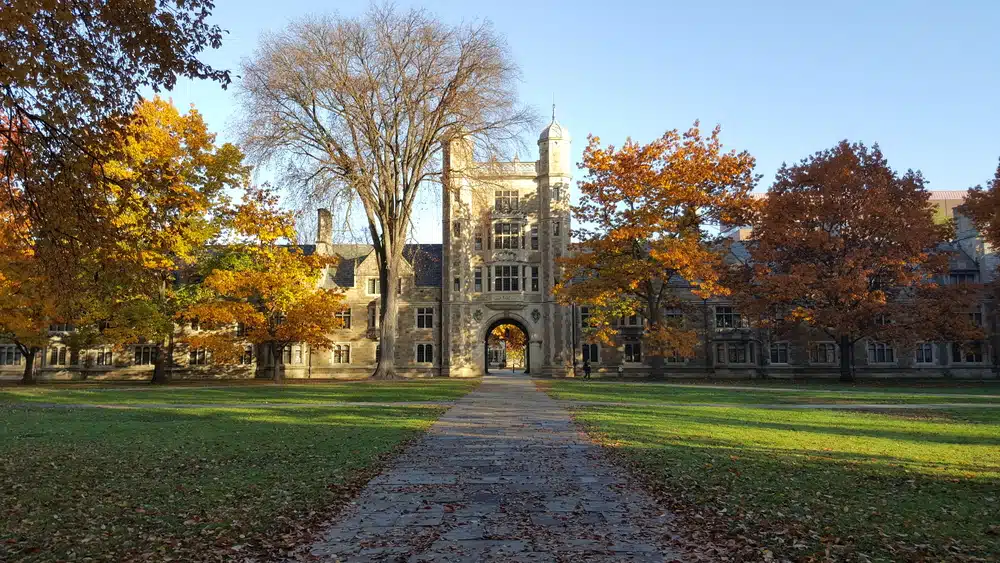
The beautiful campus of University of Michigan is undeniably one of its standout features, with its combination of history, modernity, and natural beauty across its expansive 3,070 acres. The campus is split between Central Campus—where most undergraduate classes take place—and North Campus, home to the engineering, music, and art programs.
One of the most iconic spots on campus is the Law Quad, designed in the Gothic style. It’s often featured in movies and brochures because of its Hogwarts-like vibe, and many students use it as a quiet place to study or hang out.
Another central spot is The Diag, a grassy, bustling hub in the middle of Central Campus. If you’re cutting across to class or catching up with friends, you’ll always see something happening here—students playing frisbee, clubs recruiting members, or events popping up.
And of course, you can’t talk about UMich’s campus without mentioning Michigan Stadium, aka “The Big House.” It’s the largest football stadium in the U.S., seating over 107,000 fans on game days. If you’re big into sports or just school spirit, this is definitely a pro to consider when weighing the University of Michigan’s pros and cons.
For a quieter, more natural spot, there’s Nichols Arboretum, known as “The Arb,” a serene green space perfect for hiking, studying, or just relaxing in nature. The Arb’s 123 acres include woodlands, wetlands, and even a peony garden. It’s a favorite spot for students looking to unwind, especially during the warmer months.
The contrast between the lively, energetic parts of campus like The Diag and the peaceful beauty of places like The Arb gives UMich students the best of both worlds: a vibrant academic and social life, paired with plenty of spots to relax and recharge. If this sounds like the perfect environment for you, it’s worth noting in your list of University of Michigan pros and cons.
Extensive alumni network
One of the major pros when considering the University of Michigan pros and cons is its extensive and active alumni network. With over 540,000 living alumni worldwide, UMich boasts one of the largest alumni networks in the world. This network provides students and graduates with resources, including mentorship opportunities, internships, and job connections in any field.

UMich’s alumni network includes leaders and innovators across various industries. Here are just a few notable alumni who have made their mark:
- Gerald R. Ford. Serving as the 38th President of the United States, Ford led the country during a critical time following the Watergate scandal.
- Larry Page. As the co-founder of Google, Larry Page revolutionized the internet and the way we access information. He developed the PageRank algorithm, which became the foundation of Google’s search engine.
- Tom Brady. Widely regarded as one of the greatest NFL quarterbacks of all time, Brady has won 7 Super Bowl titles during his career. A UMich football star before his NFL days, he continues to be a major figure in professional sports.
- Stephen M. Ross. A billionaire real estate developer, Ross is the founder of Related Companies, best known for developing the Hudson Yards project in New York City. He has also donated hundreds of millions to UMich, and the Ross School of Business bears his name.
- Lucy Liu. An accomplished actress, Lucy Liu has had a successful career in both film and television. Known for her roles in Charlie’s Angels, Kill Bill, and Elementary, she has broken barriers as an Asian-American actress in Hollywood.
- Michael Phelps. The most decorated Olympian of all time, Phelps has won a total of 28 Olympic medals, including 23 golds. He is celebrated for his dominance in swimming and his influence on the sport.
If you’re pursuing a career in business, tech, law, medicine, or the arts, having such a vast alumni community to tap into can give you a serious leg up in the job market. Alumni frequently return to campus to share their experiences, offer career advice, and recruit new graduates.
Cons of the University of Michigan
While UMich has plenty of advantages, there are a few downsides to keep in mind when weighing the University of Michigan’s pros and cons:
High cost of attendance
One of the downsides on the University of Michigan pros and cons list is the high cost, especially for out-of-state students. For the 2024-2025 academic year, the cost of attendance for in-state students is almost $37,000, while for out-of-state students, it’s over $80,000 per year, including tuition, fees, transportation, and personal expenses.
While that might not be as high as private schools like New York University (NYU), where tuition alone can hit around $62,000 a year, $37,000 is still pretty steep for a public university. That’s why the price tag can be a real shocker, especially if you’re comparing it to other state schools that might be more affordable for out-of-state students.
UMich does offer financial aid and scholarships, but how much help you’ll get can vary. It’s important to consider how these costs stack up if you’re coming from out-of-state. In-state students benefit the most, with programs like the Go Blue Guarantee, which covers full tuition for families earning less than $75,000 per year.
For out-of-state students, financial aid is more limited, and many end up paying closer to the full $80,000 per year. There are merit-based scholarships available, but they’re competitive. While UMich uses both the FAFSA and CSS Profile to determine aid, out-of-state students typically get less need-based aid compared to in-state residents.
Even with financial aid, UMich’s high cost of attendance can still be a challenge, especially for out-of-state families. It’s important to carefully compare the potential aid package with the total costs to see if it’s manageable in the long run. Be sure to take these into consideration when looking at the pros and cons of the University of Michigan.
Large student population
One of the potential cons to keep in mind when considering the University of Michigan’s pros and cons is its large student body. With over 50,000 students enrolled, UMich is one of the largest universities in the U.S. While this means there’s a wide variety of people to meet, diverse clubs and organizations to join, and endless opportunities to explore, the sheer size of the student population can be overwhelming for some.

For students who prefer a more intimate, close-knit environment, the size of UMich can feel impersonal. It can also take more effort to stand out in such a large crowd, whether in academics, extracurriculars, or networking for internships. Some students find it difficult to maneuver in this huge environment, especially in the first year when they’re adjusting to college life.
That said, the large student population does bring advantages too—there’s always something happening, from sports events, cultural festivals, to new clubs to join. However, for students who prefer a more personalized college experience, a smaller university might be a better fit. When weighing the University of Michigan’s pros and cons, it’s important to consider if you’ll feel comfortable in a big campus setting.
Cold winters
If you’re not a fan of cold weather, Ann Arbor’s winters could be a challenge. From November to March, the temperatures frequently drop, with average lows around 19°F (-7°C) and highs of 31°F (-1°C). Snowstorms are common, and Ann Arbor typically sees 40-60 inches of snow each winter. While the beautiful campus of University of Michigan looks magical under all that snow, the frigid weather can make daily routines tough.
Walking to class in those conditions means bundling up with layers, gloves, a warm coat, and sturdy snow boots. If you’re from a warmer climate, getting used to icy sidewalks and freezing winds might take some adjustment. The cold can last for months, so it’s important to be prepared for a long winter season.
On the flip side, if you enjoy winter sports or activities like sledding, ice skating, or skiing, the area offers plenty of opportunities to make the most of the season. But if you prefer mild or warm weather, these extended winters could definitely be a con when considering the University of Michigan’s pros and cons.
Frequently Asked Questions
1. Is the University of Michigan a good school?
Yes, the University of Michigan is widely considered one of the best public universities in the U.S., ranked 21st nationally. Its strong academic programs, commitment to research, and diverse campus life make it a top choice for students. However, it’s important to weigh the University of Michigan pros and cons to see if it’s the right fit for you.
2. What is the University of Michigan acceptance rate?
The University of Michigan acceptance rate for the Class of 2027 was approximately 18%. While UMich is more accessible than some elite private schools, it still attracts a competitive pool of applicants.
3. What makes the University of Michigan campus beautiful?
The beautiful University of Michigan campus is a mix of historic and modern buildings. The Law Quad and The Diag are standout landmarks, and students love the outdoor spaces like Nichols Arboretum. The University of Michigan pros and cons list certainly includes its scenic and lively campus as a big pro.
Takeaways
Here’s a quick rundown of the University of Michigan’s pros and cons to help you figure out if it’s the right fit:
- With a selective 18% acceptance rate, UMich attracts top students from across the world for its strong academics.
- One of the major ports in the University of Michigan pros and cons list is its variety of academic programs, including highly ranked schools like the Ross School of Business and the College of Engineering, which offer students real-world experience and career preparation.
- The University of Michigan’s beautiful campus is another highlight. It offers a mix of historic and modern architecture, along with vibrant student life. The Law Quad and Michigan Stadium are iconic spots on campus.
- One of the cons in the University of Michigan’s pros and cons is the high cost of attendance, especially for out-of-state students, with total costs exceeding $80,000 per year.
- Need more advice in weighing the University of Michigan’s pros and cons? A college admissions consultant can provide expert guidance tailored to your specific preferences and needs. Let AdmissionSight help you make a college choice you won’t regret.










