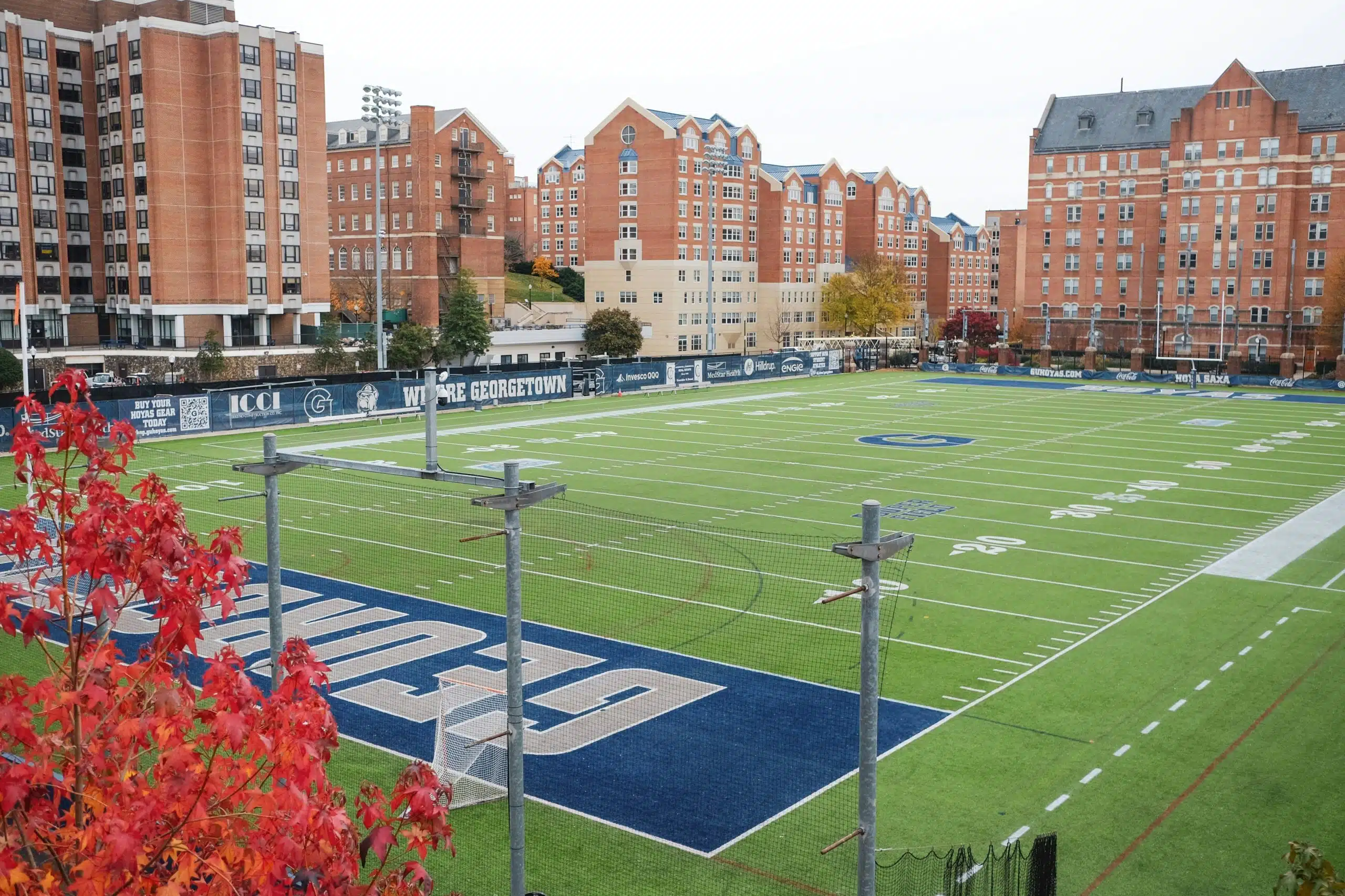
Georgetown University is a private Jesuit research university founded in 1789, making it the oldest Catholic university in the U.S. Its main campus, known as the Hilltop, has been located in the Georgetown neighborhood of Washington, D.C. since its founding. Today, the university’s primary address is 37th and O Streets NW, placing it in a historic, residential area just above the Potomac River.
The campus sits in an urban setting, but it feels quieter and more contained than much of the city. Tree-lined streets, historic row houses, and nearby waterfront views give the area a distinct character that blends college life with the energy of Washington, D.C.
In this guide, you’ll get a clear look at Georgetown’s campus and what makes it stand out, how to get there using different transportation options, and what it’s like to live in and around the neighborhood as a student.
- Georgetown University Campus Location
- Getting to Georgetown University
- Living Near Georgetown University
- Why You Should Visit Georgetown University
- Frequently Asked Questions
- Takeaways
Georgetown University Campus Location
The Hilltop Campus of Georgetown University is located in the Georgetown neighborhood of Washington, D.C. It sits above the Potomac River on elevated ground, giving the campus a more enclosed, campus-like feel within the city.
One of the defining features of Georgetown’s campus is its mix of architectural styles. Early buildings reflect the Federal era, with simple brick designs similar to the flat-fronted row houses found throughout the neighborhood. Later development during the Victorian period introduced more detailed structures, and today, historic buildings sit alongside newer facilities, creating a campus that has evolved over time rather than following a single style.
In terms of size and layout, Georgetown’s main campus covers about 104 acres, making it relatively compact. Academic buildings, residence halls, and student facilities are all within walking distance, so daily life is centered around the Hilltop.
The surrounding Georgetown neighborhood is historic and residential, with cobblestone streets, row houses, and a mix of boutiques, coffee shops, restaurants, and galleries. It functions as an extension of campus, with 17 undergraduate residence halls and many upperclassmen living nearby, so student life naturally extends into the neighborhood.
Main campus landmarks
Two of the most recognizable buildings at Georgetown are Healy Hall and Lauinger Library, both visible from the front gates and nearby areas like Key Bridge. These buildings are closely tied to Georgetown’s identity and serve as central academic spaces on campus.
Healy Hall is the university’s flagship building and one of its most historically significant landmarks. Built between 1877 and 1879 in a medieval Flemish Romanesque style, it stands out from other campus buildings. Its architects, Paul Pelz and John Smithmeyer, also designed the Library of Congress, and Healy Hall was designated a National Historic Landmark in 1987.
Lauinger Library is the main undergraduate library and one of the most visually distinct buildings on campus. Completed in 1970 and designed by John Carl Warnecke, it’s a prominent example of Brutalist architecture, with raw concrete and bold, angular forms. Its tower was designed to echo the spires of nearby Healy Hall, creating a contrast with the surrounding historic buildings while still fitting into the campus skyline.
Another key landmark is the Old North Building, the oldest remaining academic structure on campus, built between 1794 and 1797. Its steps have long served as a gathering place for major events, and the building has hosted fourteen U.S. presidents, from George Washington to Barack Obama.
Beyond academic buildings, Georgetown has several important student and recreational spaces. The Healey Family Student Center (HFSC) serves as the main hub for student life, with dining options, study areas, meeting rooms, and spaces for student organizations. For athletics and fitness, the Yates Field House includes a gym, pool, and courts for both varsity and recreational use.
Outdoor spaces also play a key role in campus life. Dahlgren Quadrangle is widely considered to be the heart of Georgetown’s campus where students relax, study, and attend campus events, while the Leavey Center Plaza serves as another common gathering spot.

Georgetown’s other campus: Capitol Campus
In addition to the Hilltop, Georgetown University also operates the Capitol Campus in downtown Washington, D.C. Located at 111 Massachusetts Ave. NW, the campus sits just steps from the United States Capitol, placing students close to major government offices, courts, nonprofits, think tanks, and policy organizations throughout the city.
The campus brings together several Georgetown schools and programs in one downtown location, including Georgetown Law, the McCourt School of Public Policy, the McDonough School of Business, the School of Continuing Studies, and the Earth Commons Institute. Programs connected to health, medicine, nursing, and the College of Arts & Sciences also use the space for classes, events, and research.
The campus also includes student housing and community spaces. Its 55 H residence offers apartment-style housing with study lounges, community spaces, outdoor gathering areas, and a penthouse fitness center. The surrounding neighborhood is filled with coffee shops, restaurants, markets, and public spaces throughout downtown D.C. and areas like Union Market.
Because the Capitol Campus is integrated into the city, transportation is especially important. Georgetown operates a free shuttle between the Capitol Campus and the Hilltop, making it easier for students to move between classes, events, and housing. Students can also use nearby Metro stations like Washington Metro’s Union Station and Judiciary Square stops, while many students choose to walk or use bikeshare programs to get around downtown.
Beyond academics and housing, the Capitol Campus also expands Georgetown’s access to internships and service opportunities through the Center for Social Justice (CSJ). Through partnerships with city agencies, nonprofits, and community programs, students can engage directly with public service and policy work while living and studying in the nation’s capital.
Georgetown University in Qatar
Georgetown University in Qatar (GU-Q) was established in 2005 through a partnership between Georgetown University and Qatar Foundation. Located in Doha’s Education City, the campus offers a four-year undergraduate program in international affairs that leads to a Bachelor of Science in Foreign Service (BSFS) degree.
Like Georgetown’s Washington, D.C. campus, GU-Q emphasizes global engagement, cross-cultural understanding, and international studies. The campus brings together students from different countries, cultures, and faiths, with programs and discussions focused on politics, diplomacy, economics, and global issues.
Getting to Georgetown University
Getting to Georgetown University is relatively straightforward thanks to its location in Washington, D.C. Travelers can visit the Hilltop campus by public transportation, car, rideshare, or university shuttle services, depending on where they’re coming from.
One important thing to know is that Georgetown does not have a Metro station directly on campus, so most visitors use nearby stations, buses, or shuttles to get to the university.
Below, we’ll break down the most practical ways to get to Georgetown, including public transportation, driving alternatives, and airport access for visitors traveling from outside Washington, D.C.
Public transportation options
Again, one of the most important things to know about getting to Georgetown is that there’s no Metrorail station directly on campus. Instead, students and visitors typically combine Metro access with buses or Georgetown’s shuttle system to reach the Hilltop Campus.
Several Metrobus routes stop close to campus. The G2 bus stops directly at Georgetown’s main gates at 37th & O Streets NW and connects to the Dupont Circle Metro station on the Red Line. The D6 bus stops near the entrance of MedStar Georgetown University Hospital along Reservoir Road and connects to multiple Metro stations, including Dupont Circle, Farragut North, Farragut West, and Metro Center.
Other commonly used bus routes include the D2, which stops near 35th Street and Reservoir Road, the 38B, which connects Georgetown with Rosslyn and Foggy Bottom, and the 30-series buses (30N, 30S, 31, and 33) along Wisconsin Avenue, which provide access to neighborhoods and Metro stations across Washington, D.C.
To help students get around more easily, Georgetown also operates the Georgetown University Transportation Shuttle (GUTS). This free shuttle system connects the Hilltop Campus with nearby Metro stations, including Dupont Circle and Rosslyn, as well as university offices along Wisconsin Avenue. GUTS is widely used by students, faculty, and staff throughout the year.
For visitors using taxis or ride-share services, Georgetown recommends setting your destination as Georgetown University or 3700 O St. NW to reach the main campus entrance more easily.
Getting there by car or other means
For visitors driving to Georgetown University, the Hilltop Campus is accessible through major routes including I-95, I-495 (Capital Beltway), I-270, and the George Washington Memorial Parkway, with many directions leading drivers across the Key Bridge into Georgetown.
Parking is available in the Southwest Garage, accessible from 3611 Canal Road NW. Street parking is also available throughout Georgetown, though spaces are often limited and subject to restrictions. Once parked in the garage, visitors can use elevators to enter the main campus.
For students traveling from out of state or internationally, three major airports serve the Washington, D.C. area:
- Baltimore Washington International Airport (BWI)
- Dulles International Airport (IAD)
- Reagan National Airport (DCA)
Reagan National is generally the closest airport to Georgetown, while Dulles and BWI offer more international and long-distance flight options.
Biking and rideshare services are also common around Georgetown and downtown Washington, D.C. Many students use bikeshare programs or apps like Uber and Lyft to travel between campus, internships, and nearby neighborhoods.
Living Near Georgetown University
Life on the Hilltop Campus combines the feel of a traditional college campus with the energy of Washington, D.C. While Georgetown University is located in a major city, the area around campus feels more contained and community-oriented than downtown D.C.
Students stay involved through clubs, performances, lectures, game nights, and campus events throughout the week. Georgetown also regularly hosts talks from scholars, policymakers, journalists, and global leaders, giving students direct access to discussions on politics, media, and international affairs.
Daily life is shaped just as much by the surrounding neighborhood. Students spend time at nearby coffee shops, restaurants, boutiques, museums, and small music venues. Food is a major part of the Georgetown experience, with on-campus dining spaces like Leo O’Donovan Hall and a weekly Farmers’ Market held during the fall and spring semesters.
Green spaces and sustainability initiatives are also part of the culture on the Hilltop. The campus lawns and outdoor gathering spaces add to Georgetown’s traditional feel, while student-led programs like Georgetown ReUSE, the Food Recovery Network, and the Hoya Harvest Garden reflect the university’s Jesuit focus on service and community engagement.
Places to check out near Georgetown University
Students at Georgetown University have plenty to explore both around campus and throughout Washington, D.C. Near the Hilltop, popular outdoor spots include Georgetown Waterfront Park, where students can walk along the Potomac River, and Dumbarton Oaks, known for its historic gardens and quieter atmosphere. Students also spend time shopping and dining along M Street, one of the busiest streets in the neighborhood.
The area also includes several landmarks tied closely to Georgetown’s history and culture. Visitors can tour the Old Stone House, the oldest unchanged building in Washington, D.C., or walk the famous Exorcist Steps, featured in the movie The Exorcist.
Along the waterfront, students can rent kayaks from the Key Bridge Boathouse or eat at restaurants in Washington Harbour. Beyond Georgetown itself, students also have easy access to museums, monuments, and performance venues throughout downtown Washington, D.C.
Why You Should Visit Georgetown University’s Campus
Visiting Georgetown University in person can give you a better sense of whether the school is the right fit for you. A website or virtual guide can show you what the campus looks like, but actually walking through the Hilltop, going on a tour, and exploring the neighborhood gives you a clearer understanding of the school’s atmosphere, student culture, and daily environment.
For many students, a campus visit either confirms their interest in a school or changes their perception of it. You may realize you prefer a more urban setting, a quieter campus atmosphere, or a different type of student community than you originally expected. That’s especially important when deciding where you can realistically see yourself spending the next four years.
If you’re planning a visit, Georgetown offers official campus tours, information sessions, and virtual resources through its admissions office.
As you research schools and plan campus visits, having a strong admissions strategy can make the process much more productive. AdmissionSight’s Senior Editor College Application Program can help you build a well-researched college list, strengthen your application, and better understand how each school fits into your goals. By the time you visit campuses, you already have a clearer sense of what you’re looking for academically, socially, and personally.
If you want personalized guidance throughout the college admissions process, consider scheduling a consultation to learn more about our services.
Frequently Asked Questions
1. What is Georgetown University’s address?
Georgetown University’s main Hilltop Campus is located at 37th and O Streets NW, Washington, D.C. 20057. The university is situated in the historic Georgetown neighborhood above the Potomac River.
2. How big is Georgetown University?
Georgetown’s Hilltop Campus covers about 104 acres. While relatively compact compared to many large universities, most academic buildings, residence halls, and student facilities are within walking distance.
3. Can I visit Georgetown University before applying?
Yes. Georgetown offers official campus tours, information sessions, and virtual visit options through its admissions office. Visiting campus can help you better understand the university’s atmosphere, location, and student life before applying.
4. Is parking available at Georgetown University?
Yes. Visitor and daily parking are available in the Southwest Garage, which is accessed from 3611 Canal Road NW. Street parking is also available nearby, though spaces can be limited and subject to restrictions.
5. What landmarks are near Georgetown University?
Popular landmarks near Georgetown include the Georgetown Waterfront Park, Dumbarton Oaks, the Exorcist Steps, and the shopping and dining areas along M Street. Students also have easy access to museums and major attractions throughout Washington, D.C.
Takeaways
- Georgetown University’s Hilltop Campus is located in the historic Georgetown neighborhood of Washington, D.C., giving students a traditional campus environment within a major city.
- Georgetown’s campus is known for its blend of historic and modern architecture, major landmarks like Healy Hall and Lauinger Library, and student spaces that extend into the surrounding neighborhood.
- In addition to the Hilltop, Georgetown also operates the Capitol Campus in downtown Washington, D.C., along with Georgetown University in Qatar.
- Visiting campus in person can help you better understand Georgetown’s atmosphere, student life, and whether the university feels like the right fit for you.
- Working with an admissions expert can help you evaluate schools like Georgetown more strategically and build a balanced college list.