

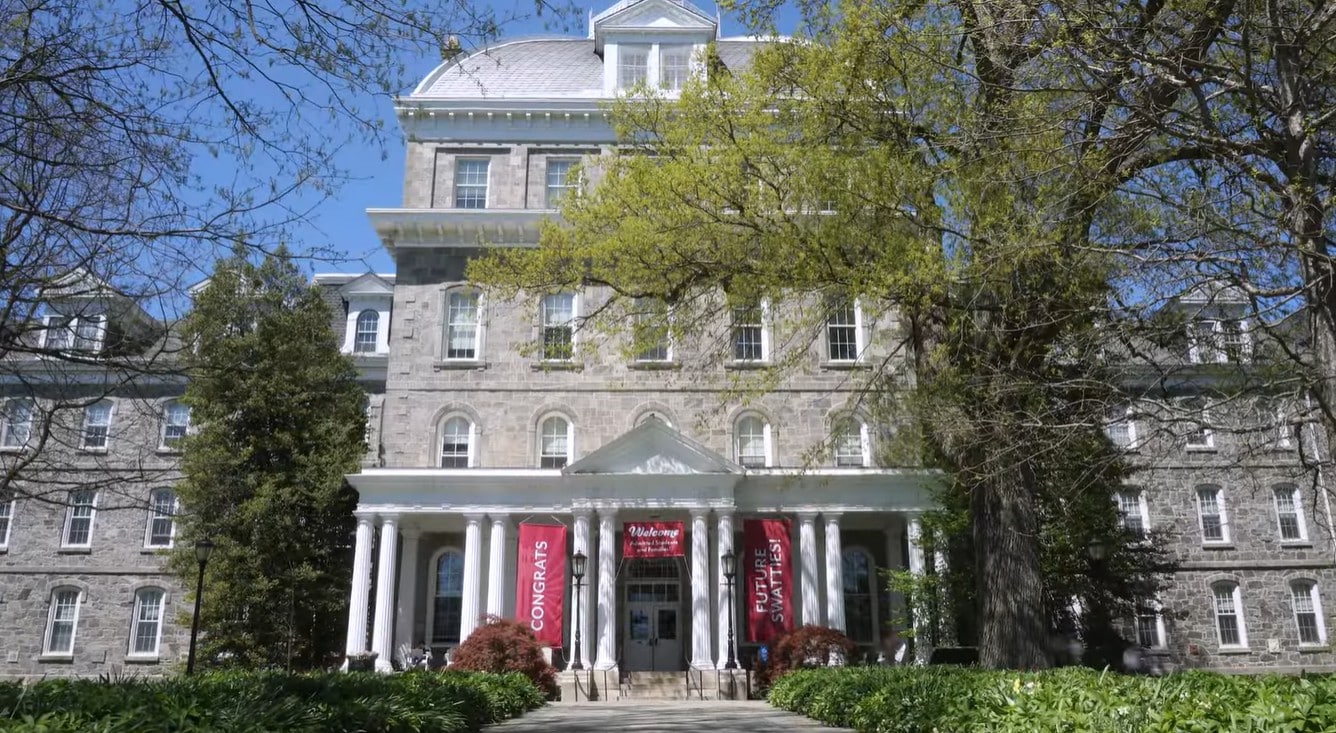
Founded in 1864 by Quakers, Swarthmore College is a private, nonsectarian liberal arts institution with an engineering program, and it has called 500 College Avenue, Swarthmore, PA 19081 home ever since. Located in a quiet suburban borough 11 miles southwest of Philadelphia, the 425-acre campus is simultaneously a working arboretum, its Collegiate Gothic buildings woven into wooded hills and manicured gardens.
This guide covers the campus and its landmarks, affiliated academic sites, how to get here by train, car, or plane, and what daily life near campus actually looks like.
- Swarthmore College Campus Location
- Getting to Swarthmore College
- Living Near Swarthmore College
- Why You Should Visit Swarthmore College Campus
- Frequently Asked Questions
- Takeaways
Swarthmore College Campus Location
Swarthmore College sits within the borough of Swarthmore, a quiet, walkable college town in Delaware County, Pennsylvania. The GPS address for the main visitor parking area is Visitor’s Center Rd, Swarthmore, PA 19081, though the college’s official mailing address is 500 College Avenue.

Swarthmore’s campus spans 425 acres and is almost entirely encompassed by the Scott Arboretum, a living museum established in 1929 that features more than 4,000 plant varieties, including magnolias, flowering cherries, hydrangeas, and tree peonies.
Architecturally, the campus is defined by its Collegiate Gothic style: sturdy stone buildings, arched doorways, and slate rooftops that harmonize with the surrounding forest and lawns. The overall layout is walkable and coherent, with Parrish Hall at the geographic and symbolic center, radiating outward toward academic buildings, residence halls, athletic facilities, and natural spaces like Crum Woods. An extensive network of pathways, including the historic Magill Walk and the newer, accessible Peter Graham Swingwalk, connects every corner of campus without ever requiring a car.
The borough of Swarthmore itself is a small, tight-knit community with a distinctly college-town character. The SEPTA regional rail station sits directly adjacent to campus, making the college feel connected to Philadelphia without sacrificing the calm and greenery that define the area’s identity.
Main campus landmarks
Swarthmore College is rich with places that shape daily student life and leave a lasting impression on first-time visitors. Here are the key landmarks you should know:
Parrish Hall
Located at the geographic and symbolic center of campus, Parrish Hall houses the Admissions Office (on the second floor) and a range of student life offices. Its wide front lawn, affectionately nicknamed “Parrish Beach,” is the gathering spot of choice on warm days and one of the most iconic spaces on any American liberal arts campus.
Scott Outdoor Amphitheater
Built into a natural hollow on the edge of campus, this breathtaking outdoor venue features eight grass-edged stone tiers framed by towering old tulip trees. Commencement is held here every year, rain or shine, a tradition that speaks to how deeply the outdoor setting is woven into campus culture.
Magill Walk
The tree-lined central path that connects the SEPTA train station at the foot of campus to Parrish Hall at its center. Magill Walk is the campus’s main artery, its most photographed promenade, and the first thing most visitors see when they arrive.
Benjamin West House
Built in 1724, this is the oldest building on campus and a National Historic Landmark. It served as the birthplace of the renowned painter Benjamin West and now operates as the College’s Visitor Information Center, staffed 24 hours a day. It is the ideal first stop for any campus visit.
McCabe Library & Seven-Library System
McCabe Library is the primary hub for academic research on campus, part of Swarthmore’s network of seven libraries.
Kohlberg Hall
A modern academic building designed to blend seamlessly with the campus’s traditional stone aesthetic. It houses social science and humanities programs and is home to the popular Kohlberg Coffee Bar, a beloved campus gathering spot.
Lang Performing Arts Center (LPAC)
The heartbeat of Swarthmore’s arts community, LPAC features a concert hall and multiple performance spaces that host student-led productions, faculty concerts, and visiting artists throughout the year.
Crum Woods
A 220-acre native hardwood forest that adjoins the main campus along Crum Creek. Used for ecological research, hiking, and quiet reflection, it dramatically extends Swarthmore’s sense of natural immersion beyond the manicured arboretum gardens. As the college likes to say: “A creek runs through it.”
Dean Bond Rose Garden
One of 16 gardens on campus, this organically maintained garden is celebrated for its 21st-century approach to rose cultivation. It is also the site of a beloved commencement tradition: each year, graduating seniors select a rose to pin to their gown before processioning to the Amphitheater.
Black Cultural Center (BCC)
A cornerstone of Swarthmore’s Black community for more than 50 years, the BCC provides dedicated space for cultural programming, social events, and community building.
Singer Hall & the Science Center
Modern facilities for Swarthmore’s natural science and engineering programs. The Science Center features an exterior wall that doubles as an outdoor chalkboard, a fitting symbol of learning beyond the classroom.

The Inn at Swarthmore
Located at the edge of campus adjacent to the train station, the Inn offers 40 guest rooms, event spaces, and The Broad Table Tavern restaurant. It also houses the Swarthmore Campus & Community Store and is the most convenient lodging option for campus visitors.
Swarthmore’s other campuses and affiliated sites
Swarthmore College operates a single residential campus, but its academic footprint extends meaningfully beyond its own borders through powerful institutional partnerships.
Swarthmore is a founding member of the Tri-College Consortium with Bryn Mawr College and Haverford College, and maintains a cross-registration agreement with the University of Pennsylvania. Students gain access to courses, libraries, faculty, and social life across four distinct campuses.
A dedicated Tri-Co Van shuttle connects the three consortium campuses, and SEPTA Regional Rail provides easy access to Penn’s campus in West Philadelphia.
These partnerships also open doors to collaborative research and experiential programs across the Philadelphia region, including:
- The Philadelphia Behavioral Science Initiative (with Penn, the Harvard Kennedy School, and city officials)
- The Early Novels Database project (with Penn and Bryn Mawr)
- The Field Linguistics School, which has sent Tri-Co students to Mexico and Micronesia to help revive endangered languages
The Tri-Co Philly Program is a particularly distinctive initiative, offering urban-themed courses from multiple disciplines and connecting students directly to Philadelphia’s civic, cultural, and intellectual life.
Getting to Swarthmore College
Swarthmore College is exceptionally accessible, whether you’re arriving from Philadelphia, New York, Washington D.C., or flying in from across the country. Its location 11 miles southwest of Philadelphia, with a SEPTA train station literally at the foot of Magill Walk, makes it one of the better-connected small liberal arts colleges in the nation.
Public transportation options
The most convenient way to reach Swarthmore is by train. The SEPTA Media/Wawa Regional Rail line stops directly at Swarthmore Station, steps from the heart of campus. From Philadelphia’s 30th Street Station (the main Amtrak hub), the ride to Swarthmore takes approximately 25 minutes. The last train from 30th Street to Swarthmore departs at 12:02 a.m. on weekdays and 11:46 p.m. on weekends.
For those flying into Philadelphia, the SEPTA Airport Line runs from Philadelphia International Airport to Penn Medicine Station, where passengers transfer to the outbound Media/Wawa line directly to Swarthmore Station. The total journey from airport to campus typically takes 45–60 minutes by rail.
Amtrak trains from New York and Washington D.C. arrive hourly at 30th Street Station. Greyhound bus service is also available from major Northeast Corridor cities, with SEPTA connections at Jefferson Station in Philadelphia.
Students receive a free SEPTA Key Card through the College’s UPass Program, covering public transportation throughout the academic year, making Philadelphia easily and affordably accessible.
On campus, the Garnet Shuttle runs a full campus loop from 7 a.m. to 4 a.m., seven days a week, with 11 stops. Live tracking is available through the TriCo Transit Network App.
Getting there by car
If you’re driving from the north (New Jersey Turnpike or I-95): Take Exit 6 to I-276 West (Pennsylvania Turnpike), then Exit 20 to I-476 South, then Exit 3 (Media/Swarthmore). Turn left onto Baltimore Pike.
From the south (I-95): Take Exit 7 to I-476 North, then Exit 3 (Media/Swarthmore). Turn right onto Baltimore Pike.
From Philadelphia International Airport by car: Take I-95 South to Exit 7, then I-476 North to Exit 3. Turn right onto Baltimore Pike, then right onto Route 320 South and follow signs to visitor parking.
Visitor parking is available in the Benjamin West Lot (main visitor lot, off North Chester Road), Whittier Lot, and Fieldhouse Lot. Display your printed campus-visit confirmation as a parking permit. The Benjamin West House, open 24 hours, serves as the visitor information center.
For ride-share services, use the Benjamin West parking lot as your drop-off or pickup point. A typical ride from Philadelphia International Airport costs approximately $30–$45 and takes around 20 minutes.
Living Near Swarthmore College
Incorporated in 1893, partly in response to the growth that followed the college’s founding, Swarthmore is a walkable, tree-shaded community with a clear college-town identity and a strong local character.
Approximately 96% of Swarthmore students live in college housing, surrounded by wooded trails, organic gardens, and the quiet that makes deep reading feel natural. The borough’s small, walkable town center offers boutique shops, cafes, and a cooperative grocery. Residence halls range from cozy nine-person houses to lively 200-person dorms, most housing a diverse mix of class years and students.
Places to check out near Swarthmore College
Between the campus, the surrounding borough, and Philadelphia 25 minutes away by train, there is plenty worth exploring around Swarthmore College.
The Scott Arboretum spans the entire 425-acre campus as a living museum with more than 4,000 plant species, open daily dawn to dusk at no charge. The Scott Outdoor Amphitheater and Cunningham House Garden, a secluded pond-centered retreat near McCabe Library, are two spots students return to regularly.
Just beyond campus, Crum Woods and Smedley Park offer miles of hiking trails through native hardwood forest along Crum Creek. For more open space, Ridley Creek State Park stretches over 2,600 acres of Delaware County woodlands with 13 miles of hiking trails and a creek stocked with trout.
For dining and town life, the Broad Table Tavern at the Inn at Swarthmore offers farm-to-table dining at the edge of campus. Swarthmore Town Center, steps away, has boutique shops, cafés, and a weekly farmers market. On campus, the Kohlberg Coffee Bar is a daily stop for coffee and pastries.
The Lang Performing Arts Center hosts concerts and performances in five venues, all open to the public and most without reservations. The Players Club of Swarthmore, a community theater founded in 1911, and Hedgerow Theater Company in nearby Rose Valley round out the local arts scene.
Philadelphia is the area’s biggest draw. Via SEPTA from the station steps off campus, students reach Center City in roughly 25 minutes, with access to the Philadelphia Museum of Art, the Barnes Foundation, Independence National Historical Park, the Kimmel Center for the Performing Arts, professional sports at the Wells Fargo Center and Citizens Bank Park, and one of the country’s best restaurant scenes.
Why You Should Visit Swarthmore College’s Campus
No amount of research, data, or virtual content can substitute for the experience of standing on Parrish Beach on a clear afternoon, walking the length of Magill Walk, or sitting in the Scott Outdoor Amphitheater and imagining yourself crossing that stage at graduation. Campus visits are the most underrated tool in the college search process, and for a place as visually and atmospherically distinctive as Swarthmore, the in-person experience is especially clarifying.

Many students arrive expecting a prestigious small college and leave their visit understanding something more specific: that the combination of academic intensity, Quaker-rooted community values, natural beauty, and Philadelphia proximity creates a college environment unlike any other. Others visit and realize the intimate scale or rigorous culture is not quite the right fit, which is equally valuable information.
To schedule a tour, explore visit formats, and access virtual resources, visit the official campus visit page.
Building a thoughtful college list requires strategic research, honest self-assessment, and experienced guidance. Our Senior Editor College Application Program helps students build a well-researched, balanced college list and develop a competitive overall application, so that by the time you visit a campus like Swarthmore, you already know where it fits in your bigger picture.
Frequently Asked Questions
1. What is Swarthmore College’s address?
Swarthmore College’s official address is 500 College Avenue, Swarthmore, PA 19081. The GPS address for the main visitor parking lot is Visitor’s Center Rd, Swarthmore, PA 19081. The Admissions Office is located on the second floor of Parrish Hall, a 5–10 minute walk from the Benjamin West parking lot.
2. How big is Swarthmore College?
The Swarthmore College campus spans 425 acres and is almost entirely encompassed by the Scott Arboretum. An adjoining 220-acre native hardwood forest (Crum Woods) extends the natural environment further. The college enrolls approximately 1,702 undergraduate students with a student-to-faculty ratio of 8:1.
3. Can I visit Swarthmore College before applying?
Yes. Swarthmore offers in-person campus tours and information sessions as well as virtual visit options. Visit swarthmore.edu/admissions-aid/campus-tours-and-virtual-visits to explore options and schedule a visit.
4. Is parking available at Swarthmore College?
Yes. Visitor parking is available in the Benjamin West Lot, Whittier Lot, and Fieldhouse Lot. During weekday business hours (7:00 a.m. to 3:30 p.m.), visitors may park in designated visitor sections. A printed campus-visit email confirmation serves as your parking permit and should be displayed on your dashboard.
5. What landmarks are near Swarthmore College?
Nearby highlights include Smedley Park and Crum Woods for hiking, the John Heinz National Wildlife Refuge for wildlife observation, and the Inn at Swarthmore’s Broad Table Tavern for dining. Via SEPTA Regional Rail (approximately 25–30 minutes), visitors and students can access Philadelphia’s full range of museums, historic sites, restaurants, and cultural venues, including the Barnes Foundation, the Philadelphia Museum of Art, and Old City’s historic district.
Takeaways
- Swarthmore College is a private liberal arts college founded in 1864, located at 500 College Avenue in the suburban borough of Swarthmore, Pennsylvania. Its 425-acre campus is both a Collegiate Gothic academic campus and a nationally recognized arboretum with more than 4,000 plant varieties.
- The most convenient way to reach campus is by train. The SEPTA Media/Wawa Regional Rail line stops directly at Swarthmore Station, connecting to Philadelphia’s 30th Street Station in about 25 minutes and to Philadelphia International Airport via a single transfer.
- Through its Tri-College Consortium, Swarthmore students have access to four institutions’ worth of courses, libraries, and campus life.
- Swarthmore students get the best of both worlds: a walkable, tight-knit college town with a campus that doubles as a hiking and garden destination, and one of America’s great cities just 25 minutes away by train.
- Building the strongest possible application is a strategy that makes the difference. Our Private Consulting Program pairs you with an expert who will guide you through every stage of the process, from building a well-researched college list to submitting a competitive final application. Schedule your free consultation today.










