


Around 1 million associate degrees were handed out in the 2020-2021 school year, with 39% of those being in liberal arts, according to the National Center for Education Statistics. When it comes to bachelor’s degrees, social sciences and history—key parts of the humanities—accounted for 8% of the 2.1 million awarded, which is about 268,000 degrees. Many of these degrees were earned at top liberal arts colleges.
If you’re thinking about going to a liberal arts college, you’ve got plenty of options. There are over 200 private liberal arts schools in the U.S. These schools focus on a well-rounded, multidisciplinary education, which is perfect if you’re someone with a lot of different academic interests.
In this blog, we list the top 10 liberal arts colleges according to U.S. News and World Ranking and provide an analysis of whether you should go to a liberal arts college.
- What Are the 10 Best Liberal Arts Colleges in the US?
- A Closer Look at the Top 10 Liberal Arts Colleges
- What Is the Difference between Liberal Arts Colleges and Traditional Universities?
- Should You Go to a Liberal Arts College?
- Frequently Asked Questions
- Takeaways
What Are the 10 Best Liberal Arts Colleges in the US?
The table below shows the top 10 liberal arts colleges rankings. It’s important to note that the ranking isn’t solely based on the acceptance rate and average SAT and ACT scores. These schools are ranked holistically:
| Rank | School | Acceptance Rate | SAT Average | ACT Average | GPA Average | Popular Majors |
| 1 | Williams College | 10% | 1470-1560 | 33-35 | 4.13 | Econometrics and Quantitative Economics
General Psychology English Language and Literature Biology/Biological Sciences Mathematics |
| 2 | Amherst College | 10% | 1360-1550 | 31-35 | 4.1 | Computer Science
Political Science and Government English Research and Experimental Psychology Biology |
| 3 | Swarthmore College | 7% | 1460-1560 | 33-34 | 4.09 | Political Science
Biology Economics Computer and Information Sciences English |
| 4 | United States Naval Academy | 9% | 1200-1420 | 24-31 | 3.66 | Engineering
Social Sciences Physical Sciences English Language and Literature Computer and Information Sciences |
| 5 | Bowdoin College | 8% | 1480-1550 | 33-35 | 3.96 | Biology and Biochemistry
Computer Science Economics English Government and Legal Studies |
| 6 | Pomona College | 7% | 1480-1560 | 33-35 | 4.06 | Economics
Mathematics Computer and Information Sciences Biological and Biomedical Sciences Social Sciences |
| 7 | Wellesley College | 14% | 1440-1550 | 33-35 | 3.98 | Economics
Information Science Political Science and Government Psychology Social Sciences |
| 8 | Carleton College | 22% | 1430-1550 | 32-35 | 4.09 | General Mathematics
Computer Science Biology and Biological Sciences Econometrics and Quantitative Economics International Relations and Affairs |
| 9 | Claremont McKenna College | 11% | 1450-1560 | 33-35 | 4.09 | Economics
Psychology Government International Relations Philosophy |
| 10 | United States Air Force Academy | 14% | 1250-1450 | 26-33 | 3.8 | Management
Biology Behavioral Science Civil Engineering Aeronautical Engineering |
A Closer Look at the Top 10 Liberal Arts Colleges
1. Williams College
Location: Williamstown, MA
For 17 straight years, Williams has held the top spot on US News’ list of the top liberal arts colleges. Williams College offers a well-rounded education through three main academic branches: arts and humanities, social sciences, and science and mathematics. Unlike many other liberal arts schools, Williams also offers two graduate programs: development economics and art history.
On top of that, it provides graduate programs in art history and economics. With small classes and a 7-to-1 student-to-teacher ratio, you’ll get plenty of personalized attention.
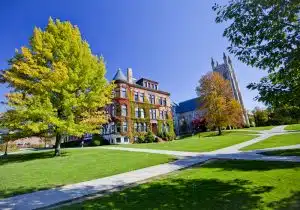
The school has a long history of firsts. Its alumni society is the oldest in the world, it hosted the first intercollegiate baseball game, and it was the first college in the U.S. to have its graduating class wear caps and gowns back in 1887.
If you’re into outdoor activities, the nearby ski lodges and winter sports scene are perfect for some fun off-campus.
2. Amherst College
Location: Amherst, MA
Amherst College offers over 100 student organizations to get involved with, and it’s worth noting that fraternities have been banned since 1984. The college takes pride in having one of the oldest athletics programs in the country and boasts the third-oldest football field.
The Amherst Mammoths compete in NCAA Division III as part of the New England Small College Athletic Conference, and they’ve had a long-standing athletic rivalry with Williams and Wesleyan in the Little Three conference, which has been around for over 100 years.
As one of the top liberal arts colleges, Amherst ensures a strong sense of community. As a freshman, you’ll live on campus in one of seven residence halls.
Amherst is also big on sustainability, actively working to protect 500 acres of open land and water in its own wildlife sanctuary. Some of its notable alumni include former U.S. President Calvin Coolidge, Prince Albert II of Monaco, and former Chief Justice of the U.S. Supreme Court Harlan Fiske Stone.
3. Swarthmore College
Location: Swarthmore, PA
Swarthmore College was originally founded by members of the Religious Society of Friends (Quakers), but today, it has no formal religious affiliatiAs one of the top liberal arts colleges, it offers over 100 student organizations on campus, so there’s plenty to get involved in. The school has around 20 NCAA Division III varsity sports teams, all backed by Phineas the Phoenix, their energetic mascot.

Swarthmore is part of the Tri-College Consortium, which means you can take classes at Bryn Mawr and Haverford Colleges as well. Unlike most liberal arts schools, Swarthmore also offers an undergraduate engineering program which sets it apart academically.
As one of the top liberal arts colleges, Swarthmore is known for producing high-achievers, with alumni that include five Nobel Prize winners, plus a number of Rhodes, Truman, and Fulbright Scholars.
Notable alumni include:
- Nancy Grace Roman, NASA’s first chief of astronomy and the “mother of the Hubble telescope”
- Michael Dukakis, former Massachusetts governor and presidential candidate
- Robert Zoellick, former president of the World Bank
- Henry W. Kendall, Nobel Prize in Physics (1990) winner for his discovery of quarks as part of his work in particle physics
- Edward C. Prescott, Nobel Prize in Economic Sciences (2004) winner for his contributions to dynamic macroeconomics
- John C. Mather, Nobel Prize in Physics (2006) winner for his work on the Cosmic Background Explorer Satellite (COBE).
4. United States Naval Academy
Location: Annapolis, MD
The United States Naval Academy is the second oldest of the five federal service academies, where students, called midshipmen, are officers in training. Your tuition is fully covered by the U.S. Navy in exchange for serving on active duty after you graduate. While the Naval Academy differs from other top liberal arts colleges, it shares a commitment to producing well-rounded graduates through a combination of academics, leadership, and physical training.
Throughout all four years, midshipmen need to meet physical education requirements to graduate, and there’s no shortage of activities to keep you busy outside the classroom. With over 70 extracurriculars, from debate to scuba diving, there’s something for everyone. The Naval Academy ensures midshipmen develop broad leadership and technical skills.
All midshipmen live together in Bancroft Hall, a massive dorm, and receive a monthly stipend while they’re at the academy.
When you graduate from the Naval Academy, you’ll earn a Bachelor of Science degree and serve in the U.S. Navy or Marine Corps. To apply, you’ll need to submit an application directly to the academy and also secure a nomination, typically from a member of Congress.
5. Bowdoin College
Location: Brunswick, ME
Bowdoin College offers more than 100 student organizations, with one of the most popular being the Outing Club, which organizes around 150 trips each year. As one of the top liberal arts colleges, Bowdoin promotes intellectual curiosity and community engagement through these organizations.
If you’re into intellectual discussions, you might be interested in the Peucinian Society, founded in 1805 and one of the oldest literary societies in the U.S.—it even counts poet Henry Wadsworth Longfellow among its past members.

Originally a men’s college, Bowdoin started admitting women in 1971. It was also ahead of its time when it became the first school to make the SAT and ACT optional for admissions back in 1969. In 1997, Bowdoin did away with fraternities, replacing them with college-owned social houses.
Bowdoin encourages more than half of its students to take advantage of the opportunity to study abroad for a semester, with choices from over 100 affiliated programs.
Some of Bowdoin’s notable alumni include Olympic gold medalist Joan Benoit Samuelson, author Nathaniel Hawthorne, educator and activist Geoffrey Canada, former U.S. President Franklin Pierce, and NBC News correspondent Cynthia McFadden.
6. Pomona College
Location: Claremont, CA
When Pomona College was founded, the goal was to create “a college of the New England type,” with small classes and close student-faculty connections. Today, it stands as one of the top liberal arts colleges in the nation and is part of the NCAA Division III Southern California Intercollegiate Athletic Conference.
With around 45 majors to choose from and an 8:1 student-faculty ratio, you’ll get plenty of personalized attention. Plus, as a Pomona student, you have the unique benefit of being able to take classes at any of the other six schools in the Claremont Colleges consortium, including Scripps, Claremont McKenna, Harvey Mudd, Pitzer, Claremont Graduate University, and Keck Graduate Institute of Applied Life Sciences.
7. Wellesley College
Location: Wellesley, MA
Wellesley College is a women’s liberal arts school and one of the top liberal arts colleges, as well as one of the original Seven Sisters Colleges, which includes schools like Mount Holyoke, Vassar, Smith, Radcliffe (now part of Harvard), Bryn Mawr, and Barnard.
Wellesley offers a cross-registration program with MIT, giving you access to a wider variety of courses. As one of the top liberal arts colleges, Wellesley also allows you to spend a semester at another school in the Northeast through the Twelve College Exchange Program.
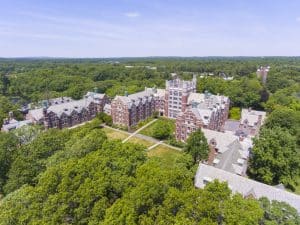
The college is known for its strong science programs and is home to the country’s second oldest physics lab. Additionally, Wellesley’s Davis Degree Program allows women over 24 to attend college. Notable alumni include former Secretaries of State Hillary Rodham Clinton and Madeleine Albright, and ABC news anchor Diane Sawyer.
8. Carleton College
Location: Northfield, MN
Carleton College is located in the river town of Northfield, Minnesota. As one of the top liberal arts colleges in the country, Carleton offers a well-rounded education with a vibrant campus life. The Carleton Knights compete in 19 varsity sports as part of the NCAA Division III Minnesota Intercollegiate Athletic Conference.
With over 170 student organizations, there’s always something fun to get involved in—groups like the Carleton Juggling F.I.S.H., the One Knight Stands cabaret troupe, and the Knightingales a cappella group add to the campus creativity.
As one of the top liberal arts colleges, Carleton offers nearly 40 undergraduate majors, and its Goodsell Observatory features three historic telescopes, plus modern ones that are used for classes and public events. Notable alumni include Anthony Downs, author of An Economic Theory of Democracy, and former Supreme Court Justice Pierce Butler.
9. Claremont McKenna College
Location: Claremont, CA
Claremont McKenna College is part of The Claremont Colleges, a seven-college consortium that includes some of the top liberal arts colleges like Scripps, Pomona, Harvey Mudd, Pitzer, Claremont Graduate University, and Keck Graduate Institute. You can take classes at any of these schools, plus enjoy their social events, athletics, and dining services.
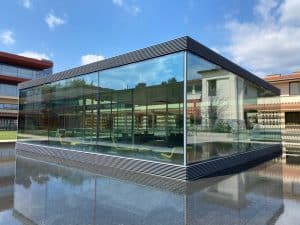
There’s no shortage of clubs to join, whether you’re into improv with Without the Box or singing in the Shades a cappella group, among many others. Claremont McKenna emphasizes a strong sense of community, with all freshmen living on campus and about 97% of students sticking with on-campus housing for all four years.
While primarily an undergraduate college, Claremont McKenna does offer a master’s program in finance through the Robert Day School of Economics and Finance. Originally founded as Claremont Men’s College, it became coed in 1976.
10. United States Air Force Academy
Location: Air Force Academy, CO
At the U.S. Air Force Academy, students, known as cadets, follow a strict daily routine with limited free time, but there are plenty of extracurricular clubs and activities to get involved in. While the academy focuses on military training, it shares a commitment to developing well-rounded leaders, similar to the approach at top liberal arts colleges.
All incoming cadets go through a five-week training program to get them ready for military life. Admission is also highly selective, with the latest Air Force Academy acceptance rate at 11.21% for the Class of 2028.
Athletics are a big part of cadet life—everyone has to participate in either intercollegiate or intramural sports. The cadets must pass a fitness test each semester. The Air Force Fighting Falcons compete in NCAA Division I and have strong rivalries with Army and Navy.
Academics at the Air Force Academy are built around a core curriculum that all cadets complete. This core curriculum provides a broad-based education that, much like the programs at top liberal arts colleges, ensures cadets are well-prepared in a variety of disciplines.
While this core curriculum forms the majority of the academic experience, cadets also choose a major from over 30 options. Military training is a continuous part of life at the academy, including courses and hands-on instruction in aviation and airmanship throughout all four years.
What Is the Difference between a Liberal Arts College vs University?
The main difference between liberal arts colleges and traditional universities lies in their approach and size.
Top liberal arts colleges are typically smaller and focus on giving you a well-rounded education. You’ll take classes in a variety of subjects—like humanities, sciences, and social sciences—regardless of your major, which is perfect if you’re someone who enjoys exploring different fields. Plus, with smaller class sizes, you get more one-on-one time with professors and a close-knit community feel.
Traditional universities, on the other hand, are usually larger and offer a wider range of programs, including graduate and professional degrees. They tend to focus more on research and specialized fields of study.
In bigger universities, you might have larger lecture-style classes, especially in your early years, but you’ll also have access to more resources, research opportunities, and a bigger variety of extracurriculars. It really comes down to whether you’re looking for a more intimate learning environment or a bigger campus experience with more academic options.
Should You Go to a Liberal Arts College?
Deciding whether to go to a liberal arts college really depends on what kind of college experience you’re after. If you love the idea of exploring different subjects and prefer smaller classes where you can get to know your professors, one of the top liberal arts colleges might be a great choice.

These schools are all about building skills like critical thinking, communication, and problem-solving, which can set you up for success in a wide range of careers. Plus, if you’re looking for a close-knit community and enjoy forming strong connections with your peers and faculty, you’ll probably feel right at home.
Liberal arts colleges are perfect if you have broad interests or aren’t sure about your major yet. They encourage you to explore different fields before narrowing things down. If you enjoy reading and writing, you’ll likely thrive in a liberal arts setting since there’s usually a lot of both involved.
But, if you’re more focused on a specific field, want to get into research, or prefer the energy of a larger campus, a traditional university might suit you better. It really comes down to what you’re looking for academically and socially.
Frequently Asked Questions
1. What is a liberal arts degree?
A liberal arts degree is a well-rounded education that covers a broad range of subjects, including humanities, social sciences, natural sciences, and the arts. It focuses on developing critical thinking, communication, and problem-solving skills and prepares you for a variety of careers rather than training for a specific job, which is a hallmark of many of the top liberal arts colleges.
2. What are the four liberal studies?
The four main areas of liberal studies are:
- Humanities. Subjects like literature, philosophy, history, and languages.
- Social sciences. Disciplines such as sociology, psychology, economics, and political science.
- Natural sciences. Fields like biology, chemistry, physics, and environmental science.
- Mathematics. Involving areas of math and quantitative reasoning.
3. Are the Ivy League liberal arts colleges?
No, Ivy League schools are not considered liberal arts colleges. The Ivy League is a group of eight prestigious universities, known for their research programs and larger student bodies, offering both undergraduate and graduate degrees. While they emphasize a strong liberal arts foundation in their undergraduate programs, they are classified as research universities rather than liberal arts colleges.
Takeaways
The top liberal arts colleges provide a unique educational experience that focuses on a broad, multidisciplinary approach. With small class sizes and a focus on critical thinking, communication, and problem-solving, these institutions are designed for students who have a wide range of academic interests.
- Many top liberal arts colleges, like Williams and Amherst, offer small class sizes and low student-to-faculty ratios, allowing for more personalized attention and a closer relationship with professors.
- Liberal arts colleges often have strong campus communities with numerous student organizations and extracurricular activities which creates a well-rounded college experience.
- The focus on critical thinking and communication skills at liberal arts colleges prepares students for a wide range of careers, rather than limiting them to a specific field of study.
- Can’t decide whether a liberal arts college or a traditional university is for you? We recommend that you consult a college admissions expert to help you narrow down your choices and make a decision that works to your advantage.










