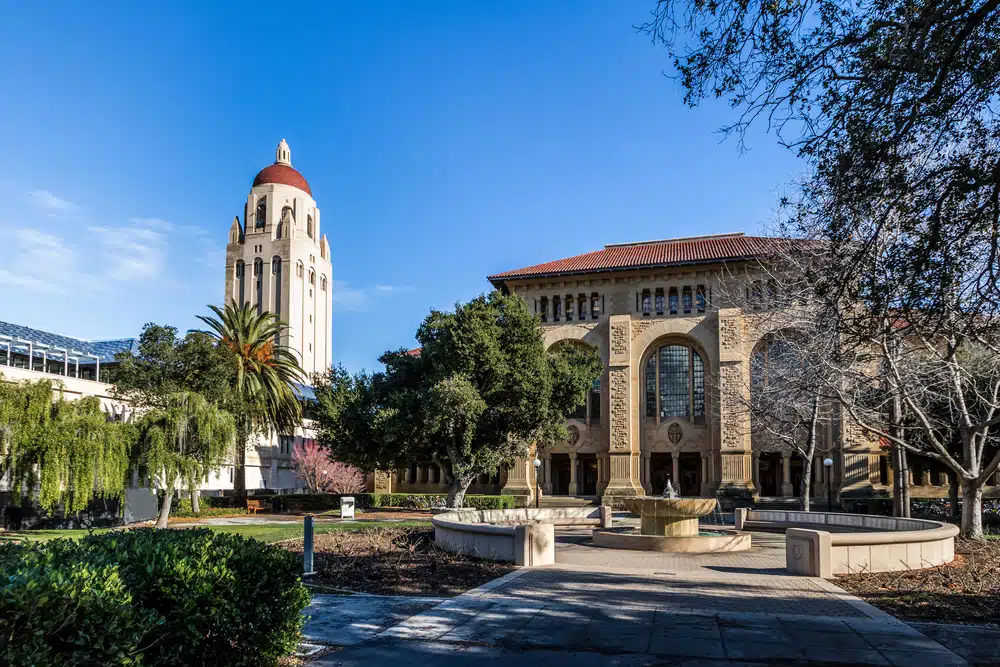
Stanford University is a private research university founded in 1885 in Stanford, California, by Leland and Jane Stanford in memory of their only son, Leland Jr., who died of typhoid fever at 15. Today, over 7,300 undergraduates study across three schools: Humanities and Sciences, Engineering, and Sustainability.
Stanford’s reputation rests on a specific weave: world-class academics, a research ecosystem that rivals any institution in the world, structural ties to Silicon Valley, and a campus culture that treats risk-taking as part of the curriculum. This guide breaks down each of those qualities and covers the programs Stanford is best known for, so you can assess whether it’s the right fit.
- What Is Stanford University Best Known For?
- What Majors and Programs Is Stanford Known For?
- How AdmissionSight Can Help You Get Into Stanford
- Frequently Asked Questions
- Takeaways
What Is Stanford University Best Known For?
Stanford has several defining qualities that set it apart from peer institutions:
The Silicon Valley connection and entrepreneurial culture
No university in the world has a relationship with its surrounding industry the way Stanford does with Silicon Valley. In the 1950s, engineering dean Frederick Terman began encouraging Stanford students to commercialize their academic work rather than take jobs on the East Coast. That philosophy produced immediate results: William Hewlett and David Packard, both Terman students, founded Hewlett-Packard, and in 1951 Stanford established the Stanford Research Park, the first university-affiliated research park in the country. The park now houses over 150 companies, including Lockheed Martin, Varian Medical Systems, and Volkswagen’s Electronics Research Laboratory.
That founding ethos has compounded over seven decades. Google was born on campus when Larry Page and Sergey Brin developed the PageRank algorithm as Stanford PhD students in the late 1990s, incorporating the company out of a garage in Menlo Park while still enrolled. Yahoo came from Stanford electrical engineering PhD students Jerry Yang and David Filo, Netflix from Reed Hastings with his Stanford master’s in computer science, and Instagram from Kevin Systrom and Mike Krieger, who both graduated from Stanford.
Stanford’s location near Sand Hill Road, the global center of venture capital means Sequoia Capital, Kleiner Perkins, and Andreessen Horowitz are all within a few miles of campus. Students pitch partners during office hours, and internships regularly convert to seed rounds. The Stanford StartX accelerator, the d.school’s Launchpad program, and the Stanford Venture Studio all formalize that pipeline, giving students direct support for building companies as part of their education.
Academic and research reputation
Stanford ranks #4 nationally in the 2026 U.S. News & World Report Best Colleges rankings, #1 in the Wall Street Journal’s 2026 Best Colleges list, and #3 in the QS World University Rankings 2026.
Stanford is home to 20 living Nobel laureates. Recent laureates include Professor of Chemistry Carolyn Bertozzi, who won the 2022 Nobel Prize in Chemistry for her development of bioorthogonal chemistry reactions used in cancer drug delivery, and economist Alvin Roth, who won the 2012 Nobel Prize in Economics for his work on market design, which now shapes how kidney transplant matching and medical residency placement work in the United States.
Stanford Medicine operates Stanford Health Care, a 600-plus-bed academic medical center where undergraduate researchers work alongside physicians and scientists. Stanford Law School consistently ranks among the nation’s top law programs alongside Harvard and Yale and is ranked #1 nationally for 2026.
Undergraduates have direct access to this research infrastructure through Undergraduate and Independent Projects under the office of the Vice Provost for Undergraduate Education (VPUE), which funds student-led projects through grants including the VPUE Major Grant (up to $15,000 for year-long projects) and the Short-Term Undergraduate Research Grant for summer work.
World-class programs across engineering, business, and the humanities
Stanford’s undergraduate programs span three schools. The School of Humanities and Sciences covers over 40 disciplines including history, philosophy, cognitive science, mathematics, and the biological sciences. The School of Engineering, ranked #2 nationally for graduate engineering by U.S. News, houses undergraduate programs in computer science, electrical engineering, mechanical engineering, bioengineering, and eight other fields. The School of Sustainability, established in 2022, focuses on interdisciplinary research and coursework around climate, energy, and environmental systems.
Stanford operates on a quarter system, with three 10-week terms per year. This means students can complete more courses across more departments over four years than they would in a semester-based structure, which reinforces the cross-disciplinary approach Stanford is known for.
An unusually open, interdisciplinary campus culture
Stanford’s motto, “Die Luft der Freiheit weht” (German for “The wind of freedom blows”), was chosen by founding president David Starr Jordan and reflects how the university approaches learning. The Hasso Plattner Institute of Design, known as the d.school, sits at the center of that philosophy.
Founded in 2004 with a $35 million gift from SAP co-founder Hasso Plattner, the d.school teaches human-centered, prototype-driven problem solving. Its courses are open to every Stanford student regardless of major. The flagship course “Design Thinking Bootcamp” brings together teams of engineers, lawyers, business students, and artists. “Design for Extreme Affordability” challenges interdisciplinary teams to develop products for communities living on under $2 a day, and several of those projects have become companies or nonprofits.
This philosophy extends into the broader curriculum. The Human-Computer Interaction (HCI) Group in the Computer Science department works directly with the d.school on joint research projects. Meanwhile, the Program in Writing and Rhetoric teaches argumentation through real-world policy cases. Stanford students are expected to build things alongside studying them, and the campus culture rewards that combination.
Google, Legally Blonde, and other fun facts
Three facts worth knowing about Stanford beyond the rankings:
Google started here. Larry Page and Sergey Brin developed PageRank as a research project to rank web pages by link authority, originally calling the search engine “Backrub.” They incorporated Google in September 1998 while still enrolled as PhD students, using a garage in Menlo Park rented from Susan Wojcicki, who later became CEO of YouTube, as their first office.

Stanford has won more NCAA team championships than any university in the country: 137 as of 2025, with at least one championship per year for 49 consecutive years across sports including swimming, gymnastics, sailing, and tennis.
Legally Blonde has Stanford roots. Author Amanda Brown based the novel on her own experience as a student at Stanford Law School. The 2001 film and subsequent Broadway musical both trace directly to Brown’s time on campus.
If you want to learn more, check out this comprehensive list of Stanford fun facts.
What Majors and Programs Is Stanford Known For?
Stanford offers 66 undergraduate majors across its three schools. The quarter system makes double majoring and pursuing interdisciplinary concentrations more feasible than at most semester-based universities.
Strongest undergraduate majors
Stanford’s most popular programs reflect its identity well: technically rigorous, interdisciplinary by design, and oriented toward research from the start. Here are the five fields where Stanford has the most strength and the highest enrollment:
- Computer science. Stanford’s CS department ranks among the top programs in the world (ranked #2 by QS) and houses the Stanford AI Lab, founded in 1963 by John McCarthy, who coined the term “artificial intelligence.” Students can specialize in artificial intelligence, machine learning, human-computer interaction, or systems, and the department’s proximity to Silicon Valley creates a direct pipeline into Google, Apple, Meta, and hundreds of startups through recruiting relationships and their alumni network.
- Social sciences. Stanford’s social science programs span economics, political science, psychology, sociology, and urban studies, giving students a wide range of options within a single broad field. The economics program has particular strength in market design and behavioral economics, and the political science department is backed by the Hoover Institution, a policy research center on campus with an archive holding over 100 million items.
- Engineering. The School of Engineering ranks #2 nationally and houses undergraduate programs in aero/astronautics, electrical, mechanical, civil, environmental, and bioengineering. Students have access to facilities including the Stanford Nanofabrication Facility and the Product Realization Lab, where they machine and fabricate physical prototypes as part of their coursework.
- Interdisciplinary studies. This category reflects Stanford’s ability to build a program that crosses traditional departmental lines. Human Biology, one of Stanford’s most popular and distinctive majors, lives here, combining biology, medicine, social science, and public health into a single structured degree with tracks in Global Health, Neuroscience and Behavior, and Human Evolutionary Biology.
- Mathematics and statistics. Stanford’s mathematics department has faculty strength in areas including number theory, probability, and mathematical finance, and the statistics department is one of the most influential in the world, having produced foundational work in machine learning and data science. Both programs feed directly into Stanford’s graduate programs and into quantitative roles across finance, technology, and research.
For detailed program coverage including career outcomes and research opportunities, check out our full guide on Stanford’s best majors.
Signature programs and professional schools
Beyond undergraduate majors, Stanford’s professional schools are among the most selective in the world and shape the university’s academic identity as much as any department.

The Stanford Graduate School of Business ranks #1 or #2 globally and is a long-term target for Stanford undergraduates through its Deferred Enrollment program, which allows current seniors and recent graduates to secure admission before starting their careers. Stanford Law School ranks #1 nationally for 2026 and carries one of the lowest faculty-to-student ratios of any major law school, giving students access to research collaboration and mentorship that is harder to find at larger programs.
Stanford Medicine, meanwhile, is closely integrated with undergraduate pre-med pathways: undergraduates can conduct research in medical school labs, enroll in graduate-level coursework through the Honors Co-Terminal program, and apply to Stanford’s MD program with four years of institutional familiarity already behind them.
Rounding out the picture is the d.school, which sits outside the professional school structure but is equally central to Stanford’s identity. Open to all students regardless of major, it offers courses in healthcare innovation, education design, and civic technology. Its flagship Design Thinking Bootcamp consistently ranks among the most oversubscribed courses on campus.
How AdmissionSight Can Help You Get Into Stanford
Stanford’s acceptance rate for the Class of 2028 was 3.61%, with 57,326 students applying and only 2,067 admitted. That makes it one of the most selective universities in the world, consistently more difficult to gain admission to than Ivy League schools.
Getting in requires a clear strategy for the supplemental essays, a demonstrated record of intellectual curiosity, and a compelling case for genuine fit with Stanford’s culture of entrepreneurship and interdisciplinary thinking. Our in-depth guide on how to get into Stanford covers requirements, deadlines, and essay strategy in full.
If you want expert, one-on-one support through the full application process, our Senior Editor College Application Program connects you with experienced consultants who are Ivy League graduates and trained essay editors. The outcomes speak for themselves, with roughly 75% of students earning admission to an Ivy League or top 10 university and nearly 98% getting into one of their top-choice schools.
Frequently Asked Questions
1. What is Stanford University most famous for?
Stanford is most famous for its role in building Silicon Valley, its strength in computer science and engineering, and a campus culture that actively encourages students to start companies and pursue interdisciplinary work. Google, Yahoo, Netflix, and Instagram were all founded by Stanford students or faculty.
2. What majors is Stanford known for?
The most popular programs are computer sciences, social sciences, engineering, interdisciplinary studies, and mathematics and statistics.
3. What is Stanford known for academically?
Stanford is known for research output across medicine, law, business, and engineering. The university is home to 20 living Nobel laureates, and undergraduates have direct access to research funding through the VPUE, including grants of up to $15,000 for year-long student-led projects.
4. What is Stanford best known for besides academics?
Stanford has won 137 NCAA team championships as of 2025, more than any other university in the country, with at least one championship per year for 49 consecutive years. The university also has an outsized cultural footprint: Legally Blonde was based on author Amanda Brown’s experience at Stanford Law School.
5. Is Stanford harder to get into than the Ivy League?
In most years, yes. Stanford’s acceptance rate of 3.61% for the Class of 2028 is lower than every Ivy League school, placing it among the most selective universities in the country.
Takeaways
- Stanford’s connection to Silicon Valley is structural: the Stanford Research Park, founded in 1951, was the first university research park in the country, and companies including Google, Yahoo, Netflix, and Instagram were all founded by Stanford students or faculty.
- Stanford ranks #4 in U.S. News 2026, #1 in the Wall Street Journal’s 2026 rankings, and #3 globally in QS, and is home to 20 living Nobel laureates, including Carolyn Bertozzi (2022 Chemistry) and Alvin Roth (2012 Economics).
- Stanford’s most popular programs are computer sciences, social sciences, engineering, interdisciplinary studies, and mathematics and statistics, reflecting Stanford’s identity as a technically rigorous and cross-disciplinary institution.
- Stanford’s professional schools are among the best and most selective in the world. For 2026, the GSB ranks #1 nationally, Stanford Law ranks #1 nationally, and Stanford Medicine ranks #3 globally.
- With a 3.61% acceptance rate for the Class of 2028, Stanford is one of the most selective universities in the country, and working with a college admissions expert can make a meaningful difference in how your application comes together.