Founded in 1865 by Ezra Cornell and Andrew Dickson White in Ithaca, New York, Cornell is a private Ivy League research university with roughly 16,100 undergraduates, the largest student body in the Ivy League. It is also the only land-grant university among the eight Ivies, a distinction rooted in its founding motto: “any person can find instruction in any study.”
That mission is at the heart of what Cornell University is known for: an institution that pairs Ivy League rigor with a range of practical and professional programs unmatched among its peers. This guide breaks down exactly what makes Cornell stand out, and how we can help you get into this one-of-a-kind Ivy League school.
- What Is Cornell University Best Known For?
- What Majors and Programs Is Cornell University Known For?
- How AdmissionSight Can Help You Get Into Cornell
- Frequently Asked Questions
- Takeaways
What Is Cornell University Best Known For?
Cornell’s reputation is built on a distinctive combination of Ivy League academic rigor, an unusually broad range of practical and professional programs, a dramatic natural campus, and a research output that spans agriculture, engineering, hotel management, law, and medicine.
Here is what sits at the core of that reputation:
The only land-grant Ivy League university
In 1865, Cornell was chartered under the Morrill Land-Grant Act to provide accessible, practical education to New Yorkers regardless of class or background. The vision was radical for its time: merge classical liberal arts with agriculture, engineering, and the applied sciences, and open it to anyone with the ability to learn.
That mission is alive in Cornell’s structure today. Several of Cornell’s colleges, including the College of Agriculture and Life Sciences (CALS), the College of Human Ecology, the School of Industrial and Labor Relations (ILR), and the College of Veterinary Medicine, are partially state-funded. For students who are New York residents and gain admission to one of these colleges, tuition is significantly lower than at any other Ivy League school.
Academic reputation and research output
Cornell is ranked #12 nationally by U.S. News (2026) and #16 in the QS World University Rankings 2026, consistently placing it among the top 20 universities in the world. Rankings alone, however, do not tell the full story.
Cornell operates more than 200 research centers and institutes, including the Atkinson Center for Sustainability. Cornell’s graduate engineering program ranks #11 nationally, and its undergraduate architecture program is consistently ranked the most admired in the country. Its computer science faculty are leaders in AI, machine learning, and programming languages research.
Cornell Tech, the university’s applied sciences campus on Roosevelt Island in New York City, puts Cornell’s research ecosystem directly in the middle of the world’s biggest tech and startup hub. The results speak for themselves: 86% of Cornell Tech graduates secured full-time jobs in tech, and 14% went on to found their own startups.
An unusually broad range of programs
Most Ivies are defined by a relatively narrow set of academic strengths. Cornell is defined by its breadth. Across fourteen colleges and schools, you can study aerospace engineering or art history, hotel administration or industrial labor relations, veterinary medicine or viticulture. No other Ivy offers this range, and that is a direct result of the land-grant mission.
Cornell is the only Ivy League school with a dedicated College of Agriculture and Life Sciences, a School of Industrial and Labor Relations, and an accredited College of Veterinary Medicine. If you are applying to Cornell with a specific interest in food science, fiber science, environmental economics, or labor policy, you are choosing the Ivy that was built for exactly that.
The Ithaca campus and natural setting
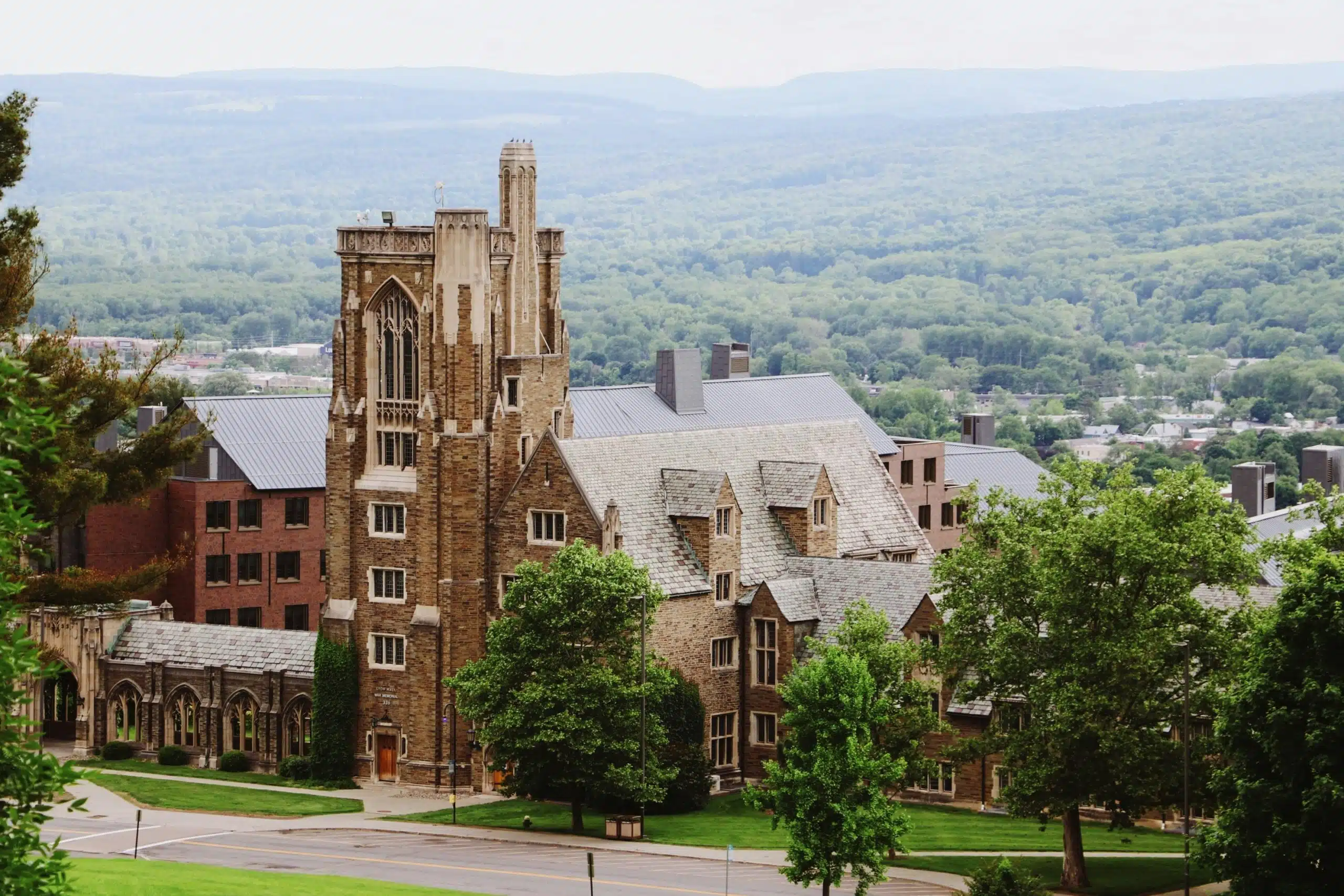
Cornell’s 745-acre hilltop campus overlooking Cayuga Lake is one of the most dramatic settings of any university in the country. Running through and around campus are gorges and waterfalls, literal gorges carved by streams, that you cross on footbridges on your way between classes. The Cornell Botanic Gardens adds another 3,000 acres of forest and gardens surrounding the main campus.
Hiking, outdoor recreation, and proximity to the Finger Lakes are genuinely part of everyday student life here. Students spend their weekends exploring the gorges.
Cornell also has a medical campus in New York City through Weill Cornell Medicine and a tech campus on Roosevelt Island, so students who want access to the city for internships, clinical experiences, or otherwise have clear pathways there, while remaining based in one of the most beautiful college towns in the country.
Chicken nuggets and other fun facts worth knowing
Did you know that the chicken nugget was invented at Cornell? Food science professor Robert C. Baker developed the recipe in 1963 in a campus lab during his 32-year tenure, and his work became the basis for the fast-food staple now consumed worldwide every single day.
As for traditions, Dragon Day is one of the oldest on campus. Every spring since 1901, first-year architecture students build a giant dragon, parade it across the Arts Quad, and set it on fire. This tradition is a rite of passage that architecture students look forward to from their very first week on campus.
Also, in 1997, a giant pumpkin mysteriously appeared atop the 173-foot McGraw Tower, and to this day, no one has definitively explained how it got there. It remains one of the most celebrated unsolved mysteries in Ivy League history.
Want to know more? We have compiled them all in our blog about Cornell fun facts.
What Majors and Programs Is Cornell University Known For?
Cornell offers more than 80 undergraduate majors and 120 minors across its fourteen colleges and schools.
Strongest undergraduate majors
Here are the five programs where Cornell holds the strongest national recognition.
- Computer science. A highly competitive program within both the College of Engineering and the College of Arts and Sciences, with research strengths in AI, machine learning, and programming languages, and strong placement into leading tech companies and graduate programs.
- Engineering. Cornell’s College of Engineering ranks #11 nationally at the graduate level according to U.S. News, with 14 undergraduate majors spanning aerospace, electrical, mechanical, civil, and biomedical engineering, supported by the Cornell NanoScale Science and Technology Facility.
- Architecture. Consistently ranked the most admired undergraduate architecture program in the country, housed in the College of Architecture, Art, and Planning, and known for its rigorous design curriculum and the Dragon Day tradition.
- Hotel administration (SHA). The Cornell SC Johnson College of Business’s School of Hotel Administration is widely regarded as the top hospitality program in the world, producing a disproportionate share of the global hospitality industry’s leadership.
- Industrial and labor relations (ILR). One of the few undergraduate programs of its kind at a top-tier research university, covering labor economics, human resources, and collective bargaining, with strong pathways into law, business, and public policy.
For detailed coverage of each program, including career outcomes and enrollment figures, visit our blog about the best majors at Cornell University.
Signature programs and professional schools
Beyond the undergraduate majors, Cornell offers professional programs. The SC Johnson College of Business houses the Dyson School of Applied Economics and Management, one of the most selective undergraduate business programs in the Ivy League, alongside SHA and the Samuel Curtis Johnson Graduate School of Management. That reputation is backed by the numbers: Dyson jumped four spots in Poets & Quants’ 2025 ranking to claim the No. 2 spot nationally, its highest placement ever, with a total index score of 98.9 out of 100.
Moreover, Weill Cornell Medicine in New York City gives pre-med students a clear route from biology or neuroscience directly into one of the country’s top medical schools. Cornell Law School and the College of Veterinary Medicine, which is one of only 33 accredited vet programs in the United States, further expand the university’s professional offerings.
How AdmissionSight Can Help You Get Into Cornell
Cornell’s acceptance rate sits in the single digits, making it one of the most selective universities in the world. Out of 72,523 students who applied for a spot in Cornell’s Class of 2029, only 6,077 received an offer of admission, an acceptance rate of 8.38%.

Cornell’s admissions process also has a critical nuance that most applicants miss: Cornell admits by college, not university-wide. This means your supplemental essays must demonstrate specific fit with your target college’s mission, culture, and curriculum, not just Cornell as a whole. Our in-depth walkthrough covers Cornell’s requirements, deadlines, and essay strategy broken down by college, giving you the specificity you need to write a compelling application.
For students who want expert, personalized guidance through the entire process, our Senior Editor College Application Program pairs you with a counselor who has a proven track record of placing students at Ivy League and top-tier schools. 75% of AdmissionSight students are admitted to an Ivy League or Top 10 university, and 98% are admitted to their top choice.
Frequently Asked Questions
1. What is Cornell University most famous for?
Cornell is most famous for being the only land-grant university in the Ivy League, a status that gives it an unusually broad range of programs, partially state-funded colleges for New York residents, and a founding mission centered on accessible, practical education. Its School of Hotel Administration, ILR program, and College of Engineering are among the most recognized programs in their fields globally.
2. What majors is Cornell known for?
Cornell’s most recognized programs include computer science, engineering, architecture, hotel administration through SHA, and industrial and labor relations through ILR. It also holds significant strength in food science, agricultural sciences, pre-med, and applied economics through the Dyson School.
3. What is Cornell known for academically?
Cornell is an R1 research university ranked #12 nationally by U.S. News 2026, with over 200 research centers and institutes. It is known for research strength in AI and computer science, sustainability, engineering, architecture, life sciences, and hospitality management. Cornell Tech extends its research reach directly into New York City’s tech ecosystem.
4. What makes Cornell different from other Ivy League schools?
Three things set Cornell apart. Its land-grant identity makes it the only such school in the Ivy League. Its breadth of programs spans 14 colleges covering fields like hospitality, veterinary medicine, and fiber science that exist nowhere else among the Ivies. And its physical setting in Ithaca, a dramatic, gorge-laced campus, shapes a distinctive student culture rooted in outdoor life and a strong sense of place.
5. Is Cornell University hard to get into?
Yes. Cornell’s overall acceptance rate is 8.38%, making it one of the most selective universities in the world. Acceptance rates vary by college, with some programs being particularly competitive. Because Cornell admits by college rather than university-wide, a strong college-specific fit is essential in the application.
Takeaways
- Cornell is the only land-grant Ivy, which explains its unique program range, from food science to viticulture, and why New York residents in state-funded colleges pay significantly less than at any other Ivy.
- Academic breadth sets Cornell apart. Fourteen colleges and professional schools spanning business, law, medicine, and veterinary science make it the only Ivy where applied and specialized fields are central to the mission
- The Ithaca campus sits on a hilltop overlooking Cayuga Lake, surrounded by gorges and the Finger Lakes.
- Cornell admits by college, not university-wide. Your application must show a clear fit with your specific target college, and students who understand this early write significantly stronger essays.
- Ready to build a stronger Cornell application? Our Private Consulting Program gives you dedicated, one-on-one support from an admissions specialist who knows exactly what Cornell colleges look for and how to position your application to match.