

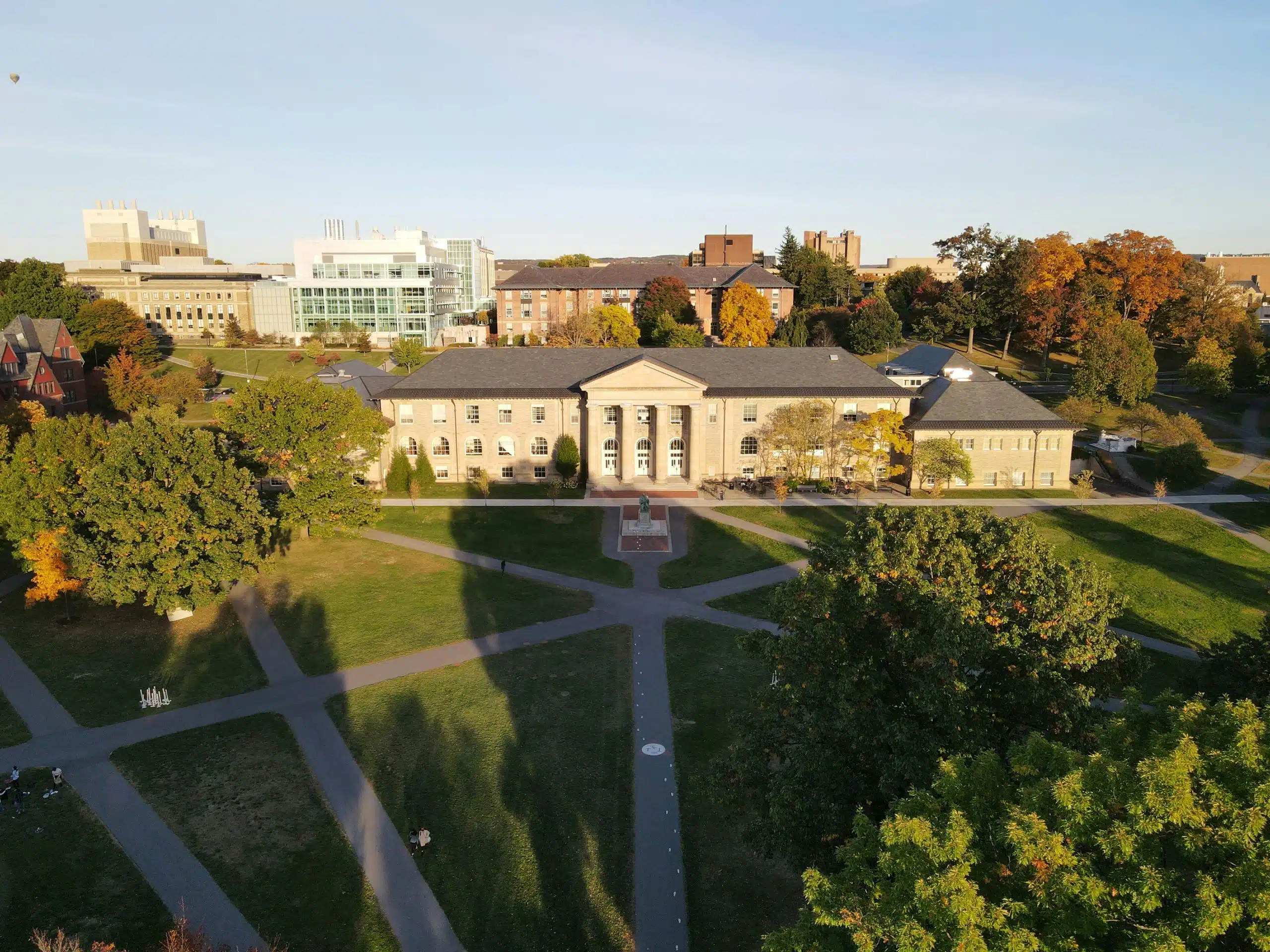
From waterfalls and clock tower chimes to fresh apple vending machines, Cornell University is full of surprises. It has the largest undergraduate population in the Ivy League, with over 16,000 students, and it’s currently ranked #11 among national universities. But those are the kinds of facts you’ll find in any brochure.
In this blog, you’ll learn fun facts about Cornell that most students don’t hear until they’re already on campus. We’ll also walk through the best campus traditions you won’t want to miss.
- 10 Fun Facts about Cornell University
- Cornell Traditions You Should Join
- Frequently Asked Questions
- Takeaways
10 Fun Facts about Cornell University
Cornell is known for its rigorous academics, beautiful campus, and rich history. It consistently ranks among the top 20 universities in the U.S. and lives up to its motto, “any person, any study,” by offering over 100 fields of study, including engineering, agricultural sciences, biological sciences, and architecture.
But how does Cornell stand out from other colleges, including the Ivies? If you’re curious about what makes this school unique, here are 10 fun facts that might surprise you:
1. Cornell was almost located in Syracuse.
Cornell University came very close to being built in Syracuse instead of Ithaca. The school was founded by Ezra Cornell, a successful businessman from Ithaca, and Andrew Dickson White, a politician and scholar from Syracuse.

The two met in the New York State Senate and combined their visions for a new kind of university. White believed in rethinking higher education, and Cornell wanted to use his wealth to benefit future generations.
White pushed for Syracuse, a growing transportation hub, as the university’s location. But Cornell had a personal reason to say no: he had been robbed of his wages there as a teenager. Instead, he chose to build the school in his hometown of Ithaca over what might’ve been the more practical option.
Honestly, it’s hard to picture Cornell anywhere else. The hills, waterfalls, and gorges feel like part of campus life.
2. The campus is huge! (And gorgeous!)
Cornell’s main campus in Ithaca covers 745 acres on a hilltop overlooking Cayuga Lake. It sits in the Finger Lakes region, surrounded by deep gorges, wooded trails, and waterfalls that you can actually walk past on your way to class. The university also owns the nearby Cornell Botanic Gardens, which has over 3,000 acres of gardens and forest.
When you tour the campus, you’ll hear the phrase “Ithaca is Gorges.” It’s a running joke here, but it’s also true. Few campuses offer this kind of natural beauty alongside world-class academics. You might walk across a suspension bridge on your way to class or hear the sound of rushing water while studying on the quad.
Beyond Ithaca, Cornell also has a tech campus in New York City and a medical school in Qatar. Still, most students say the Ithaca campus is the heart of the university. It offers a rare mix of peaceful nature, academic energy, and everyday beauty—all in one place.
3. Cornell is the only Ivy that blends public and private education.
Most Ivy League schools are fully private, but Cornell is different. It includes both private and state-funded colleges. These state-assisted schools receive support from New York State and are sometimes called contract colleges. They include:
- Cornell University College of Agriculture and Life Sciences
- Cornell University College of Human Ecology
- Cornell University School of Industrial and Labor Relations
- Cornell SC Johnson College of Business: Charles H. Dyson School of Applied Economics and Management
- Cornell Jeb E. Brooks School of Public Policy
Together, these schools receive over $130 million each year to support research and teaching. That funding helps make specific majors more affordable for New York State residents.

Even with these differences, Cornell still functions as one unified university. All students share the same campus resources, and you can take classes across colleges, regardless of your school. If you’re applying, focus on the program that fits your academic goals, whether state-supported or privately funded.
4. Cornell ranks second in the nation for dining hall food.
Cornell has one of the top-rated dining options in the country. It currently ranks second nationwide, and students regularly praise the quality and variety of the food. The university offers 10 dining rooms, a food court, multiple cafes, and a completely kosher dining room. There’s also a campus dairy bar where you can grab freshly made ice cream!
Cornell focuses on fresh ingredients and seasonal menus. Most food is made from scratch, and the university works with local farms to source ingredients when possible. There’s even a mystery shopper program, where trained student reviewers visit dining spots and give anonymous feedback on food quality and service.
Sustainability is also part of the dining culture. In 2021, Cornell Dining committed to increasing plant-based options by at least 5% to 10% each year. The dining halls also promote reusable containers and monitor how often students use them.
5. Chicken nuggets were invented here!
Long before McDonald’s made them famous, chicken nuggets were born in a Cornell lab. Robert Carl Baker, a Cornell graduate from the Class of 1943, developed the first nugget recipe in the 1960s while working as a Food Science professor. He spent 32 years at Cornell creating new poultry products that helped transform the American food industry.
Baker didn’t stop at nuggets. He also invented turkey ham, chicken hot dogs, and dozens of other items that made poultry easier to prepare, package, and sell. His work made chicken a major player in U.S. supermarkets and school cafeterias. Most people associate nuggets with fast food, but the original idea came from research done right on this campus.
6. They have a fresh apple vending machine.
Most vending machines are stocked with chips, candy, or soda. At Cornell, you can get something a little healthier. In the lobby of Mann Library, there’s a vending machine that sells fresh apples grown just a few miles away at Cornell Orchards.
The apples come in different varieties, sometimes up to nine kinds, depending on the time of year. They’re picked, stocked, and maintained by the Society for Horticulture at Cornell (SoHo), a student-run organization of graduate students in horticulture. These students also use the profits from the machine to support their projects and community events.

Cornell is one of the top schools in the world for agricultural sciences, and the vending machine is just one example of how that shows up in everyday college life. The apples are bred for flavor and texture, combining sweetness, crispness, and just the right amount of tartness.
7. Cornell is on a hill!
If you’ve received any emails or brochures from Cornell, you’ve probably seen the phrase “CU on the Hill.” It’s a play on words. CU stands for Cornell University, and North Campus, where most first-year students live, sits high on a hill. But here’s the fun part: there might actually be a giant “CU” hidden in the layout of the college dorms.
Take a look at a satellite image of North Campus on Google Maps. You’ll notice that Dickson Hall is shaped like a “C,” and Balch Hall forms a wide “U.” The two buildings sit side by side, and from above, they look like the letters “CU.” According to campus lore, they were once planned as one massive dorm, but that idea was scrapped. What’s left is a bit of accidental design that turned into an inside joke.
Whether intentional or not, the buildings spell out the university’s initials for everyone flying overhead—and for any incoming student who wants to spot them before move-in day.
8. There are hundreds of famous Cornell alums.
Cornell has produced a long list of well-known graduates across many fields. Some of the most recognizable names include Bill Nye the Science Guy, U.S. Supreme Court Justice Ruth Bader Ginsburg, Superman actor Christopher Reeve, political commentator Keith Olbermann, comedian Bill Maher, and musician Huey Lewis.
One of the most unique campus contributions came from Bill Nye. In 2011, he donated a “solar noon” clock to Rhodes Hall, which includes a clever feature that highlights Cornell’s focus on science and design. At solar noon each day, sunlight funnels through a tube and lights up a disc on the clock face. It’s a subtle but striking reminder of how science, engineering, and tradition come together on campus.
9. The Cornell Chimes ring across the quad.
Since 1868, the Cornell Chimes have rung out from McGraw Tower across central campus. During the school year, student chimesmasters perform up to three live concerts a day. Each performance features a mix of classical music, pop songs, and Cornell fight songs, all played manually on 21 bells.

It’s common to hear the bells as you walk across the Arts Quad. Some students pause to listen or try to guess the tune. You’ll hear everything from Taylor Swift to Beethoven, depending on the day. If you’re on campus during a concert, take a moment to enjoy it.
You can even book the chimesmasters for private events, including weddings. Whether you’re visiting for the first time or already enrolled, the sound of McGraw Tower is something you’ll remember.
10. Some say Cornell is haunted.
If you’re into ghost stories, Cornell has more than a few. The campus has many paranormal claims tied to specific buildings and events. One of the most chilling stories involves the 1967 fire at the original Ecohouse, which killed eight students and a professor. Since then, some have reported unexplained sounds and strange activity in the area.
Other campus buildings have their own legends. Students say Willard Straight Hall is home to ghosts in tuxedos who are seen waltzing through the building late at night. Risley Hall has its figure named “Auntie Pru,” who shows up occasionally. There’s even talk of a shadowy presence in Olin Library that some believe is a stalker spirit.
One of the most well-known campus ghosts is Alice Statler, who’s said to haunt the Statler Hotel. In 2004, two employees reported encounters with her, and one quit on the spot.
These stories may sound far-fetched, but they’ve been around for years. Whether you believe in ghosts or not, the haunted side of Cornell is part of what makes campus lore so memorable.
Cornell Traditions You Should Join
Now that you know some fun facts about Cornell, here are the campus traditions worth joining:
1. Dragon Day
Each March, Cornell celebrates one of its oldest and wildest traditions: Dragon Day. First-year architecture students design and build a massive dragon, parade it through campus, and bring it to the Arts Quad. There, the dragon faces off with a phoenix made by engineering students before being dramatically set on fire.
The tradition dates back to 1901 and takes place the day before spring break. T-shirt sales help fund the project, and the whole event draws a crowd. It’s loud, weird, and one of the most unforgettable days of the year.
2. Slope Day
Each May, Cornell students head to Libe Slope to celebrate the last day of classes with a huge outdoor concert. Thousands gather for live music, food, and one last break before finals begin. It’s one of the most anticipated days of the year.

Over the decades, Slope Day has featured major artists like Drake, Kendrick Lamar, Snoop Dogg, and the Pussycat Dolls. Even Duke Ellington and The Grateful Dead played here back in the day. Whether you’re into the music or just the atmosphere, Slope Day is a core part of the Cornell experience.
3. Sy Katz ’31 Parade
Whenever Cornell plays Columbia in New York City, the Big Red Marching Band gets its own parade through Manhattan. No other Ivie has anything like it!
The tradition began in 1972, thanks to Seymour “Sy” Katz, Class of ’31. He loved the band and thought it deserved a proper spotlight. With help from friends at the Cornell Club-New York, he secured a one-block police permit, and the Sy Katz Parade was born. Today, it’s a lively, student-led celebration that fills the streets with Big Red pride.
Frequently Asked Questions
1. What is Cornell University known for?
Cornell is known for its academic programs and stunning hilltop campus in Ithaca, New York. It’s the only Ivy League school with both private and state-funded colleges. The university excels in fields like engineering, agriculture, and architecture.
2. What are some interesting facts about Cornell University?
Cornell has many interesting facts that make it stand out from other schools. For example, chicken nuggets were invented on campus. They have a fresh apple vending machine and celebrate Dragon Day with a giant flaming sculpture.
3. What should I know about Cornell before applying?
Some Cornell colleges are state-assisted and offer lower tuition for New York residents. The campus is large and hilly, with waterfalls and gorges woven into everyday student life. It’s a fast-paced, academically intense environment but also full of tradition and personality.
Takeaways
- Cornell’s fun facts highlight its mix of academic strength, rich history, and quirky traditions.
- Students find ways to balance challenging coursework with events like Dragon Day and Slope Day.
- The campus blends natural beauty with one-of-a-kind features like chimes concerts and apple vending machines.
- Cornell’s culture encourages both serious learning and moments of fun that stick with you long after graduation.
- Not sure how to get started on your Cornell journey? An admissions expert can help you strengthen your application and improve your chances of getting in.










