Founded in 1852 as Tufts College by a group of Universalists who envisioned a nonsectarian home for higher learning, Tufts University is a private research university located atop Walnut Hill, straddling the cities of Medford and Somerville, just five miles northwest of Boston. When benefactor Charles Tufts donated the land, he famously declared he would “put a light on it,” a spirit that still defines the university today. This guide walks through Tufts’ campus landmarks, the neighborhoods surrounding it, getting around the Greater Boston area, and what everyday life on the Hill is like.
- Tufts University Campus Location
- Getting to Tufts University
- Living Near Tufts University
- Why You Should Visit Tufts University’s Campus
- Frequently Asked Questions
- Takeaways
Tufts University Campus Location
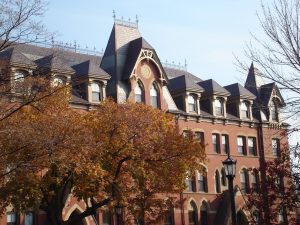
Spanning roughly 80 acres atop Walnut Hill, Tufts University is centered at 419 Boston Avenue in Medford, where the campus is located along the Medford–Somerville line. Its red-brick architecture blends historic Italianate and Georgian-style buildings around the Academic Quad with newer facilities that extend downhill into Somerville, creating a classic New England hilltop setting. The campus is naturally divided into “Uphill,” home to the academic core and residential quad, and “Downhill,” which connects more directly to the surrounding neighborhoods.
Positioned between two cities rather than alongside a single neighboring institution, Tufts draws much of its character from both Medford and Somerville. The university continues to expand its residential footprint on and around campus, including a new housing development at 401–403 Boston Avenue scheduled to open in 2027.
Main campus landmarks
Campus life at Tufts University centers on the Academic Quad, the hilltop lawn that anchors the Medford/Somerville campus and hosts major traditions, concerts, and daily student activity. Overlooking the quad is Ballou Hall (1852–1855), the university’s founding building and an Italianate red-brick landmark that now houses the offices of the president and provost. Nearby stands Goddard Chapel (1883), a blue-gray slate chapel known for its bell tower and annual Illumination Ceremony, where new students are welcomed with lanterns and light in honor of Tufts’ motto, “Pax et Lux” (“Peace and Light”).
Academic life is anchored by Tisch Library along Professors Row, which connects the Uphill and Downhill sections of campus and serves as one of Tufts’ primary study spaces. Student activity centers on the Mayer Campus Center, home to dining areas, student organization offices, meeting spaces, and the campus bookstore.
Athletics are concentrated around the Steve Tisch Sports and Fitness Center on College Avenue, alongside the wider Tufts Athletics Complex, which includes Ellis Oval, the Gantcher Family Sports and Convocation Center, baseball and field hockey facilities, and the Tufts Tennis Center.
Tufts University’s other campuses and affiliated sites
Beyond its Medford/Somerville hilltop campus, Tufts University operates several specialized campuses across Massachusetts, each serving a distinct academic purpose.
The largest is the Boston Health Sciences Campus in downtown Boston’s Chinatown neighborhood. Centered on Harrison Avenue, it houses the School of Medicine, School of Dental Medicine, Friedman School of Nutrition Science and Policy, Graduate School of Biomedical Sciences, and the Jean Mayer USDA Human Nutrition Research Center on Aging. Adjacent to the campus is Tufts Medical Center, the university’s primary teaching hospital and a major hub for clinical training.
In Boston’s Fenway neighborhood, the SMFA campus places the School of the Museum of Fine Arts beside the Museum of Fine Arts and the Isabella Stewart Gardner Museum, giving students direct access to one of the city’s leading cultural districts and extensive studio and gallery spaces.
Further west, the 594-acre Grafton Campus in North Grafton is home to the Cummings School of Veterinary Medicine. The rural campus includes the Foster Hospital for Small Animals, the Hospital for Large Animals, and the Tufts Wildlife Clinic, making it one of the country’s most comprehensive veterinary training centers.
These campuses are linked through university shuttles, MBTA transit access, and commuter rail connections, allowing students and faculty to move easily between Tufts’ academic, medical, arts, and research environments.
Getting to Tufts University
Getting to Tufts University is straightforward once you know the Medford/Somerville campus sits atop Walnut Hill, with most routes leading in through College Avenue or Boston Avenue. The easiest public transit access is via the MBTA Green Line E branch, which stops directly on campus at Medford/Tufts station along Boston Avenue.
Visitors coming from the Red Line can exit at Davis Square and either walk about 15 minutes north along College Avenue past Powderhouse Square, take the #94 or #96 bus, or use the Tufts Shuttle, which runs regularly and can be tracked through the Tufts Mobile app. From there, the campus is easily navigated through a combination of MBTA transit, university shuttles, and limited on-campus driving access.
Public transportation options
Public transit is one of the easiest ways to navigate both Tufts University and Greater Boston. The MBTA Green Line E branch stops directly on campus at Medford/Tufts station, while the Red Line’s Davis Square station is about a 15-minute walk down College Avenue. Most Tufts students can purchase discounted MBTA semester passes through the university, and SMFA students receive unlimited subway and local bus access through the SMFA UPass program.
Tufts also operates free campus shuttles, including the Davis Square Shuttle between campus and Davis Square and the SMFA Shuttle linking the Medford/Somerville and Fenway campuses. Both routes run regularly and can be tracked through the Tufts Mobile app.
For regional travel, South Station and Back Bay Station provide access to Amtrak and MBTA Commuter Rail services, while Logan International Airport can be reached by MBTA connections in under an hour.
Getting there by car or other means
Driving to Tufts University is easiest via I-93 or Route 2, both of which connect to College Avenue and Boston Avenue along the edges of campus. Parking, however, is limited. Visitors can use the Dowling Hall Parking Garage, Lower Campus Garage, or Cousens Parking Lot, with payment available through the AIMS Mobile Pay app or on-site kiosks. Most nearby street parking in Medford and Somerville requires resident permits.
For air travel, Boston Logan International Airport is the closest major airport, about 30–45 minutes away by car and accessible by MBTA connections through South Station and Davis Square. Manchester-Boston Regional Airport is another option, roughly an hour north of campus.
Biking and rideshare services are also widely used. Tufts supports cycling through bike loan programs, repair stations, and discounted access to the Bluebikes network around Medford and Somerville. Zipcar and Lyft are both integrated into campus transportation options.
Living Near Tufts University
The area surrounding Tufts University blends the feel of a traditional New England college town with the energy of Greater Boston’s urban neighborhoods. Streets around Walnut Hill are lined with Victorian homes, local businesses, and a mix of students, longtime residents, families, and artists that give the area a lively but grounded atmosphere.
Student life extends well beyond campus, especially in Davis Square, a popular Somerville neighborhood about 15 minutes away on foot or by shuttle. Known for its independent restaurants, cafés, bookstores, and music venues, it serves as one of the main social hubs for Tufts students. Nearby Medford Square offers a quieter neighborhood feel, while downtown Boston, just five miles away and accessible by the Green Line, gives students easy access to museums, concerts, professional sports, and one of the country’s strongest food scenes.
Tufts also maintains close ties with surrounding communities through civic engagement programs and partnerships in Medford, Somerville, and Boston’s Chinatown. Community initiatives, volunteer programs, and annual events like Community Day help connect the university with local residents.
Green space is a major part of campus life as well. The Academic Quad and Residential Quad provide open gathering spaces on campus, while the nearby Middlesex Fells Reservation, Mystic River, and Somerville Community Path offer easy access to hiking, biking, running, and outdoor recreation without leaving the city.
Places to check out near Tufts University
There are many things to do near Tufts. The closest and most popular student hangout is Davis Square, just a shuttle ride away, packed with restaurants, shops, and the indie Somerville Theatre, home to the Museum of Bad Art.
In Boston, the Freedom Trail connects 16 historic landmarks along a 2.5-mile walk, while Boston Common and Faneuil Hall offer classic city experiences. Art lovers can take advantage of free admission at the Museum of Fine Arts, or visit the Isabella Stewart Gardner Museum and the waterfront Institute of Contemporary Art, both easily accessible by the T.
For interactive activities, Amaze Escape in Arlington offers classic escape rooms, while Boda Borg Boston in Malden features 17 physical challenge quests. Outdoorsy students can explore the 2,200-acre Middlesex Fells Reservation or bike the 10-mile Minuteman Bikeway stretching from Bedford to Cambridge. Climbers can also check out MetroRock Boston or Brooklyn Boulders in Somerville, both reachable by bus.
Nearby Assembly Row is a go-to spot for shopping, dining, and entertainment, while Bow Market in Union Square offers a more local mix of boutiques and cafés. For vintage finds, The Garment District in Cambridge is a student favorite thrift store, while Newbury Street in Boston is lined with boutiques, salons, and restaurants for a more upscale shopping trip.

Why You Should Visit Tufts University’s Campus
Visiting Tufts University in person offers a much clearer sense of campus life than any guide can provide. The hilltop setting, the split between Uphill and Downhill, the walkability to Davis Square, and the proximity to Boston all shape the student experience in ways that are easier to understand once you are on campus.
Tufts offers campus tours and information sessions covering academics, residential life, dining, traditions, and major campus landmarks. Tours are led by current students and typically include a 45-minute information session followed by a 70-minute walking tour.
AdmissionSight’s Senior Editor College Application Program guides school selection, application strategy, and admissions planning before you even step on campus. The program will help you build your college list, see where Tufts fits into that, and how you can position your application to maximize your chances.
Frequently Asked Questions
1. What is Tufts University’s address?
The main Medford/Somerville campus is located at 419 Boston Avenue, Medford, MA 02155.
2. How big is Tufts University?
The Medford/Somerville campus spans about 80 acres atop Walnut Hill.
3. Can I visit Tufts University before applying?
Yes. Tufts offers campus tours and information sessions Monday through Friday at the Medford/Somerville campus, with registration required. Self-guided audio tours are also available for those who can’t attend a scheduled visit.
4. Is parking available at Tufts University?
Yes, but it’s limited. Visitors can park hourly at the Dowling Hall Parking Garage (419 Boston Ave), the Lower Campus Garage, or the Cousens Parking Lot, paid via the AIMS Mobile Pay app or on-site kiosks.
5. What landmarks are near Tufts University?
Davis Square (15-minute walk), the Somerville Theatre, Middlesex Fells Reservation, the Mystic River, and the Somerville Community Path are all close by. Boston’s Museum of Fine Arts and Isabella Stewart Gardner Museum are one Green Line ride away.
Takeaways
- Tufts University is located at 419 Boston Avenue on Walnut Hill, straddling the cities of Medford and Somerville, just five miles northwest of downtown Boston.
- Tufts sits at the intersection of two distinct cities, with Medford and Somerville each shaping the campus’s edges, and benefits from proximity to Davis Square’s dining and arts scene, the Middlesex Fells Reservation, and a walkable, transit-connected surrounding neighborhood.
- Beyond the main campus, Tufts operates four distinct campuses, including a Health Sciences campus in Boston’s Chinatown, an arts campus in the Fenway, and a 594-acre veterinary campus in Grafton.
- Students benefit from direct Green Line access to Boston, discounted and free MBTA pass programs, free campus shuttles, and Bluebikes bike-share, making a car-free life genuinely practical, while Logan International Airport is reachable in under an hour by transit.
- If you want to make the most of your understanding of Tufts University’s location for competitive college admissions, working with a college admissions expert can help. We’ll guide you in linking Tufts’ hilltop setting, civic-minded academic environment, and Greater Boston opportunities to your goals, showing how location strengthens your fit, interests, and future plans.