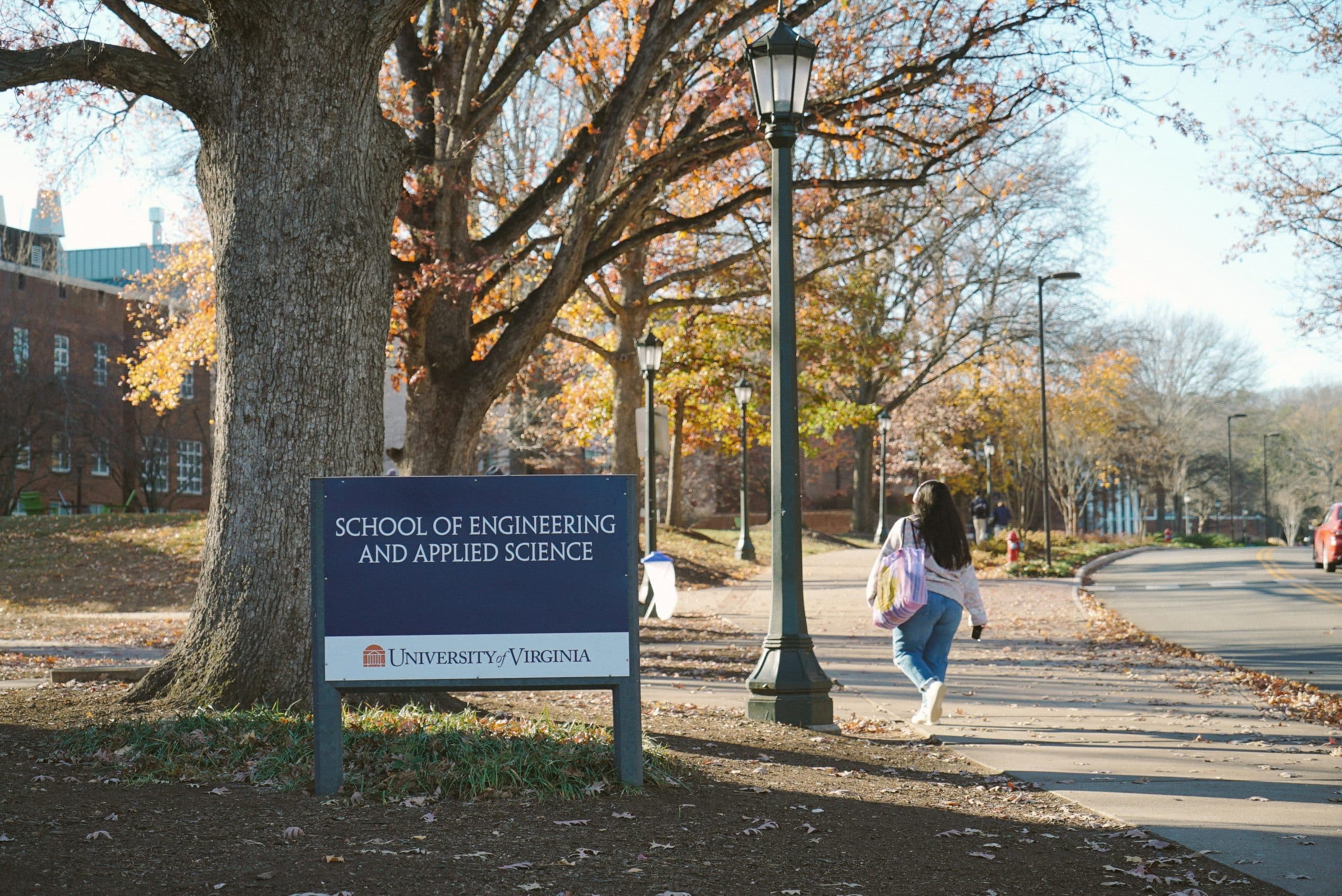
The University of Virginia (UVA) is a public research university founded in 1819 by Thomas Jefferson. Located in Charlottesville, Virginia, UVA is known for its historic Academical Village, which Jefferson designed himself and is now recognized as a UNESCO World Heritage Site.
UVA sits near the foothills of the Blue Ridge Mountains in a college-town environment that blends historic architecture, student traditions, and a strong academic culture. Students commonly refer to the campus as “Grounds,” a long-standing university tradition that reflects UVA’s distinct identity and history.
In this guide, we’ll cover where UVA is located, what makes its Grounds unique, how students and visitors typically get there, and what life in Charlottesville is like for UVA students.
- UVA Campus Location
- Getting to UVA
- Living Near UVA
- Why You Should Visit UVA
- Frequently Asked Questions
- Takeaways
UVA Campus Location
The University of Virginia is located at 1827 University Avenue in Charlottesville, a small city situated between the Blue Ridge Mountains and Virginia’s Piedmont region. UVA spans roughly 3,300 acres across Charlottesville and Albemarle County, with about one-third of that footprint concentrated in the central academic area known as Grounds. The campus includes academic buildings, residence halls, athletic facilities, research centers, and UVA Health.
UVA is especially known for its Jeffersonian architecture. Thomas Jefferson designed the original campus using Neoclassical and Palladian influences, creating the red-brick buildings, white columns, and covered walkways that still define much of the university today. The Academical Village and Jefferson’s nearby home, Monticello, were jointly designated as a UNESCO World Heritage Site in 1987.
The layout of the Grounds reflects Jefferson’s original idea of a connected academic community where students and faculty live and learn within the same shared environment. Much of the academic core is highly walkable, with classrooms, residence halls, libraries, gardens, and student spaces located close together.
Beyond Central Grounds, the university also includes North Grounds, home to the University of Virginia School of Law and the Darden School of Business, along with additional athletic facilities, research spaces, and student housing areas throughout Charlottesville.
Student life extends directly into the surrounding city. The Corner, located along University Avenue beside the Grounds, serves as a major student area filled with restaurants, cafés, bookstores, and shops. A short distance away, the Downtown Mall acts as one of Charlottesville’s main cultural and dining districts.
Main campus landmarks
The Rotunda is the defining landmark of UVA and one of the most recognizable buildings in American higher education. Thomas Jefferson designed it as a half-scale interpretation of the Roman Pantheon, and it anchors the north end of the Lawn. The Rotunda originally housed the university library and today hosts lectures, ceremonies, and university events. It was designated a National Historic Landmark in 1966 and remains one of the most visited sites on Grounds.
Stretching south from the Rotunda is The Lawn, the central green space of the Academical Village. The Lawn is lined by student rooms and the ten historic Pavilions, each designed with different classical architectural influences. Behind that are Pavilion Gardens and Jefferson’s well-known Serpentine Walls. Lawn rooms are among UVA’s most prestigious student housing options and are traditionally reserved for selected fourth-year students.
The Lawn area also includes the Memorial to Enslaved Laborers, dedicated in 2021 to honor the more than 4,000 enslaved individuals who built and maintained the early university. At the south end of the Lawn is Old Cabell Hall, which houses a major auditorium used for concerts, lectures, and ceremonial university events.
The Edgar Shannon Library serves as UVA’s primary research library and study space following a major renovation that was completed in 2024. Meanwhile, nearby Newcomb Hall is one of the university’s main student centers, with dining areas, student organization offices, meeting rooms, and event spaces.
UVA’s arts and athletics facilities are spread throughout the Grounds. The Fralin Museum of Art and the Kluge-Ruhe Aboriginal Art Collection support the university’s visual arts programs, while Scott Stadium and John Paul Jones Arena host Virginia Cavaliers athletics, concerts, and major campus events.
UVA’s other campuses and affiliated sites
While Charlottesville remains the center of the University of Virginia, the university also operates several additional campuses and affiliated sites serving graduate, professional, medical, and continuing education programs.
As mentioned earlier, one major extension of the Grounds is North Grounds, located northwest of the university’s central academic area. North Grounds is home to the University of Virginia School of Law and the Darden School of Business, along with graduate housing, research facilities, and athletic spaces. The area has its own distinct layout and architectural style while remaining connected to Central Grounds through university transit and walking routes.
UVA’s medical and healthcare programs are centered around UVA Health on the southern side of Grounds. The medical campus includes the School of Medicine, School of Nursing, University Hospital, specialty clinics, and major research facilities, making it one of the university’s largest professional and employment centers.
Beyond Charlottesville, UVA has expanded its presence in Northern Virginia through UVA Northern Virginia and its newer Fairfax campus located within the Inova Center for Personalized Health. The 55,000-square-foot facility supports graduate degrees, professional certificates, and continuing education programs across fields such as business, engineering, data science, commerce, and healthcare.
The university also maintains a long-standing partnership with Inova Fairfax Hospital, where UVA medical students complete clinical training and rotations. In addition, the Darden School of Business operates executive education and professional programs from its Rosslyn location near Washington, D.C.
UVA Wise
University of Virginia’s College at Wise, commonly known as UVA Wise, is a public liberal arts college located in Wise, Virginia, in the southwestern part of the state near the Appalachian Mountains. Although it is part of the broader UVA system, UVA Wise operates as its own separate institution with a smaller residential campus and a stronger liberal arts focus.
UVA Wise offers undergraduate programs in areas such as business, education, nursing, environmental science, and the humanities. Compared to the main Charlottesville campus, the college has a significantly smaller student population, with about 1,922 students compared to roughly 22,000 in Charlottesville, creating a more close-knit campus environment centered around undergraduate teaching and student support.
The campus is known for its mountain setting, outdoor recreation opportunities, and strong regional ties to Southwest Virginia. While it operates independently from the main UVA Grounds, students at UVA Wise still benefit from connections to the larger University of Virginia system and its academic reputation.
Getting to UVA
The University of Virginia Grounds are located in Charlottesville, roughly two hours southwest of Washington, D.C. and about an hour northwest of Richmond. Getting to UVA is manageable by car, train, bus, or plane, though the available options can vary depending on where students or visitors are traveling from.
Below, we’ll cover public transportation options, driving and parking information, nearby airports, and how students typically get around Charlottesville and the Grounds.
Public transportation options
UVA operates its own free bus network called the University Transit Service (UTS), which connects academic buildings, residence halls, parking areas, the medical center, and nearby neighborhoods throughout the day. UTS is one of the primary ways students travel around the Grounds and can be tracked in real time through the university’s transit apps and services.
Students can also use Charlottesville Area Transit (CAT), the city’s public bus system, which serves downtown Charlottesville and surrounding neighborhoods. One of the most commonly used routes for students is the free trolley line running along University Avenue between the Grounds and the Downtown Mall.
Train travel is another practical transportation option for UVA students. Amtrak operates service through the Charlottesville Union Station at 810 West Main Street, located between the university and downtown Charlottesville. The station provides rail connections to cities including Washington, D.C., Richmond, New York, and other destinations along the Northeast Corridor.
Students traveling longer distances can also use the Virginia Breeze bus service, which connects Charlottesville to destinations including Washington Union Station. During major academic breaks, UVA Student Council additionally operates the Airbus coach service, offering roundtrip transportation between the Grounds and nearby airports.
Getting there by car or other means
Charlottesville is accessible by car through major routes including Interstate 64 and U.S. Route 29, which connect the city to Richmond, Northern Virginia, Washington, D.C., and other parts of the state. University Avenue serves as one of the main roads leading directly onto the Grounds.
Parking on the Grounds is managed through UVA Parking and Transportation. Students who keep vehicles on campus must obtain parking permits, while visitors can use hourly parking options through the ParkMobile app. The Central Grounds Garage, located beneath the University Bookstore, serves as one of the university’s main visitor parking locations.
Many students living near the Grounds choose not to bring a car because Charlottesville is relatively compact, walkable, and bike-friendly. Walking and cycling are common ways to travel between classes, residence halls, restaurants, and student areas around the university.
Students and visitors traveling to UVA can also choose from several nearby airports, including:
- Charlottesville Albemarle Airport (CHO)
- Richmond International Airport (RIC)
- Washington Dulles International Airport (IAD)
- Ronald Reagan Washington National Airport (DCA)
- Baltimore/Washington International Thurgood Marshall Airport (BWI)
The closest airport is CHO, located about eight miles north of the Grounds with direct flights to several major hub cities. IAD is farther away but offers more domestic and international flights. Rideshare services like Uber and Lyft are also widely available throughout Charlottesville and near campus.

Living Near UVA
Life at UVA offers a mix of college-town culture and major research university activity. Charlottesville is small enough for students to quickly become familiar with the area while still offering a strong arts scene, local restaurants, outdoor recreation, and access to larger cities like Richmond and Washington, D.C.
Student life at UVA is highly active both on and off the Grounds. The university has more than 800 student organizations, a strong Greek life presence, and Division I athletics in the Atlantic Coast Conference (ACC). Virginia Cavaliers football and basketball games, especially at Scott Stadium and John Paul Jones Arena, are major social events throughout the academic year.
Much of daily student life centers around the Corner and the surrounding University Avenue area beside the Grounds. The Corner is filled with restaurants, cafés, bookstores, and local businesses where students study, eat, and spend time between classes. A short walk or trolley ride away, the Downtown Mall offers an eight-block pedestrian district with restaurants, galleries, boutiques, music venues, and the outdoor Ting Pavilion performance space.
Charlottesville is also known for its outdoor access, food scene, and overall quality of life. The city was included in Outside Magazine’s 2023 list of “The 15 Happiest Places to Live in the U.S.,” reflecting the city’s mix of outdoor recreation, community culture, and livability.
Places to check out near UVA
Students at the University of Virginia have access to a mix of historic sites, outdoor destinations, restaurants, music venues, and local cultural attractions throughout Charlottesville and the surrounding region.
The Blue Ridge Mountains are visible from much of the Grounds, and nearby destinations such as Shenandoah National Park and the Blue Ridge Parkway are popular for hiking, camping, scenic drives, and weekend trips. The Charlottesville area also sits in the center of Virginia wine country, with vineyards such as King Family Vineyards and Barboursville Vineyards located within driving distance of campus.
Students interested in history and architecture often visit Monticello, the historic home of Thomas Jefferson. Charlottesville is also known for its food scene, with popular student and local spots including Bodo’s Bagels, The Virginian Restaurant, and Citizen Burger Bar.
Live music, film screenings, arts festivals, and Virginia Cavaliers sporting events contribute to Charlottesville’s active college-town atmosphere throughout the year. Areas like the Downtown Mall and the Ting Pavilion regularly host concerts, community events, and performances attended by both students and local residents.
Why You Should Visit UVA’s Campus
The University of Virginia is one of the few colleges where the physical campus is deeply tied to the university’s identity and traditions. Seeing the Grounds in person gives you a better understanding of how students experience UVA day to day, from walking across the Lawn between classes to spending time around the Corner and downtown Charlottesville.
An in-person visit can also help you notice details that are difficult to understand through brochures or rankings alone. You may realize you enjoy UVA’s blend of historic architecture and active student culture, or you may discover that the size, setting, or social atmosphere feels different from what you expected. Those reactions often become much clearer once you spend time on campus yourself.
UVA offers official information sessions, student-led tours, self-guided visits, and virtual resources for prospective applicants. You can find updated tour schedules and visit information through the official UVA Admissions Visit Grounds page.
For students still narrowing down their college list, AdmissionSight’s Senior Editor College Application Program can provide additional guidance throughout the admissions process. The program helps you evaluate schools more strategically while strengthening your essays, extracurricular positioning, and overall application approach.
By the time you begin visiting campuses, having a clearer admissions strategy can make it easier to evaluate which universities genuinely match your academic goals, interests, and preferred campus environment. Learn more by scheduling a consultation with us.
Frequently Asked Questions
1. What is UVA’s address?
University of Virginia is located at 1827 University Avenue, Charlottesville, VA 22903.
2. How big is UVA?
UVA spans roughly 3,300 acres across Charlottesville and Albemarle County in central Virginia. About one-third of that footprint is concentrated in the university’s central academic area known as the Grounds surrounding the historic Academical Village.
3. Can I visit UVA before applying?
Yes. UVA offers student-led tours, information sessions, self-guided visits, and virtual resources for prospective students and families. You can schedule a visit through UVA’s official website.
4. Is parking available at UVA?
Yes. Visitor parking is available throughout the Grounds through hourly parking locations and garages. Students who keep vehicles on campus must obtain parking permits, although many students living near the Grounds rely on walking, biking, and public transportation instead.
5. What landmarks are near UVA?
Popular destinations near UVA include Monticello, the Downtown Mall, Shenandoah National Park, and the Blue Ridge Parkway. The Charlottesville area is also known for its vineyards, hiking destinations, restaurants, and arts venues.
Takeaways
- The University of Virginia is located in Charlottesville, Virginia, giving students a college-town environment surrounded by central Virginia’s historic landscape.
- UVA’s Grounds are known for their Jeffersonian architecture, historic Academical Village, and landmarks such as the Rotunda, the Lawn, and Old Cabell Hall, all of which play a major role in university traditions and student life.
- Beyond the central Grounds, UVA also operates additional academic and professional sites including North Grounds, UVA Northern Virginia, and UVA Wise.
- Visiting UVA in person can help you better understand the atmosphere of the Grounds and Charlottesville community.
- Working with an admissions expert can help you build a stronger and more strategic college application plan.