Wake Forest University is a private research university founded in 1834. Originally established in the town of Wake Forest, North Carolina, the university relocated to Winston-Salem in 1956 and moved onto the former Reynolda estate of the R.J. Reynolds family. Today, Wake Forest University’s main campus sits at 1834 Wake Forest Road in Winston-Salem, just north of the city’s downtown area.
Wake Forest’s Reynolda Campus is known for its tree-lined walkways, Georgian-style architecture, and traditional college-campus atmosphere. At the same time, its location in Winston-Salem gives students easy access to restaurants, arts venues, local businesses, and research and innovation spaces throughout the city.
In this guide, we’ll cover where Wake Forest is located, what its campus areas and major landmarks are like, how students and visitors typically get there, and what life in Winston-Salem looks like for Wake Forest students.
- Wake Forest Campus Location
- Getting to Wake Forest
- Living Near Wake Forest
- Why You Should Visit Wake Forest
- Frequently Asked Questions
- Takeaways
Wake Forest Campus Location
Wake Forest University is located in Winston-Salem, North Carolina, on the 340-acre Reynolda Campus just north of downtown. The campus sits on land that was once part of the Reynolda estate of R.J. Reynolds and Katharine Reynolds, and that history still shapes the character of both the university and the surrounding area.
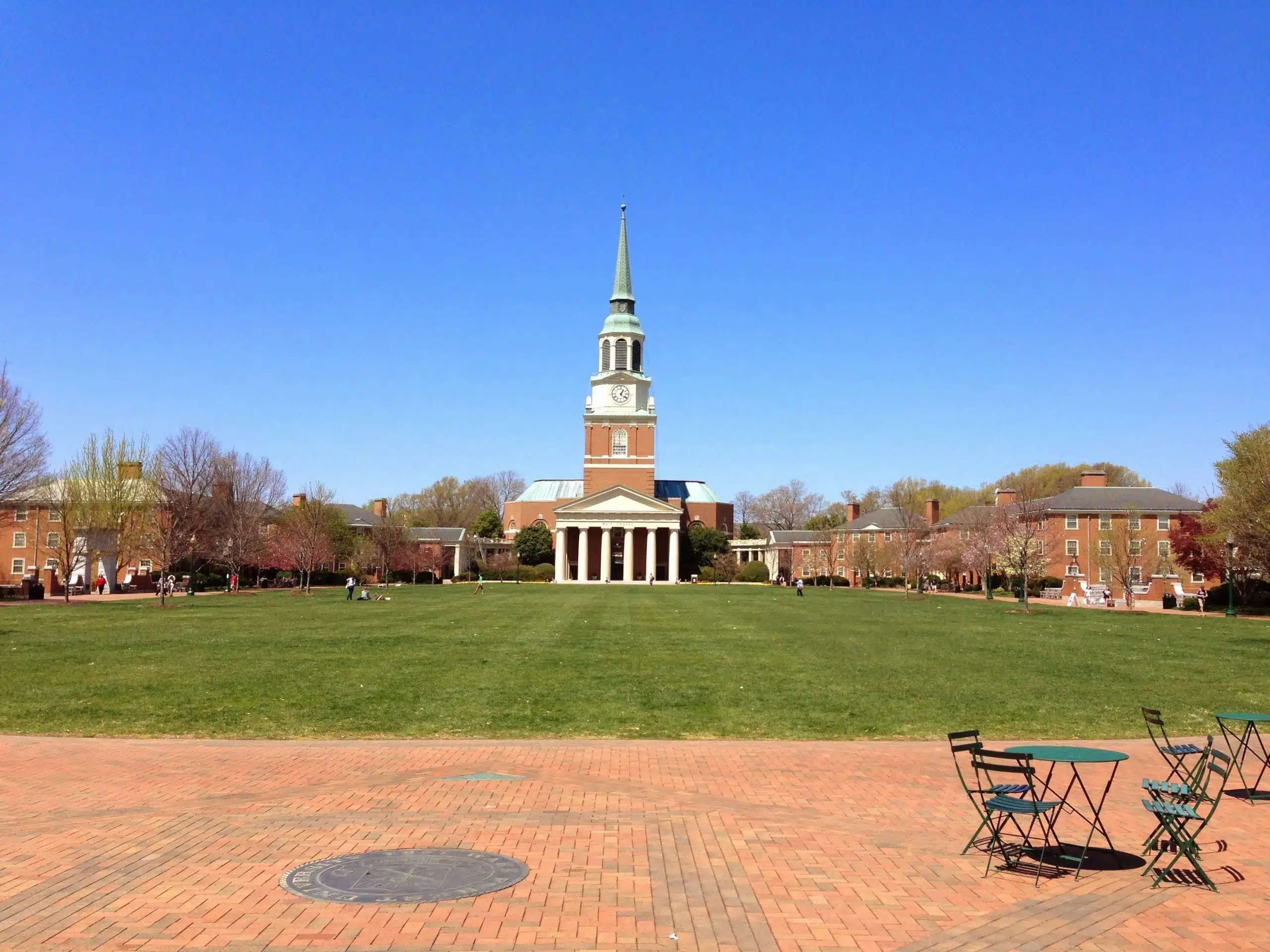
The Reynolda Campus is known for its architectural consistency and traditional collegiate atmosphere. Many of its more than 80 campus buildings were designed in a modified Georgian style using Old Virginia brick, granite, and limestone. Slate roofs, copper accents, and wrought-iron details give the campus a unified appearance that helped rank Wake Forest 13th on Architectural Digest’s list of the most beautiful college campuses in the United States.
The campus layout is compact and highly walkable. Much of the academic core is centered around Hearn Plaza and Manchester Plaza, with Reynolda Hall serving as a central gathering point for administration, dining, and student activity. Most academic buildings, residence halls, and dining areas are within a short walking distance of one another, making it easy for students to navigate campus throughout the day.
Residential life is also a major part of the Wake Forest experience. First-year students are required to live on campus and are placed in one of the university’s residential communities through a housing model called The Forest. Wake Forest has eight first-year residence halls, and all are located within walking distance of the university’s 15 dining facilities and eateries.
Main campus landmarks
Wait Chapel is the defining architectural landmark of the Reynolda Campus. Its copper spire is visible from much of campus, and its location at the center of Hearn Plaza gives it both symbolic and physical importance within university life. The chapel hosts major Wake Forest traditions, including freshman convocation and commencement, while also housing classrooms for the Divinity School and the Department of Religion.
Directly across from Wait Chapel is Reynolda Hall, which serves as both an administrative and student hub. The building houses the offices of the President, Provost, and Dean of the College, along with popular dining spots like The Pit and the Magnolia Room that make it part of many students’ daily routines.
Smith Reynolds (ZSR) Library serves as the university’s primary research library and study space, while Benson University Center functions as the main student hub with dining areas, student organization offices, and Pugh Auditorium. Although Benson was built in the 1990s, its Virginian brick design blends closely with the surrounding campus architecture.
Farrell Hall, home to the Wake Forest School of Business, is one of the university’s most modern academic buildings and combines updated technology with Wake Forest’s traditional architectural style. The building also received LEED Gold Certification from the U.S. Green Building Council for its environmentally sustainable design.
Wake Forest’s arts and recreation facilities are spread across the Scales Fine Arts Center, the Wake Forest Wellbeing Center, and the historic W. N. Reynolds Gymnasium, which supports student performances, fitness, wellness, and recreational activities throughout the year.

Wake Forest’s other campuses and affiliated sites
While the Reynolda Campus serves as the center of undergraduate life and most academic programs, Wake Forest University also operates several additional campuses and affiliated locations in Winston-Salem and beyond.
One of the university’s most prominent extension sites is Wake Downtown, located in Winston-Salem’s Innovation Quarter. The district focuses heavily on research, technology, and biomedical sciences, and Wake Downtown supports academic work in fields such as engineering, biochemistry, and health sciences. The facility places students near research institutions, startup companies, and medical centers throughout the Innovation Quarter.
Wake Forest’s medical programs are based at the Wake Forest School of Medicine near the Ardmore neighborhood in Winston-Salem. The campus also includes Atrium Health Wake Forest Baptist, one of the region’s major academic medical centers, where students and faculty participate in clinical training, healthcare, and medical research.
Beyond Winston-Salem, Wake Forest maintains the Wake Forest Charlotte Center in Uptown Charlotte. Opened in 1995, the center primarily serves graduate business and professional education programs, including part-time MBA, executive education, and continuing education offerings designed for working professionals.
Wake Forest also operates the Wake Washington Center in Washington, D.C., which gives students access to internships, policy resources, and professional opportunities connected to government, politics, media, and international affairs.
Getting to Wake Forest
Since Wake Forest’s Reynolda Campus is located just north of downtown Winston-Salem, the campus is highly accessible by car, public bus, rideshare, and university shuttle. Winston-Salem is a mid-sized college town that offers many of the amenities and conveniences of a larger city.
For first-time visitors or incoming students, most campus tours and visitor check-ins begin at the Porter Byrum Welcome Center at 1580 Wake Forest Road, where visitor parking is also available.
Below, we’ll cover public transportation options, driving and parking information, nearby airports, and how students typically get around campus and Winston-Salem.
Public transportation options
Winston-Salem does not have a subway or light rail system, so students and visitors primarily rely on buses, shuttles, rideshare services, and walking to get around the city and campus. Fortunately, Wake Forest University has a compact, walkable, and bike-friendly campus that makes it relatively easy for students to move between academic buildings, residence halls, and nearby destinations without a car.
The main public transit provider in the city is the Winston-Salem Transit Authority (WSTA), which operates bus routes throughout Winston-Salem and the broader Piedmont Triad region. WSTA buses connect students to downtown Winston-Salem, shopping centers, restaurants, and other off-campus locations.
Wake Forest’s own shuttle network, called the Wake Line, is the most commonly used transportation system for students. The shuttle operates routes between the Reynolda Campus, Wake Downtown, off-campus housing areas, shopping destinations like Target and Hanes Mall, and other popular student locations around Winston-Salem.
For evening transportation, Wake Forest also offers an on-call shuttle service that provides free rides around campus and nearby university neighborhoods. During major academic breaks, the university operates airport shuttle services to Greensboro’s Piedmont Triad International Airport (GSO) and Charlotte Douglas International Airport (CLT).
Getting there by car or other means
Wake Forest is accessible by car from several major roads around Winston-Salem, including University Parkway, Reynolda Road, and Polo Road. However, because the campus is compact, highly walkable, and supported by a strong shuttle network, many students don’t bring a car during the academic year. Students who do bring a vehicle to campus must register it through Transportation and Parking Services, which manages student parking permits.
Walking is one of the easiest ways to get around campus. Most academic buildings and dining locations are within a five-minute walk of the first-year residence halls. Students can also bike around campus using the university’s bike racks and the ReCycle Bike Share program, which offers a limited number of semester-long bike rentals.
For students who only need a car occasionally, Wake Forest participates in the Zipcar program. Zipcars are located near the first-year residence halls and can be rented by students ages 18 and older by the hour or day. Rental rates include gas, roadside assistance, and insurance. Rideshare services like Uber and Lyft are also widely available throughout Winston-Salem and near campus.

Living Near Wake Forest
Student life at Wake Forest combines a traditional college-campus environment with an active academic, social, and extracurricular culture. Wake Forest encourages students to explore academics, arts, athletics, research, and student organizations at the same time, creating a campus atmosphere where involvement outside the classroom is a major part of daily life.
The university offers more than 250 student organizations along with hundreds of arts-related events throughout the academic year, including the student-run Wakeville Arts Festival, gallery exhibitions at Hanes Gallery, theater productions, concerts, and campus performances. Students can join groups such as Wake Women in Computer Science (WiCS), the student newspaper Old Gold & Black, and niche organizations like the World Tea Association (WTA).
Student wellbeing is another major focus of campus life through initiatives like We Are Wake, a campus-wide effort that supports mental health awareness and helps students, faculty, and staff recognize and respond to emotional distress within the campus community.
Many traditions at Wake Forest are rooted in the university’s motto, “Pro Humanitate,” which translates to “for humanity.” Events like Hit the Bricks and Wake ’N Shake raise money for cancer research and healthcare initiatives, while Project Pumpkin brings local children and community organizations onto campus for annual fall celebrations and activities.
Places to check out near Wake Forest
Students at Wake Forest University have access to a mix of outdoor spaces, local restaurants, arts venues, and weekend destinations throughout Winston-Salem and the surrounding area.
One of the most popular areas near campus is Reynolda Village, which features restaurants, cafés, boutiques, and small shops located in restored buildings from the original Reynolds estate. Just beside it, Reynolda Gardens offers walking trails and garden spaces that many students use for studying, running, or relaxing outdoors.
Students looking for outdoor recreation beyond campus often spend time at Salem Lake, Pilot Mountain State Park, and Hanging Rock State Park, all popular for hiking, biking, and weekend trips. Meanwhile, downtown Winston-Salem has become a major social and entertainment area for students, with restaurants, breweries, arts venues, and local events throughout the year.
Arts and entertainment are also a major part of life in Winston-Salem. Students attend performances by the Winston-Salem Symphony, screenings during the RiverRun International Film Festival, and exhibitions at the Southeastern Center for Contemporary Art (SECCA). Sports fans can also watch the Winston-Salem Dash play at Truist Stadium downtown.
Winston-Salem has also gained national attention for its quality of life. Livability.com ranked the city among its 2025 Top 100 Best Places to Live, highlighting its combination of arts, dining, outdoor recreation, and growing innovation economy.
Why You Should Visit Wake Forest’s Campus
Wake Forest is one of those universities where the atmosphere matters just as much as the academics. Visiting campus in person gives you the chance to experience the scale of the Reynolda Campus, see how walkable the university feels, and understand how closely connected student life is to Winston-Salem and the surrounding Reynolda area.
An in-person visit can also help you decide whether Wake Forest’s environment matches what you want from college. Some students are drawn to the university’s smaller size, strong campus traditions, and close-knit community, while others may realize they prefer a different type of setting after spending time there. Those reactions are difficult to fully understand through photos, rankings, or social media alone.
Wake Forest offers guided campus tours, information sessions, self-guided visits, and virtual resources for prospective students. You can explore tour options and plan a visit through the official Wake Forest Campus Visit and Tour page.
If you’re still deciding where schools like Wake Forest fit into your college list, AdmissionSight’s Senior Editor College Application Program can help you approach the process more strategically. You’ll receive personalized guidance on college selection, essays, extracurricular positioning, and college application to help build a stronger and more balanced admissions plan.
Understanding what you want from a campus before applying can make college visits far more useful and intentional. Schedule a consultation with us to learn more.
Frequently Asked Questions
1. What is Wake Forest’s address?
Wake Forest University is located at 1834 Wake Forest Road, Winston-Salem, North Carolina 27109. The university’s main Reynolda Campus sits just north of downtown Winston-Salem.
2. How big is Wake Forest?
Wake Forest’s Reynolda Campus spans about 340 acres. The campus includes academic buildings, residence halls, athletic facilities, dining areas, green spaces, and student activity centers arranged within a compact and highly walkable layout.
3. Can I visit Wake Forest before applying?
Yes. Wake Forest offers guided campus tours, information sessions, self-guided visits, and virtual tour resources for prospective students. You can schedule a visit through the university’s official campus tour page.
4. Is parking available at Wake Forest?
Yes. Visitor parking is available for admissions events and campus visits, while students who bring vehicles to campus must register through the university’s Transportation and Parking Services system for student parking permits.
5. What landmarks are near Wake Forest?
Popular landmarks near Wake Forest include Reynolda Village, Reynolda Gardens, Reynolda House Museum of American Art, Salem Lake, and downtown Winston-Salem’s arts and entertainment districts.
Takeaways
- Wake Forest University is located in Winston-Salem, North Carolina, where students experience a traditional residential campus alongside a growing arts, healthcare, and innovation-focused city.
- The Reynolda Campus is known for its Georgian-style architecture, walkable layout, and historic connection to the Reynolds family estate, with landmarks such as Wait Chapel, Reynolda Hall, and Hearn Plaza shaping campus life.
- Beyond the main campus, Wake Forest operates additional academic and professional sites including Wake Downtown, the Wake Forest School of Medicine, the Charlotte Center, and the Wake Washington Center.
- Visiting campus in person can help you better understand Wake Forest’s close-knit environment, student culture, and overall fit.
- Working with an admissions expert can help you build a stronger and more strategic college application plan.