Vanderbilt University is a private research university founded in 1873 and located at 2201 West End Avenue, Nashville, Tennessee. The campus sits approximately 1.5 miles southwest of downtown in the West End neighborhood of midtown Nashville.
This guide covers the campus and its landmarks, Vanderbilt’s other major sites, how to reach campus, and what the surrounding area looks and feels like for students.
- Vanderbilt University Campus Location
- Getting to Vanderbilt University
- Living Near Vanderbilt University
- Why You Should Visit Vanderbilt University’s Campus
- Frequently Asked Questions
- Takeaways
Vanderbilt University Campus Location
Vanderbilt’s campus spans 340.7 acres in Nashville. Nashville is a big city, but it can have the college-town feel. You can go from the heart of the city to the main campus in a 5-minute walk. Centennial Park borders campus to the northwest, and Belmont University is a short distance south on 21st Avenue.
The entire campus is a certified arboretum, home to over 6,000 trees and shrubs representing over 190 species, extending over more than 300 acres. The campus grounds were already being called “the Arboretum” by 1878, reflecting its educational purpose. Today, the campus is recognized by ArbNet as a Level II Arboretum and a Tree Campus USA site.
The original, northern section of the campus is characterized by an intimate scale, with magnolia, oak, linden, and honey locust trees interspersed among historic buildings. The architectural character across that core is predominantly Victorian Gothic and collegiate brick.
The Medical Center complex is now the geographical center of the campus. Directly across 21st Avenue from the Medical Center sits “Commons,” home to the Peabody College of Education and Human Development.
Main campus landmarks
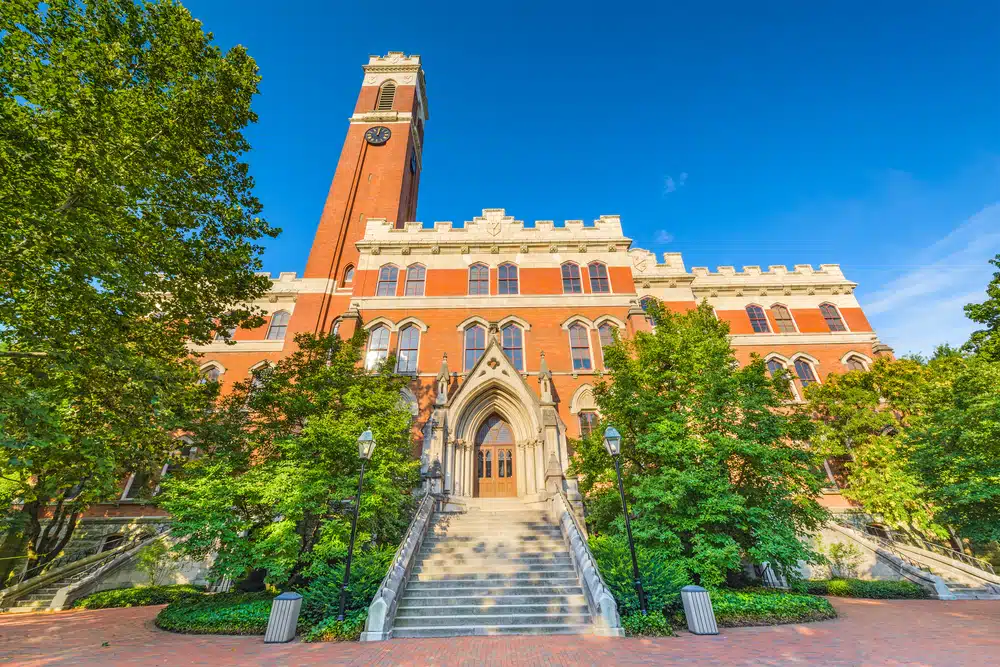
Vanderbilt has several iconic campus landmarks. Kirkland Hall is the visual and historical center of Vanderbilt’s campus. Originally called “Main Building,” Kirkland initially housed all of Vanderbilt’s classrooms and laboratories, as well as a chapel, museum, and library.
While the building was first dedicated in 1875, the hall was rebuilt in 1906 after a devastating fire in 1905 and was renamed in honor of Vanderbilt’s second chancellor, James Hampton Kirkland, and his wife, Mary Henderson Kirkland, in 1937. The rebuilt Italianate design features a single 170-foot clock tower. Its image appears on virtually every piece of Vanderbilt’s official material.
Sarratt Student Center and Rand Hall form the main student gathering hub on the northern end of campus, housing dining, performance spaces, and student offices. Student Centers consist of various buildings and spaces including Alumni Hall, Commons Center, Kissam Center, Sarratt/Rand Student Center, Student Life Center, Community Event Space, and Benton Chapel, among others.
Alumni Hall was the campus’s original student center for 50 years. In 2011, the building was added to the National Register of Historic Places for its architectural significance. Following renovation, it now houses a classroom, student lounge, study space, a café, offices, and a gym.
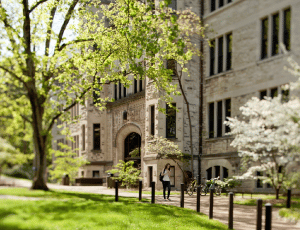
The Mayborn Building and 6 Magnolia is widely regarded as the most striking building on campus. The Mayborn side features a grand staircase and a stained glass domed ceiling, while the connected 6 Magnolia side adds a modern glass wall. The building includes food, study spaces, and offices, and draws students throughout the day.
On the western end of campus, Memorial Gymnasium is one of Vanderbilt’s most distinctive athletic venues. The court sits elevated above the seating, creating an atmosphere locally known as “Memorial Magic” unlike any other in college basketball. Next to it, FirstBank Stadium has hosted Commodores football since 1922, seating approximately 40,350, and is one of the oldest dedicated college football stadiums in the South.
Vanderbilt’s other campuses and affiliated sites
Beyond the main campus, Vanderbilt operates or is affiliated with several significant sites that students encounter depending on their program.
The Peabody Campus sits directly across 21st Avenue South. Its 50-acre grounds, with 22 main buildings surrounding the Peabody Esplanade, were declared a National Historic Landmark in 1965. Since 2008, the Peabody Campus has also served as home to The Martha Rivers Ingram Commons, where all Vanderbilt first-year students live.
Vanderbilt University Medical Center (VUMC) adjoins the south side of the main campus at 1211 Medical Center Drive. The two institutions became legally and financially separate in 2016, but VUMC clinicians continue to serve as faculty at Vanderbilt’s School of Medicine and School of Nursing, and students in health-related programs rotate through regularly.
VUMC manages more than 2.3 million patient visits per year and is the only Level 1 Trauma Center in Middle Tennessee. Within it, the Vanderbilt-Ingram Cancer Center is one of only 50 National Cancer Institute-designated cancer centers in the country and the only one in Tennessee treating both adult and pediatric cancers.
Vanderbilt is also actively expanding its presence beyond Nashville. In 2024, the university entered into a lease agreement to occupy the General Theological Seminary campus in Chelsea, Manhattan. A $520 million graduate campus is planned for Palm Beach, Florida, focused on finance, engineering, and technology, expected to be complete by 2029.
A San Francisco campus is also planned to begin operations in 2027, pending regulatory approvals.
Getting to Vanderbilt University
Vanderbilt’s midtown location makes it straightforward to reach from most directions. Whether you’re arriving from Nashville International Airport, driving in from out of town, or getting around the city as a student, there are several practical options worth knowing before your visit.
Public transportation options
Nashville’s public transit system, WeGo Public Transit, serves Vanderbilt through four routes: Route 3 (West End), Route 7 (Hillsboro), Route 75 (Midtown), and Route 77 (Thompson Wedgewood). For enrolled students, faculty, staff, and postdocs, all WeGo local and regional buses, the WeGo Star commuter rail, and paratransit services are free through the university’s QuickTicket benefit, usable any time and not just for commuting to campus.

Visitors and prospective students pay standard WeGo fares. For getting around campus after hours, Vanderbilt operates VandyRide, a nighttime shuttle for students running from 5:30 p.m. to 1 a.m., trackable in real time through the VandySafe app.
Getting there by car or other means
Nashville International Airport (BNA) is the closest airport to campus, about 10 miles east and a 15 to 20 minute drive depending on traffic. There are several ways to travel from BNA to your final destination.
The standard route follows I-40 West to the Broadway exit, then west on Broadway as it becomes 21st Avenue South, with the main campus on the right past Grand Avenue. Rideshare from BNA to the Vanderbilt area typically runs $24 to $27 before tip. Visitors who prefer public transit can take WeGo Route 18 from the airport to downtown, then transfer to Route 7 or Route 3, with the full trip taking about an hour.
Parking on campus is limited and paid. For admissions visitors specifically, the 2525 West End Garage (use 2550 Kensington Place for GPS) is the recommended option, about a 10-minute walk to the admissions office, with up to four hours of validation available for admissions events. The Wesley Place garage on campus also has public hourly spaces, though both fill quickly on weekdays.
For anyone open to other alternatives, Vanderbilt has partnered with Spin for on-campus e-bike sharing, and Nashville’s BCycle docked bikeshare has two stations adjacent to campus.
Living Near Vanderbilt University
Vanderbilt is a 340-acre arboretum in the middle of a major American city, and students move between those two realities constantly. Nashville’s climate helps: the weather is mild enough that outdoor campus life is practical for most of the academic year, with serious cold limited to the winter months and rain concentrated in spring.
Places to check out near Vanderbilt University
Nashville has no shortage of activities to do, and most of it is close. Starting right at the campus edge, Centennial Park and the Parthenon are directly across West End Avenue. The park covers 132 acres with paved trails, a sunken garden, a band shell, and a dog park. At its center stands Nashville’s full-scale Parthenon replica, built for the 1897 Tennessee Centennial Exposition, which now houses the city’s art museum and a 42-foot statue of Athena.
A 10-minute walk east, Hillsboro Village is a historic neighborhood shopping and dining district with a more relaxed, walkable character. Fannie Mae Dees Park, known locally as Dragon Park for its large mosaic dragon sculpture, sits within it. The 12 South neighborhood, a bit further south, is more polished and draws students on weekends for its combination of boutiques and restaurants.
For food, Nashville’s dining scene includes everything from casual spots like San Antonio Taco Company (a Vanderbilt institution started by two university alumni) and the Pancake Pantry, to the trendy brunch options in the Gulch and award-winning restaurants in Germantown and East Nashville.

Beyond food, Nashville’s broader calendar of things to do gives students plenty of reasons to leave campus. The Frist Art Museum, about a mile east on Broadway, is one of the Southeast’s premier art institutions, operating entirely with rotating exhibitions. The Bluebird Café, a 10-minute drive south in Green Hills, is a 90-seat songwriter’s venue that has shaped Nashville’s music identity since 1982 and is where Taylor Swift was first discovered.
For something quieter, Cheekwood Botanical Garden and Museum of Art is roughly 15 minutes southwest of campus, covering 55 acres divided into 12 distinct garden sections with seasonal installations and a fine arts museum on the grounds. Further out, the Radnor Lake State Natural Area is about 20 minutes south. It spans 1,368 acres of protected land with hiking trails and abundant wildlife.
Why You Should Visit Vanderbilt University’s Campus
Photographs and descriptions only go so far with Vanderbilt. The combination of a certified arboretum, Victorian Gothic architecture, and a midtown Nashville location is something you need to walk through to properly gauge. Students who visit often find their perception of the school shifts, and the visit also helps you assess whether Nashville itself suits you, which is a major part of the decision.
You can schedule a campus tour, information session, or PreVU visit through Vanderbilt’s official admissions visit page. Registration opens six to eight weeks before each visit date, and virtual tour options are available for those who cannot make the trip.
If you are still working out where Vanderbilt fits within your broader college list, AdmissionSight’s Senior Editor College Application Program helps students build a well-researched, strategic list and develop the application to match.
Frequently Asked Questions
1. What is Vanderbilt University’s address?
The main campus address is 2201 West End Avenue, Nashville, TN 37235.
2. How big is Vanderbilt University?
The campus spans 340.7 acres. The arboretum covers more than 300 of those acres and contains over 6,000 trees and shrubs across more than 190 species.
3. Can I visit Vanderbilt University before applying?
Yes. Information sessions, guided campus tours, and the PreVU program are all available throughout the year. Registration opens six to eight weeks before each visit date. Virtual tours are also available if you can’t make it to campus.
4. Is parking available at Vanderbilt University?
Admissions visitors can park at the 2525 West End Garage, about a 10-minute walk to the admissions office, with up to four hours of validation available for admissions events. The Wesley Place garage on campus also offers public hourly parking. Street parking near campus fills quickly on weekdays.
5. What landmarks are near Vanderbilt University?
Centennial Park and the Parthenon replica are directly across the street from campus. Hillsboro Village is a 10-minute walk east. The Frist Art Museum, Belmont University, and the 12 South neighborhood are all within a couple of miles. Downtown Nashville is about 1.5 miles to the east.
Takeaways
- Vanderbilt University is located at 2201 in the West End neighborhood of midtown Nashville, about 1.5 miles southwest of downtown.
- The campus spans 340.7 acres and is a certified arboretum with over 6,000 trees and shrubs across more than 190 species.
- Students get free access to Nashville’s WeGo public transit system, making the city easy to traverse without a car.
- Centennial Park, Hillsboro Village, and a strong dining and music scene are all within walking distance or a short ride from campus.
- Deciding where Vanderbilt fits in your college list is easier with the right guidance. Consider working with a college admissions expert to build a strategic list and a stronger application.