
The demand for geoscientists has been surging, with the U.S. Bureau of Labor Statistics projecting a 3% increase in geoscience roles through 2034. Whether you’re interested in the mechanics of tectonic plates or the chemistry of carbon sequestration, the institution you choose will define your access to high-performance computing and global field networks.
A strong earth science program in 2026 usually has three traits: quantitative training through subjects like calculus, physics, computation, field or lab work that allows you to deal with data, and structured research access through independent study, a capstone, or a thesis.
In this article, we’ll list the top 10 colleges for earth science based on the U.S. News Best Earth Science Programs and the QS World University Rankings by Subject in Earth & Marine Sciences.
- What Are the Best Colleges for Earth Science in the US?
- Massachusetts Institute of Technology
- California Institute of Technology
- Harvard University
- University of California, Berkeley
- Stanford University
- Columbia University
- University of Washington
- Princeton University
- University of Texas, Austin
- University of Colorado, Boulder
- Frequently Asked Questions
- Takeaways
What Are the Best Colleges for Earth Science in the US?
We’ve summarized some of the best colleges for earth science in a table below, along with their U.S. News and QS World University rankings:
|
Rank |
School | U.S. News Earth Science Ranking | QS World University Earth Science Ranking |
| 1 | Massachusetts Institute of Technology | 2 |
2 |
|
2 |
California Institute of Technology | 1 | 6 |
| 3 | Harvard University | 9 |
5 |
|
4 |
University of California, Berkeley | 3 | 8 |
| 5 | Stanford University | 4 |
7 |
|
6 |
Columbia University | 4 | 9 |
|
7 |
University of Washington | 9 | 10 |
| 8 | Princeton University | 9 |
12 |
|
9 |
University of Texas, Austin | 7 |
18 |
| 10 | University of Colorado, Boulder | 14 |
16 |
Note: Our ranking equally weights national and global earth science rankings, averaging each school’s positions into a composite score and ordering them from lowest to highest. For tied scores, we use the national ranking as the tiebreaker.
Let’s discuss each college one by one below.
1. Massachusetts Institute of Technology
Rankings: #2 (U.S. News), #2 (QS World University)
Key Strengths: computational earth science, climate system science & engineering, oceanography, atmospheric chemistry, planetary astronomy
Acceptance Rate: 4.56% (Class of 2029)
MIT’s Department of Earth, Atmospheric and Planetary Sciences (EAPS) excels in theoretical and computational mathematics, using AI-driven models to predict satellite-monitored flooding and ozone recovery. The curriculum is highly modular, and students can build a major around The Health of the Planet or Planetary Interior Landscapes, often supported by the Undergraduate Research Opportunities Program (UROP).
The Earth Science concentration will help you understand the planet’s past, present, and potential future. You’ll learn to see how everything on earth is interconnected, from the natural minerals found in our computer chips to the natural disasters that reshape whole landscapes. MIT also offers a new Fifth-Year Master of Science program, which allows students to seamlessly bridge the gap between undergraduate study and professional research leadership.
A major highlight is EAPS’s commitment to interdisciplinary synergy, frequently partnering with MIT’s AI labs to generate realistic climate simulations. The department’s connections to the energy sector and global policy hubs make it an ideal pipeline to careers in sustainability.
2. California Institute of Technology
Rankings: #1 (U.S. News), #6 (QS World University)
Key Strengths: seismology, tectonics, mineral physics, geobiology, geophysics
Acceptance Rate: 3.78% (Class of 2029)
Caltech’s Division of Geological and Planetary Sciences (GPS) has a reputation that is built on extreme rigor in applied mathematics, where you can expect to use differential equations and fluid dynamics to model everything from mantle convection to atmospheric circulation. The program is famously flexible, allowing undergraduates to pursue tracks in Geobiology, Geochemistry, Geology, Geophysics, and Planetary Science.
GPS students also experience faculty-led field trips, from Death Valley to Asia, that allow them to encounter geological phenomena they wouldn’t see in a laboratory or classroom. The GPS website lists classes with field trips for the whole year. For instance, for fall, Advanced Field and Structural Geology and Regional Field Geology of the Southwestern United States students can expect trips within the semester.
Caltech is associated with the Jet Propulsion Laboratory (JPL) and the Seismological Laboratory, offering students a direct pipeline to NASA missions and cutting-edge earthquake forecasting.
The culture is intensely collaborative, with a small student-to-faculty ratio that often puts undergrads as lead authors on peer-reviewed papers. In 2026, the division expanded its focus on climate engineering, exploring high-tech geochemical solutions for carbon removal through the Climate Modeling Alliance.

3. Harvard University
Rankings: #9 (U.S. News), #5 (QS World University)
Key Strengths: geobiology, paleoclimatology, atmospheric physics, environmental science
Acceptance Rate: 4.18% (Class of 2029)
Harvard’s Department of Earth and Planetary Sciences (EPS) offers a high-rigor experience within one of the world’s most prestigious academic environments. The department considers field experience a non-negotiable part of the curriculum.
In fact, every year, all EPS concentrators are invited on a faculty-led department trip. These are designed to be immersive and social, often traveling to geologically significant regions such as Hawaii, the Canadian Rockies, or the Western United States. Students can receive Harvard credit for attending approved domestic or international summer field camps through E-PSCI 174.
Research at Harvard EPS is organized into three primary clusters:
- Geology, Geophysics & Planetary Science
- Climate, Atmosphere & Oceans
- Geobiology, Geochemistry & Earth History
Undergraduates are encouraged to join these groups as early as their sophomore year through the HEUR (Harvard Earth Undergraduate Research) initiative.
Undergraduates can also join the Harvard EPS alumni network. The EPS community is centered in Hoffman Labs. Alumni frequently return for the EPS Colloquium series, providing undergraduates with direct networking opportunities with leaders in both academia and the private sector
A distinctive feature for 2026 include a surge in GiGGLES (Graduate/Undergraduate Informal Geophysics and Geology Lunch Seminars), promoting a tight-knit community despite the university’s size.
4. University of California, Berkeley
Rankings: #3 (U.S. News), #8 (QS World University)
Key Strengths: geomorphology, volcanology, environmental geochemistry, atmospheric science, marine science
Acceptance Rate: 11.43% (Class of 2029)
UC Berkeley’s Department of Earth and Planetary Science (EPS) maintains its status as a top-tier public research powerhouse. The program is deeply rooted in applied mathematics and physics. Students benefit from a discovery-based curriculum that requires field camps and senior honors theses.
Starting July 1, 2026, the department is transitioning from offering six majors to a single major in Earth and Planetary Science with a specialization in the six previous majors. All students can expect to take classes that provide an overview of Earth and its systems. Then, you’ll take classes in your specialization to build on that foundation.
UC Berkeley’s proximity to the Lawrence Berkeley National Laboratory (LBNL) provides students with unparalleled access to supercomputing and energy geoscience research. The Berkeley Lab, particularly the Earth & Environmental Sciences Area, has initiatives that center on its mission of Stewarding Earth’s Resources, with a heavy emphasis on drought modeling and carbon storage.
5. Stanford University
Rankings: #4 (U.S. News), #7 (QS World University)
Key Strengths: hydrogeology, energy resources, sustainable land use, geological sciences, earth systems
Acceptance Rate: 3.61% (Class of 2028)
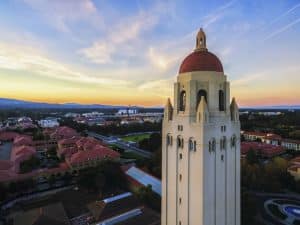
The Stanford Doerr School of Sustainability, launched in 2022, represents one of the most significant academic shifts in Stanford’s history as it sits at the intersection of traditional Earth Science and forward-looking climate solution engineering.
The school is organized into several distinct departments that cater to different aspects of the Earth system. For instance, the Department of Earth System Science is the flagship program for students interested in how the Earth’s physical, chemical, and biological systems interact. The program is heavily quantitative, where students use satellite data and Earth System Models (ESMs) to predict how the biosphere will respond to rising CO2 levels.
An interesting feature of the school is its Department of Civil and Environmental Engineering that it runs jointly with the School of Engineering. Through this, Earth Science students at Stanford can work directly with engineers on infrastructure resilience.
Stanford’s massive endowment also translates into significant Discovery Grants (totaling over $1.5 million in 2026 alone) available to faculty-led research teams, which integrates undergraduate researchers into these cutting-edge, early-stage projects. The school’s deep ties to Silicon Valley also ensure that students are at the intersection of geoscience and high-tech, often working on AI-powered disease mapping or fusion energy.
6. Columbia University
Rankings: #4 (U.S. News), #9 (QS World University)
Key Strengths: computational earth science, climate dynamics, marine geophysics, isotope geochemistry, solid earth geophysics
Acceptance Rate: 4.94% (Class of 2029)
Columbia’s Department of Earth and Environmental Sciences (DEES) is perhaps one of the most expansive geoscience networks in the world. While many associate Columbia’s excellence solely with its remote observatories (such as the Lamont-Doherty Earth Observatory), the DEES program on the Morningside campus provides a rigorous, classroom-to-field experience that treats the Earth as an integrated physical system.
DEES students use high-level mathematical modeling to study complex phenomena like seismic wave propagation and deep-time climate shifts. The curriculum is highly adaptable, offering specialized majors in Earth Science, Environmental Science, and Climate System Science. The academic culture is defined by a mandatory Senior Capstone, requiring students to spend a full year conducting original research that often culminates in a formal thesis or peer-reviewed contribution.
If you love experiential learning, the department sponsors high-intensity field excursions to locations like Italy and Death Valley, providing a hands-on contrast to the department’s heavy emphasis on theoretical physics and chemistry. Through its partnership with the Columbia Climate School, DEES ensures its graduates are equipped to bridge the gap between hard science and global sustainability leadership.
7. University of Washington
Rankings: #9 (U.S. News), #10 (QS World University)
Key Strengths: glaciology, coastal geology, astrobiology, geosciences physics, paleontology
Acceptance Rate: 41.7% (Class of 2029)
The University of Washington’s Department of Earth and Space Sciences (ESS) offers a BA and BS in Earth and Space Sciences. While both degrees share a foundational Science Core, they diverge significantly in their courses and career intent:
- BS ESS students can expect professional certification and graduate school prep. They can choose from four tracks: Geology, Biology, Physics, and Environmental Earth Sciences. Requirements include full calculus sequence, calculus-based physics, and a 6-week Summer Field Camp.
- BA ESS students are being prepared for interdisciplinary roles, such as those in science journalism, environmental law, and environmental policy. Instead of tracks, you have a 15-credit concentration. There are reduced math and physics requirements, and you’re not required to join a field camp.
The research infrastructure at UW is distinctive because it integrates federal monitoring directly into the academic building. For instance, the Pacific Northwest Seismic Network is the command center for earthquake monitoring in Washington and Oregon. Students often work as seismic analysts, helping to process real-time data from over 500 stations.
Meanwhile, the Burke Museum houses over 18 million specimens. ESS students have exclusive access to the Visible Labs, where they can work on mineralogy and vertebrate paleontology projects in view of the public.

8. Princeton University
Rankings: #9 (U.S. News), #12 (QS World University)
Key Strengths: biogeochemistry, global climate modeling, paleontology, geological sciences, climate science & modeling
Acceptance Rate: 4.42% (Class of 2029)
Princeton’s Department of Geosciences is recently undergoing a major curricular overhaul. Starting in Fall 2025, Princeton implemented a new plan of study. While the Class of 2027 can choose to opt-in, the Class of 2028 is the first to follow this modernized structure. For instance, the old curriculum had five tracks (such as Geophysics and Environmental Geochemistry), while the new curriculum has a more flexible core-and-elective model that allows students to tailor their electives according to their interests.
The Princeton University Geosciences Society (PUGS) is the heart of the undergraduate social and professional community. Unlike standard academic clubs, PUGS operates with significant departmental backing to bridge the gap between students and faculty. The society organizes study breaks, dinners, and speakers. They even facilitate visits to museums and group trips both in and out of the country.
Another especially fascinating part of the department is its Gem and Mineral Collection, which is one of the oldest and most historically significant in the U.S. It features a world-class suite of minerals from the Franklin Mining District in New Jersey, famous for its unique fluorescent minerals. Standing outside the department is the Guyot Stone, a massive glacial erratic boulder from the Swiss Alps, gifted in 1890 to honor Arnold Guyot.
9. University of Texas, Austin
Rankings: #7 (U.S. News), #18 (QS World University)
Key Strengths: sedimentary geology, structural geology, basin analysis, climate system science, hydrology & water resources
Acceptance Rate: 22.2% (Class of 2029)
The Jackson School of Geosciences at UT Austin operates as a massive consortium of three powerful units:
- Department of Earth and Planetary Sciences (EPS). The primary academic unit. It handles the teaching, degrees, and core faculty labs on the main UT campus.
- Bureau of Economic Geology (BEG). Functions as the State Geological Survey of Texas. It is a massive applied research unit focused on energy, water, and environmental policy.
- Institute for Geophysics (UTIG). A world leader in expeditionary research. They lead missions to the Arctic, Antarctic, and are heavily involved in NASA planetary missions.
While the EPS is where you take your classes, many of the highest-paying undergraduate research jobs are found at the BEG or UTIG.
At the Jackson School, research is a core part of the culture, and there are several structured pathways to get your foot in the lab door. For instance, Research Friday is an initiative where students dedicate their Fridays to research. Many faculty members avoid scheduling classes on Fridays to allow for lab work, field trips, and collaborative meetings.
The Jackson Scholars Program is a professional development program for high-achieving JSG undergraduates. Unlike other tracks, the Jackson Scholars program requires a research project that spans at least two long semesters and culminates in a written report or publication approved by the program directors.

10. University of Colorado, Boulder
Rankings: #14 (U.S. News), #16 (QS World University)
Key Strengths: alpine & arctic science, natural hazards, remote sensing, hydrology & surface processes, planetary field geology
Acceptance Rate: 75.65% (Class of 2028)
The University of Colorado Boulder’s Department of Geological Sciences treats the entire state of Colorado as its laboratory, especially thanks to its location at the seam of the High Plains and the Rocky Mountains.
CU Boulder offers a BA in Geology, allowing you to choose between two tracks. Geology is the traditional route, focusing on earth materials, surface processes, and deep-time history. Meanwhile, Geophysics is a math-and-physics-heavy track designed for students interested in seismology, geodynamics, and planetary science.
You could even take the BAM Program (bachelor’s–accelerated master), where high-achieving students begin taking graduate-level courses during their senior year and finish both a BA and an MS in just five years.
The department is deeply integrated with world-renowned research institutes, such as INSTAAR (Institute of Arctic and Alpine Research), which is perfect for those interested in climate change and glacial studies. Meanwhile, the (SamPLE Sample Preparation Lab and Educational) facility is a dedicated space for students to learn the hands-on dirty work of geology, from rock sawing to thin-section making.
Frequently Asked Questions
1. What are the top colleges for earth science in the US in 2026?
The top colleges for earth science in the US in 2026 are MIT, Caltech, Harvard, UC Berkeley, Stanford, Columbia, UW, Princeton, UT Austin, and CU Boulder.
2. Is earth science a good career?
Yes, with the global shift toward green energy and climate resilience, earth scientists are in high demand. The field offers a combination of outdoor fieldwork, high-tech lab research, and competitive salaries, especially in government, consulting, and renewable energy sectors.
3. What is the highest-paying job in earth science?
Some of the highest-paying jobs in earth science include geophysicists ($118,000 per year), drilling engineer ($113,600 per year), and hydrogeologist ($100,800). Other specialized roles in environmental management and senior consulting within the oil, gas, or renewable utilities sectors also frequently command six-figure paychecks.
4. How hard is an earth science degree?
It is scientifically demanding. Unlike general environmental studies, an Earth Science degree requires a strong foundation in calculus-based physics, chemistry, and sometimes computer programming. It’s perfect for students who enjoy applying hard science to complex, real-world physical systems.
5. What can I do with a bachelor’s in earth science?
You can work as an environmental consultant, GIS specialist, or field geologist. Many graduates enter the federal government (EPA/USGS) or private firms focusing on water resource management, natural hazard mitigation, and the burgeoning field of carbon sequestration.
Takeaways
- Top colleges for earth sciences are rebranding to reflect a global crisis. For instance, schools like Stanford (Doerr School) and Columbia (Climate School) have moved beyond traditional geology to focus on scalable climate solutions.
- A school’s physical location can also affect your undergraduate experience. For instance, UW and CU Boulder leverage their proximity to active subduction zones and the Rocky Mountains to offer living classrooms.
- Undergraduate research is highly encouraged in the top colleges for earth science, whether it’s through the Harvard Earth Undergraduate Research or thanks to UT Austin’s Research Fridays.
- Specialized roles like hydrogeologists are among some of the highest-paying positions for earth science graduates in 2026.
- Have you set your sights on a top school for earth science? A college admissions expert will help you build a strong college application, from standout extracurriculars to strong recommendations.