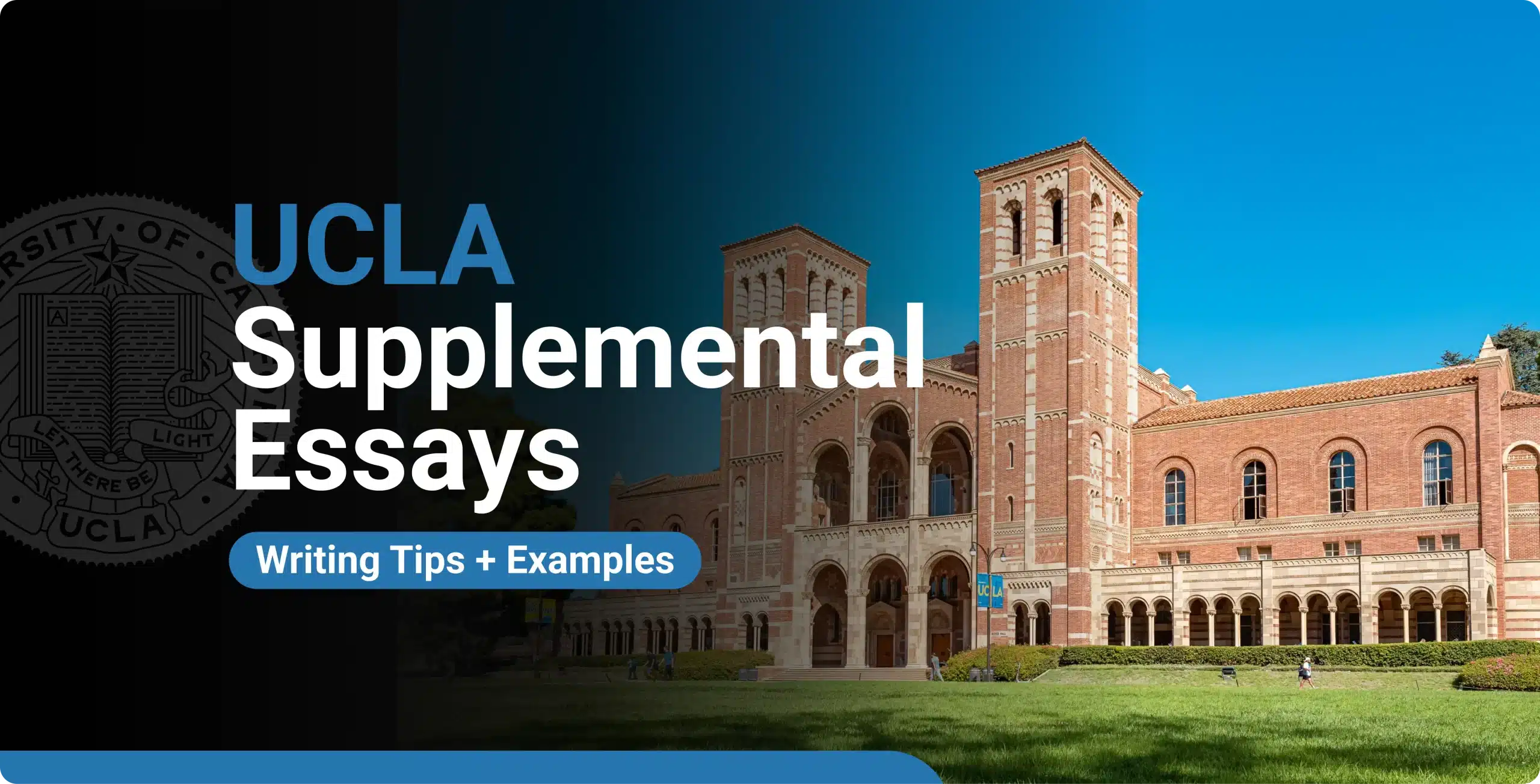
The University of California, Los Angeles (UCLA) requires four supplemental essays, officially called Personal Insight Questions. Applicants choose four out of eight prompts, and each response is capped at 350 words.
Ranked as the number 1 public university for eight consecutive years and number 17 among national universities by U.S. News, UCLA is highly competitive. Despite receiving more than 100,000 applicants each year, it has an acceptance rate of only around 9.4%.
In this guide, we break down all eight Personal Insight Questions, explain what UCLA is really asking, and share strategies to help you craft focused, compelling responses that stand out.
- UCLA Supplemental Essay Prompts
- How to Write the UCLA “Leadership” Supplemental Essay
- How to Write the UCLA “Creativity” Supplemental Essay
- How to Write the UCLA “Greatest Talent” Supplemental Essay
- How to Write the UCLA “Educational Opportunity or Barrier” Supplemental Essay
- How to Write the UCLA “Significant Challenge” Supplemental Essay
- How to Write the UCLA “Academic Interest” Supplemental Essay
- How to Write the UCLA “Community Impact” Supplemental Essay
- How to Write the UCLA “Why You” Supplemental Essay
- Writing UCLA Supplemental Essays That Work
- Frequently Asked Questions
- Takeaways
UCLA Supplemental Essay Prompts
As part of the University of California system, UCLA uses the UC Application portal rather than the Coalition or Common App, so you won’t need to worry about creating personal statements.
Instead, you’ll choose four out of eight personal insight questions and answer them in a maximum of 350 words each.
| UCLA Supplemental Essay Prompts |
|
UCLA assures that all prompts are given equal consideration, so there is no advantage or disadvantage to choosing one over the other.
How to Write the UCLA “Leadership” Supplemental Essay
| Prompt |
| Describe an example of your leadership experience in which you have positively influenced others, helped resolve disputes, or contributed to group efforts over time. (350 words) |
UCLA asks this to assess collaboration, initiative, and sustained contribution, so you must demonstrate leadership through action and impact. To answer it well, share a specific example where you influenced others, resolved conflict, or strengthened a group over time. Focus on what you did, how others responded, and what changed.
| UCLA “Leadership” Supplemental Essay Example |
| The gavel slipped from my hand and clattered onto the classroom floor, cutting through the low hum of cross-talk. It was our first meeting of the year, and half the room was already debating whether parliamentary procedure mattered if no one followed it. I picked it up, waited, and tapped once. The room quieted, watching to see what would happen next.
As president of my high school debate club, I stepped into a group full of talent and friction as we debated on hot topics from public foreign policy to healthcare access to how to bridge the digital divide. Our varsity members were seasoned from tournaments like the National Speech & Debate Association circuit, while new members stayed silent, scripts folded tightly in their hands. The resolution questioned whether the United States should intervene militarily to prevent humanitarian crises, a moral calculus the varsity debaters navigated with ease while novices hesitated at the edge. The differences among our club members extended beyond skill levels in competitions and into meetings about prep styles, debate topics, and how much a single dropped round should matter. Keeping the club intact meant figuring out how to channel that intensity productively. I changed how meetings ran. Instead of opening with announcements, I began with questions: How do we work together as a team and support the new members? Who wanted practice but didn’t know where to start? During drills, I paired varsity debaters with novices to prep cases together for formats like Public Forum and Congressional Debate. Strategy disputes turned into live run-throughs, where ideas were tested aloud and refined by the room. By spring, our organization sounded different as new members volunteered for rebuttals, feedback sharpened, and preparation became collective. Watching once-quiet voices step forward taught me how leadership grows over time: by shaping an environment where people feel welcomed and have a desire to improve. I hope to continue that work through groups like the Debate Union, where rigorous argumentation and collaboration extend beyond competition. I want to help build spaces where disagreement deepens thinking and group effort carries everyone forward. (347 words) |
Essay analysis and tips
The essay effectively responds to UCLA’s leadership prompt by demonstrating influence, conflict resolution, and sustained contribution through concrete action.
The opening scene immerses the reader in immediate tension. The dropped gavel signals disorder and division without naming it outright, revealing a leadership challenge shaped by strong personalities and uneven experience among club members. The divide between veteran debaters and novices becomes a structural issue that calls for mediation and change.
The writer shows leadership through systems and environment-building by restructuring meetings, opening discussions with guided questions, and creating intentional mentorship pairings. These choices reflect emotional intelligence and long-term thinking.
The impact becomes visible as new members step forward for rebuttals, feedback grows sharper and more constructive, and preparation becomes collaborative rather than isolated. What began as a divided team develops into a culture defined by shared investment and steady growth.
Finally, the reference to UCLA’s Debate Union extends the writer’s leadership philosophy beyond the high school setting. Rather than just concluding with a reflection on past accomplishments, the essay also emphasizes continuity by illustrating how they would apply the same collaborative approach within UCLA’s community.

How to Write the UCLA “Creativity” Supplemental Essay
| Prompt |
| Every person has a creative side, and it can be expressed in many ways: problem solving, original and innovative thinking, and artistically, to name a few. Describe how you express your creative side. (350 words) |
This prompt asks how you demonstrate creativity in your life, whether through art, problem-solving, innovation, or original thinking. Share a specific example and explain your process, not just the outcome. UCLA asks this to see imagination, initiative, and how you approach challenges beyond routine academics.
| UCLA “Creativity” Supplemental Essay Example |
| The folding chair wobbled as I stepped onto the makeshift stage, a classroom cleared just enough to fit twenty people and a strip of taped floor. A few kids sat cross-legged in front, whispering and tugging at costume sleeves. Someone backstage mouthed, “Five minutes.” I glanced at the script and crossed out a line.
I lead a youth theater troupe that performs for marginalized communities, including shelters, public hospitals, and transitional housing centers, where the space shapes the story as much as the script. We stage short adaptations and original pieces designed to travel: scenes from A Midsummer Night’s Dream rewritten with modern dialogue, devised vignettes about migration and home, and original monologues built from interviews and oral histories. Every performance asks a practical question: what will work here, with these people, today? Rehearsals begin with listening. When a Shakespeare scene felt distant in a hospital ward, we cut it down to a physical comedy sequence and added call-and-response moments. When an original piece about displacement felt heavy in a shelter, we reshaped it into an ensemble story that shared the weight across voices. Directing became an exercise in creative problem-solving. If actors disagreed about tone, we ran the scene three ways and watched what felt grounded. If a space echoed, we slowed pacing instead of raising volume. Each adjustment came from paying attention to the room and applying our creativity where it made the most sense to capture the imagination of our audience. After one performance, a woman pulled me aside and said, “Thank you for making something that felt like it was for us.” That comment stayed with me longer than the applause. It reflected the accumulation of small creative decisions: what to cut, what to soften, what to invite the audience into. Theater choreography is an art where the design of movement for stage production serves as an opportunity for vital storytelling that enhances plot, character, and emotion. Leading and performing with this group taught me how creativity lives in adaptation, care, and initiative that I carry with me in my everyday life. (346 words) |
Essay analysis and tips
This essay succeeds because it clearly demonstrates how the writer’s mind creates and why that creativity carries weight in real contexts.
The writer presents creativity as an adaptation shaped by audience, environment, and purpose. The guiding question, “What will work here, with these people, today?” reveals a mindset rooted in attentiveness and responsiveness. Creative expression for them begins with listening and observing before making deliberate adjustments, showing how creativity emerges as iterative problem-solving.
The essay highlights the creative process in concrete ways: scripts are revised, scenes reshaped, tones tested, and pacing modified to suit physical space and emotional atmosphere. Running a scene multiple ways to resolve disagreement within the theater troupe shows experimentation and collaborative refinement.
The impact is personal and meaningful. The audience member’s comment highlights the significance of those layered decisions, showing how small revisions accumulate into performances that feel intentional and inclusive.
Throughout the essay, the writer shows how creativity becomes synonymous with adaptation, care, and initiative that extend into everyday life. The essay works because it reveals a pattern of thinking that centers awareness, flexibility, and purpose.
How to Write the UCLA “Greatest Talent” Supplemental Essay
| Prompt |
| What would you say is your greatest talent or skill? How have you developed and demonstrated that talent over time? (350 words) |
This prompt asks you to identify a defining strength and show how it has grown through practice and application. Choose a genuine skill, explain how you developed it, and provide specific examples of impact. UCLA asks this to assess depth, commitment, and how you refine abilities over time.
| UCLA “Skill Development” Supplemental Essay Example |
| “Can you believe it’s almost 90 degrees, and it’s not even summer yet?” I asked. I had memorized the statistics about urban heat islands in Los Angeles, but when I began speaking to the audience of 1,000 students in attendance, my voice fell flat. Standing on the blistering blacktop, heat rising through the soles of my shoes, I felt my chest tighten. A classmate squinted against the sun while someone shifted in the back row. The script I had practiced vanished from memory as I stumbled upon my sentences as I wished I could start over again.
That moment reshaped how I approached public speaking. I began treating it as a skill to study and refine, recognizing that my delivery was important so that everyone understood my message. I practiced structuring arguments so that research and storytelling strengthened each other. When Los Angeles experienced another intense heatwave with temperatures climbing past 100 degrees in neighborhoods with little tree cover, I felt ready to speak with intention. A year later, at another city youth forum on environmental equity, I spoke publicly to reporters about how urban heat disproportionately affects low-income communities across LA. I cited studies showing that neighborhoods only miles apart can differ by nearly ten degrees due to disparities in tree canopy. I also shared the story of my friend’s grandmother, who avoids going outside in the afternoons because her block has no shade and her apartment traps heat. These statistics and stories of affected local citizens suddenly became personal, and climate change felt immediate. Afterward, several attendees approached me about organizing a local tree-planting partnership and advocating for reflective pavement initiatives near our school. The discussion moved from broad concern to specific action. Through experiences like this, I have learned that effective public speaking requires focus and responsibility in order to enact change. At UCLA, I hope to pursue the interdisciplinary Geography and Environmental Studies program, examining environmental change as a spatial, social, and political issue. Through this training, I aim to strengthen my voice and advocate for sustainable, community-centered solutions grounded in both data and storytelling. (350 words) |
Essay analysis and tips
This essay works because it clearly identifies a specific skill, traces its development over time, and demonstrates measurable impact.
First, the writer defines their greatest skill as public speaking, but shows that they’re good at it through growth rather than natural ability. The opening scene of stumbling through a speech establishes vulnerability and a clear starting point. This moment grounds the narrative in self-awareness and shows that the skill was not innate, serving as the turning point that reshapes their approach.
Second, the essay emphasizes deliberate development. The writer studies structure, integrates research with storytelling, and prepares intentionally for future opportunities. This signals discipline and refinement, aligning closely with the prompt’s focus on how the talent was developed over time.
Third, the demonstration shows the effects of their efforts to improve their public speaking skills. Speaking at a youth forum, citing localized data, and connecting statistics to personal narratives show application at a higher level, and the resulting community action proves how the writer’s speech moves them to action.
Finally, the UCLA connection reinforces continuity by clarifying the student’s broader goal: using public speaking to address environmental issues. Rather than detailing how the skill will be developed, the essay highlights what the student ultimately hopes to pursue at UCLA, aligning that long-term vision with the university’s academic environment.
When writing this essay, ask yourself not just “What am I good at?” but “When did I decide to take ownership of this ability and deliberately make it stronger?”

How to Write the UCLA “Educational Opportunity or Barrier” Supplemental Essay
| Prompt |
| Describe how you have taken advantage of a significant educational opportunity or worked to overcome an educational barrier you have faced. (350 words) |
This prompt asks you to explain how you pursued an opportunity or overcame an obstacle in your education. Provide the context, your actions, and what you learned or achieved. UCLA uses this question to assess your resilience, initiative, and ability to adapt or make the most of available resources.
| UCLA “Educational Opportunity or Barrier” Supplemental Essay Example |
| The syllabus was twelve pages long. The first reading alone spanned three centuries of political thought, as my footnotes spanned longer than the main text. I read about debates over Hobbes’s justification of absolute power, Rousseau’s paradox of being “forced to be free,” and Arendt’s warning that evil often wears the face of normalcy. I remember staring at the esoteric names—Hobbes, Rousseau, Arendt—wondering how everyone else seemed to know where to begin.
I encountered these eminent figures during the Stanford Summer Humanities Institute, where I enrolled in a seminar on political philosophy. My high school classes had prepared me to identify claims and summarize arguments. But this course demanded complex reasoning, historical grounding, and the confidence to engage challenging ideologies that had shaped centuries of debate. Rather than retreat, I changed how I worked and pursued my curiosity unabashedly. I rewrote each reading in plain language, mapping arguments across loose sheets of paper until their logic surfaced. Why does Hobbes ground political order in fear? Who remains outside Rousseau’s vision of the “general will”? My instructor welcomed these questions and pressed me to defend my interpretations with evidence. Over time, the language of philosophy grew more familiar. I started to recognize how ideas responded to one another across centuries, and how definitions carried political consequences. In one seminar, I traced a line from Enlightenment social contract theory to modern debates on civil disobedience. Classmates responded directly to my arguments, building on them and challenging my perspectives, which resulted in constructive dialogue as I felt fully immersed in intellectual inquiry. For my final paper, I analyzed how political legitimacy is constructed through narrative and collective belief rather than coercion. Writing it required revision and patience with uncertainty, exposing me to a level of argumentation I had never experienced before. That summer changed how I approach learning. Encountering unfamiliar language taught me to trudge forward fearlessly, ask better questions, and reason by first principles while questioning my assumptions. I hope to keep seeking classrooms that engage in Socratic dialogue, intellectual curiosity, and spaces where growth comes from sustained effort and shared inquiry. (350 words) |
Essay analysis and tips
This essay works for UCLA’s educational opportunity prompt because it demonstrates initiative and adaptability in a rigorous academic setting.
The writer clearly identifies a significant educational opportunity: the Stanford Summer Humanities Institute seminar. The opening establishes intellectual intimidation through dense readings and unfamiliar thinkers, framing the opportunity as demanding rather than comfortable. This signals that the student realizes growth will require intentional effort.
The essay then emphasizes active response. Instead of passively struggling through the program, the writer changes their study method by rewriting texts in plain language, mapping arguments visually, and generating probing questions. These strategies show resourcefulness and self-directed learning. The instructor’s engagement further reinforces that the writer moved from uncertainty to confident participation.
The writer progresses from confusion to tracing philosophical lineages across centuries and producing an analytical final paper grounded in independent reasoning. This evolution reflects academic maturation rather than surface-level success.
By the end, the reflection connects the experience to a broader learning philosophy centered on inquiry and persistence.
When approaching this prompt, ask yourself: When faced with a demanding educational moment, how did I actively reshape my habits or mindset to meet it?

How to Write the UCLA “Significant Challenge” Supplemental Essay
| Prompt |
| Describe the most significant challenge you have faced and the steps you have taken to overcome this challenge. How has this challenge affected your academic achievement? (350 words) |
This prompt is the usual “overcoming a challenge” one that asks you to explain a major challenge, how you responded, and how it influenced your academic performance. Focus on actions taken, growth, and measurable impact. UCLA asks this to evaluate resilience, accountability, and how you navigate adversity while maintaining academic commitment.
| UCLA “Significant Challenge” Supplemental Essay Example |
| “You’ll want to set alarms for these.” The nurse didn’t look up and just circled 6:00 a.m. and 9:00 p.m. in blue ink and slid the packet toward me. The paper smelled faintly of disinfectant. I traced the arrows branching off the word “flare,” each one leading to another pill, another precaution, and another appointment. In the hallway outside, lockers slammed in uneven percussion, the third period beginning without me.
That year, I was diagnosed with a chronic autoimmune condition marked by unpredictable flare-ups, fatigue, and constant appointments. Some mornings, my hands ached too much to type; other days, brain fog turned reading into translation. For the first time, my grades slipped. The hardest adjustment was learning to ask for help. I met with teachers after class to explain why I might need flexibility with deadlines or extended time. I rebuilt my schedule around energy rather than hours, tackling problem sets early in the morning, recording lectures when concentration wavered, dividing readings into manageable sections, and planning for flare days. Managing my health forced me to become deliberate about how I learned. I abandoned cramming for AP US History and AP Biology and focused on mastering concepts deeply enough that review required less effort. I kept meticulous planners, tracked symptoms alongside assignments, and used tutoring strategically to revisit missed material, like the economic implications of the Market Revolution and the Compromise of 1850 in APUSH, or cellular respiration pathways and feedback inhibition in AP Biology. Instead of memorizing slides the night before exams, I reconstructed my understanding from the ground up. Gradually, my grades improved, and so did my confidence. My challenges dealing with my illness rewrote my understanding of responsibility. I learned to plan deliberately, honor my limits and goals, and build systems that made progress possible. I began sharing my experiences with classmates in helping them manage their own academics. Those conversations grew into ClearPath Collective, a peer-led group I founded to offer academic planning, study check-ins, and mentorship for students facing health challenges just like myself. (343 words) |
Essay analysis and tips
This essay works because it fully addresses all three dimensions of the prompt: the challenge, the steps taken, and the academic impact.
The challenge is clearly defined and deeply personal. The chronic autoimmune diagnosis is not presented abstractly; sensory details, such as the smell of disinfectant and the sound of lockers before the beginning of the third period, establish disruption in both physical and academic spaces. The reader understands that this obstacle directly interfered with learning, concentration, and attendance. The acknowledgment that grades slipped adds honesty and accountability.
However, it’s important to note that the writer does not remain passive in the face of illness. They meet with teachers, restructure their schedule around energy patterns, shift from cramming to mastery-based learning, and track symptoms alongside assignments. These are strategic, sustainable adjustments rather than temporary fixes.
The academic effect is explicit and measurable: grades improve, study methods deepen, and confidence returns. The founding of ClearPath Collective extends that impact beyond the individual, showing initiative and broader community influence.
When writing this essay, ask yourself: Did this challenge simply happen to me, or did it fundamentally change how I approach responsibility, learning, and leadership?
How to Write the UCLA “Academic Interest” Supplemental Essay
| Prompt |
| Think about an academic subject that inspires you. Describe how you have furthered this interest inside and/or outside of the classroom. (350 words) |
This prompt asks you to highlight an academic subject you genuinely enjoy and show how you’ve pursued it beyond required coursework. Describe projects, research, competitions, independent study, or related activities. UCLA asks this to assess intellectual curiosity, initiative, and depth of engagement in a specific field.
| UCLA “Academic Interest” Supplemental Essay Example |
| “Three—two—one—” The pump hissed as we forced air into a taped soda bottle, my hands bracing it against the asphalt until we released it and it shot upward, spraying water before curving and crashing near the far curb. That afternoon, I sketched the flight in my notebook, labeling the initial velocity, launch angle, and gravity pulling it back down, then plugged in our estimates. When my calculation predicted a landing spot only a few feet from where the bottle had actually hit, I realized the arc was something I could measure, model, and nearly predict.
That moment pulled me into physics. In AP Physics 1, I immersed myself in mechanics: kinematics in one and two dimensions, Newton’s laws, free-body diagrams, work-energy theorems, conservation of momentum, rotational inertia, and centripetal force. I stayed after class, reworking projectile motion and circular motion problems until I could derive relationships instead of memorizing equations. When rotational dynamics felt intangible, I sketched force vectors and visualized angular acceleration. Physics became less about plugging numbers into formulas and more about constructing models of how systems behave. Wanting to go deeper, I attended COSMOS at UCLA and joined a physics cluster focused on mechanics and modern physics. We explored harmonic oscillators, special relativity, quantum tunneling, semiconductor physics, and nanomaterials. In lab simulations, we analyzed diffraction patterns to estimate lattice spacing and modeled particle motion under varying potentials. Long problem-solving sessions forced me to defend assumptions and refine approximations, sharpening both my intuition and mathematical rigor. Back at school, I extended that curiosity into independent projects, including modeling rocket propulsion efficiency across different mass ratios and building a rotating-mass setup to measure centripetal acceleration. I kept a notebook of questions about gravitational waves and why small-angle approximations work so reliably. I began solving physics problems recreationally, treating them as puzzles rather than assignments. What inspires me about physics is its balance of imagination and discipline. I start with an idealized model, test its limits, and revise when reality complicates it. That cycle has become more than an academic process and is how I make sense of the world. (350 words) |
Essay analysis and tips
This essay works because it clearly identifies a specific academic subject, demonstrates sustained engagement, and shows intellectual depth beyond classroom requirements.
The opening anecdote grounds the inspiration in a concrete moment. The water bottle rocket experiment becomes the origin of modeling, prediction, and mathematical reasoning. The writer quickly turns curiosity into measurement and calculation, establishing genuine academic motivation.
Listing advanced topics from AP Physics 1 is effective because they are paired with behaviors. They rework problems, derive relationships, sketch force vectors, and visualize systems rather than simply absorbing the concepts. This signals active learning rather than passive completion.
The writer then extends interest beyond the classroom. Attending COSMOS at UCLA, engaging with modern physics concepts, participating in simulations, and defending assumptions in problem-solving sessions all reflect initiative and higher-level inquiry. Independent projects and self-generated questions further reinforce that physics is pursued voluntarily and consistently.
Finally, the reflection ties everything together by articulating why physics inspires them and how its modeling process shapes their worldview.
When approaching this prompt, ask yourself: Where did curiosity turn into sustained action, and how can I show depth rather than just exposure?

How to Write the UCLA “Community Impact” Supplemental Essay
| Prompt |
| What have you done to make your school or your community a better place? (350 words) |
This prompt asks you to demonstrate impact. Describe specific actions you took to improve your school or community and explain the results. Focus on initiative, collaboration, and sustained contribution. UCLA asks this to understand your civic engagement and how you contribute meaningfully to shared spaces.
| UCLA “Community Impact” Supplemental Essay Example |
| The trash bags behind the cafeteria sagged in the heat; when one split, unopened milk cartons and plastic-wrapped sandwiches slid across the pavement, apples knocking against the drain. A custodian hauled another bag toward the trash area, its weight thudding against the brick. I stood there in my Environmental Action Club shirt, watching sealed lunches pile up at the base of the dumpster.
As Outreach Coordinator, I proposed creating a structured food recovery program. I began by researching district health codes and liability policies, then met with our cafeteria manager and a nearby community pantry to explore safe redistribution options. We launched a monitored “Share Table” where students could leave unopened items for others to take and set up a weekly collection system for surplus packaged food that met safety standards. I drafted a proposal detailing food safety, storage, and volunteer roles, then presented it to our assistant principal and district nutrition director. After approval, I trained students to run the table and track donations under my leadership. Within a semester, we diverted hundreds of pounds of food from landfills and delivered dozens of boxes to the pantry. My team and I also focused on prevention. I organized a campus waste audit to quantify how much food was discarded daily. Presenting the data to the student government, I advocated for smaller default portion sizes and clearer signage encouraging students to take only what they would eat. The cafeteria later introduced flexible serving options, reducing waste at the source. This experience reshaped how I think about sustainability. Environmental action is based on our daily actions and choices and rooted in community needs. Addressing food waste meant navigating policy, collaborating with administrators, and designing systems that could benefit our community. In college, where environmental research intersects with civic engagement, I hope to continue working on food justice and waste reduction initiatives. Improving my school began with noticing what was discarded, identifying solutions to be resourceful, and finally by building a system that reallocated excess waste and surplus for proper distribution, so no one is left behind. (344 words) |
Essay analysis and tips
This essay works because it clearly shows awareness, initiative, execution, and measurable community impact.
The opening scene establishes a specific, visible problem. The sensory details of unopened milk cartons and apples sliding toward a drain make food waste tangible rather than abstract.
The writer then researches health codes, meets with administrators and the community pantry, drafts a formal proposal, and builds a monitored system. This shows leadership grounded in logistics and policy. The creation of the Share Table and weekly collection system demonstrates initiative and follow-through.
The impact is measurable and sustained. Hundreds of pounds of food are diverted, donations are tracked, and portion sizes are adjusted through advocacy informed by a campus waste audit. The change affects both redistribution and prevention, improving the system long term.
Finally, the reflection ties the experience to a broader philosophy of sustainability rooted in collaboration and structure.
When writing this essay, you should reflect on what community issue you noticed, what you did to help solve it, and the effects of your efforts.
How to Write the UCLA “Why You” Supplemental Essay
| Prompt |
| Beyond what has already been shared in your application, what do you believe makes you a strong candidate for admission to the University of California? (350 words) |
This prompt invites you to add depth beyond your résumé. Highlight a quality, experience, perspective, or value not fully captured elsewhere. Be reflective and specific. UCLA asks this to understand what you believe defines you and how you would contribute uniquely to the UC community.
| Stanford “Why You” Supplemental Essay Example |
| The first time I met Liza, she was kneeling beside her shopping cart outside the public library, aligning paperbacks into tidy stacks. A laminated bus schedule swung from the handle with a pink binder clip. Her documents were sealed in a waterproof pouch labeled “important,” clothes folded tightly into reusable grocery bags.
“Night shift,” she quipped when our paths crossed during my summer program as a journalist at JCamp. For twelve years, she worked as a caregiver in a residential home, measuring medication, warming soup for insomniac residents, and memorizing which hallway light they preferred left on. When the facility closed during the pandemic, the staff housing closed too. She showed me a faded pay stub, then a rent notice creased into quarters. Now everything she owns fits into that cart, arranged with the same care she once gave other people’s rooms. Reporting Liza’s story showed me how quickly homelessness becomes statistics: eviction rates, shelter capacity, budget gaps. Through interviews with city officials, I traced months-long housing waitlists and watched funding debated in five-minute increments at a city council meeting. But what stayed with me was Liza’s quiet systems of order: dignity expressed in pink binder clips, labeled bags, and the careful way she budgeted bus fare down to the coin. At JCamp, I learned to ask who benefits, who is left out, and why, then to follow the paper trail until the answers surface. I returned home determined to write stories that connect lived experience to policy. My article examined housing delays, mapped the gaps between promised units and available beds, and spotlighted concrete proposals from local advocates pushing for rental stabilization and expanded outreach. Throughout this process, I centered Liza as a person whose daily routines revealed the structural gaps around her. I want to study journalism at UCLA because Los Angeles, one of the cities most affected by homelessness, demands rigorous, ethical, community-centered reporting. I hope to contribute to The Daily Bruin and pursue investigative work, and use it to ask better questions about the systems we accept as inevitable. (343 words) |
Essay analysis and tips
This essay works for this prompt because it reveals a defining quality that strengthens the applicant beyond grades or activities: principled, community-centered journalism rooted in human dignity.
The narrative focus on Liza establishes empathy and observational depth. The writer does not present homelessness as an abstract issue but grounds it in reality through details like the pink binder clip and labeled pouch. This demonstrates attentiveness to nuance, signaling that the applicant sees complexity where others might see statistics.
The essay highlights a clear intellectual and ethical approach, moving from individual story to structural analysis, tracing policy debates, housing waitlists, and funding gaps. This shows investigative rigor and critical thinking, which are qualities that add depth to the application.
The applicant then demonstrates initiative and impact by producing an article that connects lived experience to policy proposals. The work extends beyond a summer program and reflects sustained commitment.
Finally, the UCLA connection reinforces institutional fit by aligning the applicant’s values with Los Angeles’s urgent housing challenges and campus journalism opportunities.
The essay succeeds because it articulates both what the applicant has done, how they think, and why their perspective would meaningfully contribute to the UC community.
Writing UCLA Supplemental Essays That Work
UCLA’s Personal Insight Questions are designed to reveal character, initiative, resilience, and impact. You’ll choose four out of eight prompts, each capped at 350 words. Together, they explore leadership, creativity, talent, educational opportunity, challenge, academic passion, community contribution, and personal context.
Strong UCLA responses focus on action and growth, moving beyond generic description to show sustained effort, measurable impact, and reflection. Specific examples outperform general claims, and clarity matters more than dramatic storytelling. UCLA wants to understand how you think, how you respond to obstacles, and how you improve the communities around you.
Because you can select only four prompts, strategy matters. The right combination should showcase range while reinforcing your strongest qualities.
If you’re looking for additional support with your supplemental essays, our Senior Editor College Application Program pairs you with Ivy League–trained consultants who have helped refine more than 10,000 successful applications. Beyond meticulous, line-by-line editing, you’ll receive a comprehensive admissions strategy designed to strengthen your academic and extracurricular positioning.
Frequently Asked Questions
1. Does UCLA require supplemental essays?
Yes. UCLA requires applicants to complete Personal Insight Questions as part of the UC application.
2. How many supplemental essays does UCLA have?
UCLA provides eight prompts, and applicants must choose and respond to four.
3. What’s the word limit for UCLA supplemental essays?
Each Personal Insight Question has a maximum word limit of 350 words.
Takeaways
- UCLA requires four Personal Insight Questions, each with a 350-word limit. You’ll choose four prompts from a set of eight, allowing you to shape your narrative strategically.
- Each prompt targets something distinct: leadership, creativity, resilience, academic passion, community impact, or personal context.
- Specific actions and measurable impact will always outperform abstract claims about dedication or passion.
- The strongest essays trace growth—how you acted, what changed, and what you learned over time.
- If you want expert guidance crafting essays that highlight your depth and range, our consultants work one-on-one with students to develop focused, strategic responses that feel cohesive and authentically yours.