Being good at art helps, but it’s not the only thing that matters on the AP 2-D Art and Design Exam. In 2024, only 11.2% of students earned a 5. While most portfolios scored in the 3 or 4 range, 82.8% of students managed to pass with a 3 or higher. Altogether, 47,894 students submitted portfolios that year, and the average score was 3.31.
This blog walks you through everything you need to know about the AP 2-D Art and Design exam: how it works, what’s required, how to study effectively, and how to submit a portfolio that stands out.
- AP 2-D Art and Design Course and Exam Description
- AP 2-D Art and Design Exam Format
- AP 2-D Art and Design Sample Portfolio
- How to Build a High-Scoring AP 2-D Art and Design Portfolio
- AP 2-D Art and Design Portfolio Submission Deadline
- Is the AP 2-D Art and Design Exam Hard?
- Frequently Asked Questions
- Takeaways
AP 2-D Art and Design Course and Exam Description
The AP 2-D Art and Design course is centered on creating original artwork that shows your understanding of 2-D design principles. You’ll explore how to use materials, processes, and ideas to communicate visually through media like photography, painting, digital illustration, collage, or mixed media.
You’ll learn how to develop a sustained artistic investigation guided by a central idea or inquiry. You’ll also work on applying visual design concepts such as contrast, unity, rhythm, balance, figure-ground relationships, and emphasis. In your written work, you’ll describe your decision-making process, material choices, and how your ideas evolved through experimentation and revision.
The course asks you to create with intention and reflect on your own creative growth. You’ll produce a portfolio that includes both a series of works exploring a single theme (Sustained Investigation) and five high-quality finished pieces (Selected Works) that demonstrate technical skill and design thinking.
The course is modeled on a college-level foundation art and design studio class. Most students who take it are juniors or seniors who have some prior experience with drawing, photography, or digital design. The College Board recommends students be familiar with the elements and principles of art before enrolling, but there are no official prerequisites.
There’s no written test for this exam. Instead, you’ll build a portfolio throughout the year. You’ll be expected to complete 15 images that show your sustained investigation, 5 final selected works, and short written commentaries that explain your artistic choices, process, and intent.
AP 2-D Art and Design Exam topics
The AP 2-D Art and Design Exam assesses your ability to apply design principles and demonstrate sustained creative development. These six skill categories are central to both the course and the final portfolio:
| Skill Area | Description |
| Inquiry and Investigation | You’ll identify a central idea or question to explore across multiple works. This skill focuses on planning a coherent body of work and developing a meaningful visual theme over time. |
| Material Use | You’ll choose and handle art materials thoughtfully—whether it’s watercolor, digital tools, or collage. This includes showing control, intent, and experimentation with the materials you use. |
| Process and Revision | You’ll show how you develop and refine your ideas through sketches, drafts, iterations, or reworking pieces. This skill highlights creative problem-solving and visual evolution. |
| Composition and Design | You’ll apply 2-D design principles like contrast, balance, emphasis, rhythm, and unity. Strong work shows awareness of space, form, color, and how visual elements are arranged. |
| Artistic Intent and Communication | You’ll make choices that support your intended message or idea. This includes using imagery, symbolism, or design strategies to communicate meaning clearly to the viewer. |
| Written Evidence | You’ll describe your process, materials, and ideas using concise language. Your written responses are scored, so this skill reflects how well you articulate what your work is about and how you made it. |
Each of these skill areas shows up in both the Sustained Investigation and Selected Works sections of the portfolio. Your best chance at earning a 4 or 5 is by demonstrating growth, design fluency, and strong execution across all six.
AP 2-D Art and Design Exam Format
The AP 2-D Art and Design Exam has no multiple-choice or timed written sections. Instead, the exam is a digital portfolio submitted through the AP Digital Portfolio platform. The portfolio has two sections, and each one makes up part of your total score:
Section I – Sustained Investigation
- 15 images total
- Includes written responses
- 60% of your score
This section asks you to explore a question or theme through a body of related works. You’ll submit 15 digital images that show your ideas evolving over time. Some images will be finished artworks. Others can show process work, revisions, or detail shots that help explain your creative decisions.
You’ll also write short responses about your investigation. These must explain:
- What central idea or question you explored
- How your materials, processes, and ideas developed over time
- What changes you made as you experimented and revised your work
This section focuses on growth. The reviewers want to see that your art improved and became more focused as you went.
You’ll be evaluated on areas like:
- Creative problem-solving
- Visual and conceptual development
- Use of materials and design principles
- Risk-taking and refinement
- Consistency and progression across works
Section II – Selected Works
- 5 digital images (1 image per artwork)
- Includes a short commentary for each piece
- 40% of your score
This section shows off your best finished pieces. These five artworks should reflect technical skill, attention to design, and strong ideas. You will also write a short description for each work, including:
- The materials you used
- The processes or techniques applied
- The idea behind the work
The goal here is to show what you can do at your highest level. Each piece is scored for quality, craft, and clarity of intention. These works may be part of your sustained investigation or completely separate.
You’ll be scored on:
- Skillful use of materials
- Clear communication of ideas
- Control of composition and 2-D design
- Originality and effectiveness
AP 2-D Art and Design Sample Portfolio
To understand what a top-scoring AP 2-D Art and Design portfolio looks like, let’s examine a real example from 2024.
This student earned a score of 5 by demonstrating highly developed visual ideas, technical skill, and conceptual depth across all five selected works.

|


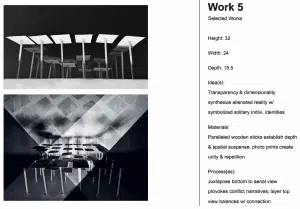
Let’s walk through why this portfolio earned a 5. This portfolio excelled in three key areas:
1. Advanced 2-D art and design skills
Each work demonstrates sophisticated use of elements like line, value, space, texture, balance, and contrast. For instance:
- Work 1 uses the repetition of eye cutouts and directional lighting to create continuous movement and spatial depth.
- Work 3 builds a 3D spatial illusion from 2D prints, using shadow and scale to imply narrative and depth.
- Work 5 juxtaposes aerial and bottom-up views, introducing multiple vantage points in one composition while maintaining visual cohesion.
The student did not simply present technically proficient images. They made design decisions that aligned with the central idea and visual intent, showing control over formal qualities like shape, rhythm, and contrast.
2. Strong synthesis of materials, processes, and ideas
All works are conceptually grounded. The artist connects form and content through thoughtful material choices and process explanations. Examples include:
- Using cardboard cutouts and Photoshop in Work 1 to express the interaction between the observer and the observed.
- Employing coarse texture and linear cuts in Work 2 to explore themes of control and vulnerability.
- Physically attaching photo prints to fingers in Work 4 to critique social identity and spatial restriction.
This kind of synthesis is essential. It shows the artist’s ability to manipulate both traditional and digital techniques in service of a larger visual argument.
3. Clear, concise, and insightful written evidence
The student’s writing identifies the materials, processes, and ideas with clarity. Phrases like “circular blurring fosters fast rhythm” and “spotlight mannikin yields isolation” demonstrate both visual literacy and conceptual awareness. Their descriptions are purposeful and use precise language to explain their intent without overexplaining.
This written component reinforces the visual message and reflects the student’s ability to analyze their own work critically, which the AP rubric highly values.
How to Build a High-Scoring AP 2-D Art and Design Portfolio
The AP 2-D Art and Design Exam doesn’t involve test questions. Instead, you’ll submit a portfolio that shows strong design skills, clear artistic intent, and consistent creative development.
You’ll be assessed on how well your work meets three major criteria: Inquiry and Investigation, Making Through Practice, Experimentation, and Revision, and Communication of Ideas. To earn a top score, you need more than talent. You need strategy, consistency, and clarity.
Here’s everything you need to do to meet the scoring criteria and submit a portfolio that stands out.
1. Start with the Course and Exam Description (CED).

The AP 2-D Art and Design CED outlines the exact skills and concepts you’ll be assessed on. Use it from day one.
- Practice the 2-D design principles listed in the CED: contrast, balance, unity, rhythm, proportion, and more.
- Organize your Sustained Investigation around a single idea, not a medium. Your 15 images should explore one question in depth.
- Use the scoring rubric as a reference while you work. Make sure every piece shows evidence of inquiry, risk-taking, and thoughtful decisions.
- Align each work with a specific purpose. Be intentional about your use of space, color, shape, and materials.
- In your written evidence, clearly explain how your work evolved. Show growth, not just results.
2. Think in terms of process, not just product.
The Sustained Investigation section is designed to reward experimentation and development. You are being graded on how you think, explore, and revise—not just how polished your final image is.
- Include progress shots, material tests, or revised versions that show how you improved an idea.
- Take risks with media, technique, and composition. The rubric favors creative thinking over perfection.
- Make sure each image adds to your investigation. Avoid repeating the same idea or layout.
- Add detail shots when needed to highlight technique, texture, or material exploration.
- If feedback changed your direction, say so in your commentary. Reviewers want to see that you reflect and respond.
3. Choose your best work for Selected Works.
This section is about technical execution and artistic control. You’ll submit five works that should each feel resolved, intentional, and well-documented.
- Pick pieces that show clear design thinking and strong command of media.
- Avoid including pieces that feel repetitive. Each work should show something new—visually or conceptually.
- Photograph your work in even lighting, crop it carefully, and avoid any glare or distortion.
- Be specific in your commentary. State the materials, techniques, and intent behind each work.
- Keep your text concise, but informative. Don’t waste space repeating what’s visually obvious. Use it to explain your choices.
4. Study sample portfolios and rubrics.
The College Board publishes actual student portfolios with scores and reader comments. These are one of your best resources.
- Study high-scoring portfolios to see how others presented cohesive investigations and communicated their process.
- Read the commentary. Notice how top students clearly explain material choices and design decisions.
- Learn from lower-scoring examples. Pay attention to gaps in development, vague writing, or weak technique.
- Look for variety. Strong portfolios show range, but they still feel like they belong to one artist.
5. Manage your time and submission process.
You can’t rush a portfolio. Start early and work consistently throughout the year.

- Break your Sustained Investigation into stages. Set goals for idea generation, experimentation, and revision.
- Schedule regular critiques. Peer and teacher feedback is essential for improving work and staying focused.
- Track your progress. Know how many images you’ve finished, what still needs refinement, and what’s ready to upload.
- Give yourself at least two weeks to photograph your work, write your evidence, and finalize everything.
- Submit on time. The 2026 AP Art and Design deadline is Friday, May 8, 2026, at 8 p.m. ET. Don’t wait until the last minute.
6. Make your Sustained Investigation feel like a real inquiry.
Think of your Sustained Investigation as you asking a big question and figuring it out through your art, one piece at a time.
- Your Sustained Investigation should be more than a themed collection. It must respond to a specific question or idea that you explore over time.
- The strongest portfolios show shifts in perspective, experimentation with new materials, and a willingness to revise or even abandon early approaches.
- Don’t feel pressured to have all polished pieces. Works in progress, altered versions, and material tests can be valuable if they show evolution.
7. Keep your visual language consistent.
A consistent visual style helps the viewer follow your thinking and trust your artistic voice.
- Your work should feel like it came from one artist, even if you’re using a range of media.
- Develop a consistent use of color, mark-making, or compositional structure across pieces.
- A portfolio that feels unified tends to score higher than one that looks scattered or disconnected.
- Use the commentary to explain how you’re maintaining visual consistency while still pushing your ideas further.
8. Don’t ignore the written evidence.
Your writing helps the viewer understand what’s going on behind the scenes.
- Reviewers rely on your commentary to understand your intent, process, and decisions. Don’t treat it as an afterthought.
- Keep it clear, specific, and tightly linked to what’s visible in the work.
- Avoid filler phrases like “I wanted to show emotion” or “I used mixed media.” Be precise about your goals and your materials.
- Use your writing to explain what can’t be seen: how you revised, what challenges you faced, and why certain decisions were made.
AP 2-D Art and Design Portfolio Submission Deadline
The final deadline to submit your AP 2-D Art and Design portfolio is Friday, May 8, 2026, at 8:00 PM Eastern Time. All three components—Sustained Investigation, Selected Works, and Written Evidence—must be uploaded and marked as final in the AP Digital Portfolio by this time.
Make sure to give yourself plenty of time before the deadline. Technical issues, incomplete uploads, or late submissions may prevent your portfolio from being scored.
To check the complete AP exam schedule and registration details, you can visit our comprehensive guide.
AP 2-D Art and Design score release date
For 2026, AP 2-D Art and Design scores are expected to be released in early to mid-July. While the College Board has not yet announced the exact date, scores typically become available around the same time each year. For reference, 2025 scores were released on July 7.
Be sure to check your College Board account starting in early July so you do not miss your score report.
Is the AP 2-D Art and Design Exam Hard?
The AP 2-D Art and Design Exam does not involve multiple-choice questions or memorization. Instead, students are assessed through a portfolio that showcases their original work, effective use of design principles, and clear explanation of their creative process.
To earn a high score, you need more than technical skill. The strongest portfolios show creative risk-taking, personal voice, and sustained visual and conceptual development across all three components.
If you’re wondering how students performed in 2024, here’s the official score breakdown:
| Score | Percentage of Students |
| 5 | 11.2% |
| 4 | 28.8% |
| 3 | 42.8% |
| 2 | 14.0% |
| 1 | 3.2% |
| Total Passing (3+) | 82.8% |
The 2024 AP 2-D Art and Design Exam had a high pass rate of 82.8%, and the mean score was 3.31. That means most students earned a 3 or higher. But getting a top score requires more than a clean final product. You’ll need to thoughtfully curate your portfolio, develop ideas over time, and clearly explain your decisions through your written evidence.
If you want expert feedback on your portfolio or help refining your sustained investigation, our AP tutorial services offer guidance that can make a real difference.
Frequently Asked Questions
1. How hard is the AP 2-D Art and Design Exam?
The AP 2-D Art and Design Exam has a relatively high pass rate. In 2024, 82.8% of students earned a score of 3 or higher, and the mean score was 3.31. However, strong scores are not guaranteed. Success depends on your ability to demonstrate original thinking, apply design principles with intention, and clearly articulate your creative process.
The portfolio is evaluated on both visual and written components. This means your work needs to be technically competent, conceptually strong, and well-explained. Students who do well are often those who thoughtfully document their process and can show sustained investigation over time.
2. How many hours should you spend on your AP 2-D Art and Design portfolio?
Building a strong portfolio requires consistent effort throughout the year. Most students spend several hours each week creating, refining, and reflecting on their work. If you’re aiming for a score of 4 or 5, plan to work steadily from the beginning of the school year, dedicating time both in and outside of class.
You’ll also need to photograph your artworks, organize your portfolio components in the AP Digital Portfolio system, and craft clear written evidence for each piece. Cramming in the final weeks is not an option; thoughtful planning and pacing are essential.
3. Is AP 2-D Art and Design worth taking?
If you’re interested in visual arts, design, or creative fields, AP 2-D Art and Design is an excellent course. It helps you build a professional portfolio that can strengthen your college applications, especially for art or design programs. The course also pushes you to explore your personal voice and develop a more thoughtful creative process.
Even if you do not plan to major in art, the portfolio can still showcase your creative thinking, risk-taking, and problem-solving skills—qualities valued across many disciplines.
4. When do AP 2-D Art and Design scores come out?
For 2026, AP 2-D Art and Design scores are expected to be released in early to mid-July. While the College Board has not yet announced the exact date, students can generally expect to see their scores around the same time each year. For reference, 2025 scores were released on July 7.
Be sure to check your College Board account starting in early July so you can access your score report promptly.
Takeaways
As you work toward a strong AP 2-D Art and Design portfolio, these are the essentials to keep in mind:
- The AP 2-D Art and Design Exam is portfolio-based, not test-based. You’ll be scored on how well you communicate ideas using design principles, materials, and written evidence.
- A strong AP 2-D Art and Design portfolio requires thoughtful planning. Your Sustained Investigation should show how ideas evolve over time, while your Selected Works must highlight technical mastery and creative risk-taking.
- There’s no need to memorize anything, but you do need to apply core 2-D design concepts with intent. Review the course framework and rubric regularly to keep your work aligned with expectations.
- Consistency matters. Whether it’s revising process images or improving your written commentary, students who take time to refine their portfolios tend to perform better on the AP 2-D Art and Design Exam.
- Students who want expert support on the AP 2-D Art and Design Exam can turn to a college admissions consultant. AdmissionSight offers personalized coaching to help students strengthen their portfolios and written work for higher scores.