


The AP Physics 2: Algebra-Based Exam might not get as much attention as AP Physics 1, but it’s just as intense. You’ll need to understand topics like thermodynamics, electric circuits, optics, and modern physics, then explain your thinking clearly across multiple question types.
22,804 students took the exam in 2024. 70.5% earned a score of 3 or higher, and the average score was 3.20. That’s a solid pass rate, but only 19.1% scored a 5, so getting a top score takes real preparation. This guide covers everything you need to know about the AP Physics 2 Exam: what’s tested, how it’s structured, and how to study in a way that actually works.
- AP Physics 2 Course and Exam Description
- AP Physics 2 Exam Format
- AP Physics 2 Exam Questions
- How to Study for the AP Physics 2 Exam
- AP Physics 2 Exam Test-Taking Tips
- AP Physics 2 Exam Date
- Is the AP Physics 2 Exam Hard?
- Frequently Asked Questions
- Takeaways
AP Physics 2 Course and Exam Description
The AP Physics 2 course focuses on big ideas in algebra-based physics. You’ll study how fluids behave, how electric circuits work, how light bends through lenses, and how energy is conserved in different systems. The course builds on what you learned in AP Physics 1, but now goes deeper into topics like thermodynamics, electromagnetism, and atomic physics.
You’ll learn how to apply physics models to explain real-world scenarios. Expect to analyze graphs, calculate physical quantities, and explain results using clear reasoning. You’ll also be asked to interpret lab data, design experiments, and use logic to justify your answers.
This course is designed to be equivalent to a second-semester college physics class for life science or pre-med majors. Most students take it in their junior or senior year. If you already took AP Physics 1, you’re in a good spot to succeed here.
The College Board recommends that you’ve completed geometry and are taking algebra II or higher. You won’t need calculus, but you should be confident with algebra, unit conversions, and trigonometry.
AP Physics 2 Exam topics
The AP Physics 2 Exam pulls questions from seven major units. Each unit has its own weight, and some topics show up more than others. Here’s the general breakdown:
| Unit | Topic | Weighting |
| 1 | Fluids | 10%–12% |
| 2 | Thermodynamics | 12%–18% |
| 3 | Electric Force, Field, and Potential | 18%–22% |
| 4 | Electric Circuits | 10%–14% |
| 5 | Magnetism and Electromagnetic Induction | 10%–12% |
| 6 | Geometric and Physical Optics | 12%–14% |
| 7 | Quantum, Atomic, and Nuclear Physics | 10%–12% |
These weightings tell you how much each unit matters on the exam. For example, Unit 3 on electric force, fields, and potential has the highest weighting. You should expect questions that ask you to calculate electric potential energy, explain field lines, or compare voltage in different configurations.
Units like thermodynamics and optics also show up a lot. You’ll need to understand how heat transfers between systems, how entropy changes, and how lenses form images. Some units like magnetism and modern physics show up less frequently, but they still matter.
If you’re aiming for a 4 or 5, focus extra time on the high-weight units, but don’t ignore the others. The AP Physics 2 Exam expects you to be confident with every topic on the course outline.
AP Physics 2 Exam Format
The AP Physics 2 Exam has two main sections. You’ll take Section I (Multiple Choice) digitally on the College Board’s Bluebook app, and Section II (Free Response) will be written by hand in a paper booklet.
The test is split into two main sections, each worth 50% of your total score:
Section I – Multiple Choice
- 40 questions
- 80 minutes
- 50% of your score
These questions come from every unit in the course. Some are stand-alone, while others are grouped around a shared stimulus like a graph or diagram. They test your understanding of physical principles and your ability to apply reasoning to unfamiliar situations.
You’ll see topics like:
- Fluid pressure and buoyancy
- Thermal energy, heat transfer, and ideal gas behavior
- Electric fields, potential, and circuits
- Magnetic forces and induction
- Light waves and ray diagrams
- Atomic and nuclear processes
Each question has four choices. There’s no penalty for guessing.
Section II – Free Response
- 4 questions
- 100 minutes
- 50% of your score
Free-response tasks:
- Question 1 – Experimental Design. Design a lab, describe procedures, predict outcomes.
- Question 2 – Qualitative/Quantitative Translation. Interpret a graph or setup, calculate unknowns.
- Question 3 – Paragraph Argument Short FRQ. Write a focused explanation using physics reasoning.
- Question 4 – Short Answer FRQ. Solve equations, sketch diagrams, justify results.
Each free-response question is worth 10 to 12 points, depending on its type. You’ll need to write in full sentences, define variables, use correct units, and clearly label each part (a, b, c). Most questions involve a combination of conceptual explanation and mathematical reasoning.
Each question has a suggested time range. Plan to spend about 25 minutes on the longer tasks and around 20 minutes on the shorter ones. Staying within these time limits helps make sure you finish all four.
You can use calculators in both sections. A formula sheet is also provided, so be sure you’re familiar with it before exam day.
How long is the AP Physics 2 Exam?

The AP Physics 2 Exam lasts 3 hours. You’ll spend 80 minutes on the multiple-choice portion and 100 minutes on the free-response portion. That includes all the time you’ll need to complete both short and long questions by hand.
In the multiple-choice section, you have about 2 minutes per question. In the free-response section, pacing becomes even more important. Ideally, you should spend around 25 minutes on each of the two longer questions and about 20 minutes on the two shorter ones.
The real challenge is staying accurate while managing your time. If you rush, your calculations could be sloppy or your justifications unclear. If you go too slow, you might not finish. Knowing how long to spend on each section helps you stay focused and avoid throwing away easy points.
AP Physics 2 Exam Questions
Both sections of the AP Physics 2 Exam test your ability to think like a physicist. You’ll be expected to apply your knowledge to real scenarios, solve equations, interpret data, and justify your answers with reasoning. Here’s what you can expect.
Multiple-Choice Questions
The College Board does not release official AP Physics 2 multiple-choice questions from recent exams. That’s because the questions are reused across different test administrations and are kept secure. However, you can still find high-quality examples in AP Physics prep books and official practice workbooks.
The following samples comes from a practice workbook published by MIT and reflects the style and rigor of real AP Physics 2 multiple-choice questions:
| 1. A solid conducting sphere is given a positive charge Q. How is the charge Q distributed in or on the sphere?
(A) It is concentrated at the center of the sphere. 2. A parallel–plate capacitor is charged by connection to a battery. If the battery is disconnected and the separation between the plates is increased, what will happen to the charge on the capacitor and the voltage across it? (A) Both remain fixed. 3. One joule of work is needed to move one coulomb of charge from one point to another with no change in velocity. Which of the following is true between the two points? (A) The current is one ampere. |
Let’s break down the correct answers and why they make sense:
- Answer: (D)
In electrostatics, any excess charge on a conductor moves to the outer surface. Inside a solid conductor at equilibrium, the electric field is zero. That only happens when charge spreads out on the surface. So the charge Q is uniformly distributed on the surface of the sphere only, not throughout the volume or center.
- Answer: (D)
Once the battery is disconnected, no more charge can enter or leave the capacitor. So the charge stays fixed. But when you increase the plate separation, the capacitance decreases. Since the formula is:
Q = C × V,
and Q stays the same while C goes down, V must increase. So the voltage increases even though the charge doesn’t change.
- Answer: (B)
Voltage (or electric potential difference) is defined as work per unit charge:
V = W / q
If it takes 1 joule of work to move 1 coulomb of charge, then:
V = 1 J / 1 C = 1 volt
This means the potential difference is one volt between the two points. The other options either confuse different physical quantities or mix up the unit relationships.
Free-Response Questions
Free-response questions (FRQs) make up 50% of your total score on the AP Physics 2 Exam. On test day, you’ll answer 4 FRQs in 90 minutes. That includes one experimental design question, one qualitative/quantitative translation question, and two short-answer questions.
Each one is multi-part and often combines different concepts, so pacing is important. You should aim to spend about 22 minutes on the longer questions and around 13 minutes on the shorter ones.
Below are real samples from the 2025 AP Physics 2 Free-Response Questions:
Question 1 – Experimental Design
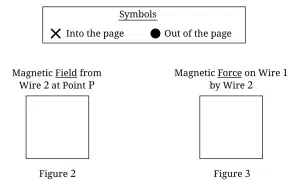
| 1. Very long Wire 1 carries current I in the +x-direction along the line y = 0. Very long Wire 2 carries current I in the +x-direction along the line y = +d. Point P is located along Wire 1 at the origin, as shown in Figure 1. The diameters of the wires are small compared to the distance between the wires. Both wires are in the xy-plane.
A. i. Complete the following tasks in figures 2 and 3. Use either arrows or the symbols shown in the box above the figures for your response.
ii. Very long Wire 3 carrying current 2I in the +x-direction is placed in the xy-plane along the line y = y₃. The net magnetic force exerted on Wire 1 by the currents in Wires 2 and 3 is zero. Derive an expression for y₃ in terms of d. Begin your derivation by writing a fundamental physics principle or an equation from the reference information. B. Wire 3 is moved very far away from Wires 1 and 2. A circular conducting loop in the xy-plane is initially held at rest below Wire 1. The loop is then moved at a constant speed in the −y-direction, as shown in Figure 4.
Indicate whether there is a clockwise induced current in the loop, a counterclockwise induced current in the loop, or no induced current in the loop. _____ Clockwise Justify your answer. |


Let’s break down what a top-scoring answer would look like:
Part A (i)
Magnetic Field from Wire 2 at Point P (Figure 2):
Response: Into the page
Magnetic Force on Wire 1 by Wire 2 (Figure 3):
Response: Out of the page
Let’s break down why this earns full credit:
- Magnetic Field at Point P. Use the right-hand rule for magnetic fields around a current-carrying wire. Point your right thumb in the direction of current in Wire 2 (positive x-direction). Since Point P is below Wire 2, your curled fingers point into the page. That’s the correct direction of the magnetic field.
- Magnetic Force on Wire 1 by Wire 2. Now apply the right-hand rule for magnetic force on a wire. Point your fingers in the direction of current in Wire 1 (positive x-direction), and align your palm to face into the page (direction of the magnetic field). Your thumb then points out of the page—the direction of the magnetic force on Wire 1.
Part A (ii)
To make the net force on Wire 1 zero, the magnetic forces from Wires 2 and 3 must cancel each other out. Using the equation for magnetic force between two wires:
F = (μ₀ I₁ I₂) / (2πr)
The force from Wire 2 is:
F₂ = (μ₀ I²) / (2πd)
The force from Wire 3 (which has current 2I and distance y₃) is:
F₃ = (μ₀ 2I²) / (2πy₃)
Set the forces equal:
(μ₀ I²) / (2πd) = (μ₀ 2I²) / (2πy₃)
Cancel common terms and solve:
1/d = 2/y₃ → y₃ = 2d
Here’s why this response will earn a top score:
Although AP Physics 2 avoids calculus, it still uses algebraic relationships. The student correctly sets up the condition for zero net magnetic force on Wire 1 by equating the magnitudes of the two forces. The reasoning is clear: since Wire 3 has twice the current, it must be twice as far to produce a force of equal magnitude. The student correctly derives y₃ = 2d using proportional reasoning and an appropriate equation.
Part B
Induced Current in the Loop:
Response: Clockwise
Justification: The loop is moving downward past Wire 1. Below Wire 1, the magnetic field points into the page. As the loop moves away from Wire 1, the magnetic flux into the page decreases. According to Lenz’s Law, the loop induces a current that tries to maintain the original magnetic flux. To do that, the loop must generate a magnetic field into the page, which requires a clockwise current.
Let’s walk through why this is the right answer:
This part tests conceptual understanding of Lenz’s Law and changing flux. Since the loop is moving away from the source of a magnetic field that points into the page, the amount of flux through the loop decreases. Lenz’s Law says the induced current will oppose that change by creating a magnetic field in the same direction (into the page). A clockwise current creates that kind of field, so the answer is correct.
Question 2 – Qualitative/Quantitative Translation
| 2. A sample of a monatomic ideal gas is sealed in a thermally conducting container by a movable piston of mass M and area A. The container is in a large water bath that is held at a constant temperature T₀. The piston is free to move with negligible friction. At the instant shown, the gas is in thermal equilibrium with the water bath, the piston is at rest, and the gas occupies volume V₀. The pressure of the air above the piston is Pₐₜₘ.
A. On the dot shown, representing the piston, draw and label the forces that are exerted on the piston. Each force must be represented by a distinct arrow starting on, and pointing away from, the dot.
B. Derive an expression for the internal energy of the gas in terms of M, A, V₀, Pₐₜₘ, and physical constants, as appropriate. Begin your derivation by writing a fundamental physics principle or an equation from the reference information. C. A block, also of mass M, is placed on the piston at time t = t₀ and is slowly lowered. The piston comes to rest at t = t_f when the block is completely released.
D. With the block still on the piston, the temperature of the water bath is changed to a new constant temperature Tₙₑw. The gas occupies the original volume V₀ when the sample of gas and the water bath come to thermal equilibrium. _____ Tₙₑw > T₀ Briefly justify your answer by referencing at least one feature of your answers to parts A, B, or C. |


Let’s walk through each part of the question and break down what a high-scoring response looks like:
Part A
Draw three force vectors originating from the center of the piston dot:
- Upward: Normal force, labeled as FN
- Downward: Gravitational force, labeled as Mg
- Downward: Force from atmospheric pressure on the top of the piston, labeled as Pₐₜₘ × A

Here’s why this is a high-scoring response:
This diagram correctly shows all the forces acting on the piston:
- The normal force (FN) supports the piston from below.
- The gravitational force (Mg) accounts for the piston’s weight.
- The pressure force (Patm × A) comes from the air above the piston.
It also uses correct directions and labels, which are required for full credit.
Part B:
Start with the ideal gas law:
PV = nRT
Solve for n:
n = PV / RT
At equilibrium, the pressure is:
P = Pₐₜₘ + (Mg / A)
Substitute into the equation:
n = (Pₐₜₘ + Mg / A) × V0 / (RT0)
The internal energy of a monatomic ideal gas is:
U = (3/2) × nRT
Substitute for n:
U = (3/2) × (Pₐₜₘ + Mg / A) × V0
Let’s break down why this is a high-scoring response:
The student starts with the correct fundamental law (ideal gas law), calculates n, substitutes appropriately for pressure, and ends with the correct expression for internal energy using only the required variables. Logical flow and substitution are both correct.
Part C:
- Sketch a curve on a P–V graph starting at high volume and lower pressure, ending at lower volume and higher pressure.
- Draw an arrow from right to left along the curve to indicate compression as the gas is compressed by the added block.

Here’s why this is a high-scoring response:
This graph correctly shows the compression process. As the block is added to the piston, the increased weight causes the gas to compress, which raises the pressure and lowers the volume. The curved shape reflects the inverse relationship between pressure and volume (consistent with Boyle’s law), and the arrow from right to left shows the correct direction over time as compression occurs.
Part D:
Selected answer: Tnew < T0
Let’s break down why this is correct:
In Part C, when the block is placed on the piston, it compresses the gas—meaning the volume decreases while the pressure increases.
Now in Part D, the gas expands back to its original volume V0, but the block is still on top. That means the added weight is still increasing the pressure.
Using the ideal gas law:
PV = nRT
If P is now greater and V is back to its original value, then to keep the equation balanced, the only thing that can change is T, and it must be lower.
Therefore, the correct conclusion is that Tnew < T0. The response earns full credit because it properly applies the ideal gas law and clearly connects it to the physical changes described in Part C.
Question 3 – Paragraph Argument Short FRQ
| 3. In Experiment 1, a student is given a resistor of unknown resistance and an air-filled parallel-plate capacitor of unknown capacitance. The student is asked to predict the expected time constant τ of a circuit if these two circuit elements were connected in series with a battery. The student has access to a battery of known emf, a switch, an ammeter, a ruler, and wires, as shown in Figure 1. The plates of the capacitor are square, and the separation between the plates is small compared to the dimensions of the plates. The capacitor is initially uncharged. Assume that the dielectric constant of air is 1.
A. Describe a procedure for collecting data that would allow the student to determine the expected time constant τ. In your description, include the measurements to be made. Include any steps necessary to reduce experimental uncertainty. B. Describe how the collected data could be analyzed to determine τ. Include references to appropriate equations and to relationships between measured and known quantities. C. In Experiment 2, the student is asked to determine the capacitance C of a new parallel-plate capacitor. For each trial, the absolute value |ΔV| of the potential difference across the capacitor is varied and the charge q stored on one plate of the fully charged capacitor is measured. Table 1 contains the data collected.
i. Indicate two quantities, either measured quantities from Table 1 or additional calculated quantities, that could be graphed to produce a straight line that could be used to determine C. Vertical axis: _____ Horizontal axis: _____ ii. On the grid provided, create a graph of the quantities indicated in part C (i).
iii. Draw a best-fit line for the data graphed in part C (ii). D. Using the best-fit line that you drew in part C (iii), calculate an experimental value for capacitance C. |


Let’s break down what a high-scoring response looks like:
Part A:
To determine the expected time constant τ, the student connects the resistor and air-filled capacitor in series with the battery, switch, and ammeter.
- Close the switch to allow current to flow and begin charging the capacitor.
- Measure the current at regular time intervals using the ammeter as the current decreases.
- Record current readings at various time points.
- Graph current vs. time and determine τ by identifying the time at which the current has decreased to about 37% of its initial value.
- Minimize uncertainty by:
- Taking multiple trials and averaging results.
- Using the same initial voltage each time.
- Ensuring tight and consistent circuit connections.
Here’s why this is a high-scoring response:
This response describes a complete and replicable method for measuring the time constant τ using current decay in an RC circuit. It references the correct variables, uses appropriate data collection (current vs. time), and includes strategies to minimize error. It also demonstrates understanding of how τ relates to current behavior during capacitor charging.
Part B:
The student can analyze the current vs. time data using the equation for current during capacitor charging:
I(t) = (V/R) * e^(−t/RC)
Since τ = RC, the student can determine τ by finding the time when the current falls to I = (1/e) * I₀, where I₀ is the initial current.
To calculate τ:
- Use the plotted data to find the time at which the current drops to about 37% of the initial value.
- Then, compute τ = t at that point.
Alternatively, plot ln(I) vs. t and determine the slope of the linear fit. The slope will be −1/RC, so τ = −1/slope.
Here’s why this answer would earn you a top score:
This response demonstrates strong conceptual understanding of how exponential decay applies to RC circuits. It offers two valid analysis methods, clearly applying the ideal capacitor charging equation to extract τ from data.
Part C:
(i) Indicating variables to graph
- Vertical axis: q (×10⁻¹⁰ C)
- Horizontal axis: |ΔV| (V)
Why this would receive top marks:
This is a correct selection based on the relationship q = CΔV. When graphed, this will produce a straight line whose slope is the capacitance C.
(ii) Creating the graph
Plot the data from Table 1:
(3.0, 2.4), (5.0, 4.2), (7.2, 5.6), (8.0, 6.6), (10.0, 8.0)
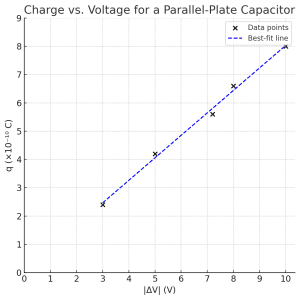
Label axes clearly:
Vertical axis: q (×10⁻¹⁰ C)
Horizontal axis: |ΔV| (V)
Title the graph if space permits: “Charge vs. Voltage for a Parallel-Plate Capacitor”
What makes this a high-scoring answer:
This shows that the student understands how to transfer tabulated data onto a graph and label it correctly. Plotting q vs. ΔV is the correct linear relationship.
(iii) Drawing a best-fit line
Draw a straight line that best fits the plotted points. The line should pass as close as possible to all points, minimizing the distance from each.
This is a key data analysis skill. A good best-fit line allows for a more accurate and consistent determination of the slope (and therefore capacitance).
Part D:
Using the slope of the best-fit line from Part C(iii):
From the linear equation q = CΔV, the slope of the q vs. ΔV graph equals the capacitance C.
For example, if the slope of the line is approximately 0.80 × 10⁻¹⁰ C/V, then:
C = 0.80 × 10⁻¹⁰ F
Why this solution hits all the right marks:
This directly applies the physical relationship and extracts a numerical value for C using the slope of the graph, as intended. The answer is realistic, appropriately formatted, and uses correct units.
Question 4 – Short Answer FRQ
| 4. Two narrow slits are a distance d apart. A screen is a distance L from the midpoint of the slits, where L ≫ d. When a laser emits monochromatic light toward the slits, a pattern of narrow bright and dark bands is observed on the screen. The centers of bright bands A and B are indicated. Three additional bright bands, including the central bright band, are observed on the screen between bands A and B, as shown.
A student claims that the distance between the center of Band A and the center of the central bright band is smaller when using a laser that emits violet light than when using a laser that emits red light. A. Indicate whether the student’s claim is correct or incorrect. Without manipulating equations, justify your answer by referencing the difference in path length traveled by the light from each slit to the center of Band A. B. Derive an expression for the distance between the centers of bands A and B when light of frequency f is emitted toward the slits. Express your answer in terms of d, L, f, and physical constants, as appropriate. Begin your derivation by writing a fundamental physics principle or an equation from the reference information. C. Indicate whether the expression you derived in part B is or is not consistent with your answer from part A. Briefly justify your answer. |

Let’s break down what an ideal response should include:
Part A:
The student’s claim is correct. Violet light has a shorter wavelength than red light. In a double-slit interference pattern, the position of bright bands depends on the wavelength:
ΔL = mλ = d * sinθ
A smaller wavelength (λ) results in a smaller angle (θ) for the same order bright band. Since the screen distance L is much larger than d, this means the distance on the screen between the central maximum and Band A will be smaller for violet light than for red light.
Why this would earn top marks:
This response correctly references the relationship between wavelength and fringe spacing. It avoids using equations to manipulate the result directly and instead uses the physical meaning of the path length difference and angle to explain why the pattern is more compressed for shorter wavelengths.
Part B:
The bright bands occur when the path length difference between the slits equals an integer multiple of the wavelength:
d sinθ = mλ
For small angles (θ), sinθ ≈ tanθ ≈ y / L, where y is the distance on the screen from the center to the m-th bright fringe. Substituting:
d (y / L) = mλ
Solve for y:
y = (mλL) / d
Using λ = c / f, substitute into the equation:
y = (m c L) / (f d)
The distance between bands A and B is 2y, since Band A is at m = +2 and Band B is at m = –2, so the total separation is for 4 fringes:
Δy = (4 c L) / (f d)
How this meets the AP scoring criteria:
This derivation uses correct starting principles from wave interference, applies valid small-angle approximations, substitutes known relationships (λ = c / f), and arrives at a clear final expression in terms of the required variables (d, L, f, c). The logic is complete and well-sequenced.
Part C:
The expression derived in Part B is consistent with the answer in Part A. The equation
Δy = (4 c L) / (f d)
shows that the distance between bands A and B is inversely proportional to frequency. Violet light has a higher frequency than red light, so the resulting Δy would be smaller. This supports the student’s claim that the spacing is smaller for violet light.
Why this earns full credit:
This response correctly interprets the mathematical relationship, connects it to the physical claim, and shows logical consistency between derivation and conceptual understanding.
These free-response questions reward clear reasoning and well-organized explanations. Always show your work, label variables, and write in full sentences. Even if your final answer is off, explaining your thought process can still earn you partial credit.
To improve on FRQs, review past AP Physics 2 student responses and scoring guidelines from the College Board. Seeing real examples will help you recognize what full-credit answers look like and avoid common mistakes.
How to Study for the AP Physics 2 Exam
The AP Physics 2 Exam tests how well you understand key physics concepts and how you apply them in new situations. You will need to justify your reasoning, interpret experimental setups, and solve both quantitative and qualitative problems. This exam is more about concepts and explanation than heavy math.

Here are the most effective ways to study:
1. Know what’s in the AP Physics 2 course.
The AP Physics 2 Course and Exam Description (CED) breaks down the course into 7 units: fluids, thermodynamics, electrostatics, circuits, magnetism, optics, and modern physics. It also outlines the science practices like modeling, data analysis, and argumentation that you’ll be tested on.
Focus on these:
- Fluids and thermodynamics often appear in qualitative questions.
- Circuits frequently show up in FRQs, including analyzing Kirchhoff’s loops or current-voltage relationships.
- Experimental design and lab reasoning are tested throughout the exam, even in multiple-choice.
Use the CED as your checklist for what to review.
2. Do targeted practice problems.
Practice exams and FRQs help you identify weak spots and get used to the exam format. After each one, be sure to:
- Review incorrect answers. Were you missing a key formula, misreading a graph, or misunderstanding a concept?
- Check your units. Dimensional analysis is key in physics. You should be able to catch errors by making sure your units cancel out correctly.
- Time yourself. Section I has 50 questions in 90 minutes. Section II gives you 90 minutes for 4 questions. Practice managing your time.
Stick to official College Board problems whenever possible, or use resources that mimic their style.
3. Understand formulas, do not just memorize.
There is a formula sheet provided, but you need to know how and when to use each one. AP Physics 2 tests whether you know the concepts behind the equations.
You should:
- Know what each variable means. For example, in V=IRV = IRV=IR, understand how increasing resistance affects current.
- Understand when to apply certain equations. Use Bernoulli’s equation only when energy is conserved. Don’t apply ideal gas law in a closed system that is not undergoing volume or temperature changes.
- Check limiting cases. If pressure goes to zero or resistance increases drastically, can your answer still make sense?
4. Practice writing explanations.
A big part of AP Physics 2 is explaining your reasoning. Whether it’s a multiple-choice question or an FRQ, you’ll be expected to justify your answers.
Here’s how to improve your written responses:
- Answer in full sentences. Say, “The pressure decreases because the fluid speeds up,” not “pressure down.”
- Use physics vocabulary. Words like “equilibrium,” “internal energy,” and “electric potential difference” should be used where appropriate.
- Label clearly. Include units, show steps, and circle your final answer.
- Justify, don’t assume. Always state why a principle applies or how a change affects the system.
5. Work with visuals and models.
Diagrams are everywhere in AP Physics 2. You’ll be interpreting circuit diagrams, ray diagrams, pressure-depth graphs, and more.
Practice with:
- Circuit maps. Know how to apply Ohm’s law and Kirchhoff’s rules.
- Ray diagrams. Practice drawing lenses and mirrors, showing image formation clearly.
- PV diagrams. Be able to describe energy changes in thermodynamic processes.
- Free-body diagrams. Draw and label all forces acting on an object, especially in fluid or electric field contexts.
7. Think conceptually.
This exam rewards deep understanding. Try to think about the why behind equations, not just plug numbers.

For example:
- Why does current remain the same in series but voltage does not?
- What’s happening at a particle level during thermal conduction?
- How does energy flow through an electric circuit?
Use thought experiments and analogies to reinforce concepts. Visuals like simulations or YouTube demos can also help solidify abstract ideas.
8. Supplement with trusted review sources.
If you need more examples or explanations, resources like Khan Academy and Fiveable can be helpful. Choose ones that are up-to-date with the course and exam structure.
Stick with sources that:
- Match the AP CED
- Offer FRQ-style questions
- Include answer explanations that go beyond formulas
Stay committed to these strategies, keep practicing regularly, and you’ll be fully prepared to tackle the AP Physics 2 Exam with confidence.
AP Physics 2 Exam Test-Taking Tips
Knowing the content is half the battle. How you handle the test itself can make or break your score. Many students lose points not because they didn’t study, but because they rushed their setups, skipped explanations, or forgot to connect their answers to physics principles.
Here’s how to avoid common test-day mistakes and stay sharp during the AP Physics 2 Exam:
1. Scan the full test first.
Before you jump in, take a minute to look over every question in the section. This helps you:
- Get a feel for the mix of topics (electrostatics, fluids, circuits, etc.).
- Spot multi-part questions that build on each other.
- Decide where to start, based on what you feel most confident answering first.
This can also help you plan how to use your time, especially if you see a lab-based question or graph-heavy one that may take longer.
2. Budget your time carefully.
The AP Physics 2 Exam gives you 90 minutes for 50 multiple-choice questions and 90 minutes for 4 FRQs. That’s about:
- 1.8 minutes per MCQ, so don’t linger too long. Flag and come back if needed.
- About 22 minutes per FRQ, with one experimental design, one qualitative/quantitative translation, one paragraph response, and one short answer.
Track your pace. Use your time wisely so you don’t run out during the FRQs, which make up half your score.
3. Pay close attention to question prompts.
Physics questions often contain subtle phrasing that affects how you respond. Misreading a single word can shift your entire answer.
To avoid careless errors:
- Underline key verbs. Are they asking you to calculate, explain, justify, or describe?
- Watch for assumptions. If it says “ideal gas,” “constant pressure,” or “no friction,” that changes what formulas you use.
- Keep units consistent. A mismatch in meters vs. centimeters can cost you points fast.
- Read every part. Some FRQs go from (a) to (e). Skipping one means skipping credit.
4. Eliminate answers that violate physics.
In multiple-choice questions, even if you are unsure, eliminate options that don’t make physical sense.

To narrow it down:
- Toss out answers that break conservation laws. If energy or charge isn’t conserved, it’s probably wrong.
- Beware of unrealistic trends. If an answer says acceleration increases forever, that’s a red flag.
- Use physics logic. Estimate, visualize, or sketch the situation to check feasibility.
5. Label clearly and explain your reasoning.
On the FRQs, clear writing and strong reasoning matter just as much as the final number.
To get full credit:
- Use correct physics terms. Say “electric potential difference,” not just “voltage.”
- Back up your answers. Do not just write formulas. Explain what’s happening and why.
- Label all diagrams and variables. Show the direction of forces, fields, currents, etc.
- Do not skip steps. If you’re solving a circuit or motion problem, show your reasoning, not just your answer.
6. Tackle each FRQ with structure.
Graders want to give you points. Make it easy for them by keeping your answers organized and readable.
- Label each part of your answer with the correct letter (a), (b), etc.
- Write clearly. Avoid scribbling or writing multiple answers to the same part.
- If your answer includes a paragraph, state your claim, explain it, and support it with evidence or reasoning.
- Show all calculations, even if you are unsure. Partial credit is possible.
7. Use leftover time to double-check.
If you finish early, use the time to:
- Review calculations. Did you forget a unit? Round too early? Drop a negative sign?
- Re-read explanations. Are your reasoning statements clear and specific?
- Scan the multiple-choice section. Did you accidentally skip one or bubble incorrectly?
Even a few minutes of review can make the difference between a 3 and a 4 or a 4 and a 5.
AP Physics 2 Exam Date
The 2026 AP Physics 2 Exam is scheduled for Thursday, May 7, 2026, at 8:00 AM (local time). Be sure to arrive at your testing location early. Most schools ask students to check in by 7:30 AM or earlier. You cannot take the test early or late unless your school arranges a makeup exam.
To see when other AP exams are scheduled, check out our comprehensive guide.
AP Physics 2 Exam score release date
For 2026, AP Physics 2 Exam scores are expected to be released in early to mid-July. For 2025, the exam scores came out on July 7.
While the exact date for 2026 hasn’t been announced yet, students will likely be able to view their Subject Score Reports through their College Board accounts around that time. To make sure you don’t miss your scores, log in to your College Board account regularly starting in early July.
Is the AP Physics 2 Exam Hard?
AP Physics 2 challenges you to apply physics concepts in experimental contexts, analyze data, and solve multi-step problems using logical reasoning. You’ll need to understand the “why” behind the formulas, not just memorize them.
If you’re wondering how tough it really is, here’s the 2024 score breakdown:
| Score | Percentage of Students |
| 5 | 19.1% |
| 4 | 18.0% |
| 3 | 33.4% |
| 2 | 22.9% |
| 1 | 6.6% |
| Total Passing (3+) | 70.5% |
With a mean score of 3.20, AP Physics 2 has a solid pass rate. Over 70% of students earned a 3 or higher, and nearly 40% scored a 4 or 5. That means a strong score is well within reach if you prepare effectively.
Still, this is not an easy exam. You’ll be tested on fluid statics and dynamics, thermodynamics, electrostatics, circuits, magnetism, geometric and physical optics, and modern physics. You’ll also need to design experiments, justify reasoning using physics principles, and explain your thinking clearly.
This is a course that values depth over memorization. To succeed, you’ll need to build strong conceptual understanding, practice with real FRQs and data sets, and be comfortable applying physics to new situations.
If you want structured support, check out our AP tutorial services. We offer targeted help with lab-based questions, experimental design, and test-taking strategies made for AP Physics 2.
Frequently Asked Questions
1. How hard is the AP Physics 2 Exam?
In 2024, about 70.5% of students earned a score of 3 or higher on the AP Physics 2 Exam, and 19.1% scored a 5. That’s a decent pass rate, but scoring in the top range still takes focused effort. You’ll need to master topics like fluid dynamics, thermodynamics, circuits, optics, and modern physics, and apply them to real-world problems.
Compared to other AP science exams, AP Physics 2 is concept-heavy and lab-focused. It’s often seen as a more intuitive follow-up to AP Physics 1, but you’ll still need strong reasoning and problem-solving skills to do well.
2. How many hours should you study for the AP Physics 2 Exam?
That depends on your current comfort level with the content and your experience with physics. Most students study between 80 and 120 hours in total. If you’re aiming for a 4 or 5, plan to study around 4 to 6 hours per week over 2 to 3 months. This should include practice problems, lab-based questions, FRQ writing, and timed review.
3. Do you need to memorize everything for the AP Physics 2 Exam?
No, but you’ll still need to know your formulas, constants, and physics vocabulary. The exam provides an equation sheet, but you need to understand when and how to use each formula, and how to interpret results.
Focus on how concepts connect, how to explain physical behavior clearly, and how to justify your reasoning with real-world examples. Practice is key to mastering both calculations and explanations.
4. Is AP Physics 2 worth taking?
If you’re thinking about majoring in physics, engineering, pre-med, or any STEM field, AP Physics 2 is a great choice. It builds on the foundation of AP Physics 1 and prepares you for college-level coursework. Even if you don’t go into a science-heavy major, the course improves your data interpretation, problem-solving, and analytical reasoning.
5. When do AP Physics 2 scores come out?
For 2026, AP Physics 2 scores are expected to come out in early to mid-July. The College Board hasn’t confirmed an exact release date yet, but that’s typically when results become available.
You’ll be able to view your scores through your College Board account. If you’re sending scores to colleges, make sure to submit those requests before the June deadline so they arrive on time.
Takeaways
If you’re preparing for the AP Physics 2: Algebra-Based Exam, focusing on strategy is just as important as knowing the material. These final reminders can help guide your review and test-day game plan:
- The AP Physics 2 Exam tests deep conceptual understanding. You need to do more than memorize equations. Be ready to explain phenomena using physics principles and apply them to unfamiliar contexts.
- Know how to approach both qualitative and quantitative questions. The AP Physics 2 Exam often requires written justifications, algebraic manipulation, and graph interpretation—sometimes all in the same question.
- Practice solving problems with real-world applications. This includes circuits, fluid systems, thermodynamic processes, and optics. Focus on lab-based reasoning, as the AP Physics 2 Exam emphasizes experimental design.
- Use authentic materials to get used to the exam format. Review scoring rubrics and past free-response questions to see how AP Physics 2 Exam graders assign points and what types of answers earn full credit.
- For expert support on the AP Physics 2 Exam, students can connect with a college admissions consultant. AdmissionSight offers personalized guidance to help students build a strong understanding of the material, sharpen their lab reasoning skills, and develop test-taking strategies for top performance.










