

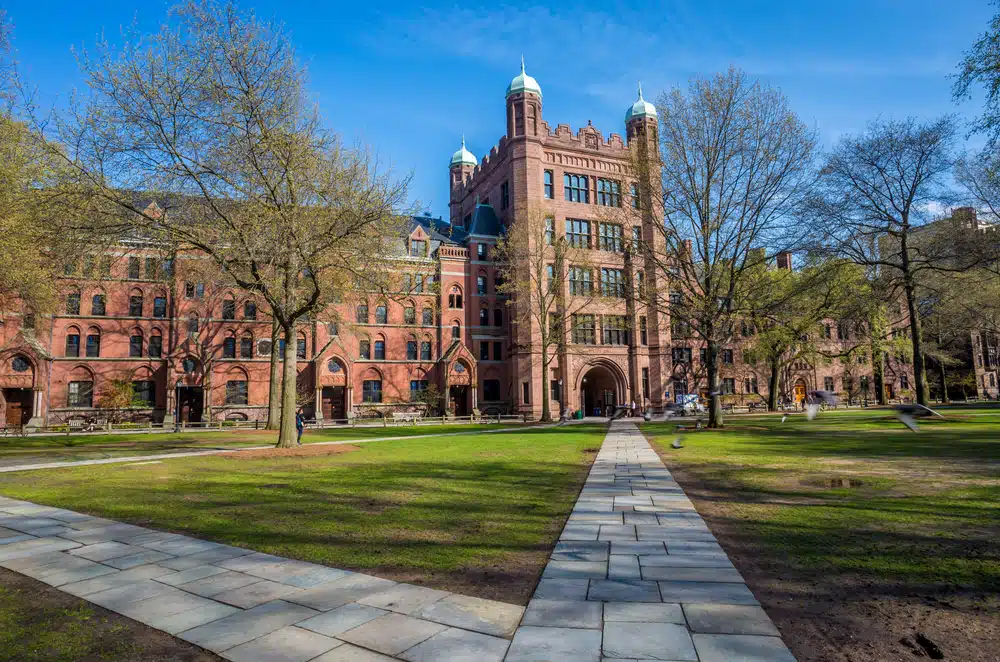
Ranked as the #5 university in the nation, Yale University is celebrated for its academic excellence. But what really makes courses at Yale special is how diverse and unexpected they can be. As a Yale undergraduate, you might spend one day writing daily mini-stories, another building devices in a makerspace, and another creating an entire fictional Martian civilization.
This list covers ten of the most unique courses at Yale that are available right now. These classes span many subjects, but they all have one thing in common: they offer experiences you definitely won’t forget.
- Daily Themes (ENGL 3450)
- Beyoncé Makes History: Black Radical Tradition History, Culture, Theory & Politics through Music
- Psychology and the Good Life (PSYC 157)
- Life Worth Living (HUMS 411)
- Nature, AI and Performance (THST 359 01)
- The Anthropology of Outer Space (ANTH 229 / HSHM 254)
- Infinity (PHIL 281)
- Plants and People (BIOL / EVST)
- Writing Dance (ENGL 434)
- Cocktail Culture: The History, Ethics & Aesthetics of Drink
- Frequently Asked Questions
- Takeaways
1. Daily Themes (ENGL 3450)
Daily Themes is one of the most iconic courses at Yale. First offered in 1907, it has a legendary reputation among students for its combination of discipline and creativity. This course pushes you to write about 300 words every single weekday, which might sound intimidating at first, but the routine quickly becomes a rewarding part of campus life.
The professor keeps things exciting by introducing unusual prompts and even staging events to spark new ideas. You could be asked to:
- Write about a heated political debate one day
- Create a piece inspired by a random conversation you overheard on campus the next
- Imagine a story based on a completely absurd or humorous situation
Each student is paired with a personal writing tutor who meets with them weekly. These one-on-one sessions are a chance to go over your work, talk about your style, and get advice on how to grow as a writer.
Why students love this course:
- It’s a Yale tradition that has shaped generations of writers.
- The constant writing helps you find your voice and overcome writer’s block.
- You get immediate feedback and close mentorship from tutors.
- The quirky prompts make every day a new challenge.
Many students say Daily Themes completely changes how they see writing. By the end of the semester, you’ll have a massive collection of short pieces, a sharper sense of creativity, and a deeper appreciation for storytelling.
2. Beyoncé Makes History: Black Radical Tradition History, Culture, Theory & Politics through Music
Taught by Professor Daphne Brooks, this new class studies Beyoncé’s work from 2013 to 2024, from the self-titled album to Cowboy Carter. It treats the music as a lens on Black history, performance, and intellectual life.

It is cross-listed in African American Studies, Women’s, Gender, and Sexuality Studies, American Studies, and Music. This is one of the boldest courses at Yale if you want to think seriously about pop culture and power.
What you will study:
- Beyoncé’s sonic, fashion, and visual media from 2013 onward
- Readings by Hortense Spillers, the Combahee River Collective, Cedric Robinson, and Karl Hagstrom Miller
What you will do:
- Screen visual albums and analyze them in class
- Work with archival materials at the Beinecke Library
- Join public-humanities projects on Beyoncé’s impact
- Build playlists that trace influences across artists and eras
This course is unique because it focuses on Beyoncé’s later albums, including Lemonade, Renaissance, and Cowboy Carter, highlighting how these works reflect deeper social and political themes.
It connects music to history, politics, and Black feminist thought, encouraging students to see pop culture as more than just entertainment. Students will explore how culture offers refuge and sparks creativity, while art challenges societal norms and encourages transformation.
3. Psychology and the Good Life (PSYC 157)
PSYC 157 became the most popular course in Yale’s history, with more than 1,000 students enrolling in a single semester. Taught by Professor Laurie Santos, it focuses on practical, science-backed strategies for improving happiness and mental well-being.
Throughout the course, students explore topics such as:
- Why our brains often misjudge what makes us happy
- The science of habits and how to build ones that stick
- Evidence-based techniques for reducing stress and anxiety
- The role of kindness and social connection in long-term well-being
The class combines large, engaging lectures with interactive activities that keep students involved throughout each session. Alongside the lectures, students complete weekly homework assignments that focus on applying the concepts they’ve learned to their own lives.
Smaller discussion groups meet regularly, which gives students a space to reflect on their progress and share challenges with their peers. The course also brings in guest speakers who offer fresh perspectives and research-backed insights on the science of happiness, making the experience even more dynamic and practical.
The class was so popular that Yale created a free online version called The Science of Well-Being. It quickly became one of the most well-known free courses at Yale, with millions of people worldwide taking it to improve their lives. This version includes video lectures, quizzes, and personal reflection exercises similar to those Yale students complete on campus.
4. Life Worth Living (HUMS 411)
Life Worth Living asks a profound question: what does it truly mean to live a meaningful life? This course at Yale brings together ideas from philosophy, religion, literature, and history to help students reflect on their own beliefs and values while examining how different cultures and thinkers have answered this question throughout time.

Through a combination of readings, discussions, and reflective writing, students are challenged to slow down and think critically about their own definition of “the good life.” The course seeks to equip you with both intellectual insights and a clearer understanding of your own core values.
Students get into a wide range of perspectives, including:
- Classical texts from traditions like Confucianism, Christianity, Buddhism, and Stoicism
- Writings from modern philosophers and ethicists who tackle questions of purpose and morality
- Real-world case studies on how individuals and communities live out their values
This course at Yale stands out because it combines multiple disciplines, offering one of the most holistic approaches to exploring life’s biggest questions. Class discussions are deeply personal and encourage open, honest conversations where students feel safe sharing their thoughts and experiences.
Throughout the semester, you’ll engage in guided self-reflection alongside academic study, which makes the course both intellectually challenging and personally rewarding. By the end, the goal is for you to develop your own framework for living a meaningful and fulfilling life.
Many students describe Life Worth Living as one of the most transformative courses at Yale. By the end of the semester, you’ll have a deeper understanding of your own values and a personal map for making decisions that align with what matters most to you.
5. Nature, AI and Performance (THST 359 01)
Nature, AI and Performance is one of the most experimental courses at Yale. Combining environmental science, artificial intelligence, and the arts, this class challenges students to see the natural world through a creative, technological lens. It’s ideal for anyone who wants to merge data-driven research with artistic expression.
Students work with real-world data gathered from nature and communities. This data can include anything from animal movements to shifting climate patterns. Using advanced software and AI tools, students transform this raw information into original pieces of music, visual art, and performance pieces.
In past semesters, students have:
- Tracked chicken movements at the Yale Farm and turned them into rhythmic sound patterns
- Converted climate data from glaciers into a multi-layered musical composition
- Designed visual projections that react to environmental changes in real time
These projects are deeply collaborative, with students from different majors working together to bridge the gap between technology and creativity.
This course at Yale stands out because it brings together science and the arts in a way that few classes do. Students get hands-on experience with creative coding and data visualization tools, allowing them to turn complex environmental information into meaningful artistic expressions.

The semester wraps up with a public showcase where students present their projects, share their ideas, and gain direct feedback. This course demonstrates the power of environmental data to raise awareness of critical global issues while highlighting the role of art and technology in shaping change.
This is one of those courses at Yale that pushes you to think differently and to create something entirely original.
6. The Anthropology of Outer Space (ANTH 229 / HSHM 254)
The Anthropology of Outer Space is one of the most creative and unusual courses at Yale. It explores outer space not through astronomy or engineering, but through the lens of anthropology. This means you’ll study how humans give meaning to the cosmos and how space exploration is shaped by culture, history, and imagination.
Instead of focusing on rockets and planets, this class examines space as a human story. It challenges you to think about how we, as a society, interpret what lies beyond Earth and what that says about us.
Throughout the semester, you’ll explore topics such as:
- The unique subculture of NASA scientists and how their daily work shapes our view of space
- The ways different societies and time periods have imagined alien life
- The cultural symbolism behind space missions, from the Space Race to modern-day Mars exploration
- How politics, media, and art influence public perceptions of outer space
One of the most exciting parts of this course at Yale is its hands-on project. Students work in groups to design a fully fictional Martian civilization, complete with its own history, values, and material culture. Past projects have included:
- Creating artifacts like Martian “currency,” tools, and music players
- Writing stories and myths that reflect the imagined society’s worldview
- Designing exhibits to present their fictional civilization as if it were real
This course at Yale stands out because it merges anthropology with speculative world-building, a rare and exciting combination. Instead of just learning theories, students practice using anthropological concepts through hands-on, creative projects.
The experience goes beyond traditional coursework as the final project brings academic study to life by combining research, storytelling, and design. Through this process, students create an imagined world that reflects real cultural principles, making the class both intellectually rigorous and deeply imaginative.
This course shows how the study of space can be deeply human, which makes it one of the most memorable courses at Yale for students who love creativity and critical thinking.
7. Infinity (PHIL 281)
Infinity is one of the most intriguing and thought-provoking courses at Yale. This class explores the concept of infinity, a topic that has fascinated philosophers and mathematicians for centuries. It challenges you to think about ideas that seem impossible or contradictory, pushing the limits of reason and imagination.

In this course, you will examine a variety of paradoxes and puzzles centered on infinity, including:
- The paradoxes of space, time, and motion
- The nature of infinite sets like cardinals and ordinals
- Complex ideas about chances, classes, and truth
While the subject may sound abstract, you will apply concepts from arithmetic, geometry, probability, and set theory to explore these ideas in a structured way.
What makes this course unique:
- It combines mathematics and philosophy, which is rare among courses at Yale
- It builds strong problem-solving and logical reasoning skills
- It encourages you to think deeply about concepts that challenge common sense and conventional thinking
Infinity is a course at Yale that goes beyond numbers and symbols. It teaches you to approach problems from different angles and to embrace the complexity of ideas that have no simple answers.
8. Plants and People (BIOL / EVST)
Plants and People is a highly interactive course at Yale that connects plant biology with human history and culture. It shows how deeply connected our lives are to the plant world, exploring topics like agriculture, food production, plant-based medicine, and the cultural roles of plants in society.
This class moves far beyond textbook learning by giving students hands-on experiences that bring the subject to life. Throughout the course, you’ll study:
- The biological processes that allow plants to grow and adapt
- The history of agriculture and its impact on civilizations
- The role of plants in global trade and the economy
- Medicinal plants and their importance in traditional and modern health practices

A major highlight of this course at Yale is its focus on experiential learning. Students spend time in Yale’s greenhouses, where they can see and interact with living plant specimens up close. These visits give students the chance to study a wide variety of plants in detail while gaining a deeper understanding of how they grow and adapt.
The class also includes tasting sessions where students sample different teas and chocolates. During these activities, they learn about each product’s origin, cultivation, and the global trade networks that bring them to market. By the end of these sessions, students develop a greater appreciation for the cultural and economic significance of plants.
This hands-on approach makes the course both engaging and memorable, setting it apart from more traditional courses at Yale.
For the final project, students can choose how to showcase what they’ve learned. Past projects have included:
- Brewing beer using plant-based ingredients
- Creating pressed-flower art collections
- Writing and performing songs inspired by plants
- Designing educational materials about plant conservation
This is one of the courses at Yale that feels immersive and personal. The combination of science, culture, and creativity makes Plants and People a memorable class that appeals to a wide range of students, from biology majors to those simply curious about the natural world.
9. Writing Dance (ENGL 434)
Writing Dance bridges the world of live performance and creative writing, which makes it one of the most distinctive courses at Yale. It challenges students to translate movement and emotion into words, sharpening both their observational skills and their ability to express complex ideas through writing.
Rather than just reading about dance, students get to experience it directly. This includes:
- Attending live dance performances, with some classes taking trips to New York City to see professional productions
- Watching rehearsals and performances by local and visiting artists
- Writing detailed critiques that go beyond description to capture the feeling, intention, and story behind each performance
By taking this course at Yale, you will build a strong set of skills that combine observation, analysis, and expression. As you observe each performance, you will develop the skill to capture its nuances through precise and vivid writing
The course deepens your understanding of visual storytelling, helping you interpret dance on a more meaningful level. Your ability to express ideas with clarity and creativity improves as you build a richer vocabulary for describing movement and artistic expression.
Through frequent presentations and discussions, you’ll build confidence while learning to give and receive meaningful feedback.
Most writing classes focus on texts, while most arts classes focus on practice or theory. Writing Dance combines both. Whether you’re an experienced dancer or simply a lover of the arts, this course pushes you to see dance as a language and to translate it into powerful prose.
10. Cocktail Culture: The History, Ethics & Aesthetics of Drink
Cocktail Culture is one of the most distinctive and cross-disciplinary courses at Yale. It explores how cocktails reflect and shape society, combining history, ethics, aesthetics, and culture. This seminar goes beyond the glass to show how drink culture has been influenced by politics, art, and science, while also influencing them in return.
In this course, you will explore:
- The rise of cocktails as a reflection of American material culture
- The influence of colonialism, imperialism, and scientific development on drinking practices
- How cocktails have been commodified and turned into symbols of social and cultural status
The course uses cocktails as a lens for examining broader societal changes. One class may focus on how a particular drink rose to popularity during a political movement, while another may analyze how mixed drinks reflect artistic trends and social values.

This course at Yale is designed as a small seminar with around 18 students to allow for dynamic conversations and deeper analysis. Discussions combine assigned readings with case studies that connect theory to real-world examples, which encourages students to think critically about the relationship between culture and consumption.
Why this course stands out:
- It combines multiple disciplines, which makes it unique among courses at Yale
- Cocktails are studied not just as drinks, but as cultural artifacts that reveal insights about race, class, gender, and power
- The curriculum highlights how everyday practices are connected to complex historical and social forces
- By the end of the semester, students gain a deeper understanding of how something as ordinary as a cocktail can reveal larger truths about society
Cocktail Culture shows how courses at Yale can take a familiar subject and transform it into a meaningful study of history and human behavior. It demonstrates that even the simplest things can provide a window into culture and values.
Frequently Asked Questions
1. What makes courses at Yale unique compared to other universities?
Courses at Yale stand out because of their diversity and creativity. While Yale offers strong programs in traditional subjects like science, literature, and history, it also has distinctive classes such as Daily Themes, Writing Dance, and the new Beyoncé course at Yale. Whether you are interested in philosophy, art, or social issues, there is a course at Yale that will fit your goals.
2. Are there free courses at Yale available to the public?
Yes, there are free courses at Yale available through platforms like Open Yale Courses. These include recorded lectures, reading lists, and other materials from actual classes taught on campus. For example, the online version of the popular Psychology and the Good Life course has reached millions of learners worldwide. These Yale online courses give you the chance to experience a taste of Yale education without paying tuition or being admitted as a full-time student.
3. How do I access Yale online courses if I’m not a student?
To access Yale online courses, visit the official Open Yale Courses website or other platforms like Coursera. From there, you can choose from a wide selection of subjects, including science, literature, history, and philosophy. These courses at Yale are completely free and include lectures, assignments, and suggested readings. You do not need a Yale email or account to participate, which makes them accessible to anyone with an internet connection.
4. What is the Beyoncé course at Yale and who can take it?
The Beyoncé course at Yale is officially titled Beyoncé Makes History: Black Radical Tradition History, Culture, Theory & Politics through Music. It focuses on Beyoncé’s albums from 2013 to 2024, examining how her work connects to Black history, feminist theory, and cultural politics. This groundbreaking course at Yale is open to undergraduates and cross-listed in African American Studies, Women’s, Gender, and Sexuality Studies, American Studies, and Music.
Takeaways
From writing every day to exploring AI, dance, and even cocktails, the most unique courses at Yale offer something for every type of student. Here are the key points to remember:
- Yale offers a wide variety of unique classes, from Daily Themes and Writing Dance to the groundbreaking Beyoncé course at Yale. These courses at Yale show that learning can be both challenging and fun, with options for every kind of interest. Whether you are passionate about writing, science, or cultural studies, there’s a class that will push you to grow.
- Some classes, like Psychology and the Good Life, are so popular that they’ve inspired free courses at Yale available online. These allow learners around the world to experience Yale’s teaching style and engage with its world-class content, even without being on campus.
- Hands-on experiences are a big part of many courses at Yale. Classes like Nature, AI and Performance and Plants and People bring learning to life through activities like data-driven art projects, greenhouse visits, and tastings of products like tea and chocolate. These interactive elements make the lessons stick and keep students deeply engaged.
- If you cannot attend classes in person, Yale online courses offer a great alternative. They are a chance to explore subjects at your own pace, prepare for future on-campus studies, or simply learn something new from the comfort of your home.
- If you need help figuring out which courses at Yale are the best fit for your goals, a college admissions consultant can provide expert guidance. AdmissionSight can help you understand Yale’s offerings, strengthen your application, and create a plan so you can make the most of your college experience.










