

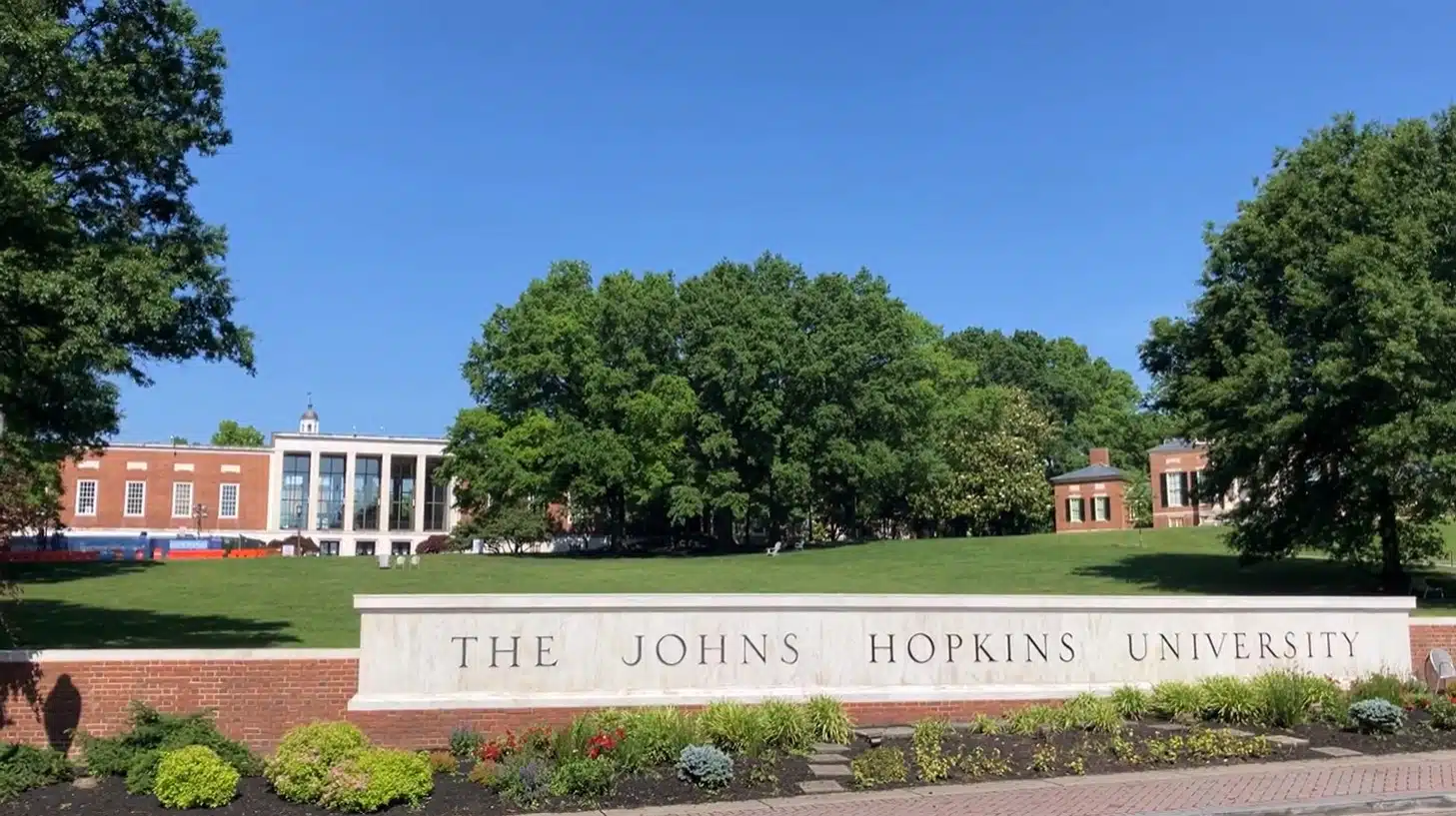
Johns Hopkins University is a private research university founded in 1876, named after the philanthropist Johns Hopkins. It established its main undergraduate campus in Baltimore shortly after its founding. Its primary address, 3400 North Charles Street, Baltimore, Maryland, places the Homewood campus in the Charles Village neighborhood, an urban setting that offers a contained and collegiate atmosphere, with red-brick buildings, open green spaces, and a traditional quad layout.
In this guide, you’ll explore the Homewood campus, its key landmarks, other campuses, transportation options, and what it’s like to live in and around Charles Village.
- Johns Hopkins’ Campus Location
- Getting to Johns Hopkins
- Living Near Johns Hopkins
- Why You Should Visit Johns Hopkins’ Campus
- Frequently Asked Questions
- Takeaways
Johns Hopkins’ Campus Location
The Johns Hopkins Homewood campus occupies a leafy, park-like setting in northern Baltimore City. Its Federal-style red-brick and marble buildings are arranged around a series of interconnected quads, giving the campus a traditional collegiate feel that stands in pleasant contrast to its urban surroundings. The campus is generally described as compact and walkable; you can cross it from north to south in about 15 minutes on foot.
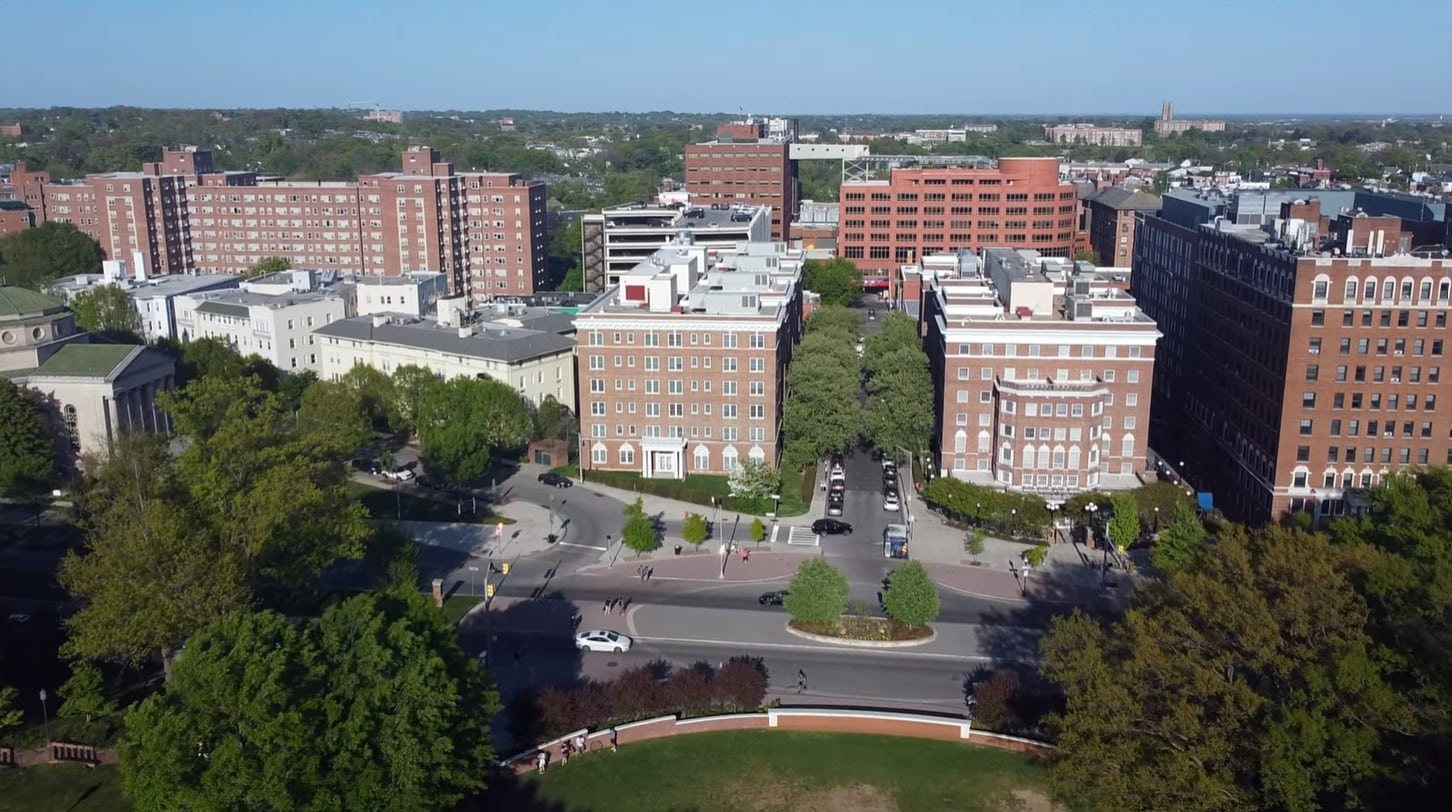
The Homewood campus is home to the Krieger School of Arts and Sciences and the Whiting School of Engineering, and it is where the vast majority of undergraduates live and study. The surrounding Charles Village neighborhood is defined by a mix of Hopkins-affiliated buildings, longtime Baltimore residents, and independent businesses along St. Paul Street and 33rd Street.
Just to the north lies Hampden, one of Baltimore’s most beloved neighborhoods. The Baltimore Museum of Art sits directly adjacent to the campus along its northern edge, making it one of the few universities in the country with a world-class art museum essentially on its doorstep.
Nearly all undergraduates at Homewood live on or near campus during their first two years, with housing options ranging from traditional residence halls with shared bathrooms to suite-style arrangements with private bathrooms and central air.
For upperclassmen, apartments and houses for rent are plentiful within walking distance, and the university’s Off-Campus Housing Office maintains searchable listings to help students find the right fit.
Main campus landmarks
The Homewood campus is anchored by several buildings and spaces that define the day-to-day experience of being a Hopkins student.
Gilman Hall
Gilman Hall is the historic heart of the Johns Hopkins campus, named after the university’s founding president. Its Federal-style façade and iconic clock tower make it one of the most recognizable buildings on campus. Inside, the Hutzler Reading Room, known as “The Hut”, features warm wood paneling, stained-glass windows, and high ceilings. As the oldest academic building on campus, Gilman Hall is where the Hopkins identity takes physical form.
The Beach
The Beach is the large central green quad at the core of the Homewood campus. Despite its landlocked location, the name stuck as students claimed this open lawn for studying, sunbathing, and socializing between classes. It functions as the social and geographic center of undergraduate life and comes alive each spring during events like Spring Fair, the nation’s largest student-run festival.
Milton S. Eisenhower (MSE) Library
The Milton S. Eisenhower Library is the university’s main research library and a central hub of academic life. Notably, it was built largely underground to preserve the sightline to Gilman Hall, an architectural decision that speaks to the campus’s careful attention to visual continuity. The MSE Library, alongside the Brody Learning Commons, serves as the primary space for research, quiet study, and collaborative academic work.
Shriver Hall and the Breezeway
Shriver Hall sits at the main entrance to the Homewood campus and is frequently used for major events, lectures, and performances. Just behind it, the Breezeway connects several buildings and offers a slightly elevated view overlooking the campus that many students find unexpectedly beautiful. Together, this area functions as a central hub for social activity and campus transitions throughout the day.
Homewood Field
Homewood Field is the historic stadium where the celebrated Blue Jays lacrosse teams play. Hopkins men’s lacrosse is one of the most storied programs in all of college sports, with 44 national titles to its name. The stadium has been a fixture on campus since 1883, the same year the first team took the field.
Wyman Park Building
The Wyman Park Building, a historic structure that once served as the Baltimore Marine Hospital, now houses various student services and administrative offices. Its layered history and distinctive presence give it a unique character among campus buildings. It sits at the edge of campus near the parking entrance off Wyman Park Drive, the same road that leads visitors to the South Garage and the Office of Undergraduate Admissions at Mason Hall.
Johns Hopkins’ other campuses and affiliated sites
While the Homewood campus is where most students live and study, the university actually spans nine campuses on three continents.
Here are the other JHU campuses and affiliated sites to help prospective students appreciate the academic breadth available to them:
East Baltimore Campus
About three miles east of Homewood, the East Baltimore campus is home to the Schools of Medicine, Nursing, and Public Health, as well as the world-renowned Johns Hopkins Hospital. This is one of the most significant medical campuses in the world, and the next step for undergraduates with pre-med ambitions or an interest in life sciences.
Peabody Institute
Located in Baltimore’s elegant Mount Vernon neighborhood, the Peabody Institute is the nation’s oldest conservatory of music. It offers a popular Double Degree Program for students who want to pursue both a liberal arts education at Homewood and a music degree at Peabody, and it hosts more than 50 public events each year.
Carey Business School
The Carey Business School occupies a waterfront location in Baltimore’s Harbor East neighborhood. Undergraduates interested in business can take certain graduate-level courses here to complement their Homewood studies.

School of Advanced International Studies (SAIS)
SAIS is prominently situated along Pennsylvania Avenue in Washington, D.C., about an hour south of Baltimore, in the new Bloomberg Center. Students at the Bloomberg Center have access to a location just minutes from the U.S. Capitol, the White House, and the National Mall.
Johns Hopkins SAIS maintains an international presence through key campuses abroad. For instance, Johns Hopkins SAIS Europe, located in Bologna, a city often ranked among Europe’s top ten for quality of life, serves as the school’s European hub. In Asia, the Hopkins-Nanjing Center in Nanjing offers an immersive experience focused on Chinese language and Sino-global relations.
Applied Physics Laboratory
Located in nearby Laurel, Maryland, the Applied Physics Laboratory is the nation’s largest university-affiliated research center. Undergraduates can participate in research projects addressing national priorities in systems engineering, technology development, and advanced analysis.
Getting to Johns Hopkins
The Homewood campus is located at 3400 North Charles Street, Baltimore, MD 21218. The Office of Undergraduate Admissions at Mason Hall is at 3101 Wyman Park Drive, with visitor parking available in the South Garage beneath the building. Because construction is ongoing in parts of campus, visitors are advised to arrive at least 15 minutes early.
Public transportation options
Baltimore’s public transit system provides multiple ways to reach Johns Hopkins’ East Baltimore campus, with reliable connections across the city and region.
The Charm City Circulator (Green Route) is a free shuttle that runs through key parts of Baltimore and stops near the Johns Hopkins Hospital, making it one of the most convenient no-cost options.
Local MTA bus services operate throughout the Baltimore metro area, with several routes stopping directly at the East Baltimore campus and Bayview Medical Center.
The Metro Subway offers a direct rail connection from Owings Mills to The Johns Hopkins Hospital, combining above-ground and underground service.
The Light Rail runs north–south from Hunt Valley to BWI Airport and Glen Burnie; to reach the hospital, transfer at Lexington Market to the Metro Subway.
For regional travel, the MARC Train connects Baltimore to Washington, D.C., and surrounding areas, with stops at Penn and Camden Stations. From there, you can transfer to local buses or the Charm City Circulator to reach campus.
Taxis are widely available across Baltimore, with consistent pickup access at the hospital’s main entrance on Wolfe Street.
For students and staff, Johns Hopkins also supports commuting through pre-tax transit passes and a free intercampus shuttle network connecting Homewood, East Baltimore, and other university locations.
Getting there by car or other means
When driving to Johns Hopkins’ Homewood campus, most routes converge on Wyman Park Drive near Mason Hall (3101 Wyman Park Drive), where the Office of Undergraduate Admissions and main visitor parking are located.
If you’re coming from the north via I-83 or I-695, take Exit 25 (Charles Street) south, continue for several miles, then merge onto St. Paul Street, turn right onto 29th Street, and follow signs toward Wyman Park Drive.
From the south via I-95, take the I-395 Downtown exit, connect to I-83 North, then exit at Druid Park Drive/28th Street and follow Sisson Street to Wyman Park Drive.
If you’re arriving from the east (via Route 50 or I-97) or the west (via I-70), you’ll typically connect through I-695 and I-95 before following the same southbound approach toward I-83 and Wyman Park Drive.
Visitor parking at Johns Hopkins is available across several campus garages, with the South Garage and San Martin Garage as the main options. The South Garage, beneath Mason Hall on Wyman Park Drive, is open 24/7 and includes limited EV charging.
The San Martin Garage, across from the West Gate entrance, is fully automated and also offers EV chargers. The West Gate Garage provides a smaller alternative near the Johns Hopkins Club.
Rates are similar across garages, typically $4–$5 for the first hour and up to $16–$19 for longer stays, with evening and weekend flat rates around $9. Event parking is often $10–$20 per vehicle. Metered spaces are limited, and some lots require permits.
Parking near campus can be tight, especially on weekdays, so public transit or rideshare is often the easier choice.
Baltimore/Washington International Thurgood Marshall Airport (BWI) is the closest major airport and is accessible from campus via the MARC train or BWI shuttle services.
For students with bikes, the campus has secure bike racks and several bike-friendly routes running along Charles Street and St. Paul Street. Electric LINK scooters are available for rent throughout the city at $1 to unlock.
Living Near Johns Hopkins
Known as Charm City, Baltimore combines a tight-knit, small-town feel with the depth and variety of a major city, and once you explore beyond Homewood, its neighborhoods quickly become part of your college experience.
Right around campus, Charles Village covers the essentials: CVS, Chipotle, Honeygrow, and the University Market (“Uni Mini”), a go-to for late-night snacks. Just north, Hampden brings an independent, creative vibe with local shops and restaurants.
Further out, the Inner Harbor and downtown expand your options, while Fell’s Point and Canton offer waterfront energy and historic streets. Federal Hill adds a mix of shopping and nightlife, and Mount Vernon, accessible by the JHMI shuttle, stands out for its architecture and cultural landmarks like the Peabody Institute and the Walters Art Museum.
Places to check out near Johns Hopkins
When you step off campus, you’ll find that Baltimore offers a mix of food, culture, and city experiences that quickly become part of your routine.
Food and cafés
You’ll have no shortage of go-to spots for quick meals and study breaks. Kajiken on 33rd Street is a favorite for ramen just steps from campus, while Pete’s Grille is a classic breakfast stop near Waverly. In Hampden, Paulie Gee’s serves wood-fired pizza and The Charmery is a go-to for ice cream, while Dooby’s in Mount Vernon offers a Korean-inspired café scene. Holy Frijoles in Hampden rounds it out as a student staple, especially for Margarita Mondays.
Arts, culture, and museums
You’re also surrounded by strong cultural institutions. The Baltimore Museum of Art sits next to campus with free admission, while Mount Vernon features the George Peabody Library and the Walters Art Museum. The National Aquarium at the Inner Harbor is a standout, and Graffiti Alley in Station North adds a more experimental, ever-changing art scene.
Green spaces and outdoor spots
When you want a break, the city offers plenty of outdoor options. Sherwood Gardens is known for its spring tulips, and Eager Park provides a large green space near the East Baltimore campus. The 32nd Street Farmers Market is a reliable Sunday stop, and the Washington Monument in Mount Vernon offers panoramic views after a short climb.
Sports and entertainment
You’ll also have access to major sports and city events. Oriole Park at Camden Yards is one of the country’s best baseball venues, and M&T Bank Stadium hosts Ravens games. Events like Baltimore Comic-Con, the Maryland Film Festival, and Artscape bring the city’s creative energy together throughout the year.
Why You Should Visit Johns Hopkins’ Campus
Reading about where Johns Hopkins is located gives you a starting point, but it can’t replicate what you experience in person; walking across the Beach, stepping into the Hutzler Reading Room, or seeing campus from the Breezeway. A visit helps you answer the question that matters most: does this place actually feel like home?

Admissions sessions and guided tours run year-round, rain or shine, with virtual tours available if you can’t visit. If you need accommodations, you can request them in advance, and accessibility resources are provided online.
If you’re serious about Johns Hopkins, visiting shouldn’t be an afterthought. It’s your chance to test your expectations against reality and understand where the school fits within your college list.
That’s where strategy matters. Our Senior Editor College Application Program helps you build a balanced list and a strong application, so when you visit a campus like Hopkins, you already know how it fits, and what it takes to get in.
Frequently Asked Questions
1. What is Johns Hopkins’ address?
The Homewood campus is located at 3400 North Charles Street, Baltimore, MD 21218. The Office of Undergraduate Admissions at Mason Hall is at 3101 Wyman Park Drive, Baltimore, MD 21218.
2. How big is Johns Hopkins?
The Homewood campus is compact and walkable, roughly a 15-minute walk from north to south. The university enrolls approximately 5,600 undergraduates at Homewood and operates across 10 academic divisions on nine campuses spanning three continents.
3. Can I visit Johns Hopkins before applying?
Yes. JHU offers guided tours and admissions sessions for prospective students throughout the year. A virtual tour with 360° views and student commentary is also available for those who cannot visit in person. Tours operate rain or shine.
4. Is parking available at Johns Hopkins?
Yes. Visitor parking is available in the South Garage beneath Mason Hall on Wyman Park Drive. Parking can be limited, especially during busy periods, so arriving at least 15 minutes early is recommended due to ongoing campus construction.
5. What landmarks are near Johns Hopkins?
The Baltimore Museum of Art is directly adjacent to the Homewood campus. Other nearby landmarks include Sherwood Gardens, the Washington Monument in Mount Vernon, the George Peabody Library, the National Aquarium at the Inner Harbor, Oriole Park at Camden Yards, and the historic neighborhoods of Fell’s Point and Federal Hill.
Takeaways
- Johns Hopkins is anchored by its Homewood campus in Baltimore, offering a compact, walkable, and traditional collegiate environment within a larger urban setting.
- The university extends far beyond Homewood, with major campuses in East Baltimore, Mount Vernon, Washington, D.C., and internationally in Bologna and Nanjing.
- Getting to and around Hopkins is manageable, with strong public transit, intercampus shuttles, and accessible driving routes, though parking can be limited.
- Living near Hopkins means engaging with Baltimore’s neighborhoods, from Charles Village to the Inner Harbor, which became a core part of your student experience.
- If Johns Hopkins is on your list, it’s smart to go beyond a generic application, targeted guidance from our Private Consulting Program can help you highlight your intellectual curiosity, research mindset, and academic direction in a way that aligns with how Hopkins evaluates applicants.










