Ever wondered what makes Columbia University stand out beyond its Ivy League prestige? Get ready to dive into some fun facts about Columbia! From its iconic campus to its rich history and unique traditions, these fascinating tidbits and quirky details about Columbia will show you why it’s a place of intriguing stories and unforgettable experiences.
- 10 Fun Facts about Columbia University
- Quick Overview of Columbia University
- Columbia University Admission Tips
- Frequently Asked Questions
- Takeaways
10 Fun Facts about Columbia University
Ready to learn what makes Columbia truly unique? These fun facts about Columbia University will surprise, impress, and maybe even make you want to visit the campus yourself!
1. You’re walking through history—literally.
When you stroll across Columbia’s campus, you’re stepping on one of the oldest Ivy League schools in the U.S., founded in 1754 as King’s College. That means it’s older than the United States itself!
2. What’s in a name?
One of the cool fun facts about Columbia University is that it wasn’t always called by that name. Founded in 1754, the institution was originally established as King’s College, thanks to a royal charter granted by King George II of Great Britain.
Following the American Revolution, in 1784, the newly formed nation sought to shed symbols of its colonial past. In this spirit, King’s College was renamed Columbia College. The name “Columbia” itself had become a popular and patriotic reference to America, derived from Christopher Columbus.
This renaming marked a significant turning point, aligning the institution with the ideals of the new American Republic. The final transformation came in 1896 when the institution, having grown in size and scope, officially became Columbia University.
3. Columbia’s lion mascot inspired MGM’s iconic logo.
Did you know that Columbia’s mascot, Roar-ee the Lion, was the inspiration behind MGM’s roaring lion logo? Alumnus Howard Dietz, who served as MGM’s director of advertising, chose the lion as a tribute to his alma mater.
4. Columbia is the origin of the Pulitzer Prize.
You might be surprised to learn this fun fact about Columbia University: it is the institution that administers the prestigious Pulitzer Prizes. These highly regarded awards recognize excellence in journalism, arts, and letters.
The Pulitzer Prizes were established in 1917 through the generosity of Joseph Pulitzer, a prominent newspaper publisher. Pulitzer’s vision extended beyond just creating awards; he also provided the funding to establish Columbia University’s Graduate School of Journalism, which opened its doors in 1912.

5. Columbia has a Core Curriculum.
You’ll take classes that every Columbia undergrad takes, like Literature, Humanities and Contemporary Civilization. The Core Curriculum has been around for over 100 years, and it’s one of the most defining parts of the Columbia experience. Some of the subjects you can choose from include:
- Literature Humanities
- Contemporary Civilization
- Frontiers of Science
- University Writing
- Art Humanities
One of the distinctive features of the Core is that it is designed to transcend disciplines. It introduces cornerstone ideas and theories from across literature, philosophy, history, science and the arts, inviting your curiosity, reflection and critique, in conversation with others.
6. Columbia played a role in the Manhattan Project.
During World War II, Columbia was instrumental in the early stages of the Manhattan Project. The Manhattan Project was a top-secret research and development project during World War II, primarily led by the United States with the support of Canada and the United Kingdom. It aimed to develop the first nuclear weapons.
The project began in 1942 and involved the efforts of many scientists, engineers, military personnel, and even academics. Pupin Hall housed significant research, and even the football team assisted in moving uranium, contributing to the development of nuclear technology.
Esteemed physicists, including Nobel Prize laureates like Enrico Fermi and Isidor I. Rabi, were part of Columbia’s research team, investigating the then-nascent field of atomic particles. A groundbreaking moment occurred in the basement laboratory of Pupin Hall when a team of Columbia scientists achieved the first nuclear fission reaction in the US.
7. Columbia has an impressive library system.
Columbia University’s library system encompasses an impressive collection of over 15 million volumes. Beyond this staggering number, the library system also provides access to over 7 million online electronic resource titles, nearly 300,000 linear feet of manuscripts and archives, over 150,000 maps, and over 1.2 million graphic and audio-visual materials.
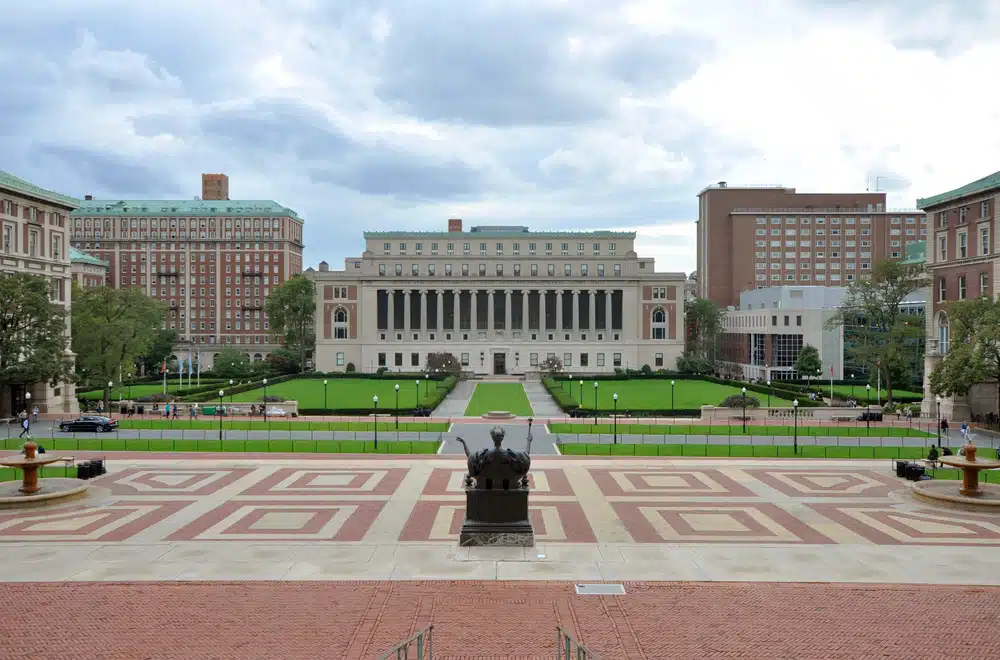
Within this extensive network of libraries, Butler Library stands as the largest single library, housing over 2 million volumes.
8. Columbia was a pioneer in sports broadcasting.
In 1939, Columbia’s Baker Field hosted the first televised sporting event—a baseball game against Princeton—marking a significant milestone in sports and media history.
The game itself was tightly contested, with Columbia emerging victorious by a score of 2–1. Although the broadcast reached only a small local audience due to the limited number of television sets at the time, it laid the foundation for the future of sports broadcasting and demonstrated how technology could transform the way fans engage with sports.
9. Havemeyer Hall is Hollywood’s favorite lecture hall.
If you’ve watched movies like Spider-Man or Malcolm X, you’ve likely seen Columbia’s Havemeyer Hall. This lecture hall is one of the most filmed college classrooms in the U.S., making it a star in its own right.
10. There’s a hidden network beneath your feet.
Beneath Columbia’s campus lies a network of tunnels shrouded in mystery and legend. Stories abound of secret passages and forgotten students, adding an element of intrigue to the university’s history.
The oldest sections of these tunnels actually predate Columbia’s presence in Morningside Heights, having been built when the land was occupied by the Bloomingdale Insane Asylum. These early tunnels were reportedly used to transport patients between buildings.
Later, during the intense research of the Manhattan Project, these hidden passageways were used to move radioactive materials between laboratories.

Quick Overview of Columbia University
Founded in 1754 as King’s College, Columbia is the oldest institution of higher education in New York and the fifth-oldest in the U.S.. It has a long-standing reputation as a prestigious Ivy League research university. In 2025, Columbia ranks #13 under National Universities as per US News and World Report.
Located in the Morningside Heights neighborhood of Manhattan in New York City, Columbia is home to its undergraduate schools:
- Columbia College
- Fu Foundation School of Engineering and Applied Science
- Barnard College (an affiliate)
- School of General Studies
You’ll find a wide array of academic pursuits here, with numerous departments and programs across its undergraduate and graduate schools.
Columbia University has officially wrapped up its admissions cycle for the Class of 2029. While Columbia didn’t break down its Early and Regular Decision numbers this year, it did release the big picture: out of 59,616 applicants, just 2,557 were accepted. That puts the overall acceptance rate at 4.28%.
If you’re looking for a university deeply connected to the history and culture of New York City with a strong emphasis on research and academic excellence, Columbia could be a great fit for you.
Columbia University Admission Tips
Thinking of applying to Columbia? With an acceptance rate hovering around 3-4%, getting in is no easy feat. But with the right strategy, it’s possible. Here’s everything you need to know to improve your chances:
1. Ace your academics.
Columbia looks for students who have excelled in a rigorous high school curriculum. Historically, the average GPA of admitted Columbia University students hovers around 3.9. You’ll want to aim for a very high GPA and take challenging courses like AP, IB, or honors classes to show you’re ready for their demanding academics.
2. Show your test-taking skills (if you choose to).
For the Class of 2025, Columbia has extended its test-optional policy. This means you can decide whether or not to submit your SAT or ACT scores. If you feel your scores are a strong reflection of your academic abilities, submitting them can certainly enhance your application.
Strong test scores can definitely boost your application. Historically, admitted students get SAT scores around:
| 25th Percentile SAT Composite Score | 50th Percentile SAT Composite Score | 75th Percentile SAT Composite Score |
| 1500 | 1520 | 1560 |
As for the ACT:
| 25th Percentile ACT Composite Score | 50th Percentile ACT Composite Score | 75th Percentile ACT Composite Score |
| 34 | 35 | 36 |
To ensure your spot, aim for the higher end of these ranges. For the SAT, aim for at least a 1550-1560, and for the ACT, aim for a 35-36.
3. Cultivate meaningful extracurriculars.
If you’re applying to Columbia, chances are you’ve already got interests that match what they value—so make sure your activities reflect that.
To really stand out, look into programs that showcase your strengths. If research is your passion, programs like the Research Science Institute (RSI) or the Garcia Summer Research Program can give you hands-on experience that looks amazing on an application. For community service, consider leadership programs like the Youth Leadership Academy or the National Youth Leadership Council.
If competition gets your adrenaline pumping, contests like the Regeneron International Science and Engineering Fair (ISEF) or the United States Academic Decathlon will show off your intellectual edge.
4. Craft compelling essays.
If you’re applying to Columbia, you’ll need to answer five supplemental essay questions. One is a list question with a 100-word limit, and the other four are short-answer essays, each up to 150 words. These Columbia-specific essays are required on top of the Common App Personal Statement.
Your essays are your chance to shine and tell Columbia who you are beyond your transcripts and test scores. Focus on being authentic, sharing your unique experiences, and demonstrating your personality. They want to understand your motivations, your intellectual curiosity, and what makes you a good fit for their community.
5. Secure strong recommendations.
Letters of recommendation provide valuable insights into your character and abilities from those who know you well. Columbia typically requires one recommendation from your guidance counselor and at least two teacher recommendations. Choose teachers who know you well and can provide specific examples.
If you’re aiming for Columbia Engineering, make sure one of those teacher recommendations is from a math or science teacher.
6. Meet Columbia’s deadlines.
When applying to Columbia University, keeping track of deadlines is crucial to stay on top of things. Here’s a quick breakdown of the important dates you need to know:
| Date | Event |
| August 1 | Application Start |
| November 1 | Early Decision Deadline |
| Mid-December | Early Decision Notification |
| Mid-January | Early Decision Confirmation |
| January 1 | Regular Decision Application Deadline |
| Late March | Regular Decision Notification |
| May 1 | Reply Date |
You can start working on your Common Application, Coalition Application, or QuestBridge Application as early as August 1. If you’re applying Early Decision to Columbia, mark your calendar for November 1—that’s your submission deadline, and it comes well before the Regular Decision deadline on January 1. Just remember: Early Decision is binding. If you’re accepted, you’re committing to attend.
And don’t lose sight of May 1 (National College Decision Day). By then, all admitted students must officially choose their school and submit an enrollment deposit to secure their spot, whether at Columbia or another university.

Frequently Asked Questions
1. Is Columbia a good school?
As one of the eight Ivy League universities, Columbia consistently ranks among the top institutions in the world. It currently holds the 13th spot for national universities in the US.
Located in New York City, Columbia offers access to incredible academic resources, a renowned Core Curriculum, and opportunities that only a global city can provide. It’s especially strong in fields like journalism, political science, economics, engineering, and the humanities.
2. How much does it cost to attend Columbia University?
The average tuition cost at Columbia is $71,170. However, Columbia is committed to meeting 100% of the demonstrated financial need for all admitted first-year students, regardless of citizenship. The university’s financial aid packages are need-based and do not include loans, ensuring that students can graduate without debt.
Notably, families with an annual income below $150,000 (with typical assets) are not expected to pay tuition.
3. What is Columbia’s motto?
Columbia University’s official motto is “In lumine Tuo videbimus lumen,” which translates to “In Your light we shall see light.” This phrase is taken from Psalm 36:9 in the Bible and reflects Columbia’s historical roots and commitment to the pursuit of knowledge and truth through enlightenment and learning.
Takeaways
- From Hollywood film sets to secret tunnels, fun facts about Columbia University prove that there’s always something new to discover on campus.
- Whether you’re a future student, a curious reader, or just love a good piece of trivia, Columbia’s rich history and vibrant culture definitely make it stand out.
- Want to shoot your shot at Columbia? Working with a college admissions consultant can help sharpen your application strategy and increase your chances of being accepted.