
Who says you can’t have real scientific research as a high school student? The High School Research Academy (HSRA) at UT Austin lets you experience exactly that. In this program, you’ll work with scientists and college students on research projects in a professional laboratory.
If you’re interested, keep reading. We’ll discuss what to expect in the program and the specifics on applying.
- What Is the HSRA at UT Austin?
- HSRA at UT Austin Acceptance Rate
- HSRA at UT Austin Application Deadline
- HSRA at UT Austin Requirements
- How to Get into the HSRA at UT Austin
- Why Join the HSRA at UT Austin?
- Frequently Asked Questions
- Takeaways
What Is the HSRA at UT Austin?
The High School Research Academy (HSRA) at UT Austin is an in-person, non-residential five-week summer research program for high school students. Hosted on the UT Austin campus by the College of Natural Sciences, HSRA places students into active research laboratories in various fields.
All participants are enrolled in NSC 309, a UT Austin extension course, meaning you earn three hours of college credit for completing HSRA. To earn those credits, you can expect to write short reflection essays and do coursework on research ethics and methods during the program.
For 2025, the program dates are June 9 to July 16, but you get a short break around July 4th for the holiday.
Activities
As an HSRA participant, you will actively engage in a real UT lab research project under the guidance of UT faculty and students. You can expect to spend roughly 15 to 25 hours per week in the lab, assisting with experiments and learning research techniques.
Outside of lab hours, you’ll attend weekly Wednesday seminar talks by UT professors or researchers, where you learn about different STEM topics and ongoing research. You’ll also complete some reading and reflection assignments as part of an academic component.
At the end of the five weeks, HSRA at UT Austin hosts a Research Symposium, where each student creates and presents a scientific poster summarizing their summer research. You’ll stand by your poster and explain your project and results to professors, peers, and family during this event.
Research opportunities
Based on your interests, you’ll be paired with a research group, depending on availability and space. There, you’ll work closely with UT Austin faculty and undergraduates in a laboratory. Here are some of the research experiences that HSRA offers:
| Discipline | Topic | Description |
| Biochemistry | Aptamer | You’ll isolate aptamer, an RNA molecule. Through this process, you’ll learn skills like micropipetting, purification of DNA/RNA, and amplification of DNA. |
| Biomanufacturing | You’ll look at how you can optimize a new E. coli secretion system to produce commercially important small peptides. | |
| Gene Regulation in Cancer | You’ll look at specific genes that have suspected but still unconfirmed roles in carcinogenesis. | |
| Biology | Behavioral Neuroscience | You’ll learn to use the Drosophila melanogaster model system to study certain parts of learning and memory through Pavlovian conditioning. |
| Discovering Signals | You’ll first be taught the necessary lab techniques, and then you’ll perform your own experiment to examine how plant cells communicate with one another. | |
| Plant Pathways | You’ll learn how to engineer a plant that can express pigments in its body to signal the presence of environmental toxins. | |
| Chemistry | Materials in Color | You’ll learn to use light to create soft materials more efficiently. |
| Practical Sensors | You’ll help create faster and cheaper sensors that can solve everyday problems. | |
| Interdisciplinary | Computational Astrophysics | You’ll use the same datasets that professional astronomers do to study the structure and motion of the different components of the universe, like star clusters and galaxies. |
| Sustainable Fashion Materials | You’ll be part of an undergraduate research team to use sustainable materials in creating fashion textiles. | |
| Urban Ecosystems: Ecology | You’ll collect water samples from Austin’s creeks to monitor them and check for habitat quality, learning how they’re affected by human civilization. |
HSRA at UT Austin Acceptance Rate
The UT Austin High School Research Academy doesn’t publish an official acceptance rate. It’s not extremely competitive since it only accepts Texas residents. However, you can still expect a relatively competitive admissions process since UT Austin’s unique summer program still draws applicants from all over the state.
HSRA at UT Austin Application Deadline
The UT Austin High School Research Academy application deadline is March 23, 2025. If you’re accepted, you’ll be notified sometime in April.
Late applications may be accepted, but there’s no guarantee that they’ll be reviewed.
HSRA at UT Austin Requirements
In this section, we’ll talk about the requirements for applying to UT Austin High School Research Academy.
Eligibility
To apply to HSRA at UT Austin, you must be:
- A Texas resident
- At least 15 years old by the start of the program
- Ideally a rising junior or senior, although rising sophomores are also considered
- Be available for the entire five-week program
Required documents
The program doesn’t ask for a lot of documents. All you need are:
- Online application form. This is available through UT’s portal.
- Personal essay. Here, you can explain why you’re interested in research and what fields or questions excite you.
HSRA explicitly states that they don’t consider GPA or class rank at all in admissions. Instead, selection is based almost entirely on your essay and stated interests
Program cost
The program cost for the HSRA at UT Austin is $4,000. You won’t need to pay anything until you’re offered a position and you’ve accepted it. If selected, you’re also responsible for arranging your own housing and transportation.
The HSRA doesn’t offer merit-based scholarships, but there are limited need-based scholarships that will cover the full program tuition and even provide a small stipend.
How to Get into the HSRA at UT Austin
Since the UT Austin High School Research Academy doesn’t require a lot of documents, applying is pretty straightforward. Here’s a step-by-step guide:
Step 1: Create a UT EID.
The electronic ID (EID) is basically your user account for UT Austin’s systems. You can register for a UT EID online with just your name and email. However, if you already have an EID from a previous UT program, you should use that instead.
Step 2: Complete the online application form.
Once you have your EID, you can log in with your EID to start the application. Fill it out with all the required information.
Spend a good amount of time writing a strong personal essay, because HSRA admissions are decided mainly by your essay and how well your interests align with the program.
In this essay, explain why you want to do research and what you hope to explore or learn. Be specific, so rather than just saying “I love computer science,” mention what about the field fascinates you and how you’ve fed your curiosity outside of the classroom. For example, you could say you built your own computer programs and now want to try computational research.
If you need help with your essay and overall application for HSRA, we offer thoughtful, one-on-one guidance to support you through the process.

Step 3: Wait for the decision notification.
HSRA releases decision notifications in April, so when that month rolls around, start keeping an eye on your email. When you’re accepted, confirm your acceptance and pay the $400 deposit to reserve your slot.
You’ll also be notified if you’re waitlisted. If this is the case, you’ll see on your MyStatus if a spot opens up.
Step 4: Handle the practical arrangements.
HSRA at UT Austin doesn’t provide housing or transportation, so you’ll need to make arrangements yourself. Aside from planning that, you should clear your schedule for five weeks. That means you can’t have any other classes, big trips, internships, or commitments during the duration of the program.
This also isn’t really required, but we recommend brushing up a bit on the basics of your chosen field just so you’re ready.
Why Join the HSRA at UT Austin?
Spending five weeks of your summer in a lab is a big commitment. But being part of the UT Austin High School Research Academy can let you experience so many benefits, such as:
1. Gain real research experience
HSRA at UT Austin gives you a genuine taste of life as a researcher while still in high school. After all, rather than just doing predefined school labs, you’re actually working on authentic research projects in UT Austin’s labs.
This means you get to use advanced equipment, learn cutting-edge scientific techniques, and contribute to experiments that might even be part of a larger study or publication.
The hands-on experience you get is great if you’re seriously considering a STEM career. By the end of the program, you’ll have a much deeper understanding of the scientific process (including how messy and exciting real research can be) and whether you enjoy doing it.
2. Experience mentorship and collaboration
Each student is matched to a lab led by a UT Austin professor (or researcher), and you’ll also usually work closely with undergraduate researchers or graduate students in that group. Meaning, you’ll get experienced people to train you on techniques, answer questions, and involve you in team discussions.
The collaborative environment also helps you learn how to work as part of a research team. Later on, you might even ask your lab mentor for a college recommendation letter or advice on college majors.
Of course, you also get to interact with other high schoolers in the program, though each of you has your own project.
3. Earn college credit
All HSRA students are enrolled in a University Extension course (NSC 309) at UT Austin and receive 3 credit hours upon completion. These are real UT Austin credits that you can later potentially transfer to whatever college you attend.
To earn the credit, you’ll need to complete academic assignments during the program, like writing reflection essays about your research experience, doing readings on research ethics, and documenting your results. Don’t worry, these assignments are integrated into the program and are meant to improve your learning.
4. Develop presentation and communication skills
Doing experiments in isolation is a part of being a scientist, but you’ll also need to communicate your findings. Throughout the HSRA at UT Austin, you’ll attend weekly seminars and engage in discussions about various research topics, which helps you practice listening and asking questions in a scholarly setting.
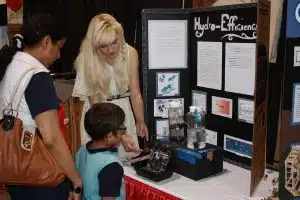
The big finish for the program is the poster presentation. Here, you’ll need to distill your research project, including the background, methods, results, and what it means, into a poster format and explain it clearly to an audience. This experience of creating and presenting a research poster is similar to what graduate students and professionals do at conferences.
By presenting, you’ll learn how to translate complex science into understandable terms, handle questions about your work, and confidently share your ideas.
5. Explore college life and STEM careers early
Even though the HSRA at UT Austin doesn’t have dorm living, you’ll still spend five weeks on the UT Austin campus, using facilities like labs, libraries, and lecture halls. This way, you still get a feel for the university atmosphere of navigating campus, interacting with college students, and experiencing a college lab. All this can make the transition to college less daunting later.
Participating in HSRA also gives you a preview of college life and careers in STEM since working in a specific research area lets you explore a potential major or career path. For instance, if you think you want to be a doctor, working in a biomedical lab at HSRA might either fuel that ambition or maybe show you that you actually enjoy lab research more than clinical work.
HSRA also lets you gain insight into what “research” really means as a career by showing you the day-to-day of a scientist. You can think of it as job shadowing. After the program, you’ll have a clearer sense of how scientific knowledge is created and whether you see yourself being part of that in the future.
Frequently Asked Questions
1. Do I receive credit for participating in the UT Austin High School Research Academy?
Yes, you receive credit for participating in the UT Austin High School Research Academy. All participants are also enrolled in a UT Austin extension course (NSC 309), which earns you 3 college credit hours upon successful completion of the program.
2. Who can join the HSRA at UT Austin?
To join HSRA at UT Austin, you must be a Texas resident, at least 15 years old by the program start, and available for the full five weeks. Rising juniors and seniors are preferred, but rising sophomores may also apply.
3. How much does HSRA cost at UT Austin?
HSRA at UT Austin costs $4,000. Limited need-based scholarships are available for students who need financial assistance.
Takeaways
- The High School Research Academy (HSRA) at UT Austin is a five-week summer research program that immerses high school students in real lab research. You’ll work with UT scientists on projects in fields like biology, neuroscience, and others, gaining hands-on experience and even earning college credit.
- UT Austin HSRA’s program dates for 2025 are June 9 to July 16.
- Participating in the HSRA at UT Austin has advantages like gaining real research experience, having mentorship and collaboration, earning college credit, developing presentation and communication skills, and exploring college life and STEM careers early.
- Looking for more similar opportunities? Consult a private admissions expert to help you look for more immersive programs that can prepare you for a STEM major and career.