

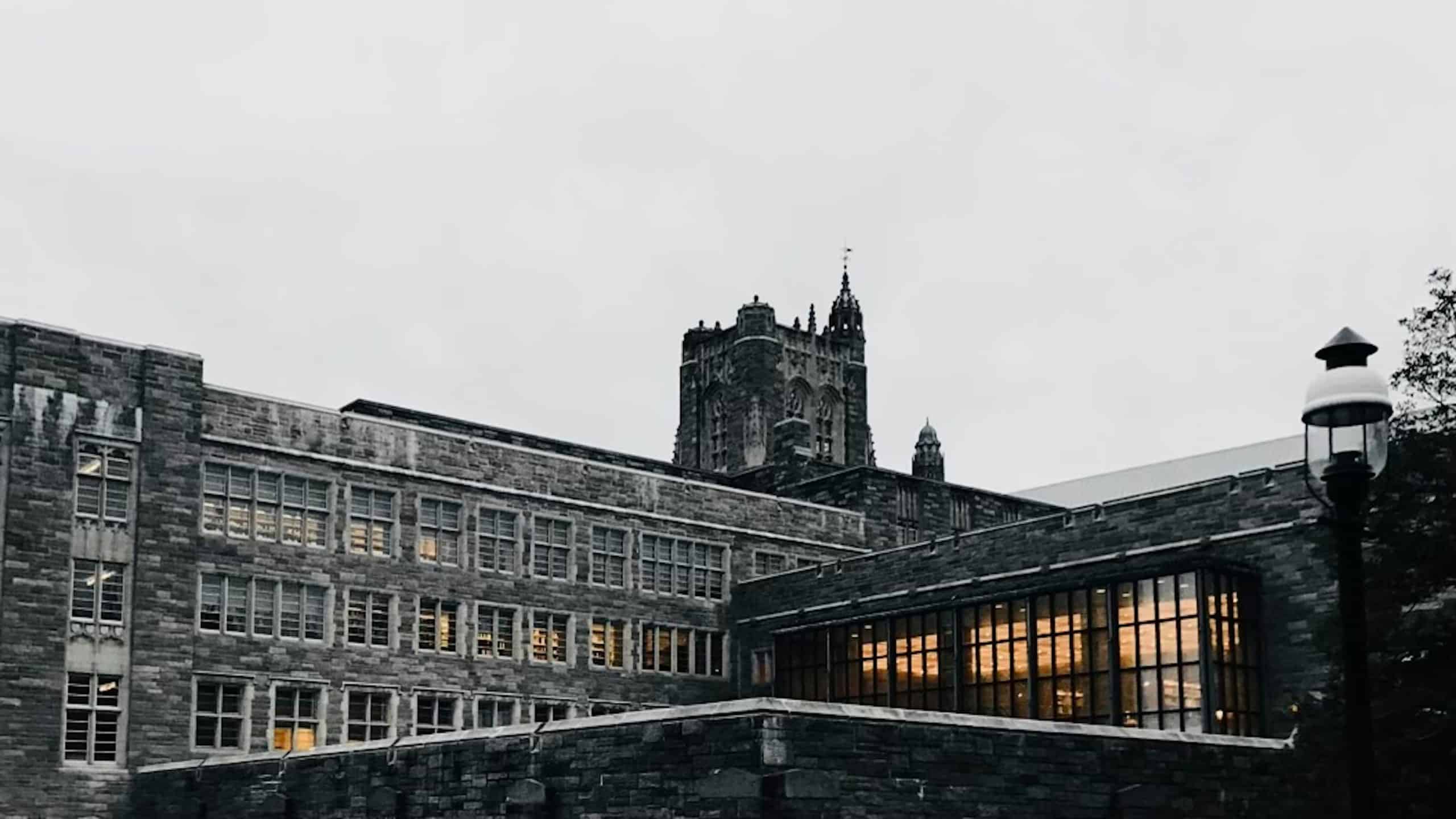
From July 1, 2023 to June 30, 2024, Princeton University awarded 1,324 bachelor’s degrees. Another 655 master’s and 403 research doctorates went out the door too. That is a full year of caps and gowns, but where did undergraduates actually study?
This guide ranks the 10 most popular majors at Princeton by that year’s graduation share and shows what makes each one feel different here. If you are sizing up majors at Princeton, this is your quick guide.
- What Are the Most Popular Majors at Princeton?
- Social Sciences at Princeton
- Engineering at Princeton
- Computer and Information Sciences at Princeton
- Biological and Life Sciences at Princeton
- Public Administration and Social Services at Princeton
- Physical Sciences at Princeton
- Foreign Languages, Literatures, and Linguistics at Princeton
- History at Princeton
- Psychology at Princeton
- English at Princeton
- Frequently Asked Questions
- Takeaways
What Are the Most Popular Majors at Princeton?
The table below, based on Princeton’s 2024–2025 Common Data Set, shows the percentage of bachelor’s degrees awarded by discipline between July 1, 2023, and June 30, 2024. These figures determine the ranking of the ten most popular majors at Princeton.
| Major | Share of Princeton Bachelor’s Degrees Conferred | Estimated Number of Graduates |
| Social Sciences | 19.5% | 258 |
| Engineering | 17.2% | 228 |
| Computer and Information Sciences | 16.1% | 213 |
| Biological and Life Sciences | 10% | 132 |
| Public Administration and Social Services | 9.8% | 130 |
| Physical Sciences | 4.8% | 64 |
| Foreign Languages, Literatures, and Linguistics | 4.2% | 56 |
| History | 4.2% | 56 |
| Psychology | 2.9% | 38 |
| English | 2.3% | 30 |
Social sciences, engineering, and computer science together account for 52.8% of Princeton bachelor’s degrees, or about 699 of 1,324 graduates. The rest is spread across life sciences, SPIA (School of Public and International Affairs), physical sciences, languages, history, psychology, and English.
Keep reading to see what makes each of these majors at Princeton distinct on campus.
Social Sciences at Princeton
Walk into a Politics seminar and you might find yourself debating foreign policy with the professor who literally wrote the textbook. Economics, Politics, Sociology, and Anthropology make up the largest share of degrees here, accounting for 19.5% of Princeton bachelor’s degrees.
U.S. News ranks Princeton #2 in Political Science, #6 in Economics, and #1 in Sociology. Those numbers matter because the same faculty driving those rankings guide your junior paper and senior thesis.
Here’s what to expect:
- Junior independent work is required, so you are researching by your third year.
- Politics students can use the campus survey research center for real polling.
- Economics pairs neatly with the Bendheim Finance certificate.
By the time you graduate, you have run real data or field studies and turned them into polished analysis. It is a skill set that travels across policy, finance, and academia.
Engineering at Princeton
Princeton Engineering operates within a liberal arts framework, so you get close advising and small classes alongside rigorous technical work. Six departments range from Civil and Environmental Engineering to Operations Research & Financial Engineering (ORFE), which integrates optimization, data science, and risk.
Rankings confirm the program’s reach:
- #25 in Graduate Engineering (U.S. News)
- #8 in Engineering and Technology worldwide (Times Higher Education)
Students have regular access to labs, faculty mentorship on capstone or thesis projects, and entrepreneurship opportunities through the Keller Center. The result is a graduate who can model complex systems and communicate solutions clearly.
Computer and Information Sciences at Princeton
Some students come for the theory. Others want to build. Princeton’s Computer Science degree makes room for both, whether you choose the A.B. path heavy on humanities or the B.S.E. track rooted in engineering. Independent work is central, and it can mean research, a design prototype, or even a shipped system.
U.S. News ranks Princeton #7 in Computer Science in the U.S., while Times Higher Education puts it #6 worldwide in the subject.
Signature features include:
- Formal ties to tech policy through a dedicated program.
- Independent work seminars that keep you on track and give peer feedback.
The takeaway is that you do not just learn how to code, you learn why an algorithm works. That distinction serves alumni well in Silicon Valley, government, and graduate research.
Biological and Life Sciences at Princeton
Princeton labs welcome undergraduates early. Whether in Molecular Biology or Ecology and Evolutionary Biology, you will likely be doing hands-on research well before senior year. The Lewis Sigler Institute brings together biology, math, physics, and computing, and EEB students can spend a semester in the field at the Mpala Research Centre in Kenya.

Program rankings:
- #6 in Biological Sciences in the U.S. (U.S. News)
- #7 worldwide in Life Sciences (Times Higher Education)
The focus on original experiments means many senior theses generate new data. For those heading to medical school, biotech, or academia, these majors provide a solid scientific and analytical foundation.
Public Administration and Social Services at Princeton
The Princeton School of Public and International Affairs offers a multidisciplinary liberal arts major for students pursuing public service and leadership in global and domestic policy. The program builds skills, knowledge, and critical thinking to tackle chosen policy issues, combining broad disciplinary exposure with focused, in-depth study.
Rankings back that up. U.S. News ranks Princeton #11 in Public Affairs and #6 in Social Policy. QS places Princeton #19 worldwide in Social Policy and Administration. You feel that strength in small classes, live policy briefs, and access to active research centers.
Why it stands out:
- Policy Task Forces with real clients and public reports.
- Methods training across economics, statistics, and qualitative analysis.
- Strong support for funded internships and study abroad tied to policy themes.
You graduate with writing samples and analysis that look like entry level policy work. SPIA is a hands-on choice among majors at Princeton if impact is your goal.
Physical Sciences at Princeton
This group of majors at Princeton includes Physics, Chemistry, and Astrophysical Sciences. The headcount is smaller, but the research footprint is huge. U.S. News puts Princeton #3 in Physics, #1 in Physics of Living Systems, and #7 in Chemistry. Times Higher Education ranks Princeton #5 worldwide in Physical Sciences. You feel that level in the labs, in mentoring, and in the depth of thesis work.
You’ll gain unique access to:
- A national fusion lab nearby for plasma physics exposure.
- An astrophysics path with two junior papers and a thesis that can be publishable.
- Modern facilities and small cohorts that make faculty contact routine.
You will learn first principles and also how to use real instruments. Physical science majors at Princeton thrive in Ph.D. study, data science, and quantitative roles.
Foreign Languages, Literatures, and Linguistics at Princeton
Princeton’s language departments are small and immersive, with literature and culture taught in the target language. Faculty-led immersion programs abroad grant Princeton credit, and the translation and intercultural communication program pairs well with any language major. Senior theses often draw on primary sources in the studied language.
Rankings highlight the quality:
- #10 worldwide in English Language and Literature (QS)
- #1 among schools offering linguistics, reflecting Princeton’s top National University rank (U.S. News)
This is a degree for students who want fluency, cultural literacy, and strong writing skills, often paired with certificates or internships abroad.
History at Princeton
Princeton’s history department trains you to read closely, argue well, and work with primary sources. It remains one of the most respected majors at Princeton.

The rankings make the case. U.S. News ranks Princeton #2 in History. QS places Princeton at #9 worldwide in History. You feel that strength in methods seminars, funded archive trips, and the two step path to the senior thesis.
What’s distinctive:
- Two junior research papers with methods training before the thesis.
- A full year senior thesis with regular advising and formal milestones.
- Access to strong archives and funding for travel or materials.
You learn to build long form arguments from evidence. History majors at Princeton often head to law, policy, publishing, consulting, and tech.
Psychology at Princeton
Princeton’s psychology program combines cognitive science, neuroscience, and social science. Labs welcome undergraduates early, and facilities range from brain imaging suites to behavioral research setups. Independent work draws on multiple methods, which gives students a broad research toolkit.
The rankings reinforce its stature:
- #2 in Undergraduate Psychology (U.S. News)
- #3 in Graduate Psychology (U.S. News)
- #22 worldwide in Psychology (QS)
By the end of the program, you have experience in experimental design, data analysis, and science communication, opening paths to research, applied data roles, and clinical training.
English at Princeton
Princeton’s English program is seminar-focused and writing-centered, blending rigorous literary study with a vibrant creative track. Consistently ranked among the nation’s best—U.S. News places it at #5—the department offers distinctive opportunities, including:
- The option to pursue a creative thesis in fiction, poetry, or screenwriting under the guidance of published authors.
- Small, discussion-driven seminars covering diverse periods, regions, and media.
- Close advising that supports both junior independent work and the senior thesis.
The program hones analytical precision and distinctive voice in equal measure, which makes English one of Princeton’s most flexible majors for those who value both critical insight and storytelling craft.
Frequently Asked Questions
1. What majors is Princeton known for?
Princeton is known for Economics, Computer Science, and SPIA on the social science side, plus Engineering. You also see standout depth in Molecular Biology, Ecology and Evolutionary Biology, Physics, Chemistry, History, English, and Psychology. These majors at Princeton attract large cohorts or deliver signature research experiences that set the programs apart.
2. What majors does Princeton offer?
Princeton offers A.B. majors in the arts and sciences and B.S.E. majors in engineering. Examples include Economics, Politics, Sociology, Anthropology, History, English, Spanish and Portuguese, Molecular Biology, Physics, Chemistry, Psychology, Civil and Environmental Engineering, Chemical and Biological Engineering, Electrical and Computer Engineering, Operations Research and Financial Engineering, and Computer Science.
You can add certificates like Finance, Statistics and Machine Learning, Entrepreneurship, Environmental Studies, or Translation to shape your path across majors at Princeton.
3. Where can I find a Princeton list of majors?
Princeton publishes an official list of undergraduate concentrations and certificates each year. Check the current Undergraduate Announcement or the Office of the Dean of the College for the up to date Princeton list of majors, then pair it with this guide to understand how the most popular majors at Princeton work in practice.
4. What are Princeton’s best majors?
“Best” depends on fit. If you want heavy math, look at Engineering, Computer Science, or ORFE. If you want policy and people, SPIA or other social sciences make sense. If you want labs, Molecular Biology, EEB, Physics, and Chemistry deliver deep research. If you love reading and writing, English, History, and Languages stand out. The best majors at Princeton are the ones whose weekly work you enjoy and can sustain.
Takeaways
Here are the key points to keep in mind as you choose among the most popular majors at Princeton:
- Social sciences, engineering, and computer science lead the most popular majors at Princeton by graduation share. Life sciences, SPIA, physical sciences, languages, history, psychology, and English round out the list.
- What sets the most popular majors at Princeton apart is structure. You get built in independent work, small precepts, policy task forces, a Kenya field semester, and access to a national fusion lab. Those features make majors at Princeton more hands on than many peers.
- You can shape your own path. A.B. and B.S.E. give different cores, and certificates like Finance, Statistics and Machine Learning, Entrepreneurship, and Translation customize majors at Princeton without adding a full second major.
- Outcomes track the training. Portfolios from independent work, lab skills, and policy briefs help Princeton graduates land roles in tech, finance, policy, research, media, and top graduate programs.
- Want help matching your fit? Students who want expert support choosing among the most popular majors at Princeton can work with a college admissions consultant. AdmissionSight offers one-on-one guidance on course plans, certificates, and thesis choices.










