

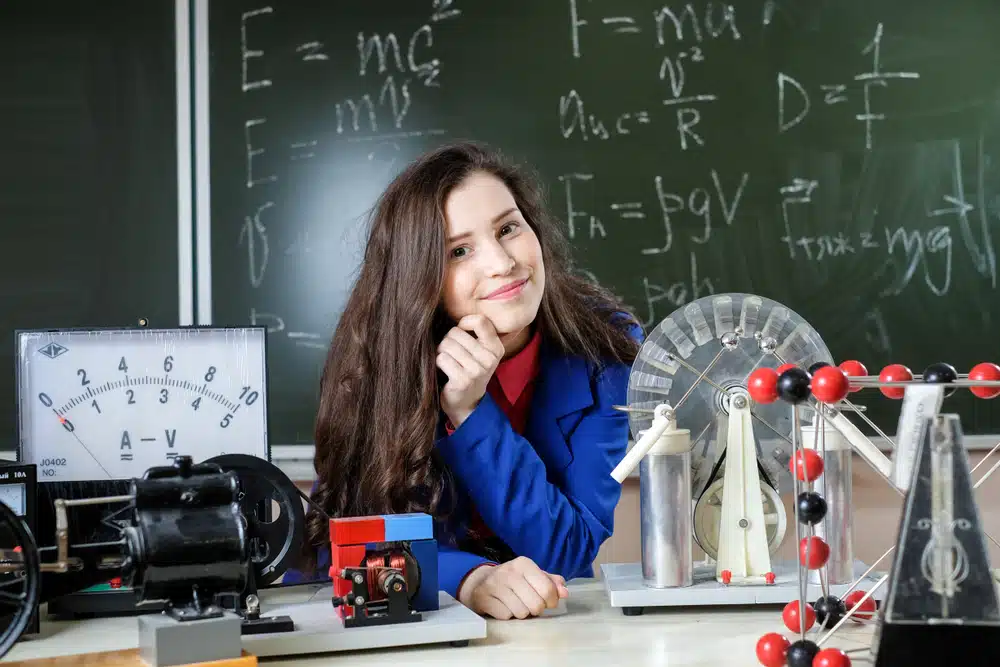
More high-school students are engaging in research as STEM opportunities expand. A 2025 study of 1,190 students found that science and engineering fair participation increased interest in STEM, with students citing “learning new things,” “doing real research,” and “exploring career paths” as key motivators. Yet physics remains one of the toughest STEM subjects, with many students struggling with abstract concepts and mathematical rigor.
This guide helps bridge that gap by offering 150 clear, high-school-friendly physics research topics across mechanics, energy systems, quantum physics, astrophysics, and modern technology.
- Key Physics Topics to Explore
- Quantum Information and Quantum Computing
- Condensed Matter and Materials Physics
- Astrophysics and Astroparticle Physics
- Biophysics and Interdisciplinary Physics
- Computational Physics and Physics AI Integration
- Frequently Asked Questions
- Takeaways
Key Physics Topics to Explore
As physics continues to evolve, a handful of fast-growing fields are reshaping what’s possible for high school researchers in 2026. Areas like biophysics, interdisciplinary physics, and signal-driven systems are especially compelling because they apply core physical principles to real-world problems without requiring massive lab infrastructure.
A standout example is “NeuroFlex: A Cost-Effective, Non-Invasive EEG-Controlled Bionic Prosthesis for Transfemoral Amputees,” a Regeneron ISEF 2025 Gordon E. Moore Award winner. Though biomedical in application, the project is rooted in physics, drawing on electromagnetic signal analysis, biophysical modeling, and mechanical control to convert brain signals into motion.
Here are five key physics areas to explore:
| Research Area | Description |
| Quantum Information & Quantum Computing | Uses quantum-mechanical phenomena (superposition, entanglement) to perform computing, simulation, cryptography, offering radically faster computations and new capabilities beyond classical computers. Interest and demand have surged with quantum technologies becoming more practical. |
| Condensed Matter & Materials Physics | Studies the physical properties of solids, nanomaterials, superconductors, topological materials, etc. This field underpins advances in electronics, nanotech, and new materials, making it central to both fundamental physics and future technologies. |
| Astrophysics & Astroparticle Physics (Cosmology, high-energy astrophysics, neutrinos, dark matter/energy) | Explores the universe: from cosmic origins, dark matter/energy, black holes, to high-energy particles from space. With growing observational capabilities and instruments, this field is expanding fast, helping answer fundamental questions about the cosmos. |
| Biophysics & Interdisciplinary Physics (physics-biology interface, soft matter, biophotonics, medical/biomedical applications) | Combines physics methods and models with biology/medicine to study living systems, biological materials, medical imaging/diagnostics. The trend toward interdisciplinary science and real-world applications is fueling growth here. |
| Computational Physics & Physics‑AI Integration (simulation, modeling, AI/ML for physics problems) | Uses computational methods, simulations, and increasingly AI/ML to handle complex systems—from quantum simulation to material design, astrophysical modeling, and more. As computational power and data-driven methods expand, this becomes a key enabler across physics. |
To guide your exploration further, the next five sections break down 30 research-ready, high-school-friendly project ideas for each fast-growing physics subfield.
Quantum Information and Quantum Computing
This section highlights key topics that explore how information is stored, processed, and protected at the quantum level:
- Analyze how information storage differs by simulating qubits vs bits using Bloch sphere tools.
- Investigate how increasing qubit superposition states affects computational complexity in small circuits.
- Measure entanglement entropy in simple two-qubit systems and its impact on algorithm performance.
- Study how measurement collapses quantum states using probability simulations.
- Model how environmental noise (decoherence) affects fidelity in single-qubit operations.
- Test efficiency differences between classical and quantum solutions for the same problem size.
- Analyze how Grover’s algorithm runtime scales with database size using simulators.
- Compare classical vs quantum performance for small transforms and assess speed differences.
- Measure how circuit depth influences error rates in simulated quantum algorithms.
- Investigate how adjusting parameters affects accuracy in simple VQA problems.
- Compare published coherence times across superconducting, trapped-ion, and photonic qubits.
- Evaluate how gate error rates differ among current quantum hardware platforms (IBM, IonQ, etc.).
- Simulate depolarizing vs amplitude-damping noise and quantify which degrades performance faster.
- Test simple error mitigation strategies (e.g., zero-noise extrapolation) on sample circuits.
- Analyze how qubit connectivity affects the feasibility of large-scale quantum algorithms.
- Model the BB84 protocol and measure error rates under attempted eavesdropping.
- Explore how different polarization orientations encode qubits in communication experiments.
- Test teleportation fidelity under noisy channels using open-source quantum SDKs.
- Compare vulnerabilities in classical encryption vs QKD systems.
- Model how entanglement distribution affects quantum network efficiency.
- Analyze sensitivity improvements offered by NV centers in diamond.
- Investigate how temperature affects superconducting qubit stability using real-world data.
- Explore why topological states (e.g., Majorana modes) could reduce error rates.
- Study tunable properties of quantum dots and how they store information.
- Evaluate how quantum processors depend on ultra-low temperatures and the limits this imposes.
- Simulate a simple QML classifier and evaluate accuracy vs a classical model.
- Test how D-Wave-style annealing solves small optimization problems compared to classical heuristics.
- Use quantum simulations to calculate molecular energies and compare accuracy with classical methods.
- Assess which classical cryptographic schemes are most vulnerable to quantum attacks.
- Compare estimated power usage for classical supercomputers vs quantum processors during specific tasks.

Condensed Matter and Materials Physics
Below are key topics related to advanced materials, electronic properties, and the physical principles that drive next-generation technologies:
- Simulate (or analyze published data) the conductivity of graphene vs temperature or defects.
- Model how adding impurities affects lattice structure and conductivity in a 2D material.
- Study what makes a material a “topological insulator,” e.g. via band-structure calculations for a simplified model.
- Research the concept of spin liquids and simulate small lattice models to detect entanglement or frustration.
- Research how lowering temperature can lead to superconductivity in certain materials, and what factors (symmetry, lattice) help.
- Simulate or analyze how 2D materials change phases (e.g. from insulator → conductor) under varying parameters.
- Model what happens when stacking different 2D materials (how properties change vs single-layer).
- Study the conditions under which the (integer or fractional) quantum Hall effect appears in 2D electron systems.
- Explore (via modeling or literature review) how applying mechanical strain changes electronic or optical properties.
- Simulate or analyze how heat flows in nanostructures vs bulk materials.
- Research how electron spin (not just charge) can be used in materials for information storage (e.g. via theoretical spin transport in simple models).
- Study how the resistance of a thin magnetic film changes under applied magnetic fields (using simplified models or published data).
- Explore how many-body interactions in solids lead to unexpected properties (e.g. correlation-driven insulators) using simplified lattice models.
- Study how confinement changes energy levels in quantum dots and potential applications.
- Simulate how nanoscale size affects absorption or emission spectra.
- Model how defects migrate, accumulate, or affect overall material behavior.
- Analyze what changes when going from a 2D material to a 3D bulk (e.g. in conductivity, band structure).
- Study heat capacity, conductivity, or magnetization of materials at low (theoretical) temperatures.
- Read up on and simulate analogies between condensed matter systems and quantum fluid behavior.
- Explore how artificially structured materials might behave differently (e.g. negative refractive index or unusual dispersion relations).
- Model how a disturbance (heat pulse, magnetic field) propagates through a solid and how it relaxes.
- Theorize or simulate how applying strain might push a material into a topological phase.
- Study how lattice vibrations propagate and how this affects thermal/electrical properties.
- Explore how electrons interacting with lattice vibrations can lead to interesting effects like resistivity, superconductivity.
- Analyze how nanoscale structure can improve efficiency for converting heat to electricity.
- Propose a hypothetical 2D material (lattice + composition) and predict its electrical or thermal behavior.
- Compare how a thin film’s properties differ from bulk material (e.g. using literature data or simulations).
- Study how reducing material dimensions affects electron energy levels and transport.
- Explore how increasing randomness in a lattice (defects or impurities) leads to electron localization.
- Design or simulate how a nanoscale material could detect external conditions (temperature, magnetic field) via changes in conductivity or optical response.

Astrophysics and Astroparticle Physics
This section includes astrophysics research topics, from the behavior of galaxies and black holes to the fundamental particles that shape cosmic evolution:
- From publicly available data (e.g. from telescopes), try to detect exoplanet transits.
- Use open-source spectral databases to classify stars and infer temperature, type, etc.
- Compare different models of dark matter distribution in galaxies and simulate rotation curves.
- Use simplified cosmological models to simulate how CMB fluctuations arise.
- Model how light from background sources bends around massive objects (estimate magnification, distortion).
- Use published photometric data to construct HR diagrams and estimate cluster ages.
- Using existing data sets, attempt to fit simple supernova light curves and infer parameters (luminosity, distance).
- Analyze how observed rotation curves differ from what visible matter predicts, exploring implications for dark matter.
- Use computational tools to see how cosmological parameters affect expansion history.
- Use simple N-body code or existing datasets to simulate galaxy distribution under gravity.
- Use archival data of solar flares and geomagnetic indices to explore correlations.
- Explore how pulsar timing can detect gravitational wave backgrounds; model what timing residuals would look like.
- Use open survey data to map galaxy positions and analyze large-scale structure.
- Use publicly available binary data to estimate mass of compact objects.
- Model how matter falling onto compact objects emits radiation and how that depends on disk parameters.
- Study proposed sources of cosmic rays and analyze observational data if available.
- Use simple models to compute expected waveforms from binary mergers.
- Use simplified models to track how a star changes over time depending on mass and composition.
- Try to estimate atmospheric composition or properties from publicly available transit spectra.
- Simulate how different values of cosmological constant / dark energy change future universe expansion.
- Use catalog data to compute mass-to-light ratios and infer dark matter content.
- Estimate how mass distribution in clusters affects light behavior, dynamics.
- Compare different methods (Cepheids, Type Ia supernovae) using published data to derive distances.
- Model basic nucleosynthesis and compare relative abundances with observations.
- Study how dust and medium affect light traveling through galaxies.
- Analyze data to identify clusters, velocities, and infer dynamics.
- Use data from galaxy surveys to explore correlations.
- Using a toy model, simulate how small density fluctuations grow into structures over cosmic time.
- Model how orbital parameters and perturbations affect long-term stability.
- Explore candidate sources (supernovae, AGNs), and compare with neutrino detection data.

Biophysics and Interdisciplinary Physics
The physics research ideas below reflect growing interest in the physics-biology interface, soft matter, biophotonics, and medical and biomedical applications:
- Simulate or measure how temperature or molecule size affects diffusion speed.
- Quantify how solute concentration changes cell size or mass over time.
- Simulate how opening/closing probabilities affect electrical signals in cells.
- Use Michaelis–Menten modeling to study how substrate concentration influences reaction rate.
- Analyze data or perform safe experiments showing protein denaturation trends.
- Model how stretching or bending DNA affects its stability and function.
- Use simple physics models to calculate stress on knees or elbows during motion.
- Measure step length, walking speed, and energy expenditure in different walking styles.
- Analyze projectile motion, torque, and force applied in throwing, jumping, or swimming.
- Study elasticity and bending stiffness in thin biological tissues.
- Simulate lift and drag in simplified flapping-wing models.
- Compare how hollow vs solid structures distribute stress.
- Compare how fluids like water, oil, or safe gel solutions mimic blood or mucus flow.
- Simulate how branching affects airflow resistance.
- Use Poiseuille’s law to model how vessel radius affects flow.
- Use diffusion equations to model nutrient spread in soft tissue.
- Simulate how flagella or cilia propulsion works.
- Create a simple electrical circuit model that mimics neuron firing.
- Measure how resistance and capacitance affect the speed of electrical signals.
- Analyze publicly available EEG datasets to identify alpha, beta, and theta patterns.
- Model how organisms gain or lose heat in different climates.
- Simulate diffusion of contaminants through soil or water.
- Study how forests, water, or open spaces affect sound attenuation.
- Measure how leaf thickness or pigmentation affects light absorption.
- Use logistic models to study carrying capacity and resource limits.
- Simulate bird, fish, or insect movement using simple alignment rules.
- Study how reaction-diffusion equations explain patterns like stripes or spirals.
- Model how animal biomechanics can improve robot limb or wing designs.
- Compare how organisms convert chemical energy to motion vs mechanical machines.
- Build a simple SIR model to study how infection rate and recovery time influence outbreak size.

Computational Physics and Physics AI Integration
The following physics research topics explore how computation, simulation, and artificial intelligence are used to model and solve complex physical systems:
- Compare ideal vs drag-affected trajectories using numerical integration.
- Use Newton’s laws to simulate stable, unstable, or chaotic orbits.
- Use finite-difference methods to visualize temperature evolution.
- Simulate standing waves, nodes, and antinodes under different tensions.
- Analyze diffusion and probability patterns in 2D or 3D random walks.
- Create computer-generated field maps for point charges, rings, or plates.
- Use conservation laws to simulate elastic or inelastic collisions.
- Simulate laminar flow in a pipe using simplified Navier–Stokes approximations.
- Use Newtonian gravity to model how stars cluster over time.
- Model interactions of a simple atomic system (e.g., Lennard-Jones potential).
- Train a simple classifier to identify straight vs curved tracks from simulated detector images.
- Compare an AI model’s predictions to numerical solutions of orbital equations.
- Use open datasets to predict temperature or rainfall trends.
- Use ML to clean noisy data from simulated detectors or sensors.
- Train a model to recognize order vs chaos in simulated dynamical systems.
- Explore whether a neural net can learn solutions to basic ODEs or PDEs.
- Use real NASA light-curve data to detect possible exoplanet dips.
- Train a CNN using open astrophysics image datasets (e.g., Galaxy Zoo).
- Use ML to estimate energy use under different conditions.
- Train a model to predict conductivity, density, or heat capacity from known material features.
- Compare speed or accuracy of two simulators running the same quantum circuit.
- Model how noise affects qubit stability over time.
- Simulate how angle, temperature, and intensity affect energy output.
- Simulate charge/discharge cycles to analyze degradation patterns.
- Model robot motion and use RL (reinforcement learning) to optimize movement paths.
- Have AI solve simple PDEs like heat or wave equations using physics constraints.
- Train a model to predict results (e.g., pendulum period) from input parameters.
- Treat cars as particles and use ML to predict congestion conditions.
- Use open seismic datasets to classify tremors or identify precursor patterns.
- Compare how well AI-generated data aligns with physics-based simulations.

How to Choose the Best Physics Research Topics
Choosing the right project can make or break your research experience. This section offers practical, high-school-friendly guidance to help you select physics research topics that match your interests, fit your available resources, stay safe and ethical, and remain focused enough to complete within your timeline.
1. Consider your personal interests.
Pick a topic you find genuinely intriguing or that sparks your curiosity. When you research something you care about, you’re more likely to stay motivated through the long hours of reading, experimenting, or coding. This intrinsic interest often leads to deeper engagement and better results.
Try a “mind-map” exercise: write down things you enjoy (e.g. astronomy, computing, biology, environment), then draw connections to physics. That can help you discover physics research topics that combine your passions.
2. Assess available resources and practical feasibility.
Before committing to a topic, check what resources you actually have: lab equipment, access to data or simulation tools, time, and possibly a mentor or teacher who can advise you. Feasibility is a core criterion for good physics research topics.
If you lack advanced lab tools or funding, focus on topics doable with simulation, data analysis, simple experiments, or theory. Simple but well-designed experiments (e.g. measuring magnet strength vs temperature, building a rubber-band-powered car, studying motion) can still yield solid data.
Also consider mentorship or supervision. Having a teacher, senior student, or knowledgeable friend guiding you—especially if your topic involves technical or conceptual depth—can increase success chances. Many guides recommend bouncing early ideas off a mentor.
3. Ensure the topic is appropriately scoped.
Good physics research topics should allow a clear, fair test—one well-defined independent variable, measurable outcomes, repeated trials, and controlled conditions—so you can draw reliable conclusions from your data. At the same time, the topic shouldn’t be so narrow that it limits meaningful analysis or insight.
For example, a well-scoped project might investigate how changing the thickness of a dielectric material affects the capacitance of a parallel-plate capacitor. The material thickness is the independent variable, capacitance is directly measurable, trials can be repeated under identical conditions, and the results connect clearly to established physical theory.
Striking this balance keeps your project manageable while still allowing you to generate results that are interesting, defensible, and scientifically valuable.
4. Check scientific relevance and timeliness.
Aim for topics that connect with current trends or active areas in physics. One effective approach is to explore recent publications in reputable journals such as Physical Review Letters, Physical Review A–E, Nature Physics, Science, and Applied Physics Letters, which highlight emerging discoveries and open questions across subfields.
Databases like arXiv, Google Scholar, and NASA ADS (for astrophysics) are especially useful for identifying trends, reviewing recent abstracts, and seeing what problems researchers are actively working on. Even scanning review papers or special issues can reveal gaps that are approachable at a student level.
Also look for “gaps” or underexplored questions. Even at a high school level, you can contribute something new (or do a fresh analysis) rather than repeating textbook experiments. Such originality makes your physics research topic stand out.
5. Verify safety and ethical feasibility.
Make sure any experiments you plan are safe, school-approved, and don’t require restricted materials. For example, avoid using hazardous chemicals or dangerous equipment unless proper supervision and permissions are secured. Many high school science-fair guides emphasize safety and compliance with school rules.
If your project involves human subjects, animals, or sensitive data—always check ethical/consent protocols. But most classic physics experiments (motion, electricity, optics, thermodynamics) are safe and compliant. That’s why many recommended physics science projects for high school stay within these domains.
Ethical feasibility also includes respecting data privacy, environmental impact (e.g. disposal of materials), and honest reporting of results. Ethical awareness is part of what makes a “good” physics research topic.
Frequently Asked Questions
1. What makes a good high school physics research topic?
A good physics research topic is specific, feasible, and aligned with your interests. It should be specific, feasible within your timeframe, safe to conduct, and capable of producing measurable data. A strong topic also relates to real scientific questions and has clear methods for experimentation, simulation, or analysis.
2. How long should a typical high school physics research project take?
Most high school physics research projects take anywhere from a few weeks to a full semester, depending on complexity. A simple experiment or simulation may take 2–4 weeks, while multi-step investigations, data-heavy studies, or competition projects often require 2–3 months.
3. Do I need access to a laboratory to complete my physics research project?
No, you don’t need a laboratory. Many solid physics projects can be done with simple materials, basic sensors, online simulations, or open datasets. Lab access helps, but well-designed experiments or computational studies can be completed without specialized equipment.
4. How can I find credible scientific sources for my research?
You can find credible sources through Google Scholar, NASA, arXiv, and university websites with open-access papers. Textbooks, reputable science organizations, and physics journals are also reliable. Prioritize peer-reviewed studies and publications from government or academic institutions.
5. What types of data collection are easiest for high school physics students?
The easiest data collection methods include simple measurements from everyday experiments, sensor data from tools like smartphone accelerometers, and results from simulations or online datasets. These require minimal equipment, allow repeated trials, and provide clean data without lab access.
Takeaways
- Choose physics research topics for high school students that genuinely interest you to stay motivated throughout the project.
- Make sure your topic is feasible with the time, tools, and resources you have available.
- Select a topic with clear, measurable variables and straightforward methods for data collection and analysis.
- Scope your topic narrowly enough to manage effectively while still producing meaningful results.
- Approach your research with curiosity, careful planning, and scientific accuracy to create a standout physics project in 2026.
- For hands-on guidance in choosing a physics research topic and building a standout project, our Science Research Program offers a 12-week, one-on-one mentorship, helping you conduct advanced research, compete at the highest levels, and strengthen your college application.










