

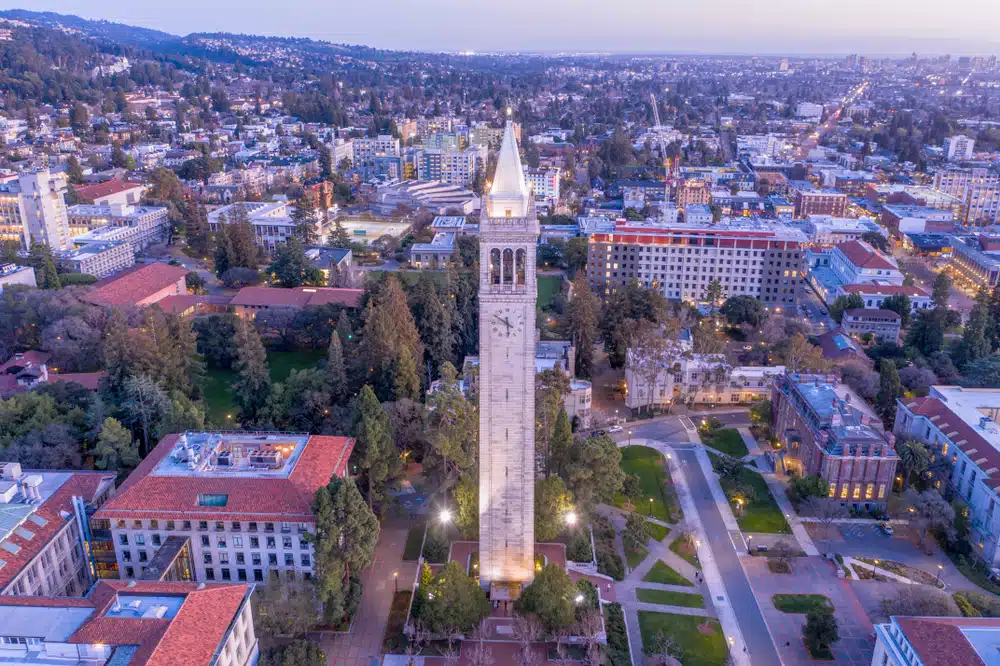
The University of California, Berkeley (UC Berkeley) is a public land-grant research university in the Southside and Northside neighborhoods of Berkeley, California. Founded in 1868, it is the state’s first land-grant university and the founding campus of the University of California system. The university opened initially in Oakland, then moved to its first permanent home in Berkeley five years later, in 1873, where it has remained ever since.
For prospective students trying to understand what attending Berkeley looks like day to day, geography is a good starting point. This guide covers the campus, UC Berkeley’s additional sites, how to get there, and what life in Berkeley is like outside the classroom.
- UC Berkeley Campus Location
- Getting to UC Berkeley
- Living Near UC Berkeley
- Why You Should Visit UC Berkeley’s Campus
- Frequently Asked Questions
- Takeaways
UC Berkeley Campus Location
The main address for prospective student visits is the Koret Visitor Center at 2227 Piedmont Avenue, Berkeley, CA 94720. The total campus encompasses approximately 1,232 acres, though the central campus occupies only the low-lying western 178 acres of this area. The rest of the property extends into the hills and, in part, across the Oakland city boundary.
The campus borders Telegraph Avenue to the east, Shattuck Avenue to the west, Dwight Way to the south, and Hearst Avenue to the north. To the west of the central campus is the downtown business district of Berkeley; to the northwest is the neighborhood of North Berkeley, including the North Shattuck neighborhood, a commercial district known for high-quality dining. Immediately to the north is a quiet residential neighborhood known as Northside with a large graduate student population. Immediately southeast of campus lies fraternity row, and beyond that the Clark Kerr Campus.
The campus is home to a number of notable buildings by early 20th-century campus architect John Galen Howard, his peer Bernard Maybeck, and their colleague Julia Morgan. The architectural character of the central campus is largely classical, the product of a 1898 international design competition funded by Phoebe Apperson Hearst. Later construction introduced modernist and postmodern buildings, giving the campus a combination of styles across its 150-plus structures.
Main campus landmarks
UC Berkeley is home to several campus attractions. Sather Tower, known as the Campanile, pulls your eye from almost anywhere on the 178-acre core, rising 307 feet as the second-tallest freestanding clock and bell tower in the world. You can ride an elevator to the observation platform, climb the final 38 stairs, and take in a view that spans the Bay, San Francisco, and the hills behind campus. Three daily carillon concerts at 7:50 a.m., noon, and 6:00 p.m. mark the rhythm of the academic day.
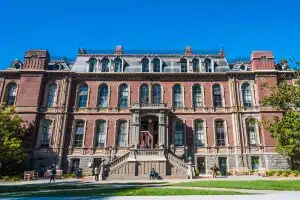
Just below the Campanile, the axis of campus opens onto Memorial Glade, a wide open lawn that functions as the informal living room of UC Berkeley. Flanked by Doe Memorial Library to the north, it is where students read between classes, where clubs set up on warm afternoons, and where the general pace of campus life becomes visible in a way no building can convey.
Doe Memorial Library itself is the central research library, serving more than 50 departments across the arts and humanities, social sciences, and international and area studies. Its North Reading Room and Morrison Library are architectural landmarks, and the Free Speech Movement Café on the ground floor serves coffee on weekdays alongside memorabilia from the movement that reshaped American campus politics in 1964.
That history plays out most visibly at Sproul Plaza, one level below and a short walk south. Added in the late 1950s, Sproul became the site of the 1964 Free Speech Movement, and it has never quite stopped serving as the campus’s primary civic space. On any given weekday, students are setting up tables for their organizations, holding demonstrations, or simply crossing through on their way to class. The Mario Savio steps at the entrance to Sproul Hall remain one of the most photographed spots on campus.
Sather Gate stands just north of the plaza, marking the historic entrance from the south side. Built in 1910 in Classical Revival Beaux-Arts style by architect John Galen Howard, it is listed on the National Register of Historic Places and has framed the southern approach to campus for over a century.
On the northeastern edge of campus, Hearst Greek Theatre gives Berkeley one of its more unusual assets: an outdoor amphitheater used for concerts, performances, and commencement ceremonies.
UC Berkeley’s other campuses and affiliated sites
Directly above the main campus, the Hill Campus encompasses several significant facilities connected to the central campus by the Bear Transit H Line shuttle on weekdays:
- Lawrence Berkeley National Laboratory occupies approximately 200 acres on the hillside, operating as a federally managed research facility where graduate students and faculty across STEM fields regularly collaborate. The Space Sciences Laboratory and the Mathematical Sciences Research Institute are also situated in this area.
- Two sites on the Hill Campus are open to the general public. The UC Botanical Garden, located in Strawberry Canyon, holds one of the most diverse plant collections in the United States, with more than 12,000 species across 34 acres arranged geographically by region of origin. The Lawrence Hall of Science, perched higher up with panoramic Bay views, is a public science museum that draws families and school groups year-round. Both are reachable from the main campus via the H Line shuttle, which runs on weekday schedules.
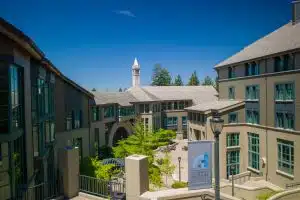
- Located immediately southeast of the main campus, Clark Kerr is a residential campus that houses undergraduate students and includes recreational facilities. It connects to the main campus by Bear Transit and sits within comfortable walking or biking distance of the academic core. Students placed there are close enough to campus that daily life runs without friction, though the setting is quieter and more residential than the units closer to Sproul.
- Six miles northwest of the main campus along the San Francisco Bay shoreline, the Richmond Field Station is UC Berkeley’s 175-acre research and innovation hub. It houses more than 1,000 researchers, students, and startup collaborators working across engineering disciplines, and its facilities include one of the world’s largest earthquake shake tables. The site is primarily a graduate and research resource, though select engineering student teams work there on applied projects.
Getting to UC Berkeley
UC Berkeley’s position in the East Bay gives it strong transit connections throughout the Bay Area. The closest parking to the Koret Visitor Center is the Stadium Parking Garage at 2175 Piedmont Avenue, but street parking around campus is metered, limited to two hours, and difficult to find during busy periods. For most visitors, transit is the easier choice.
Public transportation options
BART is the most direct way to reach campus from nearly anywhere in the Bay Area. The Downtown Berkeley BART station is a 25 to 30-minute walk from the Koret Visitor Center; exit to Shattuck Avenue and Center Street, then walk east straight through campus. From San Francisco International Airport, the Richmond-bound BART line runs directly to Downtown Berkeley. From Oakland International Airport, the Oakland Airport Connector takes you to the Coliseum BART station, where a Richmond-bound train deposits you one block from the western edge of campus.
On campus and in the surrounding area, UC Berkeley operates Bear Transit, its own shuttle system connecting the main campus, residence halls, parking garages, Downtown Berkeley BART, and the hill facilities. Four daytime lines run on weekday schedules, with two Night Safety lines extending service into the early morning hours on weekdays and weekends. The H Line specifically serves the Hill Campus, linking the main campus to the Botanical Garden, Lawrence Hall of Science, and the Space Sciences Laboratory.
Getting there by car or other means
If you are driving to campus, UC Berkeley is close to several major Bay Area freeways, including I-80, I-580, I-880, Highway 13, and Highway 24. From San Francisco or points west, the most direct route is I-80 East across the Bay Bridge, then exit onto University Avenue eastbound for two miles to the western edge of campus. From the east via Highway 24 and the Caldecott Tunnel, exit at Telegraph Avenue and head north to Channing Way, then turn left toward Piedmont Avenue.

Cyclists will find dedicated lanes and ample secure parking throughout campus, and UC Berkeley participates in the Bay Wheels regional bike-share system for those arriving without their own bike. For longer trips, the Capitol Corridor Amtrak line stops at the Berkeley station on University Avenue, a short bus ride from campus.
Living Near UC Berkeley
Berkeley gives students a city’s worth of options within walking distance of campus. The neighborhoods surrounding the main gate cover a range of characters, from the student-dense commercial strip along Telegraph Avenue to the quieter residential blocks of Northside and the restaurant-heavy stretch of North Shattuck. Beyond the immediate area, the hills, the Bay, and the broader Bay Area are all accessible enough to be genuinely part of student life.
Places to check out near UC Berkeley
If your schedule allows, there are plenty of places to explore in the surrounding area:
- Telegraph Avenue is the most immediate extension of campus into the city. Running south from Sather Gate, it offers bookstores, vintage shops, boba cafes, and Amoeba Music, one of the largest independent record stores in the country. It gets livelier closer to campus and more residential further south, but the first several blocks are worth an afternoon before or after any campus visit.
- Tilden Regional Park, up in the Berkeley Hills just above campus, is where students and locals go to decompress from city life without actually leaving. The park offers hiking, biking, and picnicking across thousands of acres, and the views of the Bay from the upper trails are among the best accessible by public transit in the region.
- Berkeley Marina, a short trip west of campus toward the Bay, offers a completely different atmosphere: open water, kite flying, sailing, and long walks along the shoreline. On clear days, the views across to San Francisco and the Golden Gate are unobstructed.
- The North Berkeley Farmers’ Market, held on Thursdays near the Gourmet Ghetto on Shattuck Avenue, is an open-air market with local produce and goods that reflects the food culture Berkeley has been associated with since Alice Waters opened Chez Panisse on that same stretch in the 1970s. The surrounding blocks remain one of the better concentrations of restaurants in the East Bay.
- The Berkeley Rose Garden, built in the 1930s and maintained by the city, sits in the hills northwest of campus and offers sweeping Bay views alongside more than 3,000 rose bushes. It is a quieter, less-visited spot than the park or marina, which makes it particularly worth knowing about.
- For arts and culture, the Berkeley Art Museum and Pacific Film Archive (BAMPFA) at 2155 Center Street holds a permanent collection of more than 20,000 works and runs a year-round film program with screenings open to the public. It is within easy walking distance of the Downtown Berkeley BART station.
Why You Should Visit UC Berkeley’s Campus
Reading about Berkeley gives you facts, but walking through Sproul Plaza on a busy Wednesday, riding the elevator up the Campanile, and sitting on Memorial Glade while the carillon plays at noon tells you something that no brochure can replicate: whether the campus actually feels right for you.
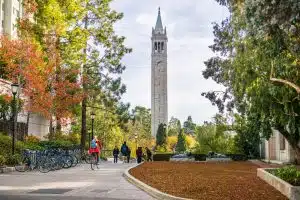
That is why a campus visit is always worth considering. UC Berkeley offers free, 90-minute accessible walking tours seven days a week, rain or shine, led by trained student ambassadors. If you prefer more flexibility, virtual and self-guided tour options are also available.
If you are working through your college list and want to make sure UC Berkeley fits your broader application strategy, AdmissionSight’s Senior Editor College Application Program can help. The program supports students in building a well-researched list and developing a competitive overall application, so that by the time you visit a campus, you already have a strategic sense of where it fits in your plan.
Frequently Asked Questions
1. What is UC Berkeley’s address?
The main visitor address is the Koret Visitor Center, 2207 Piedmont Avenue, Berkeley, CA 94720, inside California Memorial Stadium. The general campus mailing address is University of California, Berkeley, CA 94720.
2. How big is UC Berkeley?
The total campus is approximately 1,232 acres. The central academic campus, known as the Campus Park, occupies the western 178 acres, with the Hill Campus, Clark Kerr Campus, and other properties making up the rest.
3. Can I visit UC Berkeley before applying?
Yes. Free 90-minute guided walking tours run seven days a week and require advance registration through the campus tour page. Virtual and self-guided options are available through the same page.
4. Is parking available at UC Berkeley?
The closest parking to the Koret Visitor Center is the Stadium Parking Garage at 2175 Piedmont Avenue. Street parking around campus is metered, limited to two hours, and limited in availability. UC Berkeley’s Visitor Services recommends public transportation for most visits.
5. What landmarks are near UC Berkeley?
Tilden Regional Park, the UC Botanical Garden, the Berkeley Marina, the Berkeley Rose Garden, BAMPFA, and the restaurants and shops of Telegraph Avenue and North Shattuck Avenue are all within easy reach of campus.
Takeaways
- UC Berkeley’s main campus is located at 2207 Piedmont Avenue, Berkeley, CA 94720, with the central 178-acre Campus Park sitting five miles north of downtown Oakland in the San Francisco Bay Area.
- The campus total is approximately 1,232 acres, extending beyond the academic core to include the Hill Campus, Clark Kerr Campus, and the Richmond Field Station research hub.
- BART is the most practical way to reach campus for most visitors, with the Downtown Berkeley station a 25 to 30-minute walk from the Koret Visitor Center.
- Free 90-minute guided walking tours run seven days a week and require advance registration.
- If you’re still deciding how UC Berkeley fits into your overall college goals, working with a college admissions expert can help you go through the process with a clear and competitive plan.










