

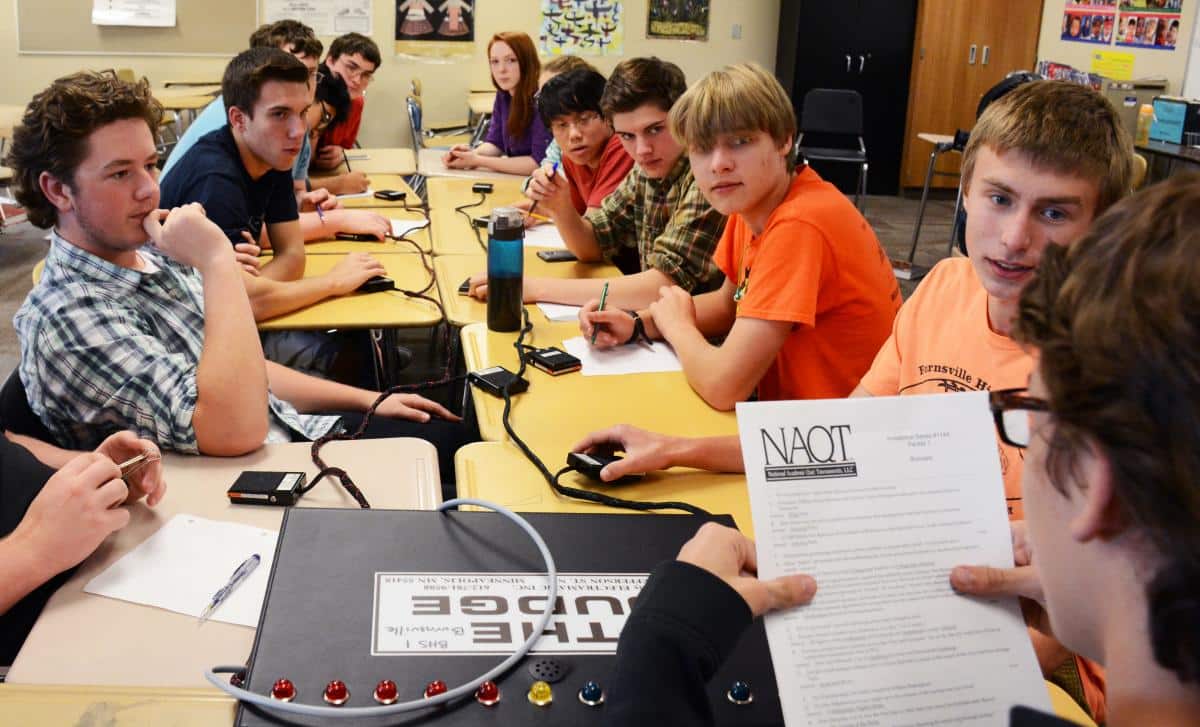
If you’re planning to apply to highly selective colleges like those in the Ivy League, you need to demonstrate strong academic ability. One of the most effective ways to do this is by participating in academic quiz bowls for high school students. These competitions help you build stronger study habits and give you concrete evidence of academic strength that matters in college admissions.
In this guide, you will find the top academic quiz bowls for high school students. Each option explains what the competition covers, who it is best for, and how it can strengthen your profile for Ivy League and other highly selective colleges.
- Best Academic Quiz Bowls for High School Students
- NAQT High School National Championship Tournament (HSNCT)
- United States Academic Decathlon (USAD)
- PACE National Scholastic Championship (NSC)
- Future Problem Solving (FPS) International Conference
- National History Bowl
- National Science Bowl (NSB)
- National All-Star Academic Tournament (NASAT)
- National Academic Championship (Questions Unlimited)
- IAC Regional & National Academic Competitions
- Delco Hi-Q
- Commissioner’s Academic Challenge
- Frequently Asked Questions
- Takeaways
Best Academic Quiz Bowls for High School Students
Academic quiz bowls are structured competitions where you answer timed questions, build recall speed, and learn how to think clearly under pressure.
They also strengthen your college applications since admissions teams look for activities that show intellectual drive, academic depth, and consistent preparation. Strong results in these competitions show that you can perform well in rigorous academic environments and have fast problem-solving skills.
Below is a table of the best academic quiz bowls for high school students, including each program’s name, location, and projected dates.
| Rank | Academic Quiz Bowl | Location | Dates |
| 1 | NAQT High School National Championship Tournament (HSNCT) | Atlanta, Georgia | May 22–24, 2026 |
| 2 | United States Academic Decathlon (USAD) | Garden Grove, California | April 23–25, 2026 |
| 3 | PACE National Scholastic Championship (NSC) | Rosemont, Illinois | June 6–7, 2026 |
| 4 | Future Problem Solving (FPS) International Conference | Bloomington, Indiana | June 10–14, 2026 |
| 5 | National History Bowl | Arlington, Virginia | April 23–26, 2026 |
| 6 | National Science Bowl (NSB) | Washington, DC | April 30 – May 4, 2026 |
| 7 | National All-Star Academic Tournament (NASAT) | Richmond, Virginia | June 27–28, 2026 |
| 8 | National Academic Championship (Questions Unlimited) | New Orleans & Chicago | May – June 2026 (specific dates vary by location and delivery format) |
| 9 | IAC Regional & National Academic Competitions | Arlington, VA & Orlando, FL | Apr 23–26 and May 21–25, 2026 |
| 10 | Delco Hi-Q | Delaware County, Pennsylvania | December 2026 – March 2027 (specific dates vary by location) |
| 11 | Commissioner’s Academic Challenge | Orlando, Florida | April 9–11, 2026 |
Let’s discuss each program one by one.
1. NAQT High School National Championship Tournament (HSNCT)
- Dates: May 22–24, 2026
- Location: Atlanta, Georgia
- Cost: $920 per team (registration fee)
The NAQT High School National Championship Tournament is the largest national quiz bowl for high school teams, with the field capped at 320 teams. You compete in fast-paced tossup and bonus rounds across literature, science, history, and fine arts.
There is no roster limit, and players may be substituted at the end of each half, during timeouts, and between games. Schools bringing many players may also register a standby team if space allows.
Teams qualify by placing well at NAQT-certified events or by meeting NAQT’s performance standards during the season. Each match uses pyramidal questions, and teams participate in multiple preliminary rounds before advancing to a tiered playoff structure.
If you want to understand how high school students prepare for high-level quiz competitions and build the skills needed for national buzzer events, read our complete guide on the NAQT High School National Championship Tournament.
2. United States Academic Decathlon (USAD)
- Dates: April 23–25, 2026
- Location: Garden Grove, California
- Cost: $750 per team (recent nationals rate)
The United States Academic Decathlon is a ten-event academic competition built around a yearly theme. For 2026, teams will compete in written tests for art, economics, literature, math, music, science, and social science, plus an essay, an interview, and prepared and impromptu speeches.
Teams include up to nine students across three GPA divisions: Honor, Scholastic, and Varsity. Schools may bring alternates as allowed by their state organization. Advancement to nationals requires a top finish at the state-level Academic Decathlon.
Nationals follow a fixed schedule that includes the objective tests, speech and interview events, and the Super Quiz relay. Scores from all events determine final rankings.
The competition is known for its workload and depth, and it remains one of the most demanding academic quiz bowls for high school students, even though it does not use a buzzer format.
If you want to see how high school students prepare for multi-event academic competitions that test writing, interviews, and subject mastery, read our complete guide on USAD.
3. PACE National Scholastic Championship (NSC)
- Dates: June 6–7, 2026
- Location: Rosemont, Illinois
- Cost: $860 per team
The PACE National Scholastic Championship is an invite-only tournament with a field cap of 84 teams. Schools qualify by earning top finishes at PACE-certified events. Tournaments that offer at least eight games and are open to all teams can send roughly the top 20% of their field to NSC, based on PACE’s qualification standards.

Registration for qualified teams involve submitting the registration form and then paying a $100 deposit to secure their spot.
Matches use pyramidal tossups and bonuses, with 20 tossups per round. Teams may substitute players between rounds. The event follows a two-day structure, with prelims on Saturday and playoffs on Sunday.
4. Future Problem Solving (FPS) International Conference
- Dates: June 10–14, 2026
- Location: Bloomington, Indiana (Indiana University)
- Cost: $825 (includes room, meals, and all conference events)
Future Problem Solving is a scenario-based academic competition where students analyze a detailed “Future Scene” and develop a written action plan. The International Conference is the final round for teams and individuals who qualify through their state or affiliate programs.
Registration for the 2026 conference opens February 1, 2026, and closes May 1, 2026. FPS also releases the World Finals topic on March 1 so students can prepare before arriving at the event.
Events include Global Issues Problem Solving, Scenario Writing, Scenario Performance, and Community Problem Solving. All work is completed under timed conditions and scored using FPS’s standardized rubric. Teams typically include four students, though individuals can qualify in several divisions.
If you want to see how high school students compete in structured problem-solving events and prepare for scenario-based analysis at a national level, read our complete guide on the FPS International Conference.
5. National History Bowl
- Dates: April 23–26, 2026
- Location: Arlington, Virginia
- Cost: $59–$99 (varies by number of team members)
The National History Bowl is a buzzer-based competition run by International Academic Competitions. Students in 12th grade and younger are eligible to compete, but teams made up of 10th graders or younger are placed in the JV division.
Players must attend the same school, although middle schoolers may join the public high school they feed into. Homeschool teams follow the guidelines set in IAC’s homeschool policy.
Teams may bring up to four players on the buzzer at once, with two alternates allowed at regional tournaments. There is no roster limit at Nationals, and schools or homeschool associations may enter multiple teams as long as they qualify through regionals.
Nationals use multiple preliminary rounds before playoffs, and question sets focus on world and U.S. history across political, cultural, and military topics.
If you want to learn how students prepare for large-scale history competitions and qualify for top national events, read our comprehensive guide on the National History Bowl.
6. National Science Bowl (NSB)
- Dates: April 30 – May 4, 2026
- Location: Washington, DC
- Cost: Free for qualifying teams (travel and lodging funded by the U.S. Department of Energy)
The National Science Bowl is a fast-paced STEM buzzer competition run by the U.S. Department of Energy. More than 350,000 students have participated in the National Science Bowl across its 35-year history, making it one of the largest and longest-running science competitions in the country.

Each year, about 10,000 middle and high school students compete in 65 high school and 50 middle school regional tournaments, but only regional champions earn a spot at nationals.
Teams consist of four students, one alternate, and a coach. Matches use tossup and bonus questions covering various STEM fields, from biology to mathematics. Nationals include round-robin play, double-elimination playoffs, and science activities hosted by the DOE.
If you want to understand how students qualify for one of the most competitive STEM buzzer tournaments in the country and how regional champions prepare for nationals, read our full guide on the National Science Bowl.
7. National All-Star Academic Tournament (NASAT)
- Dates: June 27–28, 2026
- Location: Richmond, Virginia (Virginia Commonwealth University)
- Cost: $600 per team
The National All-Star Academic Tournament brings together all-star teams selected to represent each state or equivalent. States may enter multiple teams, each with up to six players on the roster, with four playing at a time.
Any student enrolled in 12th grade or below at a school physically located in that state during the academic year is eligible for selection.
Matches use a standard quiz bowl format, and the schedule includes several preliminary rounds followed by playoffs. Question difficulty is higher than regular-season sets, which makes NASAT one of the toughest academic quiz bowls for high school students.
IQBT uses a rolling application process, and teams are typically notified of acceptance within a week of submitting their application.
8. National Academic Championship (Questions Unlimited)
- Dates: May–June 2026 (dates vary by site and delivery format)
- Locations: New Orleans, Louisiana and Chicago, Illinois
- Cost: $700 per team
The National Academic Championship requires teams to qualify by winning a tournament of at least eight teams, or by finishing in the top 15% of a varsity event, top 20% of a middle-grade event, top 25% of a JV event, or top 30% of an elementary event.
High scores on the 3-2-1 competition or Knowledge Master Open also qualify. Schools that reached the playoffs in the previous year’s championship receive an automatic bid.
Each venue runs separate JV tournaments using the “Rule of 42,” which states that the combined grade levels of the four active players cannot exceed 42. JV teams answer the same questions as Varsity teams. A Small School Champion is also named, defined as the highest-ranking school with 500 or fewer students in grades 10–12 that has a non-selective admissions policy.

Teams typically field three or four starters plus one or more coaches. Alternates are allowed but must remain off-mic until substituted in. Matches follow Questions Unlimited’s standard format of tossups and bonuses, with moderators providing brief commentary between questions.
9. IAC Regional & National Academic Competitions
- Dates: Apr 23–26 and May 21–25, 2026
- Locations: Arlington, VA & Orlando, FL
- Cost: Varies by competition
International Academic Competitions (IAC) runs multiple buzzer-based tournaments in history, geography, science, and general academics. High school teams qualify for the History Bowl Nationals through regional tournaments held throughout the school year. Geography Bowl Nationals do not require prior qualification.
Eligibility rules vary by event, but most high school divisions allow students in grades 9–12 from the same school. Rosters generally include four players on the buzzer, with substitutions between rounds.
Nationals use a structured schedule of preliminaries and playoffs. The format includes tossups and bonuses, and some rounds feature 60-second team rounds that allow collaboration.
10. Delco Hi-Q
- Dates: December 2026 – March 2027 (specific dates vary by location)
- Location: Delaware County, Pennsylvania
- Cost: Free (sponsored by the Franklin Mint Federal Credit Union Foundation)
Delco Hi-Q is the nation’s oldest continuous academic quiz competition. Twenty-one high schools participate each season. Each school fields a 10-member team, with three or four active players per match. Every school hosts one regular-season contest, and three teams compete at a time.
Matches include three rounds and draw from 14 subjects, such as American history, mathematics, geography, and Shakespeare. Teams receive a reference list at the start of the season.
Standings are based on cumulative points. The top team bypasses semifinals and advances directly to the championship match. Teams ranked 2–7 enter semifinals, where four will be eliminated. The remaining two teams face the top seed in the final.
The champion receives the Donna Zerby Trophy and a $3,000 award, with $2,500 and $2,000 awarded to second and third place, respectively.
11. Commissioner’s Academic Challenge
- Dates: April 9–11, 2026
- Location: Orlando, Florida
- Cost: Free
The Commissioner’s Academic Challenge is Florida’s statewide academic tournament for public school districts. Each district forms a team of six students from grades 9-12, with four players and two alternates, along with one coach. Teams may come from a single school or include students from multiple schools within the district.
Teams compete within divisions based on district size. Matches draw questions from language arts, math, science, social studies, fine arts, world languages, and technology. Rounds include both individual and collaborative questions, and advancement is based on cumulative performance across multiple stages.
Top teams receive trophies and medallions from the Florida High School Athletic Association. Members of each division’s championship team also receive rings. A six-student “Team Florida” is selected from across the champion and finalist teams, and each student receives a $1,000 scholarship.
Frequently Asked Questions
1. What are the best academic quiz bowls for high school students?
Some of the best academic quiz bowls for high school students include NAQT HSNCT, USAD, PACE NSC, FPS, the National History Bowl, the National Science Bowl, NASAT, the National Academic Championship, IAC events, Delco Hi-Q, and the Commissioner’s Academic Challenge.
2. Are there free academic quiz bowls for high school students?
Yes. The National Science Bowl is free for teams that win regional tournaments, and some statewide events, such as the Commissioner’s Academic Challenge, do not charge participation fees.
3. What skills do academic quiz bowls for high school students develop?
Academic quiz bowls for high school students develop skills like recall speed, subject mastery, teamwork, and quick analytical thinking under time pressure. Students also learn disciplined study habits and gain experience applying knowledge in competitive settings.
4. How do academic quiz bowls for high school students help with college admissions?
Academic quiz bowls for high school students help with college admissions by showing sustained academic engagement and a willingness to take on rigorous intellectual challenges. Strong results also help demonstrate academic strengths that may not appear in standard coursework alone.
5. When should I apply for academic quiz bowls for high school students?
Most registrations open in early fall, and many national events require qualification through regional tournaments held from late fall to spring.
Takeaways
- Academic quiz bowls for high school students train you to recall information quickly, think under pressure, and develop depth across subjects like science, history, and literature.
- National tournaments such as NAQT HSNCT, PACE NSC, USAD, the National Science Bowl, and the National History Bowl offer structured competition, and several events are free or district-funded.
- These competitions strengthen teamwork, disciplined study habits, and strategic thinking as you prepare for fast-paced buzzer or analysis-based formats.
- Strong performance in academic quiz bowls for high school students signals intellectual commitment, competitiveness, and academic strength, all of which support college applications.
- If you want guidance on building a stronger academic profile, working with a college admissions consultant can help you position your quiz bowl experience more effectively in your applications.










