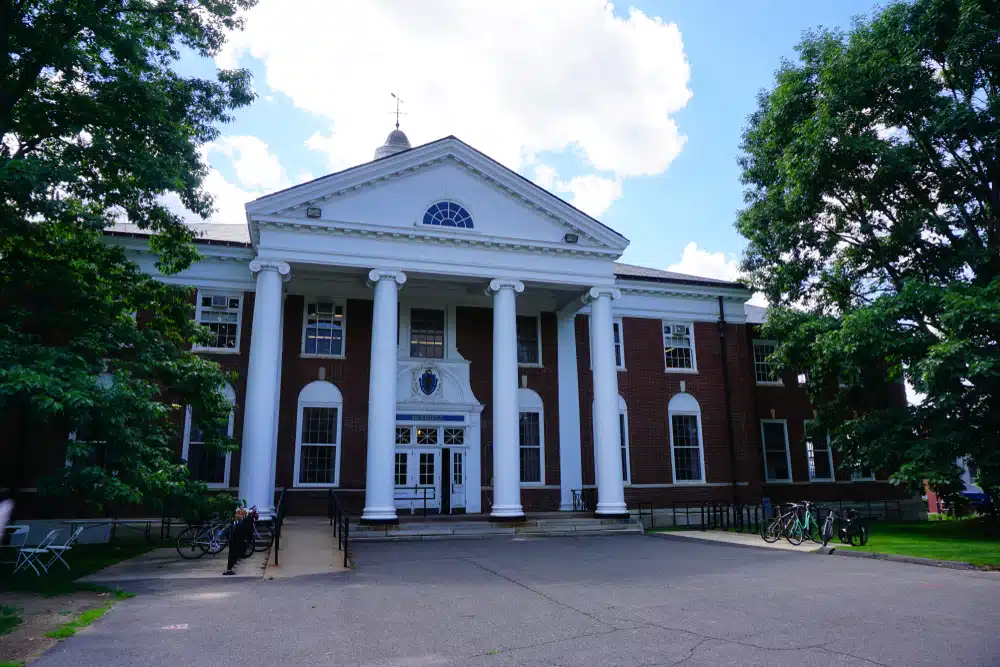
A D2 school is simply a college or university that competes in NCAA Division II sports. There are almost 300 of them across the U.S., and many strike a really nice balance between academics, athletics, and cost. If you’re aiming to play college sports but still want time for classes, friends, and maybe even a part-time job, the best D2 schools might be the perfect fit.
In this blog, we’ll explore top-ranked D2 colleges, the benefits of attending one, tips for finding your best fit, and answers to common questions about athletic scholarships and recruiting.
- 25 Best Division II Colleges
- D1 vs D2 vs D3: What You Need to Know
- The Benefits of Attending a D2 School
- Frequently Asked Questions
- Takeaways
25 Best Division II Colleges
With nearly 300 D2 schools out there, you’ve got a lot of options. Some schools are big on sports, others are all about academics, and many offer a great support system to help you succeed in both.
In this section, we’ll walk you through 25 of the best D2 schools across the country, based on data from the U.S. News & World Report rankings:
| Division 2 Schools | Acceptance Rate | Ranking | Category |
| Hillsdale College | 21% | 50 | National Liberal Arts Colleges |
| Saint Anselm College | 78% | 90 | National Liberal Arts Colleges |
| Westmont College | 80% | 108 | National Liberal Arts Colleges |
| Saint Michael’s College | 92% | 122 | National Liberal Arts Colleges |
| Ouachita Baptist University | 69% | 158 | National Liberal Arts Colleges |
| Colorado School of Mines | 60% | 76 | National Universities |
| Thomas Jefferson University | 86% | 136 | National Universities |
| Adelphi University | 78% | 189 | National Universities |
| Union University | 47% | 209 | National Universities |
| Biola University | 61% | 220 | National Universities |
| West Chester University of Pennsylvania | 79% | 220 | National Universities |
| Harding University | 45% | 296 | National Universities |
| Truman State University | 80% | 5 | Regional Universities Midwest |
| Augustana University | 59% | 13 | Regional Universities Midwest |
| Cedarville University | 63% | 15 | Regional Universities Midwest |
| Rockhurst University | 69% | 76 | Regional Universities Midwest |
| Bentley University | 48% | 2 | Regional Universities North |
| Seton Hill University | 76% | 49 | Regional Universities North |
| Molloy University | 76% | 66 | Regional Universities North |
| Rollins College | 41% | 2 | Regional Universities South |
| Florida Southern College | 59% | 11 | Regional Universities South |
| Anderson University | 53% | 34 | Regional Universities South |
| Westminster University | 69% | 12 | Regional Universities West |
| Point Loma Nazarene University | 82% | 15 | Regional Universities West |
| Dominican University of California | 96% | 22 | Regional Universities West |
Here’s a closer look at some of the best D2 schools:
- Hillsdale College is a private institution known for its intense academics and strong sense of tradition. It boasts a high first-year retention rate of 96% and maintains a low student-to-faculty ratio of 8:1, allowing for more personalized learning. Every student follows a core curriculum that includes the “Great Books,” the U.S. Constitution, and science courses. About 72% of students complete their degree within four years.
- Bentley University, located in Waltham, Massachusetts, is a private business-focused university that blends business education with the arts and sciences. Bentley fields 24 varsity teams, with 12 men’s and 12 women’s programs. Most teams compete in NCAA Division II within the Northeast-10 Conference. The men’s ice hockey team is an exception, competing at the NCAA Division I level in Atlantic Hockey America.
- The Colorado School of Mines is a premier public research university renowned for its specialized focus on engineering and applied sciences, particularly in energy, earth, and environmental disciplines. The school also competes in NCAA Division II within the Rocky Mountain Athletic Conference (RMAC). The men’s cross country team has achieved significant success, winning NCAA Division II national championships in 2015, 2019, 2022, and 2024. The football team has also been a strong contender, reaching the NCAA Division II national championship game in 2022 and 2023.
These schools are a great example of how unique and well-rounded NCAA Division II colleges can be. If you’re hoping to find a campus where you can dive into your studies, play the sport you love, and still enjoy a strong sense of community, schools like Hillsdale, Bentley, and Mines are definitely worth a closer look.
Each one offers its own mix of academic depth and athletic drive, so you don’t have to choose between a great education and competitive sports. You really can have both.
D1 vs D2 vs D3: What You Need to Know
If you’re a student-athlete exploring college options, you’ve probably heard a lot about NCAA Divisions I, II, and III. But what do these divisions actually mean and how do they differ? Here’s a simple breakdown to help you figure out which path might be right for you.
- D1 (Division I). These are the largest and most competitive athletic programs. Think packed stadiums, national TV games, and full scholarships. Sports can feel like a full-time job, especially at powerhouse schools. Examples of these schools are Boston University, Brown University, and Cornell University.
- D2 (Division II). A step down in terms of intensity and visibility, but still highly competitive. Student-athletes here often enjoy a healthier balance between academics and athletics. Scholarships are offered, but usually on a partial basis.
- D3 (Division III). These schools don’t offer athletic scholarships, and the focus is primarily on academics. Sports are still competitive, but they’re more of a complement to the college experience than the centerpiece. Emory University, Tufts, and Amherst College are all D3 colleges.
Why D2 might be the sweet spot
If you’re serious about your sport but also want time to focus on academics, career prep, and life outside of athletics, D2 could be the perfect fit. You’ll still be part of a strong athletic team, play at a competitive level, and potentially earn a scholarship but you’ll also have the flexibility to explore internships, focus on your academics, and keep your future in mind
At the end of the day, more than the prestige of a division, it’s really about finding a school where you can grow on and off the field. D2 just might give you the best of both worlds.
The Benefits of Attending a D2 School
If you’re a student-athlete thinking about your next step, you might feel like all the attention is on Division I programs. But don’t overlook NCAA Division II schools—they offer some pretty big advantages that often get missed in the hype.
The best D2 schools create an environment where you can truly thrive as both an athlete and a student. Here’s what makes them a great option:
1. More playing time
At many D2 schools, athletes get on the field or court sooner than they might at a D1 program. You’re less likely to spend years on the bench behind upperclassmen or blue-chip recruits. That means more game-time experience, which not only helps you grow as a player but makes your college career more fulfilling.
2. Closer relationships with coaches and teammates
Because D2 programs tend to be smaller and more tight-knit, it’s easier to build strong relationships with your coaches and teammates. You’re not just another name on the roster, you’re part of a community. Coaches often have more time to mentor each athlete personally, both on and off the field.
3. Balanced student-athlete lifestyle
While D2 athletes still train hard and compete at a high level, the overall lifestyle tends to be more balanced. You’ll have more time to focus on academics, participate in campus life, and explore interests outside of sports. It’s a chance to enjoy a well-rounded college experience without feeling burned out.
4. Competitive athletic scholarships
The best D2 schools do offer athletic scholarships—often partial—but they can be combined with academic aid and need-based support to make college more affordable. It’s a great way to continue playing the sport you love while getting help covering tuition.
At Bentley, for example, student-athletes may be eligible for Falcon Grants, which are need-based awards available for most varsity sports, excluding basketball and ice hockey. For these two sports, Bentley offers separate funding options that are not based on financial need. These athletic scholarships can often be combined with academic merit awards and other financial aid, making it more affordable to pursue both your academic and athletic goals.
5. Smaller class sizes and more personalized education
Class sizes at many D2 schools are smaller compared to large D1 universities. That means more chances to connect with your professors, get help when you need it, and engage more actively in your learning. It’s a setting where you’re more than just a student ID number.
In short, attending a D2 school gives you the opportunity to compete, learn, and grow without having to sacrifice one for the other. It’s the perfect place that supports all sides of who you are.
Tips for Choosing the Right D2 School
Choosing a college means picking a place to play your sport and finding the right fit for every part of your academic life. The best D2 schools offer a wide range of opportunities, but not every campus will align with your goals, values, or playing style. So, how do you narrow it down?
Here are some key tips to help you make a smart, well-rounded decision:
1. Consider your major and program strength.
Athletics are important, but academics should stay at the top of your list. Make sure the school offers your intended major and that the program has a good reputation. If you’re into engineering, for example, a school like Colorado School of Mines would be a strong match. If you’re interested in business, a place like Bentley University might be a better fit.
2. Visit campus and meet with the team.
There’s no substitute for seeing the campus in person. Walk around. Sit in on a class if you can. More importantly, spend time with the team. You’ll get a feel for how the players interact, how the coach communicates, and whether you could see yourself being part of that environment.
3. Ask about scholarship packages and financial aid.
The best D2 schools often offer partial athletic scholarships, but many also provide academic and need-based aid. Ask detailed questions about what your full financial package could look like—including merit scholarships, grants, and athletic awards. Some schools, like Bentley, even offer sport-specific aid through programs like Falcon Grants.
4. Evaluate coaching style and team culture.
The relationship you build with your coach can make or break your experience. Is their coaching style motivating or stressful? Do they prioritize development, or are they only focused on wins? Don’t be afraid to ask current players what their experience has been like—it’ll give you insight you won’t get from a brochure.
5. Think long-term: career outcomes, internships, and networking.
While athletics may be a big reason you’re choosing a school, think beyond your playing years. Look into career placement rates, internship opportunities, and alumni connections. A great D2 school will support your future just as much as your sport.
Finding the right D2 program can be about chasing rankings, if that’s what you’re after. But more than anything, it’s about discovering where you’ll grow, compete, and feel supported both on and off the field. Take your time, ask the right questions, and choose the school that feels like home.
Frequently Asked Questions
1. How many D2 schools are there?
As of the 2024–2025 academic year, there are 296 NCAA Division II (D2) member schools in the United States and Canada.
2. Do D2 schools offer athletic scholarships?
Yes, Division II schools do offer athletic scholarships. While they often aren’t full rides like in some D1 programs, many D2 schools provide partial athletic scholarships that can be combined with academic or need-based aid. It’s not uncommon for student-athletes at D2 schools to have a large portion of their tuition covered through a mix of awards. Schools like Bentley University, for instance, offer need-based athletic grants for most sports.
3. Can you go pro from a D2 program?
Absolutely. While it’s less common than from D1 programs, there are plenty of D2 athletes who make it to the pros. The path might be more competitive, and you’ll likely have to work harder to get noticed, but it’s definitely possible. For example, NFL Hall of Famer Shannon Sharpe played at Savannah State, a Division II school, before becoming one of the greatest tight ends in league history.
4. Are D2 athletes less competitive than D1 athletes?
Not necessarily. The main difference often lies in depth and scale, not in skill or commitment. Many D2 athletes are just as talented as their D1 peers but may have chosen a D2 school for better playing time, a better academic fit, or a healthier balance between sports and student life. In fact, some athletes turn down D1 offers to pursue a more well-rounded college experience at a D2 school.
5. How do D2 recruiting rules differ?
D2 recruiting rules are a bit more relaxed compared to D1. For example, coaches can begin contacting recruits earlier, and official visits can be scheduled sooner. This gives student-athletes more time to build a relationship with coaches and make informed decisions.
It also means you might hear from D2 programs before D1 coaches are even allowed to reach out. The process tends to feel more personal and less pressure-filled, which many recruits appreciate.
Takeaways
The best D2 schools offer a seriously underrated path for student-athletes. They strike a rare balance between competing at a high level and enjoying a well-rounded college experience.
- D2 schools offer the best of both worlds. You don’t have to choose between strong academics and serious athletics—the best D2 schools let you do both without burning out.
- While most D2 athletic scholarships are partial, you can often combine them with academic or need-based aid to reduce overall cost, Bentley’s Falcon Grants are a great example.
- Going pro is still on the table. It may take extra work and visibility, but athletes from D2 programs do make it to the professional level in multiple sports.
- Fit matters more than division status. At the end of the day, it’s about finding a school where you’ll thrive academically, socially, and athletically, not just chasing the prestige of D1.
- Working with a college admissions advisor can help you build a smart school list, understand scholarship options, and find a D2 program that fits your goals both athletically and academically.
Eric Eng
About the author
Eric Eng, the Founder and CEO of AdmissionSight, graduated with a BA from Princeton University and has one of the highest track records in the industry of placing students into Ivy League schools and top 10 universities. He has been featured on the US News & World Report for his insights on college admissions.