

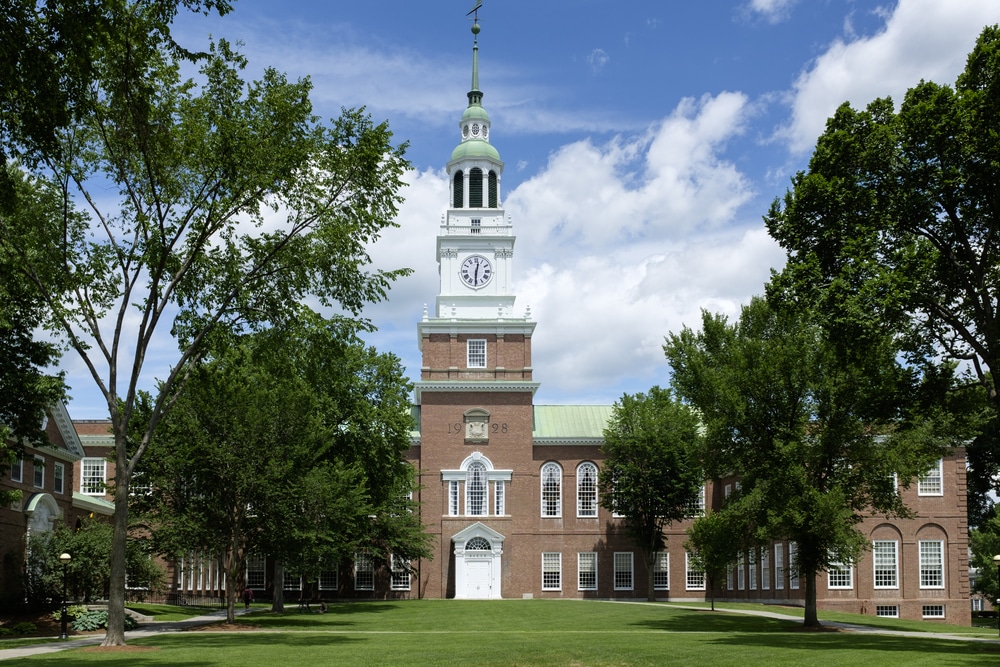
Dartmouth College is known for its strong academics and Ivy League status, but it’s also home to some of the most memorable college traditions around. From snowy competitions to campus-wide celebrations, Dartmouth students have built a spirited and unique culture.
In this blog, you’ll learn about the most iconic Dartmouth traditions that shape campus life year after year. Whether you’re thinking about applying or just curious, these moments offer a real glimpse into what it means to be part of the Big Green.
- Top 10 Dartmouth College Traditions
- Other Fun Facts about Dartmouth College
- Frequently Asked Questions
- Takeaways
Top 10 Dartmouth College Traditions
Dartmouth College is ranked #15 among national universities and has an acceptance rate of just 6%, making it one of the most selective schools in the country. But beyond the rankings and numbers, what really sets Dartmouth apart is its rich history and deep sense of community.
With only around 4,000 undergraduates, Dartmouth is the smallest Ivy League school, but it’s full of memorable traditions. From firelit bonfires to mid-winter snowball fights, these moments show the fun and energetic side of life in Hanover:
1. First-Year Trips
Before classes even begin, Dartmouth invites you into the woods. First-Year Trips is a five-day, student-led outdoor program designed to welcome new students and help them bond with classmates in small groups. It’s one of the oldest and most loved traditions on campus, running every year since 1935.

There’s no one way to “do” Trips. With nearly 30 different trip types, you can hike, farm, canoe, visit museums, or just hang out at a lakeside cabin. You don’t need any outdoor experience; you just need a willingness to join in and meet new people.
Every trip ends at Moosilauke Ravine Lodge, a rustic cabin with no Wi-Fi or cell service but surprisingly great food. Students share family-style meals, unplug from the outside world, and get to know each other without distractions. This tradition sets the tone for Dartmouth’s community-driven campus culture.
More than 90% of the incoming class signs up each year, so you’ll likely want to join in too. Whether you’re an experienced backpacker or just curious about Dartmouth life, there’s a trip for you.
2. Dartmouth Night and Homecoming
Every fall, Dartmouth kicks off Homecoming Weekend with one of its oldest and most unforgettable traditions: Dartmouth Night. First held in 1895, this annual event brings students, alumni, faculty, and staff together for an evening of celebration, community, and school pride.
The night begins with a parade through campus, led by the Dartmouth band. Students carry signs, chant class slogans, and march alongside professors and returning alumni. The route ends at the center of campus, where a towering wooden structure stands ready for the main event: the bonfire.
Once the fire is lit, the crowd gathers around the Green in a mix of cheers, music, and anticipation. First-year students take center stage by running laps around the bonfire—one lap for every year since Dartmouth’s founding in 1769.
That’s over 250 laps, often completed as a group, while classmates, friends, and alumni cheer them on. For many students, Dartmouth Night is the first time they feel truly part of something bigger. It’s loud, fiery, and a core memory that sticks with you long after graduation.
3. The Baker Bells
If you’ve ever walked through Dartmouth’s campus and heard Barbie Girl chiming across the Green, you weren’t imagining things.
The Baker Bells, housed in the tower of Baker-Berry Library, play a surprising mix of music, from the Alma Mater and Pomp and Circumstance to pop hits and birthday songs. These melodies ring out three times a day, and the bells also chime on the hour and half-hour to mark time for students heading to class.

Dartmouth is one of the few colleges that still uses real bells rather than synthesizers or samples. The bells are carefully maintained and rotated to avoid wearing them out, preserving their rich, resonant sound for years to come.
Though the bell music may sound like it’s played live, it’s mostly programmed and automated. A graduate student in the music department oversees the system, which can be accessed remotely to schedule new songs or special performances.
Despite their modern setup, the Baker Bells have become one of the most nostalgic and beloved sounds on campus. For many students, the chimes are part of the daily rhythm of Dartmouth life. As one student said, “After graduation, I know I’ll miss the bells. When I hear them ring out for that final time, they’ll be a reminder of how far I’ve come.”
Whether you’re rushing to class or just pausing for a moment on the Green, the bells offer a small, familiar comfort that defines the Dartmouth experience.
4. Presidential Debates
Dartmouth’s small size doesn’t stop it from playing a big role in national politics. Thanks to New Hampshire’s status as the first-in-the-nation primary, Dartmouth often becomes a key stop on the presidential campaign trail.
Over the past few decades, the College has hosted numerous presidential debates, town halls, and campaign events, giving students a rare front-row seat to history in the making.
One of the most groundbreaking moments came in 1984, when Dartmouth hosted the first-ever “talk show” style presidential debate. Co-moderated by television host Phil Donahue, the format broke away from rigid podium speeches. Instead, it encouraged more informal, direct exchanges between candidates and audience members.
That shift set a precedent for how debates could be more personal and less performative—and it happened right on campus.
In the years since, Dartmouth has welcomed presidential hopefuls from both major parties. Democratic and Republican forums have been held just days apart, with students often involved as moderators, reporters, or volunteers.
Whether attending a town hall in Spaulding Auditorium or watching CNN film a live segment outside the Hop, Dartmouth students get firsthand experience with political media and grassroots campaigning.
5. Winter Carnival
Winter Carnival is one of Dartmouth’s most famous (and coldest!) traditions. First held in 1911, it was originally created to give students a break during the long New Hampshire winter.
Over the years, it’s become a weekend-long celebration with ski races, themed events, and campus-wide festivities. In 1919, the carnival drew so many visitors that it caused an eight-mile traffic jam heading into Hanover. At its peak, National Geographic called it the “Mardi Gras of the North.”

One of the biggest draws each year is the giant snow sculpture built on the Green. These massive, student-made creations reflect the year’s theme, featuring everything from castles and cartoon characters to dragons and Dartmouth icons.
Other highlights include downhill skiing, ice skating, and the infamous Polar Bear Swim, where students voluntarily plunge into the freezing waters of Occom Pond. It’s not for the faint of heart, but a badge of honor for those brave enough to jump in.
And then there’s the snowball fight. After the first big snow, students get a campus-wide “blitz” (Dartmouth slang for email) written in rhyme and signed by Dr. Seuss to Robert Frost. It’s a playful nod to two of Dartmouth’s most famous literary alums.
At midnight, students gather on the Green in coats and boots, some with sleds as makeshift shields. There are no teams or official rules. It’s simply a chance to enjoy the snow and take part in a lighthearted campus tradition.
6. Dartmouth Powwow
Each spring, the Powwow transforms the Green into a celebration of Indigenous culture and tradition. Hosted by the Native community at Dartmouth, the event brings together students, alumni, families, and visitors from across the country. Dancers in colorful regalia, drum groups, and community leaders gather to share their traditions and welcome the new season.
The first Powwow was held in 1972, shortly after the College renewed its original mission to educate Native students. That moment marked the beginning of a lasting commitment, and today Dartmouth has one of the most active and well-respected Native American programs in the country.
Now more than 50 years strong, the Powwow continues to grow in size and reach. Participants represent many different tribal nations, and the event has become one of the most meaningful traditions on campus. Whether you’re taking part or simply observing, the Powwow offers a space to learn, reflect, and honor Native voices and history.
7. Green Key Weekend
Dartmouth might be famous for its winter traditions, but Green Key Weekend is when spring truly takes over campus.

Held each May, it’s the College’s biggest party of the year, packed with live music, outdoor activities, and lots of free food. Students spread out on the Green, soaking up the sun, grabbing ice cream, and enjoying the relaxed energy that defines the weekend.
Green Key traces its roots back to 1899, when it began as “House Parties Weekend.” At the time, it centered around athletic competitions, formal dances, and guests visiting from other schools. Over the years, it evolved from small fraternity gatherings to a full-campus celebration. Today, it’s casual, fun, and considered Dartmouth’s unofficial spring festival.
One of the biggest highlights is the concert, which has featured major artists like The Chainsmokers, T-Pain, A$AP Rocky, Lupe Fiasco, and Far East Movement. But the real appeal of Green Key goes beyond the music. It’s the cookouts, the sunshine, and the joy of unwinding with friends after a long term.
8. Sophomore Summer
At most colleges, the campus quiets down in the summer. At Dartmouth, it’s the opposite—for sophomores, at least. Thanks to the D-Plan, Dartmouth’s flexible quarter system, sophomores stay on campus during the summer after their second year. It’s a long-standing tradition known simply as “Sophomore Summer.”
This ten-week term marks the halfway point of your Dartmouth journey and is often described as one of the most memorable parts of college life. Sophomores enjoy a more relaxed pace without the usual academic pressure or the whole campus crowd.
Many take just two classes instead of the usual three, leaving time for hikes, river swims, and spontaneous hangouts. It’s part academic term, part summer camp, which is why some students call it “Camp Dartmouth.”
While Sophomore Summer is technically “required,” many students see it as a privilege. It offers a rare chance to slow down, reflect, and enjoy Dartmouth in a totally different way.
9. Fieldstock
Speaking of summer at Dartmouth, one of the wildest traditions of Sophomore Summer is Fieldstock. What started as a workaround for a banned river event turned into a full-blown festival.
Originally known as “Tubestock,” the event involved floating down the Connecticut River on homemade rafts and inner tubes. But when local restrictions made that tradition off-limits, the Class of 2008 came up with a new plan: take the fun to dry land.
Fieldstock is now a student-run festival held on campus, becoming a highlight of the summer term. The centerpiece event is the chariot race, where students team up to build and push decorated carts across a muddy field.

Fieldstock also features a mechanical bull, food trucks, lawn games, and a live concert to close out the day. It’s a mix of friendly competition, summer sun, and pure Dartmouth creativity.
10. Bentley Bust
In the Hopkins Center for the Arts, there’s a bronze bust with a nose that shines brighter than the rest of the sculpture. That’s because students have been rubbing it for luck for decades. Meet the Bentley Bust, one of Dartmouth’s most low-key, oddly comforting traditions.
The man behind the bust is Warner Bentley, a legendary theater professor who spent more than 40 years directing productions at Dartmouth. When he retired in 1969, the College honored him with a custom sculpture. No one planned for it to become a lucky charm, but soon after it was installed, students started rubbing the nose before exams, auditions, or just because.
Now the nose is smooth and gleaming from years of hopeful hands. The tradition even inspired a Dartmouth alumni theater group called Bentley’s Nose. And yes, it made it to primetime! Grey’s Anatomy gave the tradition a shout-out in an episode produced by Dartmouth alum Shonda Rhimes.
You’ll find the bust just outside the theater spaces in the Hop. Whether you believe in luck or not, it’s hard to resist giving the nose a quick rub. It’s one of those quiet rituals that make Dartmouth feel like home.
Other Fun Facts about Dartmouth College
Now that you know Dartmouth’s most iconic traditions, here are a few fun facts that make the campus even more unique:
1. Dartmouth is known as the Big Green.
The nickname comes from Dartmouth’s official color, forest green, which was adopted in 1866 because it was the only distinctive color not already claimed by another college. That same year, Dartmouth’s baseball team played its first intercollegiate game, and the nickname “Big Green” began to appear in athletic circles.
For decades, however, Dartmouth’s teams were unofficially referred to as “the Indians,” a name that sparked growing concern within the Native community on campus. In 1971, a group of Native American students called on the College to end the use of the Indian symbol, citing its cultural insensitivity and proposing more meaningful support for Native students.
In response, Dartmouth removed the symbol from athletic uniforms and officially discouraged its use.

Today, “Big Green” is the College’s inclusive and widely embraced team identity. The name appears on uniforms, fan gear, and in campus chants. With over 75% of undergraduates participating in varsity, club, or intramural sports, the Big Green spirit runs deep.
2. Keggy the Keg is the unofficial mascot.
Dartmouth stands out as the only Ivy without an official mascot. As mentioned earlier, the College used the “Indian” symbol, but it was retired in the 1970s after students raised concerns about cultural insensitivity. Since then, Dartmouth teams have been known simply as the “Big Green” with no mascot to go with it.
Enter Keggy the Keg. In 2003, members of The Dartmouth Jack-O-Lantern, the campus humor magazine, created a new character: a goofy, anthropomorphic beer keg with sneakers, cartoon eyes, and a wide smile. Meant as a parody of the mascot search, Keggy quickly became a student favorite.
Though not officially recognized as the Dartmouth mascot, Keggy shows up at football games, Green Key Weekend, and Homecoming, energizing the crowd and posing for photos.
Whether you find him hilarious or confusing, Keggy has become a uniquely Dartmouth symbol. He reflects the school’s mix of tradition, student creativity, and a sense of humor that doesn’t take itself too seriously.
3. The motto means “a voice in the wilderness.”
Dartmouth’s official motto, Vox clamantis in deserto, translates to “a voice crying out in the wilderness.” It’s a fitting phrase for a college surrounded by forests in rural New Hampshire and reflects the school’s early roots and mission.
The motto was chosen by Dartmouth’s founder, Eleazar Wheelock, in the 18th century. At the time, the area was still remote frontier land, and the College was created to bring education to what was then considered the wilderness. The phrase spoke to that bold vision of starting something meaningful in an isolated place.
Today, the motto still resonates. Some interpret it as a symbol of independence or leadership. Others see it as a reminder to speak with purpose, even when no one else is. However you read it, the phrase has become part of what defines Dartmouth: thoughtful, persistent, and never afraid to stand alone.
Frequently Asked Questions
1. What are some unique things about Dartmouth?
Dartmouth stands out in several ways, even among the Ivies. It has no official mascot, uses real bells in its clock tower, and requires sophomores to stay on campus for a summer term. Its rural setting and strong outdoor culture also make it different from most other colleges.
2. What are the winter traditions at Dartmouth?
Dartmouth is famous for Winter Carnival, which includes snow sculptures, ski races, and the Polar Bear Swim. There’s also a campus-wide snowball fight after the first big snowfall.
3. What is Dartmouth known for?
Dartmouth is known for its strong undergraduate focus, flexible quarter system known as the D-Plan, and close-knit campus in Hanover, New Hampshire. It’s also recognized for its many traditions, outdoor life, and a commitment to liberal arts.
Takeaways
- Dartmouth’s major traditions include First-Year Trips, Winter Carnival, and the iconic Homecoming bonfire, all of which bring students together year after year.
- Other standout traditions like Sophomore Summer, Fieldstock, and the Dartmouth Powwow reflect the college’s unique calendar, community spirit, and cultural roots.
- Fun facts include Dartmouth’s “Big Green” nickname, which comes from its official school color adopted in 1866, and its unofficial mascot, Keggy the Keg.
- Dartmouth blends Ivy League academics with a tight-knit campus, outdoor culture, and traditions that go back more than a century.
- Want to get into Dartmouth? Consider working with a college admissions expert who can help you build a strong and compelling application.










