

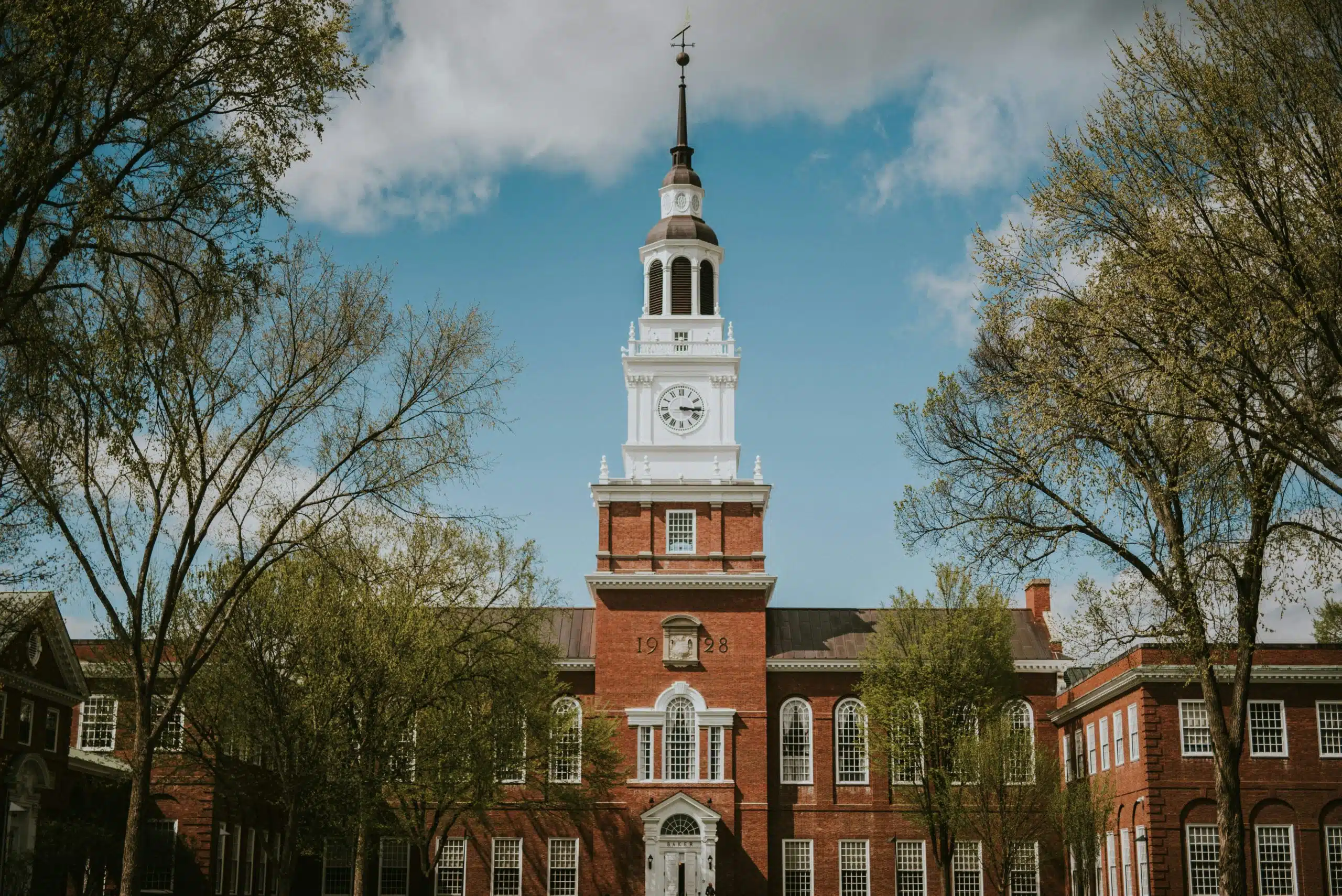
Dartmouth College is known for its Ivy status, rigorous academics, and outdoorsy student culture. Ranked #15 among national universities, Dartmouth accepts just 6% of applicants, making it very selective.
But beyond the rankings, what actually makes it unique? In this blog, you’ll find 10 fun facts about Dartmouth College you might be surprised to know. Whether you’re hoping to apply or just curious, this list gives you an honest look at what makes Dartmouth, well, Dartmouth.
- Top 10 Dartmouth Fun Facts
- Dartmouth Traditions You Should Join
- Frequently Asked Questions
- Takeaways
Top 10 Dartmouth Fun Facts
Founded in 1769, Dartmouth offers small class sizes, a close-knit community, and plenty of academic opportunities, even at the undergraduate level. But what really makes this Ivy different from the other top-tier schools? Here are 10 Dartmouth fun facts that you’ll want to know.
1. You build your own schedule with the D-Plan.
Dartmouth doesn’t follow a typical semester schedule. Instead, it runs on the “D-Plan”: a year-round academic calendar made up of four ten-week terms. While most colleges lock you into fall and spring semesters, Dartmouth lets you choose which terms you’re on campus and which you take off.

Now, you’re required to be on campus during your first-year summer, your sophomore summer, and your senior year. But besides that, you have a lot of freedom to shape your academic path. How about spending fall in Hanover, winter abroad, or taking spring off for an internship?
The D-Plan gives you more flexibility and pushes you to be deliberate with how you spend your time. It also means you’re constantly meeting people at different stages in your college life. If that sounds a little chaotic, it can be, but it also makes the campus feel even more alive.
2. First-Year Trips send you into the wild—before classes start.
Before you even set foot in a classroom, Dartmouth sends you into the woods. First-Year Trips is a five-day, student-led outdoor adventure designed to help you meet new people and feel part of the Dartmouth community.
Launched in 1935, Trips has become one of the most beloved traditions on campus. You might hike, canoe, rock climb, or just chill in a cabin with games and conversation.
The program ends at Moosilauke Ravine Lodge, a rustic cabin with no cell service or Wi-Fi (yes, really.) However, you’ll share delicious, family-style meals and spend the evenings unwinding, laughing, and bonding with your trip group. It’s a soft landing before college kicks in.
More than 90% of the incoming class signs up each year, so don’t miss out! It’s the kind of experience people talk about long after graduation.
3. Winter Carnival gets wild in the snow.
At Dartmouth, winter isn’t something to survive but something to celebrate! Every February, students throw one of the college’s oldest and whimsical traditions: Winter Carnival.
First held in 1911, this multi-day event includes everything from human dog-sled races to ice sculpture contests. The theme changes each year, but the spirit stays the same: go big, even if it’s below freezing.
One of the most talked-about events is the Polar Bear Swim, where students plunge into the icy waters of Occom Pond. Another beloved tradition is the annual snowball fight. As soon as the first big snow hits, students get invited through a campus-wide blitz (Dartmouth lingo for email) written in a playful rhyming style. Legend says it’s a nod to a poem once sent from Dr. Seuss to Robert Frost, who were both Dartmouth alumni.

The snowball fight has become a favorite part of winter for many students. If you ever find yourself in Hanover during the first snow of winter term, join the crowd, grab a handful of snow, and become part of a pure Dartmouth tradition.
4. You run around a bonfire at Homecoming.
Every fall, Dartmouth celebrates Homecoming with one of its most iconic traditions: the bonfire on the Green. It’s loud, dramatic, and steeped in more than 100 years of history. Dating back to 1888, the bonfire marks a powerful moment of unity between students and alumni.
On Friday night, the Dartmouth band leads a parade through campus, with first-year students marching alongside faculty, upperclassmen, and returning alumni. The route ends at the heart of campus, where a massive wooden structure stands ready to be lit
Once the fire is blazing, the first-year class takes center stage. In one of the most spirited (and slightly chaotic) parts of the night, they run laps around the fire—one for every year since Dartmouth’s founding. So if you’re in the Class of 2026, that means 256 laps, cheered on by the entire Dartmouth community.
There’s music, shouting, and the glow of a fire that feels more symbolic than anything else. For many students, this is when Dartmouth begins to feel like home.
5. Keggy the Keg is the unofficial Dartmouth mascot.
Did you know that Dartmouth is the only Ivy with no official mascot? For years, the college used the “Indian” symbol and the “Wah-Hoo-Wah” chant informally, but in 1974, it was retired due to growing concerns about racial insensitivity. With no mascot to rally behind, students got creative.
In 2003, members of the campus humor magazine, Jack-O-Lantern, introduced a new character: Keggy the Keg. He’s exactly what he sounds like: a giant anthropomorphic beer keg with a goofy smile and a lot of personality.
What started as a joke quickly caught on and turned into something only Dartmouth could pull off. While the college doesn’t officially recognize Keggy, he’s become a staple at Dartmouth events. You’ll spot him at football games, Green Key Weekend, and Homecoming, hyping up the crowd and posing for pictures.
Love him or not, Keggy is part of the Dartmouth experience. At a school that balances tradition with student creativity, it somehow makes perfect sense that the “mascot” is a smiling keg in sneakers.
6. Tea at Sanborn happens every weekday.
Every weekday at 4 p.m., something quietly magical happens in Sanborn Library. The reading room transforms into a tea parlor where glass teapots appear, steam rises, and cookies make their way around the room. Students pour tea into ceramic mugs and settle in for a break, with people chatting, reading, or just enjoying the calm.

It’s a near-daily ritual that’s actually been part of Dartmouth life for almost a century. Edwin David Sanborn, a professor from the Class of 1832, used to invite students to his home for tea and conversation. When the library was built in his honor in the 1930s, the afternoon tea hour became a way to carry that spirit forward.
Tea at Sanborn runs Monday through Friday during fall, winter, and spring terms. Anyone can stop by, including students, professors, and staff. The tea might change, and the cookies might vary, but the feeling never does. Sanborn at 4 p.m. is quiet, comforting, and just the right reminder to slow down.
7. The Dartmouth nickname? Big Green.
We already talked about Keggy, the unofficial mascot who stepped in after Dartmouth retired the “Indians” symbol. Now, let’s talk about what students and athletes actually rally behind today: the “Big Green” nickname.
The nickname comes from Dartmouth’s official color, forest green, which was adopted in 1866. Why that color? Simple. It was the only one not already claimed by another college. The nickname debuted that same year at the school’s first intercollegiate baseball game, and it’s been part of Dartmouth’s identity ever since.
Today, “Big Green” is printed on athletic gear, echoed in school chants, and proudly worn by student-athletes. With more than 75% of students involved in varsity, club, or intramural sports, it’s become a name and shared identity across campus.
8. The Latin motto means “a voice in the wilderness.”
Speaking of green and forests, Dartmouth’s official motto fits the setting perfectly. “Vox clamantis in deserto” translates to “a voice crying out in the wilderness,” a nod to both its location in rural New Hampshire and its founding mission.
The phrase was chosen by Dartmouth’s founder, Eleazar Wheelock, in the 18th century. Back then, the area around campus was still frontier land, and the college itself was meant to bring education to what was seen as the wilderness. The motto captured that bold, remote, and determined ambition.
Over time, the phrase has taken on new meaning. Some read it as a call for leadership, others as a symbol of individuality. But for most Dartmouth students, it’s simply part of the college’s identity: thoughtful, independent, and not afraid to speak up.
9. Presidential debates happen right on campus.
Since New Hampshire kicks off the presidential primary season, Dartmouth often finds itself at the center of U.S. politics. For over 25 years, the college has hosted presidential debates, town halls, and campaign stops that give students a front-row seat to democracy in action.

One of the most notable events happened in 1984, when Dartmouth staged the first-ever “talk show” style presidential debate, co-moderated by TV host Phil Donahue. Candidates fielded questions in a more relaxed, unscripted format that changed how debates could feel. In later years, both Democratic and Republican forums were held just days apart—right on the same campus.
Dartmouth students get involved by volunteering, asking questions, and even registering classmates to vote. For many, it’s a defining part of their Dartmouth experience and could even be a launchpad into government, policy, or journalism careers.
10. A lot of famous people went here.
We’ve already mentioned Dr. Seuss and Robert Frost, but Dartmouth’s alumni list goes beyond poets and picture books. You’ll also find actors like Meryl Streep, Mindy Kaling, and screenwriter Shonda Rhimes, the mind behind Grey’s Anatomy and Scandal.
And if you’re into politics, there’s Nelson Rockefeller, a former U.S. Vice President, and Elaine Chao, who served as Secretary of Transportation.
One of the most legendary names on that list? Dr. Seuss, of course. His real name was Theodor Geisel, and he was part of the Class of 1925. After getting caught drinking (something forbidden during Prohibition), the college dean banned him from all extracurriculars, including the campus humor magazine, Jack-O-Lantern.
But Geisel wasn’t done writing. To keep his contributions secret, he started signing his work under the name “Seuss,” and the rest is literary history.
From Hollywood to Capitol Hill, Dartmouth alums have made their mark far beyond campus. Their paths may have started in lecture halls or on the Green, but they’ve led to some pretty extraordinary places.
Dartmouth Traditions You Should Join
Now that you’ve learned some fun facts about Dartmouth College, let’s look at a few traditions you’ll want to join once you’re in the Big Green.
1. Dartmouth Powwow
Each spring, Dartmouth’s Native community hosts the Dartmouth Powwow, one of the most vibrant and meaningful events on campus. The Green fills with dancers in regalia, the sound of drums, and visitors from across the country. Students, alumni, and locals gather to celebrate Indigenous culture, community, and tradition.
The first Powwow was held in 1972, just two years after Dartmouth’s president pledged to make the college more accessible to Native students. That commitment helped build one of the strongest Native American programs in the country.
Since then, the Powwow has grown bigger each year, welcoming people from many different tribal nations. Whether you’re participating or just watching, it’s an event you won’t forget.
2. Green Key Weekend
Dartmouth knows how to do winter, but Green Key Weekend is when the campus comes alive in a new way. It’s Dartmouth’s biggest party of the year, featuring live music, outdoor events, and plenty of free food. There are cookouts, ice cream stands, and students lounging on the Green while music plays across campus. In short, it’s the highlight of spring term.

Green Key has roots going back to 1899, when it started as “House Parties Weekend.” Back then, it was all about athletic events, dances, and bringing dates from other colleges. Over time, it evolved from casual fraternity gatherings to a campus-wide tradition. Today, it’s Dartmouth’s signature spring bash.
Big-name performers have headlined over the years: think T-Pain, The Chainsmokers, A$AP Rocky, Far East Movement, and Lupe Fiasco. But you don’t need a concert ticket to have fun! The weekend is about hanging out with friends, being outside, and finally shaking off the New Hampshire winter.
3. Fieldstock
Dartmouth winter has Carnival, spring has Green Key, and for summer, there’s Fieldstock.
Held during sophomore summer, Fieldstock is a student-run festival packed with games, music, and pure chaos in the best way. The highlight? Chariot races, where students team up to push decorated carts across a muddy field in front of cheering classmates. There’s also a mechanical bull, lawn games, food, and a live concert to end the day.
Fieldstock is messy, loud, and entirely run by students. More than anything, it’s about making the most of a Dartmouth summer with sun, friends, and a little bit of friendly competition.
Frequently Asked Questions
1. What makes Dartmouth unique?
Dartmouth is a great school with many unique qualities that set it apart. It’s the smallest Ivy League school, which helps create a strong sense of community. It combines top-tier academics with rich traditions, a flexible academic calendar, and an outdoorsy student culture.
2. What is Dartmouth known for academically?
Dartmouth is known for its strong undergraduate focus, especially in majors like psychology, biology, economics, and the engineering sciences. It also has a top-ranked liberal arts approach and excellent study abroad programs.
3. Is Dartmouth the easiest Ivy?
No Ivy League school is easy to get into. Dartmouth’s acceptance rate is a mere 6%, and it’s consistently ranked among the top 15 national universities. It’s highly competitive and attracts students who want academic rigor and a tight-knit, immersive college experience.
Takeaways
- Dartmouth is full of fun facts that highlight its history, campus culture, and academic strengths.
- The school is known for its close-knit community, small class sizes, and flexible D-Plan.
- Campus traditions like First-Year Trips, Winter Carnival, and Green Key make student life unforgettable.
- From Dr. Seuss to Shonda Rhimes, Dartmouth has a long list of impressive alumni across fields.
- Is Dartmouth your dream Ivy? Work with a college admissions expert who can help you craft a strong application and improve your chances of getting accepted.










