

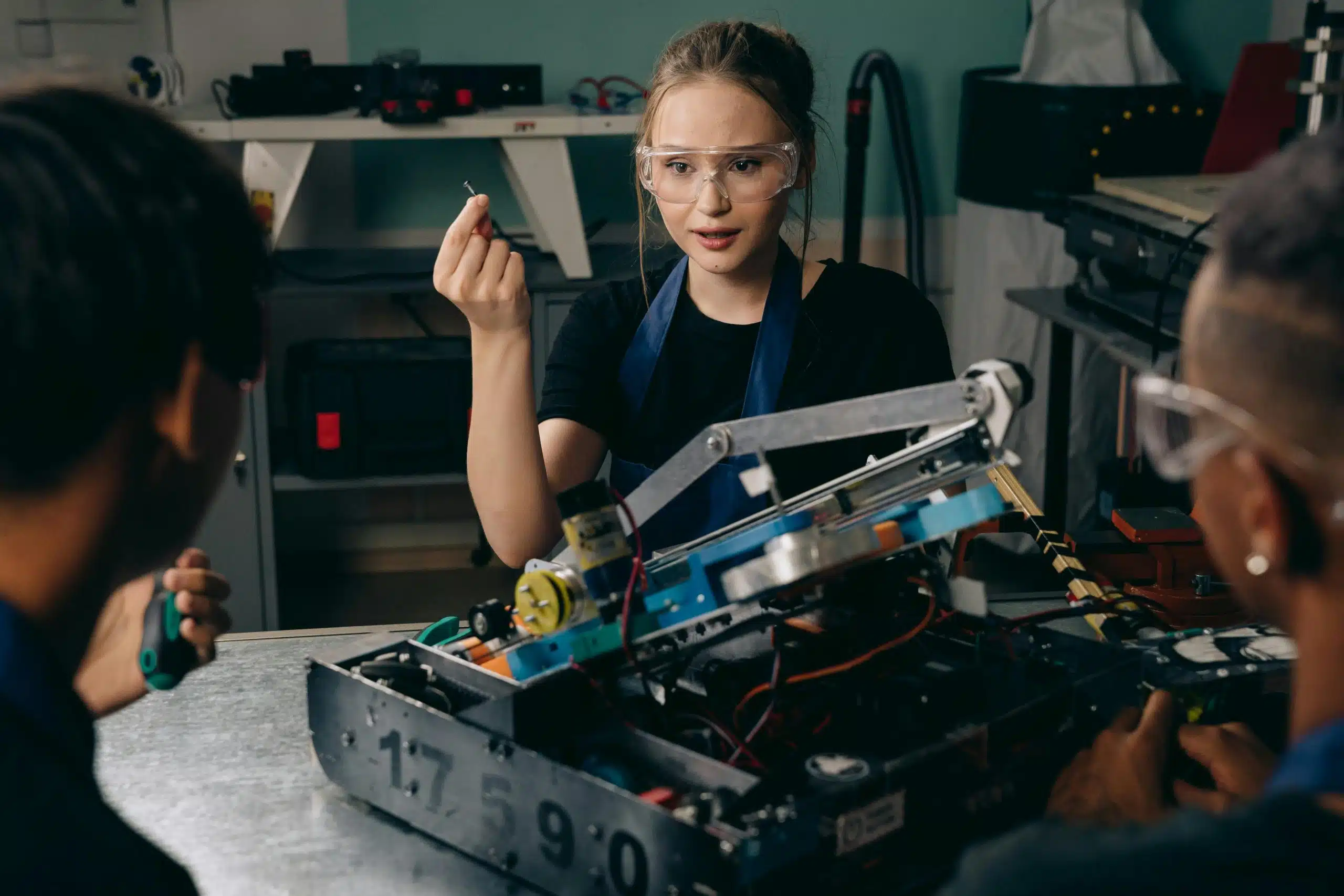
The top robotics summer programs for high school students teach you to work like an engineer—designing systems, troubleshooting problems, and refining your work through hands-on projects.
If you’re interested in mechanical engineering, AI, automation, or competitive robotics, these programs help you deepen your skills, explore future career paths, and strengthen your STEM-focused college applications.
Below, we highlight 10 of the best robotics summer programs for high school students, from university-based engineering academies to immersive robotics camps.
- Best Robotics Summer Programs for High School Students
- MIT Beaver Works Summer Institute (BWSI)
- Engineering Summer Academy at Penn (Robotics Track)
- Johns Hopkins Explore Engineering Innovation (EEI)
- Tufts Engineering Design Lab (EDL)
- iD Tech BattleBots® Robotics Academy
- Stony Brook University Pre-College: Robotics Engineering
- Missouri S&T Robotics Camp
- Boston Leadership Institute – Electronics & Robotics
- Camp Integem – AI & Robotics Programs
- iD Tech Academies (Hosted at Elite Universities)
- Frequently Asked Questions
- Takeaways
Best Robotics Summer Programs for High School Students
The best robotics summer programs for high school students provide hands-on experience with engineering, design, and coding in real-world settings. You learn how to break down complex problems, work in teams, and build functional robotic systems from scratch.
Many robotics programs for high school students also introduce college-level expectations through lab-based work and mentorship from university faculty or industry professionals. We see these experiences as strong signals of technical curiosity and academic readiness—especially for students aiming for engineering or computer science majors at top STEM schools like MIT and Caltech.
Below, you’ll find a curated list of top robotics summer programs for high school students.
|
Rank |
Program Name | Location |
Program Dates |
|
1 |
MIT Beaver Works Summer Institute (BWSI) | MIT Campus, Cambridge, MA + Virtual | July 7–August 3, 2026 |
| 2 | Engineering Summer Academy at Penn (Robotics Track) | Philadelphia, PA |
July 12–31, 2026 |
|
3 |
Johns Hopkins Explore Engineering Innovation (EEI) | Baltimore, MD + Online Options | June–July 2026 |
| 4 | Tufts Engineering Design Lab (EDL) | Tufts University, Medford / Somerville, MA |
Session 1: July 5–17, 2026; Session 2: July 19–31, 2026 |
|
5 |
iD Tech BattleBots® Robotics Academy | iD Tech Academies | Summer sessions |
| 6 | Stony Brook University Pre-College: Robotics Engineering | Stony Brook, NY |
Session 1: June 28 – July 3, 2026; Session 3: July 12 – 17, 2026 |
|
7 |
Missouri S&T Robotics Camp | Rolla, MO | June 2–4, 2026 |
| 8 | Boston Leadership Institute – Electronics & Robotics | Gann/Bentley, Waltham, MA |
June 22–July 10, 2026 |
|
9 |
Camp Integem – AI & Robotics Programs | 16 locations across California | Summer 2026 |
| 10 | iD Tech Academies (Hosted at Elite Universities) | Multiple University Campuses |
June 14–August 14, 2026 (two-week sessions) |
Let’s discuss each program one by one.
1. MIT Beaver Works Summer Institute (BWSI)
- Dates: July 7–August 3, 2026
- Location: MIT, Cambridge, Massachusetts (in person); Virtual (varies by course)
- Cost: Free for families under $150,000; $2,350 for others (online prerequisites are free)
MIT Beaver Works Summer Institute is a four-week, full-time engineering program for high-achieving high school students, primarily rising seniors. Admission requires completion of free online prerequisite courses, short essays, and a teacher or mentor recommendation. Only students living and attending school in the U.S. are eligible.
You work in team-based, project-driven courses, such as autonomous vehicles, drones, underwater robotics, machine learning, hardware security, and remote sensing. Each course ends with a final engineering project or competition that reflects college-level lab work. The program emphasizes technical depth, teamwork, and applied problem-solving rather than lectures.
If you’d like to learn more about MIT Beaver Works Summer Institute—including eligibility, competitiveness, and how to apply—read our complete guide here.
2. Engineering Summer Academy at Penn (Robotics Track)
- Dates: July 12–31, 2026
- Location: University of Pennsylvania, Philadelphia (in person, residential)
- Cost: $9,250 total ($7,750 program fee + $1,500 deposit); $90 application fee
Penn’s ESAP Robotics Track is a three-week, college-level program for high school students who want direct experience building and programming robots. Instruction is led by Penn faculty with exposure to robotics research from Penn’s GRASP Lab, one of the leading robotics research centers in the world.
You learn robotics through mechatronics, electronics, design, manufacturing, and embedded systems. Lab sessions give you the chance to learn how to use tools such as ESP32 microcontrollers, servo motors, laser cutters, and 3D printers. Teams work on a final project: a synchronized robotic orchestra built and programmed by students.
Admission is selective and requires an online application, a two-page engineering-focused essay, an official transcript, one math or science teacher recommendation, and a fee. Some programming experience is recommended but not required.
If you’d like to learn more about the Engineering Summer Academy at Penn and how to stand out when applying, visit our full guide.
3. Johns Hopkins Explore Engineering Innovation (EEI)
- Dates: June–July 2026 (4–5 weeks, format-dependent)
- Location: JHU Homewood campus, Baltimore, Maryland; online
- Cost: $10,190 (Residential); $4,097–$8,860 (Hybrid); $3,960–$4,235 (Commuter); $4,225 (Online); financial aid available
Johns Hopkins Explore Engineering Innovation (EEI) is a fast-paced, college-level engineering program where you complete the same core material taught to first-year Johns Hopkins engineering students. Successful completion of the program will earn you 3 college credits.
You rotate through multiple disciplines, including mechanical, electrical, chemical, civil, computer, and materials engineering. You can expect to experience designing projects, working in electronics and programming labs, and pushing through team-based engineering challenges.
You can study fully on campus (residential or commuter), start online and finish in person (hybrid), or complete the program live online with required lab kits. Expect to set aside around 38 hours per week in in-person or hybrid formats, and about 28 hours a week for online, with regular homework.

Admission is selective. You need strong performance in math and science, Algebra II and trigonometry, and at least one year of chemistry or physics with labs.
4. Tufts Engineering Design Lab (EDL)
- Dates: Session 1: July 5–17, 2026; Session 2: July 19–31, 2026
- Location: Tufts University, Medford/Somerville, MA (commuter or residential)
- Cost: $4,425 commuter; $5,950 residential (limited need-based aid available)
Tufts Engineering Design Lab (EDL) is a two-week, intensive program that puts you inside Tufts’ state-of-the-art Nolop Makerspace to learn how to use laser cutters, 3D printers, and robotics hardware. You’ll also learn to program in Python, build and control robots using Raspberry Pi and GoPiGo platforms, and apply CAD, sensors, motors, and embedded systems to functional designs.
Week one builds core skills in fabrication, robotics, and programming. Meanwhile, week two shifts to team-based projects involving robotics control systems, computer vision, AI/ML, and IoT concepts. You finish with a public project showcase and portfolio-ready documentation.
EDL is open to students entering grades 10–12 or 2026 high school graduates. Admission is rolling and requires an application, transcript, statement of interest, parent consent, and one recommendation. No prior coding experience is required.
5. iD Tech BattleBots® Robotics Academy
- Dates: Summer sessions (two-week program; dates vary by campus)
- Location: iD Tech Academies hosted at select university campuses (on-campus, residential)
- Cost: Starting at $5,299
The BattleBots® Robotics Academy is a two-week, on-campus robotics summer program where you design, build, program, and compete with a custom combat robot. You work in small groups using the VEX V5 robotics system to create a fully functional robot built for competition.
You start by building a drivable base and learning core engineering concepts, then design and print custom parts using CAD and 3D printers. Then, you iterate on your robot’s structure, controls, and strategy by testing, refining, and stress-testing designs through guided battle simulations. The program ends with a BattleBots®-style championship where teams compete head-to-head.
Instruction is hands-on and project-driven, designed for students ages 13–18 and accommodates beginner to advanced skill levels, with individual pacing supported through small class sizes.
You leave with an official iD Tech diploma, a course transcript detailing your technical skills, and a portfolio of completed robotics projects.
6. Stony Brook University Pre-College: Robotics Engineering
- Dates: Session 1: June 28 – July 3, 2026; Session 3: July 12 – 17, 2026
- Location: Stony Brook University, New York (in person)
- Cost: To be announced
Stony Brook University’s Robotics Engineering is a one-week, intensive engineering program for high-achieving high school students, primarily rising juniors and seniors. Admission is limited to U.S. residents ages 15–17 who are in good academic standing.
Led by award-winning professor Dr. Anurag Purwar, the curriculum is an abridged version of Stony Brook’s freshman-level Design Innovation course, offering early exposure to college-level engineering instruction.
You work through a project-based curriculum covering core robotics fundamentals, including practical electronics, mechanical design, sensing, actuation, and microcontroller programming. Using Arduino, servos, DC motors, ultrasonic sensors, and Bluetooth-based control systems, you design robot motion, prototype mechanisms, and integrate components into autonomous robotic systems.

7. Missouri S&T Robotics Camp
- Dates: June 2–4, 2026
- Location: Missouri University of Science and Technology, Rolla, Missouri (in person)
- Cost: $500 (includes housing, meals, and materials)
The Missouri S&T Robotics Camp is a short, immersive, on-campus robotics program for students ages 11–14. Designed for beginners, the camp introduces core robotics concepts through hands-on team projects using LEGO SPIKE Prime robotics kits.
You work in small groups to program robots to react to their environment—avoiding obstacles, responding to light, and completing structured challenges—before applying their skills on a FIRST LEGO League competition mat.
No prior robotics experience is required, and all materials are provided. Admission is first-come, first-served, with limited capacity, making early registration important for families planning ahead.
8. Boston Leadership Institute – Electronics & Robotics
- Dates: June 22–July 10, 2026
- Location: Gann/Bentley, Waltham, Massachusetts
- Cost: $2,500 (3-week program); $500 deposit fee
The Boston Leadership Institute’s Electronics & Robotics program is a competitive three-week engineering course that combines mechanical engineering, electrical engineering, and computer science.
You learn foundational electronics, coding, Arduino programming, sensor integration, and soldering, then apply these skills to design and assemble robotic vehicles and machines. Projects must complete tasks such as responding to sound, retrieving objects, or executing programmed behaviors.
Past cohorts have used a fully equipped robotics lab and participated in field trips to MIT’s Edgerton Center and WPI Robotics Labs for additional engineering exposure.
Admission is competitive and geared toward high-achieving students who demonstrate strong academic preparation and STEM interest.
9. Camp Integem – AI & Robotics Programs
- Dates: Summer 2026 (weeklong sessions; dates vary by location)
- Location: In-person at 16 locations across California; online options available
- Cost: To be announced (School Year 2026 is opening soon)
Camp Integem is a multidisciplinary STEM program for students ages 6–18 that focuses on artificial intelligence, robotics, coding, drones, and holographic augmented reality (AR). Using Integem’s proprietary AR platform, you can interact with your creations in real-time through a webcam, turning projects into immersive, portfolio-ready experiences.
Programs are project-based and personalized, with small class sizes and a 1:8 instructor-to-student ratio. No prior experience is required; students progress from beginner to advanced levels at their own pace.
Camp Integem is WASC-accredited, an NVIDIA AI Training Partner, and approved by the College Board to offer AP-level courses, allowing advanced students to earn NVIDIA AI certificates and build competitive STEM portfolios.
10. iD Tech Academies (Hosted at Elite Universities)
- Dates: June 14–August 14, 2026 (two-week sessions; exact dates vary by campus)
- Location: MIT (Cambridge, MA), Stanford (Palo Alto, CA), Caltech (Pasadena, CA), UCLA (Los Angeles, CA), Princeton (Princeton, NJ), Georgia Tech (Atlanta, GA), NYU–Washington Square (New York, NY), and the University of Washington (Seattle, WA)
- Cost: Starting at approximately $3,899 for day programs and $4,899–$5,999 for overnight programs, depending on campus and course (payment plans available)
Summer 2026 iD Tech Academies are two-week, immersive STEM programs for students ages 13–18 that simulate collegiate learning while building real technical depth. You study high-demand fields such as artificial intelligence, machine learning with NVIDIA®, coding, game design, and robotics—including the exclusive BattleBots® Academy—while learning in state-of-the-art university labs.

Most programs are residential, with select locations offering day formats. Visit each academy listed below for the details:
You work alongside driven peers, learn from elite instructors recruited from top universities, and complete a substantial portfolio project that strengthens STEM-focused college applications.
Open to beginner through advanced students, iD Tech Academies provide technical skills, certifications, and professional exposure, with Summer 2026 registration now open.
Frequently Asked Questions
1. What are the best robotics summer programs for high school students?
The best robotics summer programs for high school students are rigorous, hands-on, and university-based. We consider top options like MIT BWSI, Penn ESAP (Robotics Track), Johns Hopkins Engineering Innovation, and Tufts Engineering Design Lab, all of which offer advanced robotics, coding, and engineering design work, best for students aiming for competitive STEM majors.
2. Are there free or fully funded robotics summer programs?
A few robotics programs offer free or reduced-cost options, with MIT BWSI being the most notable fully funded choice for many families. Most university robotics programs charge tuition, though some provide limited financial aid. We encourage early applications to maximize funding opportunities.
3. What do students learn in robotics summer programs?
Students learn mechanical design, electronics, programming, CAD, microcontrollers, sensors, and systems integration. Advanced programs introduce AI, autonomy, and computer vision through project-based engineering work that reflects real college-level labs.
4. How do robotics summer programs help with college admissions?
Robotics summer programs strengthen college applications by showing technical curiosity, hands-on engineering experience, and commitment to STEM. Competitive robotics programs create strong portfolio pieces and demonstrate academic readiness—qualities we, at AdmissionSight, highlight in successful engineering applicants.
5. When should students apply for robotics summer programs?
Most robotics programs open applications between December and February, with deadlines in early to mid-spring. We advise applying as early as possible, especially for selective or funded programs.
Takeaways
- Robotics summer programs provide a comprehensive engineering experience—from coding and electronics to mechanical design and autonomous systems—through hands-on, project-driven learning. They also strengthen STEM applications, helping students build competitive portfolios and demonstrate sustained interest in engineering, AI, or computer science.
- University-based robotics programs signal strong academic readiness, giving students exposure to college-level labs, advanced tools, and research-centered problem-solving.
- If you want personalized help choosing the right robotics summer programs or crafting a standout engineering-focused application, our Private Consulting Program can guide you through every step—from program selection to essays, portfolios, and long-term admissions strategy.










