

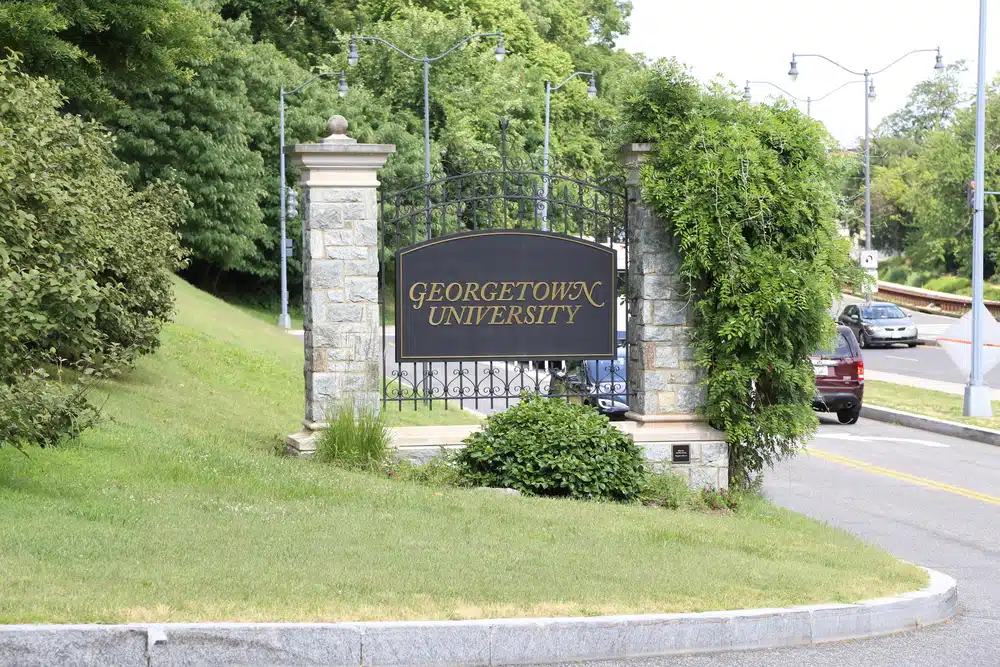
Georgetown’s reputation is built on its academic excellence and its emphasis on interdisciplinary studies. The university is particularly well-known for its programs in International Relations, Law, and Business, thanks to its prime location in Washington, D.C. This location gives students unparalleled access to internships, networking, and real-world experience in government, NGOs, and the private sector.
If you’re wondering what Georgetown can offer you in terms of academic programs, you’ve come to the right place. Let’s dive into some of the top degree programs and how they can shape your future.
- 10 Georgetown University Degrees to Consider
- Georgetown Degree ROI: What’s the Value?
- How Many Majors Can You Have in College?
- Frequently Asked Questions
- Takeaways

10 Georgetown University Degrees to Consider
Getting into Georgetown University isn’t a walk in the park. Its admissions process is both competitive and holistic, with an acceptance rate of only 13% for the Class of 2027. The university seeks students who are not only academically strong but also well-rounded, showing a mix of leadership, service, and passion.
For those who make it in, Georgetown offers a wide range of standout degree programs. Here are 10 Georgetown University degrees to consider that can help shape your future.
1. Biological Sciences
Georgetown University’s Department of Biology offers the following Bachelor of Science degrees:
- B.S. in Biology
- B.S. in Biology of Global Health
- B.S. in Environment Biology
- B.S. in Neurobiology
These majors aim to educate you in biological sciences with the latest advances within this discipline. As a graduate, you can prepare for careers in medicine, education, business, and biotechnology.
2. International Business, Language, and Culture
The IBLC Bachelor of Science program is a joint offer from the College of Arts & Sciences and the McDonough School of Business. This program is available for students after they finish their first year.
This joint degree program aims to mesh both language and business education. It emphasizes the cultural and linguistic skills and how it relates to the business sector. At the same time, IBLC studies how the latter affects change and innovation across the globe.
As a student, you will develop critical thinking skills and a more professional perspective through IBLC. It also helps you get answers to various humanistic and cultural questions by studying literature, and historical traditions, and discovering social and ethical angles related to the business world.
The International Business, Language, and Culture curriculum requires 120 credits. You must fulfill the University Core and finish a joint core for both CAS and MSB. It’s a major that combines the international business elements of the MSB program with a language major in college.
The language you choose is your IBLC concentration. With the strenuous set of requirements, pursuing this major locks you out from double majoring in a different degree program.
3. Marketing
Georgetown University’s Marketing degree teaches you to understand and deliver value to future customers. Their focus is turning you into the customers’ champion–the hallmark of a great marketer. It means not pushing products for a quick sale but instead understanding customer needs and wants to meet them.
Some tools to help accomplish this goal include:
- Brand management
- Business development
- Consulting
- Digital Marketing
As a marketing student, you will study how consumers behave and learn marketing intelligence. It allows you to develop a marketing strategy, which includes analytics, branding, and global marketing.
4. Journalism
Georgetown University uses both service-oriented liberal arts education and practical journalism for education. You will draw on the university’s academic resources and learn from top reporters in the country and the world. The best part is getting into newsrooms and joining newsmaking events in Washington, D.C., and other locales.
Some Georgetown alumni have racked up impressive awards, like multiple Emmy-winner Maria Shriver and Pulitzer Prize-winner Walter Pincus. You’ll also find big names working at top news outlets like CNN, NBC Nightly News, and The New York Times, including Frank J. Prial, Kate Snow, and Chris Cillizza.
The program aims to teach good journalism skills–critical thinking, clear expression, storytelling, and research and investigation. It also explores your duty to the truth compared to private and public ethics alongside the constantly changing ecosystem of media.
Georgetown University has deep strengths that empower its Journalism program. The following programs highlight the institution’s public service and social justice commitment:
- Political Studies
- Public Policies
- International Relations and Law
With these, you can develop core reporting skills with a grounded approach in theoretical, historical, and literary contexts. These are necessary to get a better understanding of your role as a journalist and your responsibility to society.

5. Psychology
As a psychology major, graduating means taking at least 10 psychology-related courses. The degree also requires you to attend a Psychology Major or Minor Declaration Session. Thankfully, these happen in the fall and spring semesters.
The Director of Undergraduate Studies is responsible for leading these declaration sessions. They will discuss both requirements and opportunities within the program. This person also assigns a faculty advisor, who helps work out an elective program and cognate courses for other disciples.
With this, you can get the best course sequence for your personal goals. The university also encourages you to join independent research activities, especially if you’re aiming for graduate school.
6. Communications
If you’re looking for a higher form of education, Georgetown University has various communication and journalism programs. One example is their executive master’s degree in Communication, Culture, and Technology.
The Communications degree will require at least 36 credits with a 3.0 GPA minimum. You can pick between an all-coursework option and a coursework and thesis option to get the required credit number.
If you opt for the first option, you must finish 30 coursework credits and 6 thesis coursework credits and earn an A-minus or above grade in at least one Methods course. Finally, your master’s thesis proposal must have faculty approval.
The coursework option needs 36 credit hours for standard coursework. Even when you choose this path, you must still finish a Methods course to qualify.
7. Chemistry
Biochemistry and Chemistry courses give all the necessary training in the basic principles and techniques related to the subject. After that, it will progress to more exhaustive advanced studies and research.
You will have ample career opportunities in the future since it has the American Chemical Society certification. It allows you to learn about the five chemistry divisions:
- Analytical
- Physical
- Organic
- Inorganic
- Biochemistry
If you like challenging yourself, the Chemistry major offers a rigorous undergraduate curriculum. It will prepare you for graduate study, regardless of whether it’s for chemical or biochemical sciences. The university boasts that most of its graduates are more likely to succeed in these careers.
8. Computer Science
The effects of computers and the digital age in our daily lives are palpable since most aspects of our modern society require computing to function. If you’re looking to make a change in this industry, consider taking a Computer Science major at Georgetown University.
The Computer Science Department has the following academic programs:
- B.S. in Computer Science
- A.B. in Computer Science
- A.B. in Computer Science, Ethics, and Society (CSES)
- Concentration in Technology, Ethics, and Society
- Minor in Computer Science
The Bachelor of Science (B.S.) in Computer Science is the most technical option for undergraduates. On the other hand, the A.B. degree has fewer requirements, making it a better choice if you want to double major or add a minor. At Georgetown’s College of Arts & Sciences, students have the flexibility to major, double major, or major with one or two minors, depending on their interests and goals.
For students who want to specialize in the digital ethics, law, and policy surrounding computers, the CSES major is perfect. It will combine technical training in computer science and studying the topics mentioned above.
Georgetown University follows the ACM-IEEE guidelines for computer science education, ensuring its curriculum meets top industry standards. This prepares you with the technical skills, problem-solving abilities, and up-to-date knowledge needed to succeed in the tech industry.
9. Physics
Georgetown University offers flexibility with its two Physics programs: a traditional Physics and Biological Physics major. Each has either a B.S. or an A.B. Degree, with the former designed for students desiring many career paths. It’s especially useful when you’re pursuing graduate study as well.
As for the A.B. programs, they’re handy if you plan to graduate only or get employment within other fields like medicine, business, government service, and more. It’s the best choice if you want more flexibility when getting a second major.
You must accomplish at least seven advanced courses alongside the introductory core sequence for the B.S. Physics program. Meanwhile, the A.B. equivalent only requires five.
If you’re more interested in Biological Physics, the B.S. major requires accomplishing five advanced Physics courses alongside four corollary science courses. The A.B. counterpart only needs three advanced Physics courses instead alongside the introductory core sequence.
NASA astronaut and astrophysicist John-David F. Bartoe earned both his Master of Science (1974) and Doctorate in Physics (1976) from Georgetown University.
10. Neurobiology
One of the greatest science frontiers today is Neurobiology due to our constantly evolving understanding of our brains. The major focuses on components involved in promoting brain function, such as cells, circuits, and molecules. If you’re looking to learn about biology and neurobiology, Georgetown University will give you enough foundations and opportunities for advanced study.
The range of disciplines Georgetown University supports through its Neurobiology course is wide. It involves cell, molecular, and developmental neuroscience alongside psychology and cognitive science. As a Neurobiology student, you will have a better grasp of the intersections between these.
Typically, you can enter the Neurobiology program as a Biology major. You can inform the university about your intention to focus on Neurobiology during the fall of your second year.
By spring, you must take Neurobiology (BIOL-1950), a communication-intensive course. The aim is to satisfy the requirement in the University Integrated Writing. For the succeeding years, you must finish four additional courses and some electives to have a better grasp of neurobiology.

Georgetown Degree ROI: What’s the Value?
Georgetown University offers a world-class education and a high return on investment (ROI) that sets graduates up for long-term success. According to the Georgetown University Center on Education and the Workforce, alumni earn significantly more throughout their lifetimes compared to peers from other institutions, particularly those with degrees in business, law, and health sciences.
For example, graduates of the McDonough School of Business report median salaries of $100,000 just a few years after graduation. Similarly, those who major in law or international relations have landed high-paying roles at prestigious law firms, government agencies, and international organizations.
The university’s value goes beyond just salaries. With access to leadership opportunities, internships, and professional connections, Georgetown equips its students with the skills and networks needed to thrive in various industries.
Professors, like Chester Arthur Crocker, bring real-world expertise and impactful contributions to the classroom. Crocker, a former U.S. diplomat, played a key role in shaping U.S. policy on African affairs, showing how Georgetown’s faculty are some of the top experts in their fields.
Georgetown’s School of Foreign Service stands out for its renowned focus on international relations and diplomacy, while its law school consistently produces top-tier legal professionals.
The university’s healthcare programs are equally impressive, with MedStar Georgetown University Hospital serving the community since 1898. Georgetown’s O’Neill Institute for National and Global Health Law has also played a pivotal role in shaping health policies, particularly during the COVID-19 pandemic.
Located in Washington, D.C., Georgetown offers unique opportunities for internships and networking with influential organizations, adding further value to its degrees. With over 21,000 students, the university’s academic strength, global impact, and alumni network—boasting figures like Bill Clinton and Bradley Cooper—make a Georgetown degree a powerful investment for those seeking a high-impact, well-rounded education.
When you choose Georgetown University, you’re not just investing in your present education but also setting the stage for long-term success. With its world-class faculty, top-tier academic programs, and strong alumni network, Georgetown provides you with the tools and opportunities to thrive in your future career.
The connections you make and the skills you develop at Georgetown are assets that will continue to pay off throughout your professional life. So, if you’re asking whether Georgetown is a good school, the answer is clear—it’s an investment in both your present and your future.

How Many Majors Can You Have in College?
If you’re wondering how many majors you can have in college, you’re not alone. At Georgetown, the flexibility to double major, add minors, or even dive into interdisciplinary studies is all part of the experience. This setup gives you the freedom to shape your education around your personal interests and career goals.
For instance, if you’re into politics and money, you might major in Political Science and pick up a minor in Economics, setting yourself up for a future in law, government, or finance. Or, if you’re aiming for the global stage, you could double major in International Relations and Business, giving you a solid foundation for a career in diplomacy or international business. By combining different areas of study, you’re widening your career options and standing out in the job market.
Georgetown’s College of Arts & Sciences is all about flexibility, letting you mix and match courses from different departments. This approach works especially well for students interested in emerging fields like data analytics or environmental policy, where blending disciplines can spark innovative solutions.
The Walsh School of Foreign Service takes it a step further by combining politics, economics, history, and languages to prepare you for international careers. And if you’re in a hurry to jumpstart your career, Georgetown’s 3+3 Law Program allows you to earn both a bachelor’s degree and a law degree (JD) in just six years instead of the usual seven.
Need help figuring out your path? Academic advisors are there to guide you through the process, ensuring you create a custom educational path that fits your long-term goals. Georgetown’s flexible structure ensures you graduate with a well-rounded, multidisciplinary education that keeps you adaptable in today’s fast-changing job market.

Frequently Asked Questions
1. What are the top science-related degrees offered at Georgetown?
Georgetown offers strong science programs, including degrees in Biology, Neurobiology, Chemistry, and Computer Science. These programs provide hands-on research opportunities, access to cutting-edge technology, and preparation for careers in medicine, biotechnology, and the tech industry. The university’s science programs emphasize interdisciplinary learning, allowing students to explore fields like global health, environmental science, and data ethics.
2. How does Georgetown’s International Business, Language, and Culture (IBLC) program work?
The IBLC program is a unique joint degree offered by Georgetown’s College of Arts & Sciences and the McDonough School of Business. It combines business education with language and cultural studies, preparing students for careers in international business. Students choose a language concentration while fulfilling business core requirements, gaining both linguistic skills and global business insights. This program is ideal for students looking to make an impact on a global scale.
3. What kind of journalism education does Georgetown provide?
Georgetown’s journalism program blends liberal arts education with practical, hands-on experience. Students learn from top reporters and participate in real-world newsmaking events, especially given Georgetown’s location in Washington, D.C. The program emphasizes critical thinking, storytelling, and research, while also exploring ethics and the rapidly changing media landscape. Many alumni have gone on to work for major outlets like The Washington Post, CNN, and The New York Times.
4. Does Georgetown offer flexibility in choosing majors?
Yes, Georgetown encourages students to explore interdisciplinary studies and offers flexibility when it comes to choosing majors. You can double major, add minors, or even blend courses across departments. This flexibility helps students tailor their education to align with their career goals and interests. The Walsh School of Foreign Service, for example, integrates politics, economics, and languages for a global-focused education.

Takeaways
- Georgetown offers a variety of highly respected degree programs. Some of the most popular include International Business, Law, Marketing, Journalism, and Biological Sciences.
- Being located in Washington, D.C., offers Georgetown students unique opportunities to connect with government agencies, NGOs, and private companies. It’s the perfect spot for internships, networking, and getting real-world experience.
- If you’re considering enrolling in Georgetown, it might be a good idea to chat with a college admissions consultant. They can give you personalized tips on how to get accepted and what it takes to do well there.










