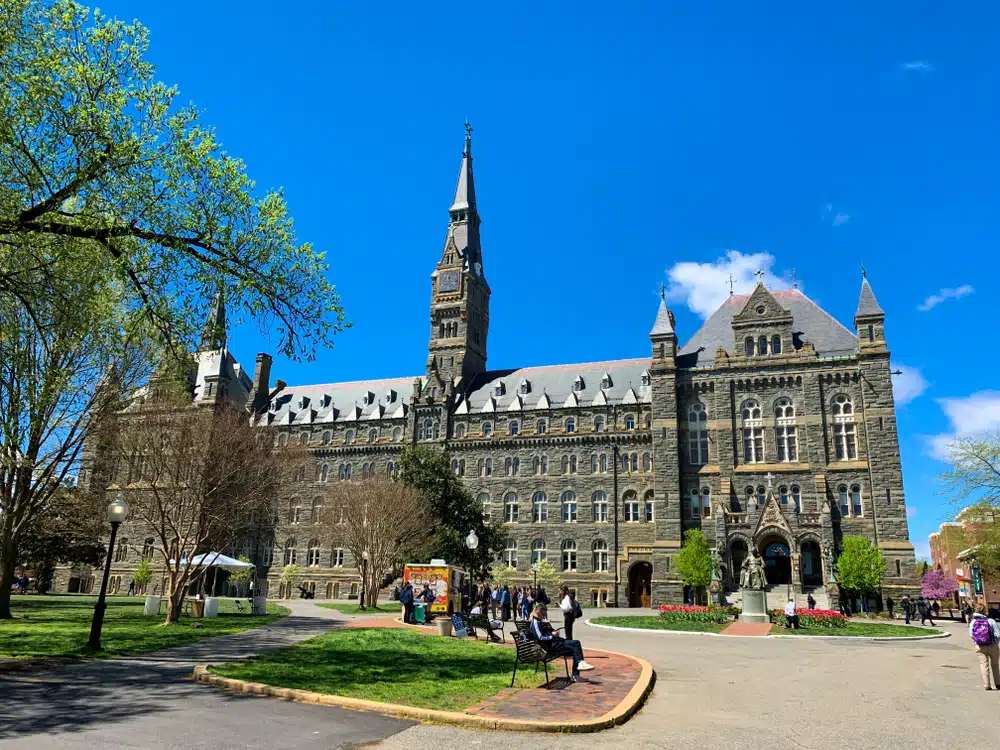
Is Georgetown University a good school? The answer is a resounding yes. According to the U.S. News & World Report 2024, Georgetown ranks #22 in National Universities. They boast of many notable students, or as they call themselves, Hoyas, who excel in politics and international relations among other disciplines. Their alumni are also a top choice for recruiters on Wall Street.
In this blog, we’ll cover the key aspects that matter most when you’re evaluating Georgetown University: the school’s reputation, notable alumni, and your career prospects after graduation. If you’re wondering whether Georgetown is the right fit for you, it’s essential to take a closer look at what is Georgetown known for:
- What Makes Georgetown University a Good School?
- Best Majors at Georgetown
- What Is Georgetown’s Admissions Process?
- Frequently Asked Questions
- Takeaways

What Makes Georgetown University a Good School?
Georgetown University, founded in 1789, is one of the oldest Catholic universities in the United States. It is undoubtedly a top-tier institution, regularly ranking among the best in the world. It’s recognized for its rigorous curriculum and dedication to intellectual growth. Let’s dive into the details by focusing on these key metrics:
Graduate and undergraduate program rankings
When you’re trying to gauge how good Georgetown University is, the school’s spot in their graduate and undergraduate program rankings is a solid clue:
- For 2024, U.S. News & World Report has ranked Georgetown University at #22 out of 439 National Universities.
- They stand at #3 for their Undergraduate International Business Program.
- Their study abroad programs stand at #4, tied with Elon University.
- Looking at their post-graduate programs, their Part-time MBA program is at #9.
The university has produced many notable figures in different fields, ranging from businessmen and celebrities to politicians and doctors.
| Notable Georgetown Alumni | Class of | Profession |
| Andrew G. Haley | 1928 | World’s First Space Lawyer |
| Bill Clinton | 1968 | Former President |
| Robert M. Hayes | 1974 | Founder, Coalition for the Homeless |
| Antonia Novello | 1975 | Physician, former U.S. Surgeon General |
| Michael A. Todman | 1979 | President, Whirlpool Corporation International |
| Patrick Ewing | 1985 | Basketball Coach |
| Bradley Cooper | 1997 | Actor and Director |
Faculty and research
The faculty at Georgetown are leaders in their fields, often making significant contributions to their disciplines. For example, Professor Chester Arthur Crocker, an American diplomat, served as Assistant Secretary of State for African Affairs during the Reagan administration. He was a key architect of the U.S. policy of “constructive engagement” during the apartheid era of South Africa, and is credited with helping to establish the terms for Namibian independence.

In fact, Georgetown’s academic excellence is evident in its School of Foreign Service, which focuses on international relations and diplomacy. The university’s law school is equally distinguished for its rigorous legal studies. Georgetown’s commitment to positive global impact and community service further solidifies its status as a top institution.
The combination of its academic reputation, resources, and values makes Georgetown an excellent choice for students, reflected in its strong enrollment numbers with 7,900 undergraduate and 13,084 graduate students enrolled as of 2024.
The university’s strategic location in Washington, D.C., provides unmatched opportunities for internships and networking with government and international organizations. This access enhances the university’s appeal and opens doors to influential networks.
Georgetown’s distinguished alumni, including leaders in business, politics, and media, attest to the exceptional education and opportunities the university provides. These factors confirm Georgetown’s standing as a top-tier institution.
Student population diversity
Georgetown University has a vibrant and diverse student community, with marginalized groups and people of color making up 42% of the student body, according to the latest diversity stats.
| Race/Ethnicity | Percentage |
| White | 54.46% |
| Asian | 12.78% |
| Black/African American | 8.41% |
| Hispanic | 10.20% |
| Native Hawaiian or Other Pacific Islander | 0.13% |
| American Indian/Native American | 0.14% |
| Two or more | 4.70% |
| Unknown | 9.20% |
Since starting the Initiative on Diversity and Inclusiveness in 2009, Georgetown has made big strides in expanding academic opportunities, improving recruitment, and making student life more inclusive.
The creation of the Office of Institutional Diversity, Equity & Affirmative Action (IDEAA) has been a major step forward, offering programs and resources to ensure equity and accessibility on campus. Specialized centers like the LGBTQ Resource Center, the Center for Multicultural Equity and Access, and the Georgetown Scholars Program show the university’s strong commitment to supporting underrepresented groups.

Best Majors At Georgetown
When it comes to how good Georgetown is, it all comes down to the strength of its programs. Georgetown offers several top-ranked majors that attract students from all over the world. Let’s dive into three of the best options you can choose from:
1. Business
Georgetown’s McDonough School of Business is known for its top-notch academics, strong career outcomes, and satisfied students, which is why it consistently ranks high both nationally and internationally. Their undergraduate program is ranked 3rd, while their MBA program is 19th in the US, and their Executive MBA program is 9th in the US.
Located in the heart of Washington, D.C., Georgetown McDonough gets the unique blend of business, government, and international relations. Plus, it’s backed by a growing network of over 200,000 Georgetown alumni worldwide.
2. Political Science
Georgetown University’s Department of Governance is highly regarded in political science, covering key areas like American politics, political theory, international relations, comparative politics, and political economy.
Their Ph.D. program is designed to train the next generation of scholars to address major challenges in political and social life, with many graduates going on to teach at top universities or take on significant roles in government and global affairs.
In addition to the Ph.D. program, the department offers four master’s degrees with a strong focus on policy. These programs dive into critical topics such as democracy, conflict, development, and U.S. politics.
The department also maintains close connections with Georgetown’s other political and policy-focused schools, including the Edmund A. Walsh School of Foreign Service, the McCourt School of Public Policy, and Georgetown Law.
Speaking of the School of Foreign Service (SFS), it’s been around since 1919 and has produced numerous influential diplomats, including former U.S. Secretary of State Madeleine Albright and King Felipe VI of Spain.
SFS also hosts major events like the Georgetown University International Conference, which attracts global leaders and policymakers. In 2019, they held the Future of Diplomacy Conference, featuring prominent speakers such as former U.S. Secretary of State John Kerry and former U.N. Secretary-General Ban Ki-moon.
3. Medicine
Georgetown University Medical Center is a major player in research, focusing on cancer, neuroscience, and global health. In 2021 alone, they brought in $250 million in research grants and contracts, driving forward medical and scientific advancements. That same year, Lombardi Comprehensive Cancer Center—D.C.’s only National Cancer Institute-designated Comprehensive Cancer Center—secured a $12.5 million grant to further cancer detection and cure research.
MedStar Georgetown University Hospital, a leading healthcare provider in the region since 1898, continues to expand its services. They opened a new surgical pavilion in 2020 to enhance patient care and serve around 450,000 patients annually.
Additionally, the O’Neill Institute for National and Global Health Law has played a crucial role in shaping health policies and laws, particularly during the COVID-19 pandemic, to ensure more accessible healthcare services.
Georgetown Medical School’s lower ranking is primarily due to financial limitations, such as a smaller endowment and less research funding compared to other top institutions. These factors impact its research output, clinical training facilities, and overall academic reputation. While its faculty and clinical experiences are respected, the school doesn’t have the same level of resources as higher-ranked medical schools.
However, Georgetown Medical School still provides a high-quality education with a strong emphasis on ethics and patient care. It offers diverse clinical experiences and aligns with Georgetown University’s values of public service. Despite the lower ranking, Georgetown graduates are well-prepared for successful medical careers, making the school a solid choice for aspiring doctors.

What Is Georgetown’s Admissions Process?
Getting into Georgetown University isn’t a walk in the park—its admissions process is known for being super competitive and holistic. They’re looking for students who are not just academically strong but also well-rounded individuals.
With such a challenging academic environment, it’s no wonder only a small percentage of applicants score that coveted acceptance letter each year. In fact, the acceptance rate for the class of 2027 is only 13%. So, what exactly are they looking for?
Academic criteria
Georgetown University requires the submission of standardized test scores as part of the application process. While they don’t require a minimum GPA or SAT score for their applicants, it’s important to understand the typical GPA and SAT scores of their admitted students.
The average GPA of students admitted to Georgetown is around 3.9 while the typical SAT scores of Georgetown admits are the following:
- Average SAT score: 1450
- 25th Percentile SAT Score: 1410
- 75th Percentile SAT Score: 1540
An average SAT score of 1450 shows just how academically strong Georgetown’s students are. The 25th and 75th percentile scores give you a sense of the range most admitted students fall into, highlighting just how competitive the applicant pool really is.
Non-academic criteria
Georgetown University takes a well-rounded approach when it comes to admissions—they’re not just focused on your test scores.
They want to see the whole of you, so your extracurriculars, community service, and personal essays are all important. The Georgetown application essays are a key part of the admissions process, these pieces help you highlight your unique strengths, passions, and the different experiences you’ll bring to the Georgetown community.
Georgetown asks for three essays:
- Special Talents or Skills Essay (250 words). Highlight any unique skills or talents not mentioned elsewhere in your application. Use specific examples or anecdotes.
- Personal or Creative Essay (1 page). Share more about yourself in a personal or creative way. Focus on what makes you unique and let your personality shine.
- Significant School or Summer Activity Essay (1/2 page). Reflect on an activity that’s meaningful to you, whether it’s a project, program, or extracurricular, and explain how it impacted you.
Tips for writing your essays:
- Be concise but thorough—word limits make every word count.
- Reflect on your experiences, and be authentic in discussing talents or important activities.
- Show why you’re a good fit for Georgetown by aligning with its values.
- Proofread carefully, and get feedback from others for fresh perspectives.

Frequently Asked Questions
1. What career opportunities are available for Georgetown graduates?
Georgetown graduates often pursue careers in government, law, business, and international relations, with many securing positions in top organizations and institutions.
2. What are the most popular majors at Georgetown?
Some of the most popular majors at Georgetown include Political Science, International Relations, Economics, Medicine, and Business.
3. Why is Georgetown Medical School ranked so low?
Georgetown Medical School’s lower ranking is primarily due to financial limitations, including a smaller endowment and less research funding compared to other top institutions, which affects its research output and clinical training facilities. Despite these challenges, the school still provides a quality education with a focus on ethics and patient care.
4. What is the student-to-faculty ratio at Georgetown?
Georgetown boasts a student-to-faculty ratio of approximately 11:1, allowing for small class sizes and personalized attention.
5. is the Georgetown alumni network like?
Georgetown has a strong and active alumni network, with graduates like Bill Clinton and Bradley Cooper holding influential positions in various fields, including politics, business, and media.
Takeaways
- Georgetown University consistently ranks among the top institutions in the U.S., boasting strong programs in business, political science, and international relations. It’s a top choice for students aiming for careers in government, law, and global affairs.
- The university has a rich history of producing influential alumni, including U.S. Presidents, diplomats, and leaders in various fields. The School of Foreign Service is particularly notable for its impact on international relations and diplomacy.
- Georgetown Medical Center is a leader in research, particularly in cancer and global health, with significant funding driving advancements in these areas. However, the medical school’s ranking is impacted by financial limitations and research output compared to other top institutions.
- Georgetown’s admissions process is highly competitive with an acceptance rate of 13% for the class of 2027, focusing on both academic excellence and well-rounded experiences. The university also emphasizes diversity and inclusion, with various programs supporting underrepresented groups on campus.
- If you’re curious about Georgetown, it might be a good idea to chat with a college admissions consultant. They can give you personalized tips on how to get accepted and what it takes to do well there.