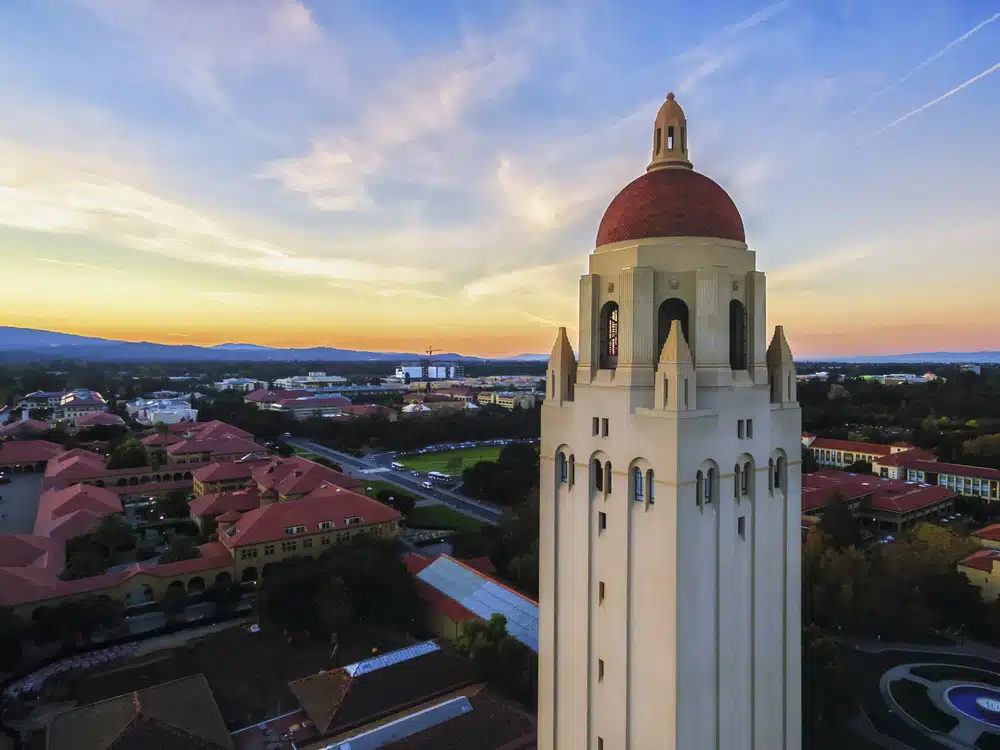
Stanford’s summer programs for high school students offer a selective set of academic experiences run through Stanford Pre-Collegiate Studies and individual academic departments. Well-known options include the Stanford Institutes of Medicine Summer Research Program (SIMR) and Stanford University Mathematics Camp (SUMaC).
These programs cover fields such as biomedical research, computer science, engineering, mathematics, humanities, and global studies. Students work with Stanford faculty and graduate mentors, complete advanced coursework or original research, and experience the academic pace of a top research university.
In this guide, we’ll highlight 12 of the strongest Stanford summer opportunities.
- Best Stanford Summer Programs for High School Students
- Stanford Institutes of Medicine Summer Research Program (SIMR)
- Stanford Humanities Institute (SHI)
- Stanford University Mathematics Camp (SUMaC)
- Stanford AI4All
- Stanford Summer Session
- Stanford Pre-Collegiate Summer Institutes
- International Relations Summer Program
- Cardiothoracic Surgical Skills Summer Internship
- Clinical Anatomy Summer Program
- Legal Studies for High School Students
- Inspiring Future Scientists through Shadowing (IFSS)
- Stanford Young Investigators
- Frequently Asked Questions
- Takeaways
Best Stanford Summer Programs for High School Students
Below is an overview of the 12 most prestigious summer programs at Stanford, including their program names, locations, and general seasonal dates.
|
Rank |
Program | Location |
Dates |
|
1 |
Stanford Institutes of Medicine Summer Research Program (SIMR) | Stanford School of Medicine | June 8 – July 30, 2026 |
| 2 | Stanford Humanities Institute (SHI) | Stanford University |
Session 1: June 21 – July 10, 2026 |
|
3 |
Stanford University Mathematics Camp (SUMaC) | Stanford University + Online | Online: June 15 – July 3, 2026 • Residential: June 21 – July 17, 2026 |
| 4 | Stanford AI4All | Stanford University + Online |
Online: June 15 – June 26, 2026 • Residential: July 19 – July 31, 2026 |
|
5 |
Stanford Summer Session | Stanford University | June 20 – August 16, 2026 |
| 6 | Stanford Pre-Collegiate Summer Institutes | Online |
Session 1: June 15 – June 26, 2026 • Session 2: July 6 – July 17, 2026 |
|
7 |
International Relations Summer Program | Stanford University | June 20 – August 16, 2026 |
|
8 |
Cardiothoracic Surgical Skills Summer Internship | Stanford University |
Summer 2026 (expected) |
| 9 | Clinical Anatomy Summer Program | Stanford School of Medicine |
Session 1: June 8–12, 2026 • Session 2: June 22–26, 2026 • Session 3: July 6–10, 2026 • Session 4: July 20–24, 2026 |
|
10 |
Stanford Intensive Law & Trial | Palo Alto, CA (Stanford Law School x Envision) | June 24–July 3, 2026 • July 6–15, 2026 • July 17–26, 2026 |
| 11 | Inspiring Future Scientists through Shadowing (IFSS) | Stanford University |
June 16 – June 26, 2026 |
|
12 |
Stanford Young Investigators | Stanford University (Bay Area only) |
Applications open Feb 1, 2026 |
Let’s discuss each program one by one.
1. Stanford Institutes of Medicine Summer Research Program (SIMR)
- Dates: June 8 – July 30, 2026
- Location: Stanford School of Medicine
- Cost: Free (no tuition), though housing is not provided
The Stanford Institutes of Medicine Summer Research Program (SIMR) is one of the most prestigious summer programs in the country, designed for high school juniors and seniors interested in biomedical science, translational medicine, and laboratory research.
Chosen applicants get to pick from eight official research institutes:
- Immunology
- Cancer Biology
- Stem Cell Biology
- Neuroscience
- Cardiovascular Science
- Genetics
- Bioinformatics
- Bioengineering
Over eight weeks, participants learn core research techniques. These may include PCR, Western blotting, handling of animal models, computational biology, stem cell work, and data analysis. Students also attend professional development workshops that explore science careers, research ethics, and college pathways. Many students present a final poster summarizing their research findings.
Admission is highly competitive. SIMR typically accepts only about 50 students per year, and priority often goes to students with strong STEM backgrounds. Eligibility includes a minimum age of 16 and U.S. residency. Explore more of the program in our comprehensive guide to SIMR.
2. Stanford Humanities Institute (SHI)
- Dates: Session 1: June 21 to July 10, 2026; Session 2: July 12, 2026 – July 31, 2026
- Location: Stanford University
- Cost: $8,850
Offered through Stanford Pre-Collegiate Studies, the Stanford Humanities Institute (SHI) places students in faculty-led seminars focused on a single, defined humanities course rather than a general survey of the field. For the 2026 summer term, students enroll in one of the following official humanities courses:
- Ancient Rome and Its Legacies
- Books to Bollywood
- Colonial Extractions of African Cultural Treasures
- The Greeks and Beyond
- Happiness and the Good Life
- Magical Realism: One Hundred Years of Solitude
- Racial Identity in the American Imagination
- Revolutions
Courses emphasize close reading of primary texts, historical and philosophical analysis, and sustained discussion in small seminar settings. Students complete a major research paper under faculty guidance and refine their arguments through writing workshops and peer critique. The program culminates in a symposium where students formally present their research.
Applicants submit transcripts, an academic writing sample, and teacher recommendations. To increase your chances of getting into the program, read our complete guide to SHI.
3. Stanford University Mathematics Camp (SUMaC)
- Dates: Online: June 15 to July 3, 2026; Residential: June 21 to July 17, 2026
- Location: Online and Onsite at the Stanford campus
- Cost: Online: $3,750; Residential: $8,950
Stanford University Mathematics Camp (SUMaC) is one of the most rigorous mathematics summer programs for rising juniors and seniors with a strong interest in abstract, proof-based mathematics. SUMaC focuses on advanced mathematical thinking through two tracks: Program I (Number Theory) and Program II (Abstract Algebra and Algebraic Topology).
The program’s emphasis is on learning how mathematicians think. Students construct formal proofs, explore the historical development of key ideas, and investigate mathematical structures. While the program is theory-driven, instructors also introduce applications.
SUMaC is offered in both online and residential formats:
- Online program. Three-week accelerated format, live lectures and synchronous problem-solving, virtual guest talks, final research presentations, and a cohort of 64 students.
- Residential program. Four weeks on Stanford’s campus, daily weekday academic sessions, structured evening and weekend activities, in-person collaboration, and a cohort of 40 students.
Applicants submit transcripts, teacher recommendations, and a required SUMaC problem set. Math contest experience, such as AMC or AIME, is common among admitted students, but it is not required.
SUMaC does not offer academic credit or grades. Interested in joining this program? Check out our complete guide to SUMaC.
4. Stanford AI4All
- Dates: Online: June 15 to June 26, 2026; Residential: July 19 to July 31, 2026
- Location: Online and on-site at Stanford University
- Cost: Online: $4,120; Residential: $9,800
Hosted by the Stanford Institute for Human-Centered Artificial Intelligence (HAI) in collaboration with Stanford Pre-Collegiate Studies, Stanford AI4All aims to broaden participation in artificial intelligence (AI) by supporting students from underrepresented communities.
Students learn core concepts in machine learning and neural networks while examining fairness, bias, and ethical decision-making in real-world AI systems. Instruction is paired with computing labs, live demonstrations, and discussions that connect technical tools to social impact.
A central component of the program is a collaborative research project. Working in teams under Stanford faculty, graduate mentors, and AI practitioners, students design and present an original project at a final symposium. Past project areas have included medical imaging, climate modeling, natural language processing, computer vision, robotics, and medical AI.
Stanford AI4ALL is open to students in grade 9 at the time of application and welcomes participants from around the world. Prior experience in programming or artificial intelligence is not required.
Explore other AI camps you can participate in this summer.
5. Stanford Summer Session
- Dates: June 20 to August 16, 2026
- Location: Stanford University
- Cost: $1,505 per unit
Stanford Summer Session gives eligible high school students the chance to take Stanford undergraduate courses for credit, with the option to live on campus and join structured residential programming.
Course options span STEM, humanities, and social sciences, from computer science and engineering to economics, biosciences, and writing. For 2026, we recommend the following courses:
- Accounting for Managers and Entrepreneurs
- An Intro to Making: What is EE (ENGR40M)
- Technology Entrepreneurship (ENGR145S)
- Principles of Data Science (DATASCI112)
- Programming Methodology (CS106A)
- Programming Abstractions (CS106B)
- Mathematical Foundations of Computing (CS103)
- Economics from Outer Space (ECON109)
- Sustainability Design Thinking (CEE176G)
- Deliberative Polling and AI Governance: Shaping Ethical Parameters for AI (COMM112S)
Admission typically reviews academic readiness through required application materials such as transcripts and recommendations. Students must be 16 or older by the program start date.
Want to learn more about the program? Check out our detailed guide to the Stanford Summer Sessions.
6. Stanford Pre-Collegiate Summer Institutes
- Dates: Session one: June 15 to June 26, 2026; Session two: July 6 to July 17, 2026
- Location: Online
- Cost: $3,200
The Stanford Pre-Collegiate Summer Institutes offer intensive, two-week online courses for students in grades 8–11. Each course functions like a short college seminar, with live instruction, advanced readings, discussion, and project-based work. Courses are ungraded and non-credit, with small class sizes that allow for individualized feedback.
With more than 40 courses available, selecting the best option matters. Below are ten of the most rigorous and popular choices:
- Artificial Intelligence
- Introduction to Machine Learning
- Biomedical Engineering
- Biotechnology: Innovations and Applications
- Discrete Mathematics
- Innovation and Entrepreneurship
- Product Design
- Philosophy of Artificial Intelligence
- Creative Writing: Creative Nonfiction, Fiction, and Poetry
- Social Determinants of Health
Looking to join the 2026 sessions? Before you do, read our comprehensive guide to Stanford Pre-Collegiate Summer Institutes.
7. International Relations Summer Program
- Dates: June 20 to August 16, 2026
- Location: Stanford University
- Cost: $1,505 per unit
The International Relations Summer Program is offered through Stanford Summer Session. Students study core theories of international relations, including the causes of war and peace, global trade and protectionism, environmental governance, and international inequality. Lectures are paired with small-group discussion sections, data analysis, and applied policy work that mirrors Stanford’s social science curriculum.
The course is structured around faculty lectures held three times per week that integrate theory, case studies, and discussion, alongside weekly discussion sections devoted to close reading, debate, and analytical writing.
Students also complete a midterm exam and a cumulative final exam, conduct quantitative data analysis using a real public-opinion survey, and collaborate on a policy memo advising the U.S. President on a global issue. Regular response papers support the development of strong critical reading and argumentation skills.
Admission requires a Stanford Summer Session application, academic transcripts, and written responses. Students may also enroll in additional Stanford Summer Session electives in related social science fields.
Before applying or enrolling, we recommend reviewing the full course syllabus to understand the workload, grading structure, and academic expectations.
8. Cardiothoracic Surgical Skills Summer Internship
- Dates: Summer 2026 (expected)
- Location: Stanford University
- Cost: $4,500
Hosted by Stanford’s Cardiothoracic Surgical Skills and Education Center, the Cardiothoracic Surgical Skills Summer Internship is an intensive, hands-on program for high school students exploring careers in medicine, surgery, and biomedical science.
Instruction is delivered by Stanford faculty, surgical residents, and clinical staff through a structured daily schedule. Mornings focus on lectures covering cardiac and thoracic anatomy, disease processes, and surgical decision-making. Afternoons are dedicated to supervised technical labs, where students work directly with surgical instruments and simulation models provided by the program.
The program runs Monday through Friday, with lectures from 9:00 a.m. to 12:00 p.m. PST and technical skills sessions from 1:00 p.m. to 4:00 p.m. PST. Full-time attendance is required for the duration of the internship.
Admission is selective and requires submission of Stanford Summer Session application materials. Students considering surgical or medical careers will find this program especially valuable for understanding the academic intensity, technical precision, and ethical responsibility of cardiothoracic surgery.
9. Clinical Anatomy Summer Program
- Dates: Session 1: June 8-12, 2026; Session 2: June 22-26, 2026; Session 3: July 6-10, 2026; Session 4: July 20-24, 2026
- Location: Stanford School of Medicine
- Cost: $4,000
The Clinical Anatomy Summer Program (CASP) at Stanford University is an immersive, in-person experience that introduces high school students to human anatomy through a clinically focused lens. Designed for students considering careers in medicine and allied health fields, the program emphasizes how anatomical knowledge directly informs diagnosis, surgical decision-making, and patient care.
CASP combines faculty-led lectures, hands-on anatomy labs, and live surgical demonstrations. Students work with real human anatomical specimens and cadavers, learning musculoskeletal, neurological, thoracic, abdominal, and head-and-neck anatomy.
The curriculum also integrates clinical case discussions, exposure to medical imaging, and guest lectures from Stanford faculty representing fields such as surgery, dentistry, and other health professions. By the end of the week, students complete a mock practical exam modeled after medical school anatomy assessments.
CASP is a non-residential, full-day program, typically running from 9:00 a.m. to approximately 4:00 p.m. each weekday. Students are responsible for their own transportation. Because the program uses authentic anatomical material and surgical demonstrations, applicants are encouraged to thoughtfully consider their comfort level with clinical environments before applying.
Explore our comprehensive list of medical-related summer programs to know your options that will align with your goals.
10. Stanford Intensive Law & Trial
- Dates: June 24-July 3, 2026, July 6-15, 2026, July 17-26, 2026
- Location: Palo Alto, California
- Cost: $5,699
Intensive Law & Trial, a 10-day program developed jointly by Stanford Law School and Envision, provides high school students with direct exposure to legal studies. The centerpiece of the experience is a full mock trial officially endorsed by the American Mock Trial Association.
Participants work in assigned legal teams and prepare a case from the ground up. This includes reviewing case files, analyzing evidence, developing legal strategy, drafting witness questions, anticipating objections, and constructing opening and closing statements. Students rotate through courtroom roles such as attorney, witness, and legal clerk.
Instruction is delivered through daily lectures and skill-building workshops led by Stanford Law School faculty, practicing attorneys, and legal educators. Topics often include constitutional law, criminal procedure, rules of evidence, trial advocacy, and ethical decision-making. Workshops focus on practical skills such as persuasive argumentation, witness examination, legal writing, and oral advocacy.
As one of Stanford’s summer programs for high school students focused on law, this experience mirrors the intensity of pre-law coursework. It is best suited for students considering careers in law, public policy, debate, or advocacy.
11. Inspiring Future Scientists through Shadowing (IFSS)
- Dates: June 16 to June 26, 2026
- Location: Stanford University
- Cost: Free
Inspiring Future Scientists through Shadowing (IFSS) is a free, selective summer program hosted by the Stanford University Department of Chemistry within the School of Humanities and Sciences. Designed for rising high school juniors and seniors, IFSS introduces students to cutting-edge chemical research.
The two-week program runs Monday through Friday, 9:00 AM to 12:00 PM. Instead of being assigned to a single research project, participants shadow multiple Stanford graduate students working across different areas of chemistry, from materials science to physical, organic, or interdisciplinary chemistry.
While applicants may come from any background, the program prioritizes expanding access and offering a first exposure to professional research environments. Key eligibility requirements include:
- Students must be at least 16 years old by the first day of the program.
- Applicants must live and attend school locally in Alameda, Santa Clara, San Francisco, or San Mateo counties.
- The program is non-residential, and participants are responsible for daily transportation.
- Students who have already graduated from high school are not eligible.
The IFSS application typically opens in early 2026 and includes a student application, short written responses, and a teacher’s letter of recommendation.
Ready to explore more research programs this summer? Check out our complete list of research opportunities.
12. Stanford Young Investigators
- Dates: Applications open on February 1, 2026
- Location: Stanford University, Bay Area–local students only
- Cost: Unpaid internship
Stanford Young Investigators is a research-focused summer internship hosted by the Stanford Doerr School of Sustainability. The program places students directly into active Stanford research groups, where they contribute to ongoing environmental and earth science projects under the supervision of graduate students, postdoctoral scholars, and lab managers.
Interns typically work 15 to 30 hours per week on a regular weekday schedule arranged with their supervisor. Most students are assigned to one research group and one primary project, which may involve laboratory work, fieldwork, data analysis, or computational research, depending on the group’s focus.
Projects span disciplines ranging from oceans, environment, and Earth systems to Earth and planetary sciences, energy and the built environment, environmental social sciences, sustainable agriculture at the O’Donohue Family Stanford Educational Farm, and the history of life and biodiversity, including mass extinction research using fossil and geological datasets.
In addition to lab work, interns participate in weekly group activities, including research talks, lab tours, campus sustainability programming, and occasional field trips. Interns also gather for working-group lunches twice a week, which provide structured opportunities to learn about sustainability research across disciplines and connect with fellow interns.
Frequently Asked Questions
1. What are the best Stanford summer programs for high school students?
Programs such as SIMR, SUMaC, Stanford AI4All, and Stanford Pre-Collegiate Summer Institutes rank among the best because they provide advanced coursework, mentorship, and hands-on experience at Stanford.
2. Are there free Stanford summer programs for high school students?
Yes. SIMR and IFSS are two free options. Stanford AI4All is also free for selected applicants, making it a strong choice for students seeking accessible Stanford summer programs for high school students.
3. What subjects do Stanford’s summer programs typically cover?
Subjects span medicine, AI, biology, mathematics, humanities, international relations, engineering, law, and environmental science. Students can choose either academic coursework or hands-on research, depending on the program.
4. How can Stanford’s summer programs help with college admissions?
Joining Stanford’s summer programs demonstrates academic initiative and readiness. Students build portfolios, earn college credit, complete advanced projects, and gain mentorship from Stanford affiliates. Admissions officers recognize the rigor of these experiences.
5. When should I apply for Stanford’s summer programs?
Most applications open between November and January, with deadlines from January to March. Competitive programs like SIMR or SUMaC fill quickly, so students benefit from preparing materials early.
Takeaways
- The strongest Stanford summer programs for high school students help you explore advanced subjects, strengthen research skills, and work directly with Stanford faculty or researchers.
- Stanford’s summer programs span medicine, engineering, AI, humanities, mathematics, and global studies, giving students many pathways to explore academic interests.
- Free and competitive summer experiences like SIMR, IFSS, and AI4All offer exceptional access to research without tuition barriers.
- Early preparation is essential. Applications require essays, transcripts, recommendations, and sometimes problem-solving assessments.
- If you want expert guidance tailored to your academic goals, consider AdmissionSight’s Private Consulting Program, which helps students build standout academic profiles that strengthen top-tier college applications.