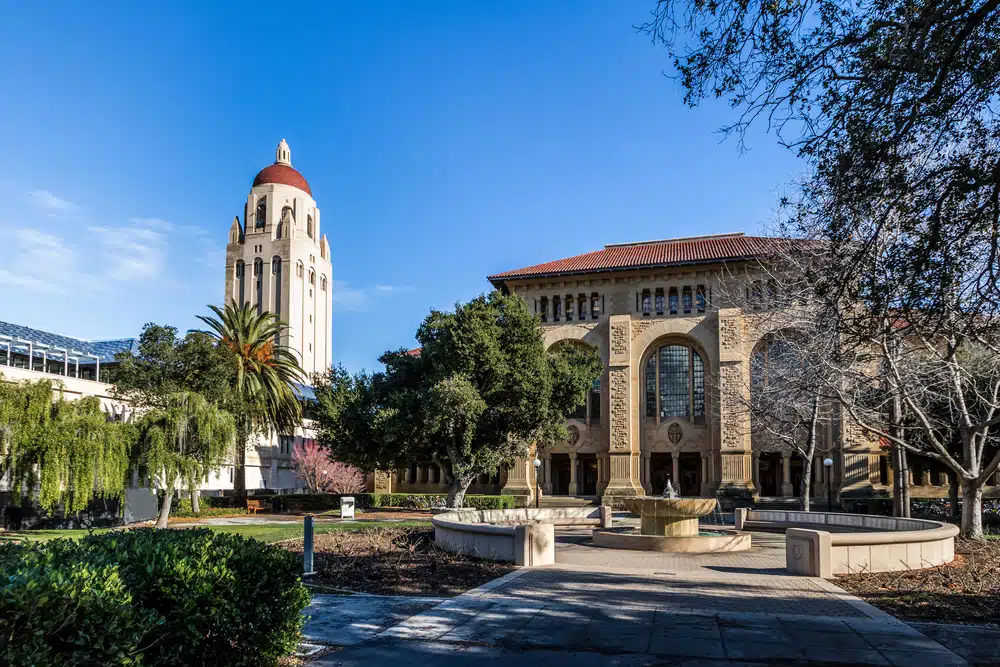
There’s a quiet Stanford vs Caltech rivalry, but it’s not the loud, football-fueled kind you get with Stanford vs. Cal or Harvard vs. Yale. This one’s more subtle and rooted in academics. Stanford has a big, bold energy. It’s known for tech, business, and research, with deep ties to Silicon Valley. Caltech is smaller and more focused, with a close-knit community that’s into scientific exploration and industry-leading research.
So yes, the rivalry exists, but it lives in the labs, research grants, and academic rankings, not on the football field. In this blog, you’ll get a closer look at how Stanford and Caltech compare when it comes to academics, campus culture, research opportunities, and student life. If you’re torn between these two powerhouses, this guide will help you think beyond prestige and find your best match.
- Stanford vs Caltech: A Quick Overview
- Stanford vs Caltech: Acceptance Rate
- Stanford vs Caltech: Rankings
- Stanford vs Caltech: Admission Requirements
- Stanford vs Caltech: Cost of Attendance
- Stanford vs Caltech: Financial Aid and Scholarships
- Final Verdict: Stanford vs. Caltech
- Frequently Asked Questions
- Takeaways
Stanford vs Caltech: A Quick Overview
Choosing between Stanford and Caltech isn’t exactly easy. You’re weighing world-class academics, prestige, and totally different campus vibes. There’s a lot to think about—program strengths, costs, career goals, and what kind of environment you’ll thrive in. But once you’ve narrowed it down to these two, the real challenge begins.
Before we get into the details, let’s take a step back and get a feel for what makes each of these schools stand out.
Stanford University
Stanford University was founded in 1885 by Leland and Jane Stanford in honor of their only son, Leland Jr. From the start, the school set itself apart—it opened in 1891 as nonsectarian, coeducational, and tuition-free. The Stanfords wanted the university to serve the public good, and that mission still shapes Stanford today.
Now, Stanford is known worldwide as a powerhouse of innovation and influence. Its School of Engineering is top-tier and has played a major role in the creation of companies like Google, Instagram, and Hewlett-Packard. The Graduate School of Business is also one of the best, attracting ambitious minds from around the globe.
Stanford’s alumni network reads like a who’s who of tech, business, and politics. You’ll find connections to Elon Musk, Sundar Pichai (CEO of Alphabet), and LinkedIn co-founder Reid Hoffman. U.S. Supreme Court Justice Sandra Day O’Connor earned her law degree here, and political leaders like Condoleezza Rice and Senator Cory Booker are among its grads.
California Institute of Technology
Caltec got its start in 1891 as Throop University, a small vocational school in Pasadena, California. It wasn’t until the early 1900s that it began shifting toward science and engineering, thanks in large part to astronomer George Ellery Hale, who pushed the school toward cutting-edge research and academic excellence.
Since then, Caltech has built a reputation as one of the most elite and intellectually intense institutions in the world—especially in physics, chemistry, and engineering. Despite its small student body, the school consistently ranks among the top research universities globally.

Caltech is deeply involved in major scientific breakthroughs, particularly in astronomy, space exploration, and theoretical physics. It operates NASA’s Jet Propulsion Laboratory (JPL), which has led missions to Mars and other parts of the solar system. From quantum mechanics to seismology to AI, some of the most important advances in science have Caltech’s stamp on them.
As for notable alumni, the list is packed with brilliance. Nobel Prize winners like Richard Feynman, Kip Thorne, and Linus Pauling all made their mark here. The school also helped shape tech pioneers like Intel’s Gordon Moore and even Elon Musk, who briefly attended before heading to other ventures.
Stanford vs Caltech: Acceptance Rate
Stanford and Caltech are two of the most selective universities in the world, and getting in is no small feat. Every year, thousands of top students from around the globe shoot their shot, but only a tiny percentage actually get accepted. For the Class of 2028, both schools maintained extremely low acceptance rates, making them some of the toughest universities to get into.
Here’s a quick look at how their acceptance rates compare:
| School | Acceptance Rate |
| Stanford | 3.6% |
| Caltech | 2.3% |
Stanford is tough to get into, but Caltech takes it to another level. For the Class of 2028, Stanford accepted just 3.6% of applicants. That’s 2,067 students out of more than 57,000 who applied. Meanwhile, Caltech was even more selective, with only 315 students admitted from a pool of 13,863. That’s a 2.3% acceptance rate and a seriously intense one.
Caltech’s ultra-low rate is both about high standards and size. With only around 1,000 undergrads total, there just aren’t many seats to fill. When you’re working with a class that small, every spot counts.
And then there’s the focus. Caltech is laser-sharp when it comes to STEM. It’s not casting a wide net across dozens of majors; it’s looking for students who are already deeply into science, engineering, or math, and thriving in it.
So if you’re aiming for a spot at either of these schools, your application has to be not just strong, but stand-out impressive.
Stanford vs Caltech: Rankings
If you’re deciding between Stanford and Caltech, checking out university rankings can give you a strong starting point. Rankings aren’t everything, but they can help you compare academic reputation, research influence, and how graduates typically fare in the real world.
Here’s a quick look at how Stanford and Caltech have ranked over the past few years in three major lists: Times Higher Education, QS World University Rankings, and U.S. News & World Report.
| World Rankings | Princeton | Caltech |
| Times Higher Education 2025 | #6 | #7 |
| Times Higher Education 2024 | #6 | #7 |
| Times Higher Education 2023 | #3 | #6 |
| QS World University Rankings 2025 | #6 | #10 |
| QS World University Rankings 2024 | #5 | #15 |
| QS World University Rankings 2023 | #3 | #6 |
| US News Best National University Rankings 2025 | #4 | #6 |
| US News Best National University Rankings 2024 | #3 | #7 |
| US News Best National University Rankings 2023 | #6 | #9 |
Stanford and Caltech are both academic giants, but how they perform in rankings really depends on the lens you’re looking through. Based on the latest data:
- Times Higher Education places Stanford slightly ahead, holding the #6 spot for three years in a row (2023–2025), while Caltech trails just behind at #7 across the same period. It’s a close call, but Stanford edges out consistently.
- In the QS World University Rankings, though, Stanford takes a clear lead. It ranked #3 in 2023, #5 in 2024, and #6 in 2025. Caltech, by contrast, started strong at #6 in 2023 but dropped to #15 in 2024 and #10 in 2025. While still excellent, there’s a bit more fluctuation on Caltech’s side.
- On the U.S. News Best National University Rankings, Stanford again maintains a solid presence—#6 in 2023, climbing to #3 in 2024, and landing at #4 in 2025. Caltech, meanwhile, ranks slightly lower, staying between #9 and #6 over the same span.
But here’s the truth: rankings don’t tell the full story. They’re helpful for getting a general feel for a school’s global reputation or academic strength, but they can’t show you what it’s actually like to live and learn there.
If you’re deciding between Stanford and Caltech, look beyond these numbers. Consider the campus vibe, the kind of research you want to do, your learning style, and where you see yourself growing. The right fit isn’t always the highest rank, it’s the place that challenges you and feels like home.
Stanford vs Caltech: Admission Requirements
Let’s take a closer look at what it takes to get into Stanford and Caltech. While both are incredibly selective, their admissions teams look for different strengths. So while both schools expect academic excellence, the kind of standout they’re looking for isn’t always the same.
| Application Requirement | Stanford Requirements | Caltech Requirements |
| Application Platforms | Common Application
Coalition Application QuestBridge |
Common Application
QuestBridge Application |
| Application Fee | $90 or fee waiver available | $75 or fee waiver available |
| Standardized Tests | Requires test scores from students attending Fall 2026.
Average test scores: SAT: 1510–1570 ACT: 34–35 |
Requires test scores for the Class of 2029
Average test scores: SAT: 1530-1570 ACT: 35-36 |
| High School Coursework Recommendations | 4 years of English
4 years of math 3+ years of science 3+ years of a foreign language 3-4 years of history and social studies |
4 years of math, including calculus
1 year of physics 1 year of chemistry 1 year of biology (recommended) 4 years of English 2 years of history and/or social sciences (3+ years recommended) |
| GPA | No minimum requirements
Average GPA: 4.2 |
No minimum requirements
Average GPA: 4.2 |
| Letters of Recommendation | 1 counselor recommendation
2 teacher recommendation letters 1 optional letter |
2 teacher recommendations:
1 from a math or science teacher 1 from a humanities or social sciences teacher |
| Supplemental Essays | 8 Stanford essay questions | 6 Caltech-specific essay prompts |
| Application Deadlines | Restrictive Early Action: November 1
Regular Decision: January 5 |
Restrictive Early Action: November 1
Regular Decision: January 3 |
To apply to Stanford or Caltech, you’ll need to submit a solid application, but the requirements differ slightly between the two. Stanford will require standardized test scores starting with students applying for Fall 2026. Caltech will also require test scores again, beginning with the Class of 2029, after temporarily suspending them in past cycles.
If you do submit, strong scores will help—historically, competitive applicants at both schools have SAT scores in the 1500+ range and ACT scores between 34 and 36:
- Stanford’s average admitted SAT range is 1510–1570 and ACT scores come in at 34–35.
- Caltech’s numbers are even more selective: 1530–1570 on the SAT and 35–36 on the ACT.
Neither school has an official GPA cutoff; however, both report an average GPA of 4.2, so aiming for top grades is crucial.
If you’re aiming for Stanford or Caltech, your extracurriculars can make a huge difference in your application. Both schools want to see what you’re passionate about, how committed you are, and the impact you make, but they look for different types of activities.
At Stanford, leadership and a well-rounded approach matter a lot. They’re especially impressed by applicants who align with Stanford’s interdisciplinary programs, like the Symbolic Systems major, which blends computer science, linguistics, philosophy, and psychology, or Stanford’s Haas Center for Public Service, which supports students working on social impact projects.
Caltech, on the other hand, is all about STEM. They’re looking for students who love research, problem-solving, and getting hands-on with science and technology. If you’ve competed in math Olympiads, built projects for science fairs like Regeneron ISEF, coded your own software, or participated in robotics teams, that’s right in Caltech’s wheelhouse.
Activities that align with programs like the Summer Research Connection (SRC) or the Undergraduate Research Fellowships (SURF) can show that you’re ready to thrive in their research-driven environment.
If you need a step-by-step guide to getting into Stanford or Caltech, we’ve put together up-to-date resources to help you craft a standout application:
Stanford vs Caltech: Cost of Attendance
Applying to elite schools like Stanford and Caltech is an exciting step, but it’s also a major financial decision. Both schools offer an incredible education and access to top-tier opportunities, but the overall cost can be significant. That’s why it’s important to look closely at the numbers before you commit.
Let’s break down the estimated cost of attendance for Stanford and Caltech for the 2024–2025 academic year:
| School | Tuition and Fees | Living Costs (housing, food, transportation etc.) | Total |
| Stanford | Tuition: $67,731
Fees: $2,475 |
Housing and food: $22,167
Books: $840 Personal expenses: $3,300 Transportation: $4,800 |
$96,513 |
| Caltech | Tuition: $65,622
Fees: $2,586 |
Housing: $12,105
Food: $8,886 Books/course materials: $1,428 Personal Expenses: $3,285 |
$93,912 |
Stanford is more expensive than Caltech by $2,601 per year. This difference comes primarily from higher living and transportation costs at Stanford. While tuition and fees at both schools are relatively close—Stanford at $70,206 (tuition + fees) and Caltech at $68,208—the added cost of housing, food, and transportation at Stanford brings its total higher.
These numbers don’t include financial aid just yet. When you’re choosing between Stanford and Caltech, you’re looking at two of the most prestigious universities in the world—and that kind of education comes with a high price tag. Tuition is a major part of it, but once you add housing, meals, books, and other day-to-day expenses, the total can add up quickly.
That’s why it’s smart to look at the full cost of attendance early in the process. Getting a clear picture now can help you avoid surprises later and give you more time to plan and explore your financial aid options.
Stanford vs Caltech: Financial Aid and Scholarships
Stanford and Caltech are both pricey, but they back it up with strong financial aid programs designed to make their education more accessible for students from all income levels.
Stanford is need-blind for U.S. applicants and promises to meet 100% of your demonstrated financial need. If your family earns less than $100,000 a year, chances are you won’t pay tuition, and in many cases, room and board are covered as well.
Caltech also offers generous aid, especially for students pursuing STEM fields who need financial support. Like Stanford, they’re need-blind for U.S. applicants and commit to covering 100% of demonstrated need. Their aid packages often include grants, scholarships, and work-study opportunities. One thing to keep in mind is the higher cost of living in California, which can make daily expenses more noticeable compared to other locations.
Here are a few financial aid options and scholarship opportunities available at both schools:
Financial aid and scholarships at Stanford
- Need-Based Aid for Low-Income Families. If your family earns under $100,000 a year and has typical assets, you likely won’t pay tuition. If your family makes under $75,000, tuition, housing, and meals are usually covered.
- Athletic Scholarships. Stanford offers NCAA Division I sports scholarships. These are awarded by coaches based on your athletic ability and how you fit on the team.
- Stanford Scholarship (Grant Aid). Most students who get financial aid receive this grant from the university. It’s based on your family’s financial situation—not your grades.
- Federal Pell Grant. If you’re a U.S. citizen with significant financial need, you may qualify for this federal grant. It can be combined with Stanford’s own aid.
- Yellow Ribbon Program. For veterans and military-connected students, this program helps cover tuition and fees not fully paid by the Post-9/11 GI Bill. Stanford matches VA contributions.
Financial aid and scholarships at Caltech
- Need-Based Grants and Scholarships. Caltech covers 100% of demonstrated financial need for all admitted students. This aid usually comes in the form of grants and scholarships, so you won’t have to pay it back. If your family needs support, Caltech will work to make cost a non-issue.
- Stamps Scholarship. This prestigious, merit-based award is given to top students. It covers part of tuition and provides extra funding for research, internships, travel, and other academic enrichment.
- Federal and State Grants. Eligible U.S. students can receive additional aid through Federal Pell Grants and Cal Grants (for California residents). These don’t need to be repaid and can help reduce out-of-pocket costs.
- Caltech First-Year Undergraduate Research Fellowship (FURF). This program gives first-year students the chance to receive funding for summer research projects under faculty mentorship.
- Named Scholarships. Caltech also offers named donor-funded scholarships based on both need and merit. These awards are automatically considered when you apply for financial aid—no separate application required.
Final Verdict: Stanford vs. Caltech
Stanford and Caltech are two of the most respected universities in the U.S., but they offer very different college experiences. The best choice for you depends on what kind of environment you’re looking for.

- Stanford sits right in the heart of Silicon Valley and thrives on innovation. It’s known for top-ranked programs in computer science, engineering, business, and design, and it encourages students to think across disciplines. If you’re interested in launching a startup, collaborating on real-world projects, or combining tech with social impact, Stanford gives you the network and resources to do just that.
- Caltech, on the other hand, is a STEM powerhouse with a tight academic focus on physics, engineering, mathematics, and scientific research. You’ll learn directly from world-renowned scientists, work in cutting-edge labs, and have access to places like NASA’s Jet Propulsion Laboratory.
So which one’s the better fit?
If you’re someone who thrives in an interdisciplinary, fast-moving environment and wants to stay close to innovation and entrepreneurship, Stanford might be your perfect match. But if you’re deeply curious about how the universe works, love problem-solving, and want to be immersed in serious scientific discovery, Caltech could be the place where you truly thrive.
Ultimately, both schools offer world-class academics, generous financial aid, and alumni networks that can open nearly any door. What matters most is finding the school that matches your goals, interests, and the kind of experience you want over the next four years.
Frequently Asked Questions
1. Which school is harder to get into—Stanford or Caltech?
Both schools are highly selective, but Caltech edges out as slightly more competitive based on acceptance rates. For the Class of 2028, Stanford admitted 3.6% of over 57,000 applicants (2,067 students), while Caltech admitted just 2.3% from a much smaller pool of 13,863 applicants (315 students).
2. Do both Stanford and Caltech offer good financial aid?
Yes. Both Stanford and Caltech meet 100% of demonstrated financial need for admitted U.S. students and are need-blind in admissions. Stanford also offers strong support for families earning under $100,000.
3. Are Stanford and Caltech in the Ivy League?
Stanford and Caltech aren’t Ivy League schools. The Ivy League is a group of eight elite private universities located in the northeastern United States, originally formed as an athletic conference. These schools are Harvard, Yale, Princeton, Columbia, UPenn, Dartmouth, and Cornell.
Takeaways
Stanford and Caltech are both top-tier universities, but they offer very different experiences. Choosing between them means looking past rankings and asking yourself what kind of student you are, what kind of environment helps you grow, and which school better matches your personal and academic goals.
- Caltech is more selective, but Stanford is more popular. While both schools are highly competitive, Caltech admitted only 2.3% of applicants for the Class of 2028, compared to Stanford’s 3.6%.
- Both schools are expensive, but offer generous financial aid. Stanford and Caltech meet 100% of demonstrated financial need and are need-blind for U.S. applicants.
- Both schools offer top-tier research, but in different ways. Stanford emphasizes cross-disciplinary and entrepreneurial work through centers like Bio-X and HAI. Caltech offers early, focused STEM research via programs like SURF and access to NASA’s Jet Propulsion Lab.
- A college admissions expert can help you highlight the right strengths, refine your essays, and build a smart strategy tailored to each school’s values.