You don’t need to be a master sculptor to do well on the AP 3-D Art and Design Exam, but skill alone won’t carry you. In 2024, just 6.2% of students earned a 5. The majority of portfolios scored in the 3 or 4 range, with 72% of students passing the exam with a 3 or higher. Altogether, 9,180 students submitted portfolios that year. The average score was 3.04.
This blog walks you through everything you need to know about the AP 3-D Art and Design Exam: how it works, what it requires, how to study effectively, and how to submit a portfolio that actually stands out.
- AP 3-D Art and Design Course and Exam Description
- AP 3-D Art and Design Exam Format
- AP 3-D Art and Design Sample Portfolio
- How to Build a High-Scoring AP 3-D Art and Design Portfolio
- AP 3-D Art and Design Portfolio Submission Deadline
- Is the AP 3-D Art and Design Exam Hard?
- Frequently Asked Questions
- Takeaways
AP 3-D Art and Design Course and Exam Description
The AP 3-D Art and Design course is centered on creating original three-dimensional artwork that shows your understanding of 3-D design principles. You’ll explore how to use materials, processes, and ideas to communicate visually through media like sculpture, ceramics, installation, metalwork, jewelry, or digital 3D modeling.
You’ll learn how to develop a sustained artistic investigation guided by a central idea or question. You’ll also work on applying spatial design concepts such as form, volume, mass, space, surface texture, balance, and repetition.
In your written work, you’ll describe your decision-making process, material choices, and how your ideas evolved through experimentation and refinement.
The course asks you to create with intention and reflect on your creative growth over time. You’ll produce a portfolio that includes both a series of works that explore a single theme (Sustained Investigation) and five high-quality finished pieces (Selected Works) that demonstrate strong design and craftsmanship.
The course is modeled on a college-level foundation 3-D art and design studio class. Most students who take it are juniors or seniors with some experience in sculpture, ceramics, or other three-dimensional media. The College Board recommends students be familiar with basic design principles before enrolling, but there are no formal prerequisites.
AP 3-D Art and Design Exam topics
The AP 3-D Art and Design Exam assesses your ability to apply 3-D design principles and demonstrate sustained creative growth. These six skill areas are at the core of both the course and the final portfolio:
| Skill Area | Description |
| Inquiry and Investigation | You’ll identify a central idea or question to explore across multiple works. This skill focuses on planning a cohesive body of 3-D work and developing a strong visual theme over time. |
| Material Use | You’ll select and manipulate materials like clay, metal, wood, fiber, or digital media with intention. This includes showing control, innovation, and exploration in how you use materials and tools. |
| Process and Revision | You’ll document how your 3-D work evolves through sketching, prototyping, constructing, and refining. This area highlights your ability to problem-solve and improve ideas across versions. |
| Composition and Design | You’ll apply 3-D design principles such as form, mass, volume, space, and surface. Strong work shows an understanding of spatial relationships and how 3-D elements interact in the round. |
| Artistic Intent and Communication | You’ll make intentional choices to communicate ideas through your artwork. This might include symbolic use of form, material, or structure to clearly express your theme to the viewer. |
| Written Evidence | You’ll explain your creative decisions in writing. This includes describing materials, processes, and ideas clearly and concisely, so reviewers understand your artistic thinking. |
Each of these skill categories is assessed in both the Sustained Investigation and Selected Works sections of the AP 3-D Art and Design portfolio. The more fluently you demonstrate growth, creativity, and design skill across all six areas, the stronger your portfolio score will be.
AP 3-D Art and Design Exam Format
The AP 3-D Art and Design Exam has no multiple-choice or timed written sections. Instead, the exam is a digital portfolio submitted through the AP Digital Portfolio platform. The portfolio has two sections, and each one counts toward your final score:
Section I – Sustained Investigation
- 15 images total
- Includes written responses
- 60% of your score
This section asks you to explore a central question or idea through a connected body of 3-D works. You’ll submit 15 digital images that show your ideas developing over time. Some of these images may show finished artworks. Others might include in-progress work, revisions, detail shots, or experiments that help explain your creative thinking.
You’ll also respond to written prompts about your investigation. These must explain:
- What central idea or inquiry guided your work
- How your materials, processes, and concepts evolved
- What changes you made as you experimented and revised
This section is all about growth. The reviewers want to see how your ideas matured and how your work became more intentional as you went along.
You’ll be scored on areas like:
- Creative problem-solving
- Visual and conceptual development
- Effective use of materials and 3-D design principles
- Willingness to take risks and refine your ideas
- Consistency and evolution across your portfolio
Section II – Selected Works
- 5 artworks (2 images per work = 10 images total)
- Includes short commentary for each work
- 40% of your score
This section showcases your five strongest finished pieces. These artworks should demonstrate technical skill, attention to 3-D design, and clear ideas. For each piece, you’ll provide a short written description that covers:
- The materials you used
- The techniques or processes you applied
- The idea or message behind the work
The goal is to show your best creative thinking and execution. Each piece is judged on quality, craftsmanship, and clarity of intention. Your selected works may come from your sustained investigation, or they can be entirely separate.
You’ll be evaluated on:
- Skillful and intentional use of materials
- Clear communication of ideas
- Control of form, volume, space, and surface
- Originality and design effectiveness
Together, these two sections make up your complete AP 3-D Art and Design Exam portfolio. The stronger your work across both, the higher your chance of earning a top score.
AP 3-D Art and Design Sample Portfolio
To understand what a top-scoring AP 3-D Art and Design portfolio looks like, let’s look at a real example from 2024.
This student earned a score of 5 by demonstrating strong spatial design, technical execution, and original ideas across all five selected works.

|
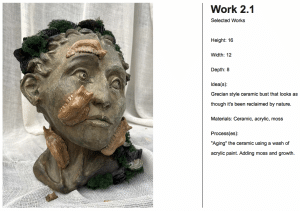
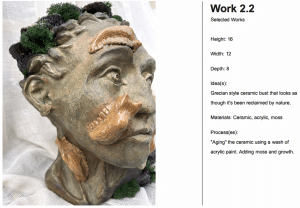
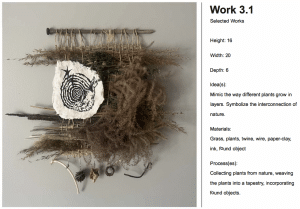
Let’s walk through why this portfolio earned a 5. This portfolio excelled in three key areas:
1. Advanced 3-D art and design skills
Each piece shows refined technical skill and a strong grasp of 3-D design principles like form, proportion, repetition, texture, and spatial composition. For instance:
- Work 1 displays expert sculptural modeling in clay to depict two calves conjoined at the head, with detailed features and an expressive, lifelike presence.
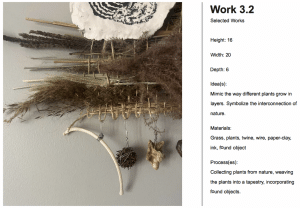
- Work 3 uses weaving and mixed natural materials to mimic botanical growth, layering textures and shapes to construct a dimensional, organic form.
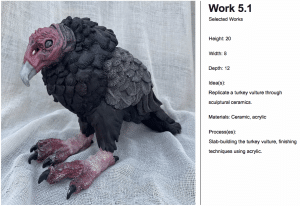
- Work 5 demonstrates anatomical precision and textural contrast in a lifelike turkey vulture, sculpted with careful slab-building and detailed painting.
The student demonstrated more than just technical skill by making intentional choices that aligned with their conceptual goals. Each work reflects an awareness of how to use 3-D elements to build meaning while maintaining visual balance and craftsmanship.
2. Strong synthesis of materials, processes, and ideas
Every artwork thoughtfully connects concept, media, and method. The artist demonstrates a deep understanding of how physical materials can amplify thematic intent. Examples include:
- Work 1 uses a ceramic bust of two-headed calves to critique overbreeding and livestock consumption, enhanced through layered acrylic and chalk pastel textures.
- Work 2 presents a Grecian-style bust reclaimed by moss and insects, visually exploring decay and the reclaiming power of nature.
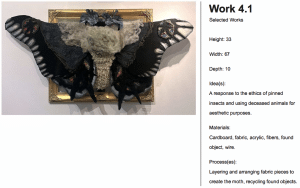
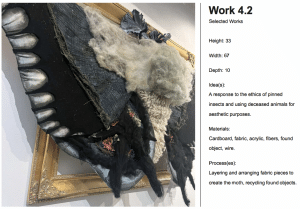
- Work 4 transforms found objects and fabric into a large moth, raising ethical questions about the use of animals for aesthetic display.
This level of synthesis is key. The artist uses material manipulation not only to shape a form but also to make a point, creating cohesion between the idea, the medium, and the execution.
3. Clear, specific, and intentional written evidence
The writing clearly outlines the materials, processes, and ideas behind each work. Descriptions like “layering acrylic on top of the ceramic and dusting it with chalk pastel” and “symbolize the interconnection of nature” reveal the student’s ability to explain both how and why each piece was made.
This writing complements the visual work and reflects the student’s capacity for critical thinking about their own artmaking. It communicates intent clearly without oversimplifying or using vague language, which is exactly the kind of writing the AP rubric rewards.
How to Build a High-Scoring AP 3-D Art and Design Portfolio
The AP 3-D Art and Design Exam doesn’t include any test questions. Instead, you’ll submit a digital portfolio that demonstrates strong design skills, original thinking, and a consistent creative process focused on three-dimensional form.
You’ll be scored on how well your portfolio meets the following criteria: Inquiry and Investigation, Making Through Practice, Experimentation, and Revision, and Communication of Ideas. Scoring high requires more than technical talent. You need intention, craftsmanship, and clarity.
Here’s how to meet the scoring criteria and stand out:
1. Start with the Course and Exam Description (CED).

The AP 3-D Art and Design CED outlines the exact skills and design concepts you’ll be evaluated on. Use it to guide every decision from the beginning.
- Practice 3-D design principles listed in the CED: volume, proportion, surface, structure, light, and space.
- Choose a specific question to guide your Sustained Investigation. The best portfolios are idea-driven, not just medium-based.
- Use the rubric to self-check your progress. Make sure your works reflect risk-taking, inquiry, and thoughtful choices.
- Make every work intentional. Think carefully about how you use materials, space, and physical form.
- In your commentary, explain how your work evolved. Reviewers want to understand how your thinking changed over time.
2. Emphasize process and transformation.
The Sustained Investigation is designed to reward growth, experimentation, and thoughtful revision.
- Document your process. Include photos of maquettes, material tests, or works-in-progress that show change.
- Take creative risks. Experiment with unexpected materials, structural techniques, or interactive elements.
- Make sure each image adds to your story. Avoid repeating the same structure or solution.
- Use alternate views. If your work has important spatial features, show different angles to help reviewers understand them.
- Reflect on feedback. If critiques helped you shift direction, mention that in your writing.
3. Pick your strongest works for the Selected Works section.
This section is about showing refined technical skill and confident use of materials. Your five pieces should be resolved, carefully documented, and clearly communicate your ideas in 3-D space.
- Choose pieces that highlight spatial design and control. Strong form and structure are key.
- Avoid works that feel similar. Each one should offer something new—whether conceptually, formally, or materially.
- Photograph your pieces carefully. Use good lighting, neutral backgrounds, and multiple angles if needed.
- Be clear in your commentary. Describe how materials, form, and surface treatment support your message.
- Stay concise but informative. Don’t repeat what’s obvious. Use the space to explain decisions.
4. Study real portfolios and scoring notes.
The College Board shares real student portfolios with commentary from AP readers. These are one of the most useful resources you can learn from.
- Analyze high-scoring portfolios. See how other students balanced experimentation with refinement.
- Pay attention to commentary. Notice how students explain their use of materials and spatial strategies.
- Compare strong and weak examples. Learn what separates a top-scoring portfolio from one that lacks cohesion or development.
- Look for variety and unity. Strong portfolios include a range of ideas while still feeling connected.
5. Manage your time and submissions wisely.
You’ll need time to plan, create, revise, photograph, and write. Spread out your work and avoid last-minute scrambles.
- Break your project into phases. Set goals for developing ideas, building forms, and refining them.
- Get regular feedback. Studio critiques and peer reviews can help sharpen your direction.
- Track your progress. Know how many pieces you’ve completed, what needs refining, and what’s ready to upload.
- Give yourself time to document. Photographing 3-D work takes effort—allow at least two weeks.
- Submit before the deadline. For 2026, the AP Art and Design deadline is Friday, May 8, 2026, at 8 p.m. ET.
6. Treat your Sustained Investigation like research in 3-D form.

Instead of just showcasing technique, your portfolio should ask a meaningful question and explore it through physical, sculptural form. The practice is the research: each experiment, revision, and material choice helps you refine your ideas and move the investigation forward.
- Go beyond a theme. Build your Sustained Investigation around a concept that invites exploration and evolution.
- Show progression. Don’t be afraid to revise or abandon ideas as your understanding deepens.
- Include process materials. Rough studies, failures, and remakes can show growth and risk-taking.
7. Be consistent with your visual language.
Even if you use different materials, your work should feel like it came from the same artistic voice.
- Maintain coherence across your work. Use consistent choices in surface treatment, spatial composition, or sculptural methods.
- Avoid visual disconnection. Portfolios that feel unified tend to score higher.
- Explain your consistency. Use your commentary to show how each piece connects to your overall vision.
8. Don’t neglect the written evidence.
Your writing explains the decisions the viewer can’t see. It supports your ideas, shows intent, and gives context for your process.
- Treat the commentary as part of your art. Use it to clarify, not to fill space.
- Be direct and specific. Link your words to what the viewer sees: material choices, structure, function.
- Avoid vague explanations. Skip phrases like “I just wanted to express myself.” Be concrete about your goals and methods.
- Explain what’s not visible. If you revised a form or changed materials, describe why it mattered.
Creating a high-scoring AP 3-D Art and Design portfolio requires more than technical ability. It calls for intentional choices, visible growth, and a clear connection between your materials and your message. When you stay focused, work with purpose, and let your ideas shape your form, your portfolio will stand out on its own.
AP 3-D Art and Design Portfolio Submission Deadline
The final deadline to submit your AP 3-D Art and Design portfolio is Friday, May 8, 2026, at 8:00 PM Eastern Time. All three components—Sustained Investigation, Selected Works, and Written Evidence—must be uploaded and marked as final in the AP Digital Portfolio by that time.
Be sure to leave yourself enough time before the deadline. Incomplete uploads, last-minute errors, or technical problems can prevent your portfolio from being scored.
To view the full AP exam calendar and registration details, you can check out our comprehensive guide.
AP 3-D Art and Design score release date
For 2026, AP 3-D Art and Design scores are expected to be released in early to mid-July. While the College Board hasn’t confirmed the exact date, scores typically become available around the same time each year. For reference, 2025 scores were released on July 7.
Make sure to log in to your College Board account starting in early July so you don’t miss your score report.
Is the AP 3-D Art and Design Exam Hard?
The AP 3-D Art and Design Exam doesn’t include multiple-choice questions or written prompts. Instead, you’ll submit a portfolio of original three-dimensional work that showcases your command of sculptural materials, effective visual organization, and a strong sense of concept.
The strongest portfolios display artistic risk-taking, personal voice, and a consistent evolution of ideas across all three components: Sustained Investigation, Selected Works, and Written Evidence.
If you’re curious about how students performed in 2024, here’s the official score breakdown:
| Score | Percentage of Students |
| 5 | 6.2% |
| 4 | 24.3% |
| 3 | 41.4% |
| 2 | 23.4% |
| 1 | 4.7% |
| Total Passing (3+) | 72.0% |
In 2024, 72% of students earned a passing score of 3 or higher. The mean score was 3.04. While most students passed, fewer reached the top score range. To stand out, your portfolio must go beyond technical execution. Show development over time, clarify your decisions through strong written evidence, and present sculptural work that is both intentional and conceptually sound.
If you’re looking for guidance on how to build a competitive portfolio or want expert feedback on your work, our AP tutorial services can help you refine your ideas and maximize your score.
Frequently Asked Questions
1. How hard is the AP 3-D Art and Design Exam?
The AP 3-D Art and Design Exam had a moderate pass rate in 2024. About 72% of students earned a score of 3 or higher, and the mean score was 3.04. Still, top scores are not easy to earn. Strong portfolios go beyond refined technique by demonstrating conceptual thinking, intentional material choices, and clearly articulated artistic decisions.
Portfolios are judged on both visual work and written evidence. That means your sculptures, installations, or other 3-D forms need to demonstrate intentional choices and a clear evolution of ideas. High-scoring students often document their process thoroughly and use their commentary to support what can’t be seen directly in the work.
2. How many hours should you spend on your AP 3-D Art and Design portfolio?
Success comes from consistent work throughout the year. Most students spend several hours each week experimenting with materials, refining their constructions, and reflecting on what their work is trying to say. If your goal is to earn a 4 or 5, start early and treat your Sustained Investigation as an ongoing research project in 3-D form.
You’ll also need time to photograph your pieces properly, document failed attempts or process materials, and write thoughtful commentary. Good pacing is essential, so don’t try to cram it all in at the last minute.
3. Is AP 3-D Art and Design worth taking?
If you’re passionate about sculpture, architecture, fashion, product design, or any other spatial medium, AP 3-D Art and Design can help you build a strong portfolio. It’s especially valuable for students applying to creative programs that want to see hands-on, three-dimensional work.
Even if you don’t plan to major in art, the course encourages experimentation, visual storytelling, and risk-taking—all skills that translate well into design, engineering, and other problem-solving fields.
4. When do AP 3-D Art and Design scores come out?
For 2026, AP 3-D Art and Design scores are expected to be released in early to mid-July. The College Board has not confirmed an exact date, but scores usually become available around the same time each year. As a reference, 2025 scores were released on July 7.
To avoid delays, be sure to check your College Board account regularly in early July so you don’t miss your score report.
Takeaways
As you work toward a strong AP 3-D Art and Design portfolio, these are the essentials to keep in mind:
- The AP 3-D Art and Design Exam is portfolio-based, with no written test. Your score depends entirely on how well your portfolio communicates ideas through form, material, and process.
- A high-scoring AP 3-D Art and Design portfolio reflects thoughtful experimentation. Reviewers want to see how your ideas evolve over time through risks, revisions, and material exploration.
- Clear and specific writing matters just as much as strong visuals. Use your commentary to explain your decisions, document transformation, and clarify your artistic voice.
- In 2024, 72% of students passed the AP 3-D Art and Design Exam with a 3 or higher, but only 6.2% earned a 5. To reach the top, your portfolio must reflect cohesion, creativity, and conceptual depth.
- For students seeking expert support on the AP 3-D Art and Design Exam, a college admissions consultant can provide personalized guidance. AdmissionSight offers focused portfolio reviews and strategic advice to help students present their strongest creative work.