The University of California, Berkeley (UC Berkeley) is one of the bigger UC campuses, containing many academic buildings, facilities, housing, and even natural reserves. But overall, how big is UC Berkeley?
In this article, we’ll talk about not just the school’s campus size, but also how its student body and alumni network contribute to how big it is.
- How Big Is UC Berkeley’s Campus?
- How Big Is UC Berkeley’s Student Body?
- UC Berkeley Class Demographics
- UC Berkeley Class Size: What Can You Expect?
- How Big Is UC Berkeley’s Campus Life?
- How Big Is UC Berkeley’s Alumni Network?
- Frequently Asked Questions
- Takeaways
How Big Is UC Berkeley’s Campus?
The UC Berkeley campus size is 1,232 acres and is split into two major parts:
- Central campus. This is the iconic and perhaps most well-known part of UC Berkeley, where most of the academic buildings, libraries, student life facilities, and administrative offices are located. This central area spans about 178 acres.
- Hill campus. This part of the campus extends into Berkeley Hills. The area is largely undeveloped and includes natural reserves, research facilities, and housing. It gives space for ecological research, outdoor recreation, and green areas that give the campus a rest from urban life.
To give you an idea of how big UC Berkeley is, let’s compare it to other UC campuses:
| UC Campus | Size |
| UC Davis | 5,300 acres |
| UC Santa Cruz | 2,000+ acres |
| UC Irvine | 1,474 acres |
| UC Berkeley | 1,232 acres |
| UC Riverside | Around 1,200 acres |
| UC San Diego | Around 1,200 acres |
| UC Santa Barbara | 989 acres |
| UCLA | 419 acres |
| UC San Francisco | 61+ acres |
As you can see, UC Berkeley is the fourth biggest UC campus.
Key areas and landmarks
Let’s talk about some key areas and landmarks you can find within UC Berkeley’s huge campus:
- Doe Library. This is the main research library on campus, housing an extensive collection of humanities and social sciences materials. Its grand classical architecture also contains reading rooms that offer a traditional academic atmosphere.
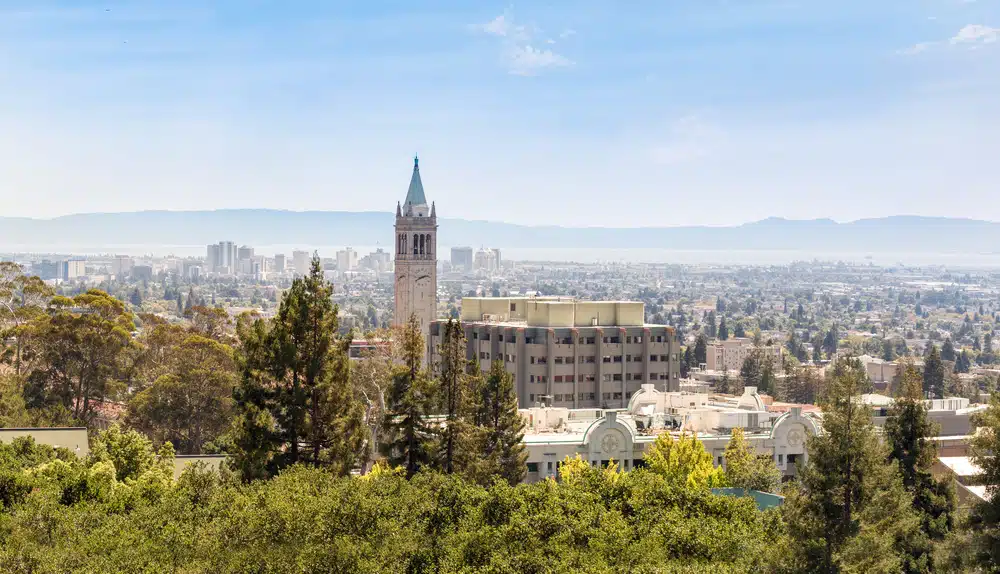
- Sather Tower (aka Campanile). This 307-foot bell tower is one of UC Berkeley’s most recognizable symbols. It offers panoramic views of the campus, the city of Berkeley, the San Francisco Bay, and beyond. It’s still a functional structure housing a carillon of 61 bells that chime regularly throughout the day!
- Valley Life Sciences Building (VLSB). This huge building is a central location for life sciences research and education at UC Berkeley. It contains biological sciences departments— including integrative biology, molecular and cell biology, and plant and microbial biology. It also has extensive research labs and the Essig Museum of Entomology.
- Strawberry Creek. This natural waterway flows through the heart of the UC Berkeley campus. It also serves as a living laboratory for environmental science students and provides a natural space where everyone can relax and take a break from the academic bustle.
- UC Botanical Garden. This is a 34-acre garden that serves as a living museum where you can study plant diversity and conservation. It showcases a vast collection of plants from around the world organized geographically.
Research facilities, extensions, and field stations
It’s also worth noting that UC Berkeley has off-campus facilities that let its presence and research activities extend beyond its central grounds. Below are a few examples:
- UC Berkeley at Moffett Field. UC Berkeley has a land-lease agreement at Moffett Field in Mountain View, with plans to develop a research and education hub, particularly focusing on aerospace and related fields in collaboration with NASA.
- Field Station for the Study of Behavior, Ecology and Reproduction. This research facility is just in the Berkeley Hills, but it’s still considered a field station, providing a semi-natural environment for studying animal behavior.
- UC Berkeley Extension. The UC Berkeley Extension has locations in areas like downtown San Francisco and other Bay Area sites. They’re primarily focused on continuing education and professional development.
How Big Is UC Berkeley’s Student Body?
UC Berkeley doesn’t just have a big campus. It also has a huge student population that fills its grounds.
For Fall 2025, the total student enrollment is 45,882 across all its colleges and schools. This is divided into 33,070 undergraduates and 12,812 graduate students.
Looking at UC Berkeley’s Common Data Sets, the number of freshmen they admit fluctuates per year. This can depend on the number of applicants and the slots available per major. For instance, the school admitted 13,714 out of 124,245 applicants for Fall 2024. Meanwhile, for Fall 2023, they accepted 14,769 out of 125,916 applicants.
UC Berkeley Class Demographics
UC Berkeley has a very diverse student population. Here’s a quick look at its Fall 2024 undergraduate students:
| Ethnicity | Population |
| Asian Non-Underrepresented | 13,416 |
| Chicanx/Latinx | 6,880 |
| White | 6,584 |
| African American/Black | 1,351 |
| Native American/Alaska Native | 182 |
| Pacific Islander | 59 |
| Asian Underrepresented | 51 |
| Decline to State | 1,265 |
| International | 3,282 |
This diversity enriches your educational experience and prepares you for a globalized world. After all, interacting with peers from different backgrounds exposes you to more perspectives, experiences, and ideas. This encourages critical thinking, intellectual curiosity, and a more nuanced understanding of complex issues.
You’ll also develop these intercultural communication and collaboration skills. That’s because engaging with people from different cultures promotes empathy and breaks down stereotypes. All these will lead to greater self-awareness and challenge your personal biases.
A diverse student body will also challenge existing power structures and promote a more equitable and inclusive campus environment, preparing you and your peers to be advocates for social justice in your future endeavors.
UC Berkeley Class Size: What Can You Expect?
The student-to-faculty ratio at UC Berkeley is 19:1, meaning that for every 19 students, there is one faculty member. This ratio can give you a general overview of the academic environment, but it doesn’t directly translate to the number of students in every single class. After all, this ratio takes into account all faculty members, including those involved primarily in research or administration, not just undergraduate instruction.
UC Berkeley is a pretty big school, but 71% of its undergraduate classes still have fewer than 30 students. But overall, the average size of the institution’s undergrad classes sits at 53.6 for academic year 2024-2025.
This means you can expect a combination of class sizes throughout your undergraduate experience at UC Berkeley. You’ll likely be part of some large lecture courses—especially in your first two years in general education courses that everyone is required to take and introductory courses in subjects like biology, chemistry, physics. But, as you specialize, you’ll get more intimate upper-division seminars and labs.
How Big Is UC Berkeley’s Campus Life?
UC Berkeley is home to more than 1000 student organizations. Getting involved in campus life is a great way for you to find your community, explore passions outside of academics, develop leadership skills, and make a large campus feel more intimate.
Let’s look at the types of organizations you join and pick out a few examples from them:
Academic and professional organizations
Academic and professional organizations are centered around specific academic disciplines or career fields. They give you opportunities for learning, networking, skill development, and community building related to those areas. Some examples are:
- Pre-Medical Honor Society. This is perfect for students pursuing careers in medicine, thanks to opportunities for volunteering, networking with healthcare professionals, and academic support.
- Berkeley Consulting Group. This student-run consulting organization provides pro-bono consulting services to real-world clients. It offers members hands-on experience in problem-solving, teamwork, and client interaction, preparing them for careers in consulting and business.
- UC Berkeley Society of Women Engineers. This organization supports and empowers women in engineering and technology through outreach, professional development, and community building.
Cultural and identity-based organizations
These organizations are formed around shared cultural, ethnic, national, religious, gender, sexual orientation, or other identity characteristics. They provide spaces for community building, cultural exchange, support, advocacy, and celebration of shared heritage and experiences. Examples of these organizations at UC Berkeley are:
- Berkeley Hillel. This provides a center for Jewish life on campus, offering religious services, cultural events, and community building.
- Queer Alliance Resource Center. This umbrella organization for LGBTQ+ students provides support and resources and organizes social events.
- Chinese Students and Scholars Association. This is a large organization for Chinese students and scholars, organizing cultural events and providing support.

Performing arts and creative expression
Performing arts and creative expression organizations are dedicated to various forms of artistic performance and creative output. Some examples are:
- UC Berkeley Symphony Orchestra. This is a large ensemble that performs classical and contemporary orchestral repertoire. It’s open to all students with instrumental proficiency.
- BareStage Productions. This is a student-run theater group that produces a variety of plays throughout the academic year, while also offering opportunities for acting, directing, and technical roles.
- The Daily Californian. This is UC Berkeley’s independent student newspaper. Aside from journalism, it also offers opportunities for students interested in photography and graphic design.
Social and political advocacy groups
Social and political advocacy groups aim to raise awareness, promote discussion, and advocate for change on social, political, and environmental issues. Examples of these groups are:
- Students for Sensible Drug Policy UC Berkeley Chapter. This promotes evidence-based drug policies and harm reduction strategies through education and advocacy.
- Amnesty International at UC Berkeley. This organization works to protect human rights worldwide through awareness campaigns, letter writing, and advocacy efforts.
- The Berkeley Project. This is the biggest community service organization at UC Berkeley, coordinating volunteer projects that connect UC Berkeley students with local community needs.
Sports and recreation
Sports and recreation groups give you opportunities to participate in physical activities—ranging from competitive club sports to casual intramural leagues and outdoor adventures. Examples you can check out are:
- Cal Hiking and Outdoor Society. This organizes hiking, camping, backpacking, and other outdoor trips to explore the natural beauty surrounding the Bay Area.
- Cal Quidditch. Also known as Cal Quadball, this organization plays the sport inspired by the Harry Potter series!
- Intramural sports. Sports like basketball and soccer have organized leagues and tournaments within the university for students of all skill levels to play on a competitive or recreational level.
Greek life
Greek life groups are social organizations centered around fraternities (for men) and sororities (for women). They often emphasize brotherhood/sisterhood, social events, philanthropy, leadership development, and academic support. Some examples are:
- Alpha Kappa Alpha Sorority, Inc. A historically Black sorority focused on scholarship, sisterhood, service, and social action.
- Kappa Alpha Order. A social fraternity emphasizing brotherhood, tradition, and gentlemanly conduct.
- Alpha Phi Omega. A co-ed service fraternity based on the principles of leadership, friendship, and service.
Special interest and hobby clubs
Special interest and hobby clubs are centered around specific non-academic passions, hobbies, or niche interests. They provide a space for students with shared enthusiasm to connect, learn, and engage in activities related to that interest. Some examples are:
- Cal Culinary Club. This club organizes cooking workshops, potlucks, and food-related events for students who enjoy cooking and exploring different cuisines.
- Game Design and Development Club. This community provides resources and a space for students interested in creating video games.
- Cal Animage Alpha. This is a club for anime and manga enthusiasts, organizing screenings, discussions, and cultural events.

How Big Is UC Berkeley’s Alumni Network?
UC Berkeley is more than just its campus and students. When talking about how big UC Berkeley is, it’s also worth looking at its vast alumni network. Some notable UC Berkeley alumni include:
- Chris Pine. An American actor best known for his roles as James T. Kirk in the Star Trek reboot film series and Steve Trevor in the DC Extended Universe films Wonder Woman and Wonder Woman 1984.
- Brenda Song. An American actress best known for her roles are Wendy Wu in Wendy Wu: Homecoming Warrior and London Tipton in The Suite Life franchise.
- Joan Didion. An American writer and journalist, considered to be one of the pioneers of the New Journalism literary movement.
- Jennifer Doudna. The laureate for the Nobel Prize in Chemistry in 2020. She is a biochemist who did pioneering work in CRISPR gene editing while also making other contributions to biochemistry and genetics.
- Ernest Lawrence. An American nuclear physicist who received the Nobel Prize in Physics in 1939 for his invention of the cyclotron.
Being part of the Cal Alumni Association when you graduate from UC Berkeley will let you grow your professional network, mentor current UC Berkeley students and fresh grads, and even join the wine club!
Frequently Asked Questions
1. How many acres is UC Berkeley?
UC Berkeley is 1,232 acres big. This covers both Hill campus and the central campus.
2. Is UCLA or UC Berkeley bigger?
UC Berkeley is bigger with 1,232 acres. Meanwhile, UCLA is actually the second-smallest UC campus with 419 acres.
3. How many students does UC Berkeley take?
For Fall 2024, UC Berkeley admitted 13,701 freshmen and 5,454 transfers. The number fluctuates every year since it depends on factors like the available slots per program.
Takeaways
So how big is UC Berkeley? The main things to remember are:
- The UC Berkeley campus size is 1,232 acres overall, with the central campus covering about 178 acres.
- UC Berkeley’s student body for the academic year 2024-2025 has a population of 45,882. Despite the huge population, 71% of the undergraduate classes still have less than 30 students.
- There are more than a thousand student organizations you can consider joining at UC Berkeley. These organizations span academic groups, sports, and special interest clubs, ensuring there’s at least one community for everyone.
- Do you think UC Berkeley is for you? Consult a private admissions expert to discuss your options and whether UC Berkeley is the best fit for you.