

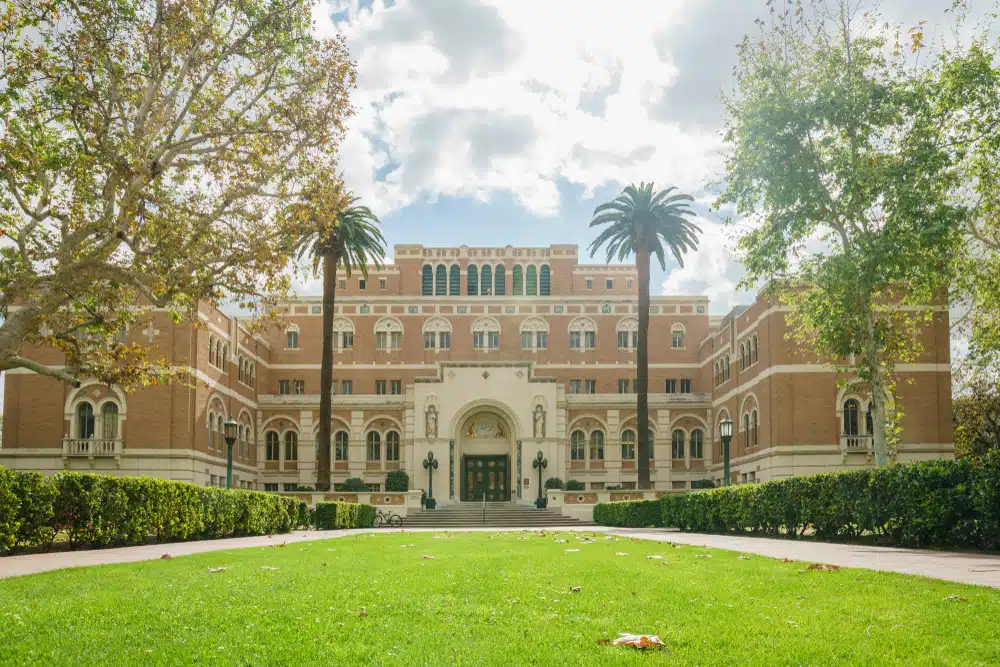
If you’re dreaming of becoming a Trojan, you’re probably already impressed by the University of Southern California’s sunny Los Angeles location and famous alumni. But there’s so much more to this iconic university than meets the eye. In this blog, we’re diving into fun facts about USC that will give you a fresh look at what makes the school so special.
13 Fun Facts about USC
Founded in 1880, the University of Southern California (USC) is one of California’s oldest private research universities and a major force in academics, innovation, and culture.
From Hollywood connections to historic traditions, the University of Southern California has more to offer than just top-ranked majors. Here are 12 fun and surprising facts that showcase the spirit, culture, and legacy of USC:
1. USC’s guiding philosophy
USC’s motto is: “Palmam qui meruit ferat.” It’s Latin for “Let whoever earns the palm bear it.”
In simple terms, it means “let the reward go to the one who has earned it,” emphasizing merit, achievement, and excellence—core values that reflect USC’s competitive and driven academic culture.
2. Where USC ranks among the best
In 2025, USC ranks #27 under National Universities, according to U.S. News & World Report.
3. The powerhouses of USC
Located in the University Park neighborhood of Los Angeles, USC places you right in the middle of one of the most dynamic cities in the world. It’s home to several undergraduate schools, including:
- Dornsife College of Letters, Arts and Sciences
- Viterbi School of Engineering
- Marshall School of Business
- School of Cinematic Arts
- Glorya Kaufman School of Dance
- Thornton School of Music
Whether you’re interested in business, engineering, the arts, or anything in between, USC offers a wide variety of top-ranked programs that let you dive deep into your passions.
USC’s acceptance rate for first-year fall admissions rose to 10.4% for the incoming class of 2029, according to the USC Office of Admission.

4. Bronze glory
Ever noticed that stoic Trojan warrior statue? Well, here’s a fun fact about USC: Tommy Trojan has been striking his iconic pose since 1930!
Positioned to the left of Tommy is the historic Bovard Administration Building, which dates back to 1922. On the right, Trousdale Parkway serves as a main thoroughfare through the heart of campus. Beyond Tommy and Bovard, you’ll catch a glimpse of Alumni Memorial Park, adorned with lush lawns and trees, leading up to the majestic Doheny Library.
5. Galloping guardian
That majestic white horse you see at football games? Traveler has been the official mascot since 1961! Imagine the excitement as this stunning steed, with its Trojan warrior rider, charges around the Coliseum track every time USC scores, all to the tune of “Conquest.”
The tradition of Traveler began in 1961 after Bob Jani, USC’s director of special events, and Eddie Tannenbaum, a USC junior, were inspired by seeing Richard Saukko riding his white horse, Traveler I, in the Rose Parade earlier that year. They persuaded Saukko to bring his horse to the Los Angeles Memorial Coliseum during USC football games to serve as a live mascot, a tradition that has continued ever since.
While the specific breed of horse serving as Traveler has evolved over the years, ranging from an Arabian/Tennessee Walker to a pure-bred Arabian and now a Spanish Andalusian, one consistent feature has been its pure white coat.
6. Hollywood’s launchpad
Aspiring filmmakers, listen up! USC’s Cinematic Arts is a legendary training ground. Since 1929, this school has been a powerhouse in the entertainment industry.
The list of notable graduates includes:
- Ke Huy Quan ’99 (Jonathan Ke Quan) (Everything Everywhere All At Once, Indiana Jones and the Temple of Doom, The Goonies)
- Patrick Schwarzenegger ’16 (Gen V, The Terminal List, The Staircase)
- Gregg Araki MFA ’85 (Now Apocalypse, Mysterious Skin, The Doom Generation)
- George Lucas ’66 (Star Wars, American Graffiti, THX 1138)
- Ryan Coogler MFA ’11 (Sinners, Black Panther, Creed, Fruitvale Station)
7. Campus cameo
Given its location in the heart of the entertainment capital, it’s perhaps unsurprising that USC’s campus itself has played a starring role in numerous productions. The university’s campus has served as a backdrop for countless movies and television shows, making it a familiar sight even for those who have never set foot in Los Angeles.
The University Park Campus, with its diverse architectural styles ranging from Romanesque Revival to Modernist, offers a versatile range of settings for filmmakers. From iconic films like Social Network and Forrest Gump to popular television series such as The Office, Legally Blonde, How to Get Away with Murder, and Gilmore Girls, various locations on campus have been featured.
8. Cardinal and gold standard
Those vibrant school colors? Cardinal and gold were officially adopted in 1896, symbolizing the heart (cardinal) and the wealth of opportunity (gold) in sunny Southern California.
While this choice is usually attributed to Marion Bovard in 1888, historical records indicate that the official approval of cardinal and gold as USC’s colors occurred in 1896 under the university’s third president, Reverend George W. White. Initially, the gold shade had a more orange hue, but in 1958, it was changed to a more vibrant yellow.
9. Bell brawl
That intense rivalry with UCLA? Here’s another fun fact about USC: The winner of their annual football clash gets to ring the coveted Victory Bell, a tradition dating back to 1939. This 295-pound brass bell has even been the subject of some legendary pranks!
The tradition began when the UCLA Alumni Association gifted the bell to UCLA, and for two seasons, Bruin cheerleaders would ring it after every score. However, in 1941, a group of USC’s Trojan Knights famously stole the bell, hiding it for over a year and significantly escalating the rivalry.
To prevent further incidents, the student body presidents of both schools signed the Victory Bell Accords in 1942, formalizing the annual exchange of the trophy to the winner of the football game.
One of the most infamous pranks occurred in 1958 when UCLA students took to the skies in a helicopter and dropped manure on the Tommy Trojan statue. Another year, they snuck onto USC’s campus and sawed off Tommy’s arm, repositioning it in a highly suggestive pose.
But USC has had its share of memorable pranks too. In 1989, USC students released 20,000 cardinal-and-gold-painted crickets into UCLA’s Young Research Library. Even now, you can still find the occasional cricket between the pages of older books.
10. Fight song
The USC fight song, “Fight On!”, is one of the most recognizable in college sports and is played at every USC athletic event.
The song “Fight On!” was composed in 1922 by Milo Sweet, with lyrics by Sweet and Glen Grant, originally as an entry in a student spirit competition. Over time, it evolved into the official fight song of USC and became a powerful symbol of Trojan pride.
11. Olympic gold mine
When it comes to the Olympics, USC is a true champion! They’ve produced more Olympic athletes than any other university in the entire United States, racking up hundreds of medals and representing dozens of countries.
Since the 1904 Olympic Games, USC has maintained a strong presence in both the Summer and Winter Olympics. Trojan athletes have represented an impressive 65 countries in the Games. Their achievements include a remarkable tally of 153 gold medals, 96 silver medals, and 77 bronze medals.
Ever since USC’s first gold medalist, freshman Fred Kelly ’16, earned the gold in the 110-meter high hurdles in Stockholm in 1912, Trojan athletes have won at least one gold medal at every Summer Olympics. This includes the U.S.-boycotted 1980 Moscow games, when swimmer Michelle Ford ’84, competing for her native Australia, captured the gold in the 800-meter freestyle.
This consistent success has led to USC being recognized as a powerhouse in Olympic sports.
12. Literary landmark
That grand old library on campus? The Doheny Memorial Library is home to a rare book collection, including a genuine leaf from the Gutenberg Bible! Talk about a priceless piece of history right on campus.
Opened in 1932, the Edward L. Doheny Jr. Memorial Library has served as a vital intellectual and cultural place for generations of students and faculty. This landmark building, USC’s first freestanding library, is home to a vast collection of books and journals, as well as dedicated spaces for study and special events.
13. Bovard’s big stage
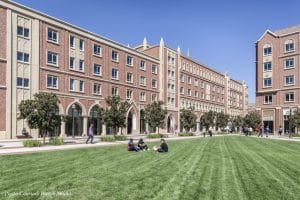
Opened in 1921, Bovard Auditorium, located within the George Finley Bovard Administration Building, stands as one of the oldest and busiest performance venues in the Los Angeles area.
Named after USC’s fourth president, George Bovard, the auditorium has a rich history of hosting countless student performances, visiting dignitaries, acclaimed authors, and renowned performing artists. Notably, civil rights leader Martin Luther King Jr. delivered a speech at Bovard Auditorium in 1967.
In 2003, the auditorium underwent an extensive renovation, which enhanced the audience experience through improvements to the design, acoustics, seating, and stage lighting systems.
Famous USC Traditions
USC is rich in traditions that bring the Trojan Family together, creating unforgettable moments of school spirit and pride. Let’s take a closer look at some of the most beloved customs that define the Trojan experience:
1. Senior fountain run
The Senior Fountain Run is a beloved USC tradition that marks the end of undergraduate studies in a spirited and unforgettable way. On this exciting day, graduating students celebrate their college journey by running through 30 fountains scattered across campus. It’s a rite of passage, symbolizing the transition from student life to the next chapter.
However, it was cancelled by the USC Administration this year due to health risks and costs. They proposed a “Senior Run” instead.
2. Card stunts
On October 21, 1922, the Trojan Knights, led by Yell Leader Lindley Bothwell, introduced the first-ever sequential card stunt, featuring an impressive 500 cards. While Cal and Stanford had been performing card stunts for years, USC’s Knights made history by creating the world’s first moving card stunt at Bovard Field.
To participate in the card stunt, students in the USC “rooting section” were required to wear white shirts. The Trojan Knights, tasked with organizing the stunts, were given two seats at the end of each aisle—one for themselves and one for their date. Initially, only one section was designated for the stunt, but over time, an additional section was added, effectively doubling the capacity for card stunts.
In the late 1980s, safety concerns over thrown cards led to the suspension of card stunts at USC football games. Despite efforts to revive the tradition in the 1990s and early 2000s, it wasn’t until 2011, during the USC-UCLA game, that the stunts made their spectacular return.
3. The Victory Bell
One cherished tradition at USC football games is the iconic Victory Bell. Originally gifted to UCLA in 1939 by the UCLA Alumni Association, this 295-pound bell once sat atop a Southern Pacific freight locomotive.
Today, the Victory Bell is proudly carried by the Trojan Knights on Game Day. Before each game, the Knights ring the bell as they walk down Trousdale Boulevard, signaling the excitement to come.
During the game, the bell rings on the sidelines after every USC touchdown, rallying the Trojan Family and energizing the crowd. The bell also makes appearances at official University functions and special events.
Frequently Asked Questions
1. What is the story behind the Victory Bell at USC?
The Victory Bell was originally a gift to UCLA from the UCLA Alumni Association in 1939. It weighs 295 pounds and was once perched atop a Southern Pacific freight locomotive.
Today, the Victory Bell is in the hands of the Trojan Knights, who ring it before and during USC football games, rallying the Trojan Family and adding to the excitement of each touchdown.
2. Who is Tommy Trojan at USC?
Tommy Trojan is an iconic statue and symbol of USC. While Tommy Trojan is not based on any specific individual, he represents the idealized Trojan student-athlete—strong, determined, and courageous. The statue is a tribute to the excellence and spirit of USC’s athletic programs.
3. How did the tradition of card stunts begin at USC?
In 1922, the Trojan Knights created the first-ever sequential card stunt during a USC football game. This tradition quickly became a hallmark of USC spirit, with students participating in elaborate displays using large cards. Although card stunts briefly disappeared in the late 1980s, they made a triumphant return in 2011.
Takeaways
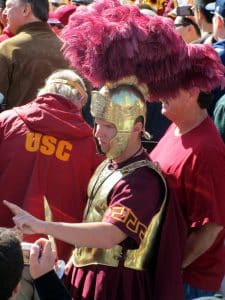
- From the iconic Victory Bell to the spirited card stunts, these fun facts and time-honored customs make being a Trojan an unforgettable experience.
- Whether you’re cheering at a football game or walking by Tommy Trojan, you’re a part of a legacy that has shaped USC’s unique spirit. Take a moment to appreciate the traditions that make USC truly special—and who knows, you might even create a few of your own!
- Dreaming of becoming a Trojan? Working with a college admissions consultant can help sharpen your application strategy and increase your chances of being accepted.










