
Every year, Ivy League schools get flooded with applications. Take Harvard, for example: for the Class of 2028, it had over 54,000 applicants, and only 3.6% got in. But the competition isn’t the only thing that makes Ivy League admissions unique. There are a few other factors you’ll want to know before diving into the Ivy League application process.
So, how do you create a strong Ivy League application? No worries—we’ve got you covered. In this post, we’ll walk you through what top schools are really looking for, how to stand out beyond just grades and test scores, and how to build a solid application timeline that gives you enough time to get everything done without the stress.
- How Ivy League Schools Rate Your Application
- How to Create an Application Worthy of Ivy League Admission
- Ivy League Admission Trends to Watch out For
- Frequently Asked Questions
- Takeaways
How Ivy League Schools Rate Your Application
When Ivy League admissions officers evaluate your application, they’re examining every part of your profile using a detailed rating system: academics, extracurriculars, personal qualities, and more. While each school has its own approach, they’re all looking for essentially the same things.
We got a rare look into this process thanks to Harvard University. During the Students for Fair Admissions lawsuit, Harvard’s internal rating system became public, giving us one of the clearest windows into how elite universities actually make their decisions.
Here’s how Harvard (and most Ivy League schools) breaks down their evaluation:
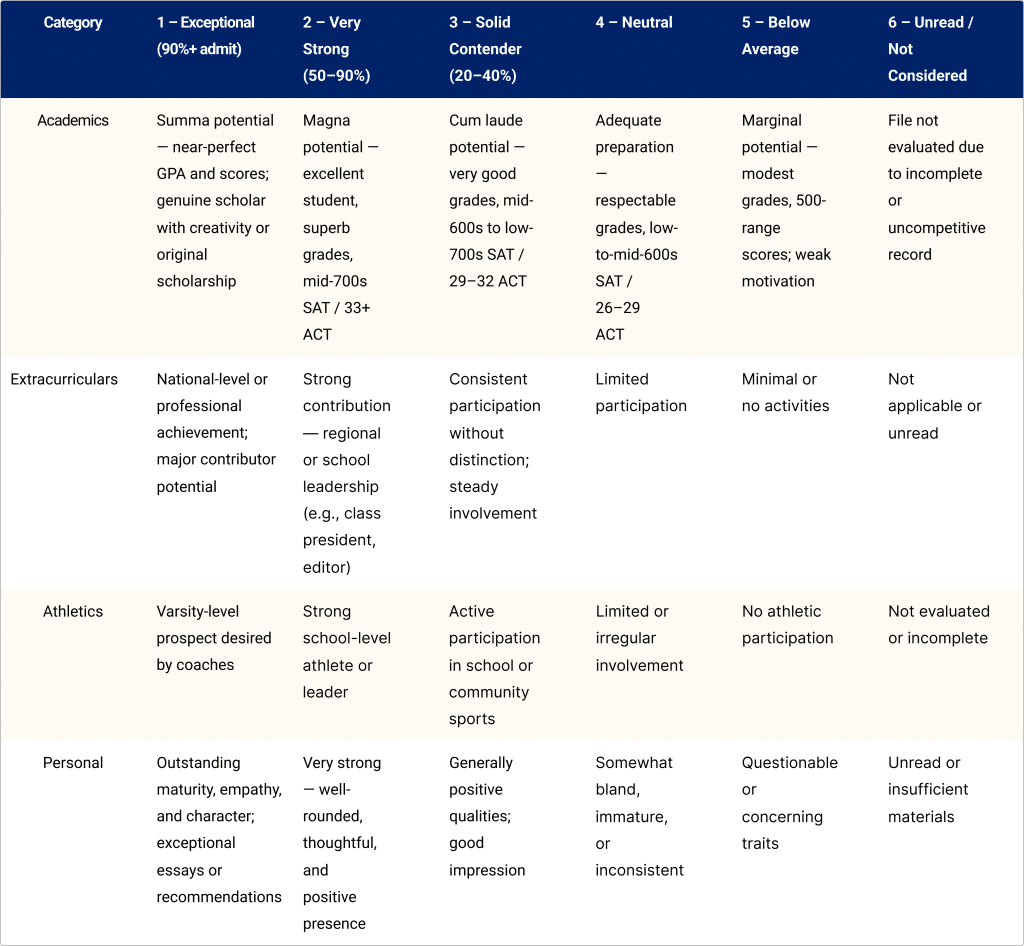
At the end of the process, all six components of your file—academics, extracurriculars, athletics, personal qualities, recommendations, and school support—are combined into a holistic overall score. This number isn’t an average of your six ratings. Instead, it skews toward your strongest areas.
For example, if you receive a 6 in athletics but earn 1s in academics and extracurriculars, your overall rating will still lean toward 1 or 1-, since academic and leadership strength carry greater weight. This approach allows Ivy League admissions officers to recognize applicants with exceptional promise even if they have weaker areas elsewhere.
Each category in the table shows how admissions officers translate your achievements and character into a numerical rating from 1 to 6. A “1” reflects exceptional performance—someone who stands out nationally or even internationally—while a “3” signals a solid but less distinguished profile. A “5” or “6” indicates credentials that fall below the competitive range or applications that are incomplete.
These scores help contextualize your strengths relative to the rest of the applicant pool. Let’s go through each category:
- Academics. Students rated “1” in academics usually show summa-level potential. Think perfect or near-perfect GPAs, SAT scores above 1500, or ACTs above 33, combined with intellectual creativity or original scholarship. Those at “2” or “3” have excellent grades and strong test results, while “4” or lower suggests weaker preparation. Ivy League admissions officers use this scale to identify who will thrive in their most demanding classrooms.
- Extracurriculars. Admissions readers use this rating to gauge initiative, influence, and long-term commitment. A “1” rating here reflects national-level recognition or professional achievement, someone who’s already made a tangible mark in their field, whether through research, arts, or leadership. A “2” means strong regional or school-level impact, such as being student body president or leading a major project. Applicants at “3” show consistent involvement without special distinction, while “4” or below indicates limited participation or opportunities constrained by circumstance.
- Athletics. Only a small number of applicants earn a “1” in athletics, typically recruited varsity prospects desired by college coaches. A “2” or “3” can still strengthen your profile when it shows leadership, teamwork, or sustained effort. A “4” or “5” in this category doesn’t harm non-athletes, but higher ratings can boost your competitiveness when paired with strong academic or personal qualities.
- Personal. The personal rating—arguably the most subjective—captures traits like maturity, empathy, and authenticity. A “1” here signals exceptional character and presence, often revealed through essays, interviews, and recommendations. A “2” or “3” suggests generally positive qualities, while “4” or lower may reflect immaturity or concerning behavior. Students with slightly lower academic ratings can stand out if they demonstrate sincerity, thoughtfulness, or resilience that earns them a high personal score.
Together, these ratings illustrate the holistic nature of Ivy League admissions. Officers look for depth, balance, and individuality across categories rather than perfection in one. You can offset a “3” in one area with a “1” in another when your overall story shows promise, purpose, and character.
In the next sections, we’ll break down exactly how you can aim for top ratings across these categories and build a stronger Ivy League application.
How to Create an Application Worthy of Ivy League Admission
The college admissions journey really kicks off in your junior year, but if you’re aiming for the Ivy League, the work starts way before that. Building a strong application doesn’t happen overnight. It takes years of thoughtful planning and smart choices.
Even students who are super talented and well-qualified often don’t realize just how much goes into it. That’s why starting early and having a game plan can make a huge difference when it’s time to apply.
Ivy League schools are looking for something special—students who stand out not just on paper but in real life, too. So how do you build an application that’s truly Ivy League-worthy? Here’s a detailed breakdown of what you should work on and how much time you should realistically expect to invest in the Ivy League admissions process, from start to finish.
1. Excellent academics is a prerequisite.
Duration: 4 years
At a lot of colleges, your grades and test scores are the biggest part of the admissions decision. If you’ve got straight A’s and solid test scores, that might be enough to get you in especially at schools that aren’t super selective. But when it comes to the Ivy League and other top-tier schools, they’re looking for more than just numbers.
Ivy League schools routinely turn down even students who score a perfect 1600 on the SAT. That shows you how academic success alone doesn’t guarantee a spot. You don’t need perfect stats to get in, but even if you have them, there’s still no guarantee.

That said, let’s take a look at the average GPA that each Ivy League school accepts:
| School | Average GPA | Acceptance Rates |
| Harvard University | 4.2 | 3.6% |
| Yale University | 4.1 | 3.7% |
| Princeton University | 4.1 | 4.6% |
| Columbia University | 3.9 | 3.9% |
| University of Pennsylvania | 3.9 | 5.4% |
| Brown University | 3.9 | 5.2% |
| Dartmouth College | 4.1 | 5.3% |
| Cornell University | 4.1 | 8.4% |
Ivy League schools might not list a specific GPA you need to get in, but this chart says a lot. You’ll be up against students who have seriously impressive grades—most are close to perfect.
Each year, the average GPA for accepted students keeps climbing, which means the bar is getting higher. A top GPA won’t promise you a spot, but it does give you a solid shot and helps keep you in the game.
2. Find and develop a hook.
Duration: 4 years
Your “hook” is that one thing about you that grabs the attention of admissions officers. It’s what makes you stand out from a sea of other applicants. Think of it as your main passion or focus, the thread that ties your whole application together.
Building a strong hook takes time, so it’s a good idea to start early. Freshman year is a great time to try different activities, classes, and volunteer work to see what you really enjoy. As you go through high school, keep leaning into the things that excite you most.
Look for ways to stay involved, take on more responsibility, or even lead in those areas. The goal is to show real dedication to something that matters to you and that will naturally shine through in your application.

Here are five specific examples of strong hooks that can stand out in an Ivy League application:
| Hook | Description |
| STEM research prodigy | You’ve loved science for years, joined school science fairs, and even worked in a real research lab. Maybe you helped write a paper or won a big competition. Your hook is your strong passion for science and discovery. |
| Social justice advocate | You care about making a difference in your community. You started a project to tackle problems like hunger, education, or the environment. You’ve taken action and worked with others to create change. That passion for helping people is your hook. |
| Creative writer | You’ve been writing stories or poems for fun, and some of your work got published or won awards. Maybe you even published your own book. Your hook is your creativity and love for writing. |
| Young tech entrepreneur | You created an app or started a small online business in high school. You figured out how to build it, share it, and help people with it. Your hook is your drive to create and your tech skills. |
| Talented athlete | You’ve competed at a really high level in your sport, maybe even nationally or internationally. You may have also helped coach others. Your hook is your dedication to your sport and your leadership. |
3. Start an independent project.
Duration: 2 years
One of the best ways to show off your hook is by starting your own passion project. This could happen anytime during sophomore year, junior year, or even early senior year. The goal is to take something you care deeply about and turn it into something that helps others. Doing this shows colleges that you’re motivated, passionate, and a natural leader.

Your project can be anything that fits your interests. It could be a research project, a nonprofit, a community program, or even a small business. If you’re interested in STEM, resources like Science Buddies can help you explore project ideas and turn them into a clear plan. Take a few months to think it through, make a plan, and set some clear goals.
Once you get started, keep track of what you do and how you grow. That way, when it’s time to write your college applications, you’ll have real stories to tell and solid proof of what you’ve accomplished.
4. Explore colleges and build your college list.
Duration: 1 year
Junior year is a great time to start looking into colleges and building your list. You’ll want to check out different resources and rankings to get a feel for what schools are out there. Just keep in mind that each ranking system focuses on different things.
For example, U.S. News and World Report looks at things like academic reputation and graduation rates, while Forbes leans more into financial factors like return on investment, student debt, and alumni salaries.
As you explore, don’t just rely on rankings. Also take a close look at how your own grades and test scores compare to the schools you’re interested in.
If your numbers fall in the middle 50% of a school’s admitted students, that’s a good match. If you’re above the 75th percentile, it could be a safety school. And if you’re below the 25th percentile, it might be a reach. The goal is to build a balanced list with a mix of all three.
5. Prepare for and take standardized tests.
Duration: 1-1.5 years
Most students finish the math they need for the SAT or ACT by the end of sophomore year, which makes spring a good time to take a practice test for each. These diagnostic tests help you figure out where you stand and which test might be a better fit for you.

As of 2025, only two Ivy League schools remain purely test-optional: Princeton University and Columbia University. Students applying to these schools can choose to submit SAT or ACT scores, but it’s not required for admission.
The rest of the Ivy League schools are shifting their policies. Harvard University, Brown University, Yale University, the University of Pennsylvania, and Dartmouth College have announced that they will require standardized test scores again, starting with the Class of 2029 (students applying in fall 2025). Cornell University has a mixed approach, some of its individual colleges now require test scores, while others still follow a test-optional policy.
Now, let’s take a look at the Ivy League schools’ 25th and 75th percentile composite scores for both SAT and ACT during the Class of 2028 admission cycle:
| Ivy League School | 25th and 75th Percentile SAT Composite Score | 25th and 75th Percentile ACT Composite Score |
| Harvard University | 1460-1580 | 33-35 |
| Yale University | 1500-1560 | 33-35 |
| Princeton University | 1510-1560 | 34-35 |
| Columbia University | 1500-1560 | 34-35 |
| University of Pennsylvania | 1500-1570 | 34-35 |
| Brown University | 1510-1560 | 34-35 |
| Dartmouth College | 1440-1560 | 32-35 |
| Cornell University | 1480-1550 | 33-35 |
Most Ivy League schools have SAT score ranges between 1460 and 1560, and ACT scores usually fall between 33 and 35. If your scores land in this range, you’re right in the middle of what accepted students typically have.
But if you really want to boost your chances, try to aim above the 75th percentile. Scoring on the higher end helps you stand out in a super-competitive crowd.
6. Put together your essays and applications.
Duration: 6 months to 1 year
Putting your college application together usually takes about six months, and even though it’s the shortest part of the process, it’s also the most important. If you’ve been building your application story throughout high school, this is where all that effort pays off. By this point, you should have a good idea of what makes your journey unique and how to share it in your application.
Start in the spring of junior year by asking for recommendation letters from teachers, counselors, or mentors who know you well. Then, use the summer before senior year to focus on your personal statement. This essay takes time—it involves a lot of thinking, writing, rewriting, and editing.
Colleges usually post their supplemental essay prompts in August, so plan to spend the rest of your summer and early fall working on those. Don’t forget your activities list, either. Even though you can finish it in a week or two, it’s still an important part of your application and deserves just as much attention as everything else. Try not to leave it until the last minute.
Ivy League Admission Trends to Watch Out For
The past few years have completely reshaped the college admissions process in the U.S. Big changes—like the impact of COVID-19, the end of affirmative action, and growing activism on campuses—have made today’s admissions world look very different from just ten years ago. For students and parents, keeping up with these shifts can really help when it comes time to apply.

When COVID hit, many colleges dropped testing requirements, and some—like the UC system, UPenn, Princeton, and Columbia—have kept test-optional policies. But starting with the 2024–25 cycle, top schools began bringing tests back. Dartmouth was the first Ivy to do this, followed by Brown, Yale, and Harvard. Cornell will require test scores again by fall 2026.
For the Class of 2027, schools like Penn, NYU, and Yale saw record-breaking application numbers. But more applicants didn’t mean more spots, so acceptance rates dropped simply because there wasn’t more room.
Now that testing is returning, that trend may start to shift. For example, Brown’s Early Decision acceptance rate for the Class of 2029 rose to 17.9%, up from 14.4% the year before.
In 2023, the Supreme Court ended affirmative action. Since then, colleges have been working to boost socioeconomic diversity instead. Many now offer free tuition for families under a certain income level. Duke and Yale, for instance, offer full tuition coverage for families earning under $150,000 a year.
These changes are shaping the future of admissions and being aware of them can help you plan smarter.
Ultimately, we prepared a complete guide for each Ivy League school that breaks down the admissions process and gives you tips to make your application shine:
- How to get into Harvard
- How to get into Yale
- How to get into Princeton
- How to get into Columbia
- How to get into University of Pennsylvania
- How to get into Brown
- How to get into Dartmouth
- How to get into Cornell
Frequently Asked Questions
1. Which is the easiest Ivy League school to get into?
Based on acceptance rates, Cornell University is generally considered the easiest Ivy League to get into. It had the highest acceptance rate among the eight, around 8.4%.
2. Which Ivy League school gets the most applications?
Cornell University typically receives the most applications among the Ivy League schools. It has received over 65,612 applications for the Class of 2028, with UPenn right behind it at 65,250 applications.
3. When are Ivy League applications due?
Ivy League Regular Decision applications are usually due January 1, while Early Decision or Early Action applications are typically due November 1.
4. Is a 3.7 GPA bad for the Ivy League?
A 3.7 GPA isn’t bad. It’s actually strong. But for the Ivy League, it can be on the lower side, especially since many admitted students have close to perfect GPAs. That said, admissions are holistic. You still have a chance if you have standout test scores, amazing essays, strong extracurriculars, or a unique story. It’s not impossible, but you’ll need to shine in other areas.
Takeaways
Getting into the Ivy League is about playing the long game. You need to know what you’re good at, use your time wisely, and start planning early. A strong Ivy League application doesn’t come together at the last minute.
- Start early and think long-term. You can’t build a strong Ivy League application overnight. It takes years of consistent effort, starting as early as freshman year.
- Good grades aren’t enough. Even perfect test scores or GPAs won’t guarantee a spot. You need to stand out with a strong “hook” and show real passion for something meaningful.
- Aim for a balanced college list. Don’t just apply to reach schools. Know your stats, compare them with past admitted students, and include match and safety options too.
- Admissions are changing, so stay updated. With testing policies shifting and affirmative action ending, it’s important to keep track of trends so you can adjust your strategy accordingly.
- Maximize your resources and chances of getting in by working with a college admissions expert.