


At UC Berkeley, being premed or pre-health isn’t an official major or minor—it’s more like a career track for students aiming for graduate-level health professions. You can follow this path no matter your major, whether you’re studying biology or English literature.
Most medical school applicants tend to major in biological sciences, but here’s the thing—no major gives you an edge in the admissions process. What really matters is completing the required prerequisite courses for your specific health profession. So, choose a major you’re passionate about and focus on meeting those course requirements.
This blog covers the complete academic requirements for the UC Berkeley premed track and highlights some of the best majors to pursue if you plan to follow this path at this top university.
- The Premed Track at UC Berkeley
- UC Berkeley Premed Requirements
- What Is the Best Major for a UC Berkeley Premed?
- Tips for Maintaining a High GPA
- Frequently Asked Questions
- Takeaways
The Premed Track at UC Berkeley
If you’re a UC Berkeley premed, you’re in good company—each year, nearly 1,000 Berkeley grads apply to medical school, making it one of the top producers of med school applicants in the country.
It’s no surprise why. UC Berkeley is known for its world-class biomedical research and consistently ranks as one of the best public health universities in the U.S. And with UC San Francisco, one of the nation’s leading medical schools, just around the corner, you’ll have access to incredible clinical and research opportunities right next door.

As a UC Berkeley premed, you’re part of a community with a strong track record of getting into medical schools and other health professional programs, like dental, nursing, optometry, pharmacy, physical therapy, physician assistant, and veterinary schools. Success as a UC Berkeley premed means keeping up a solid GPA while balancing a tough course load with activities like research and community service.
Admissions committees are looking for well-rounded applicants who’ve explored their chosen profession and shown a genuine passion for helping others in different settings.
The best part? UC Berkeley’s premed community offers endless opportunities to thrive. From top-notch learning and research experiences with world-class faculty to access to over 50 health-related student organizations, you’ll have plenty of ways to gain clinical, service, and leadership experience.
Plus, being surrounded by a variety of healthcare settings near campus makes it even easier to dive into hands-on opportunities while staying true to your passions and interests.
UC Berkeley Premed Requirements
If you’re a UC Berkeley premed student, it’s important to know that the requirements for health professions can vary depending on the field and even the specific program. That’s why it’s a good idea to check out the prerequisite coursework for your health profession of interest early on.
Most health professional programs require lower-division courses in math and science—think biology and chemistry. Some also expect upper-division science classes and coursework in the humanities or social sciences. While you’re at UC Berkeley, it’s best to complete these prerequisites here while staying on track to finish your degree.
As a UC Berkeley premed, building a strong academic foundation should be a top priority from your very first semester. Don’t hesitate to take advantage of the educational resources available to you, like the Student Learning Center, the Educational Opportunity Program, and various student organizations. These can help you stay on top of your coursework and make the most of your premed journey.
It’s important to know which courses are typically required by medical schools and how you can meet those requirements here. Here’s a breakdown of the most common prerequisites and the UC Berkeley courses that fulfill them:
- Chemistry (4 semesters with lab). CHEM 1A & CHEM 1AL, CHEM 3A & CHEM 3AL, CHEM 3B & CHEM 3BL, and MCELLBI 102
- Biology. BIOLOGY 1A with BIOLOGY 1AL, BIOLOGY 1B, plus an upper-division biology course (recommended)
- Physics (2 semesters with lab). PHYSICS 7A & 7B or PHYSICS 8A & 8B
- Mathematics & Statistics (2 semesters). Usually covered by MATH 10A & 10B or a mix of calculus (MATH 1A, 1B, 16A, or 16B) and statistics (PB HLTH 142, STAT 2, STAT 20, or STAT 131A)
- English (2 semesters). Reading and Composition (R&C) courses are highly recommended, even if you have AP credit. You could also explore courses in English, Comparative Literature, Rhetoric, or the upper-division College Writing Program.
- Social & Behavioral Sciences. While not required, courses like General Psychology or Intro to Sociology are great for MCAT prep and a better understanding of healthcare’s human side.
Making sure you complete these courses while balancing your other academic interests is key to staying on track for med school.
How to pick the right courses
Creating your class schedule can definitely feel overwhelming at first! It might seem tricky to fit all the required courses in the right order, especially when you have multiple options to choose from for certain requirements.

Most UC Berkeley premeds follow the same biology and chemistry sequences but branch out when it comes to math and physics. The good news? Any of the listed sequences are perfectly acceptable for medical school admissions, so your course choices will mostly depend on your major.
For instance, if you’re majoring in Molecular and Cell Biology (MCB), you can go with either the Math 10 series or the Math 1 series—but the Math 16 series isn’t accepted for the MCB major. On the other hand, if you’re in the Nutritional Sciences–Physiology and Metabolism (NS-PM) major in the College of Natural Resources, you can take the Math 10 or Math 16 series.
Just keep in mind that the Math 16 series needs to be paired with a statistics course, like Stats 2.
It’s all about finding the combination that works best for your goals and major! That said, consider the following when planning out your future UC Berkeley premed courses:
- Your major requirements. These are the courses you’ll need to graduate in your major. If you’re a science major, some of these might overlap with your premed requirements, but if not, you’ll need to plan for both. We’ll dive more into majors a bit later.
- Breadth requirements. Don’t forget about these—they’re part of UC Berkeley’s general education curriculum and need to fit into your plan.
- Premed prerequisites. Some premed courses have their own prerequisites, so be sure to check the course catalog to understand what you need to take first.
- MCAT timing. If you’re planning to take a gap year before med school, you can take the MCAT later in your college journey. This gives you more flexibility to spread out your premed courses. We’ll talk more about this soon.
- Balancing your schedule. Try not to overload yourself with too many tough courses at once. Spread them out to keep your workload manageable and reduce stress.
With a little planning, you can create a schedule that works for both your academic and personal goals!
Other premed courses at UC Berkeley
Beyond the standard premed requirements, UC Berkeley offers plenty of unique courses that can help you explore new interests or even enhance your premed journey. Here are a few options to check out:
- Freshman and sophomore seminars. These small, one-unit courses (usually numbered 24) are taught by some of Berkeley’s top faculty. They’re a low-pressure way to dive into an interesting topic while getting to know your professors and classmates.
- DeCal courses. These 1–2-unit courses are designed and taught by students, covering a wide range of topics—from Harry Potter to Molecular Biology Basics to Premed 101. If you’re an upperclassman, teaching a DeCal is also a fantastic way to build leadership skills.
- Study abroad. While studying abroad as a premed can be tricky, it’s totally doable! Some majors, like Molecular and Cell Biology (MCB), provide pre-approved course lists to help you stay on track. If you study abroad during the summer or take summer courses to fulfill requirements, you’ll have even more flexibility with your travel plans. For something truly unique, consider specialized courses like Biology and Geomorphology of Tropical Islands in Mo’orea, French Polynesia, which can count as research credit for some majors.
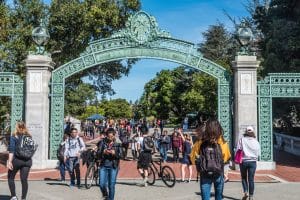
These options let you expand your horizons and get the most out of your time at UC Berkeley while staying focused on your goals!
What Is the Best Major for a UC Berkeley Premed?
At UC Berkeley, there’s no official “premed” major—just like at other highly ranked UC campuses. Instead, Berkeley premeds come from all kinds of academic backgrounds, from philosophy to chemical engineering, and students have successfully gotten into medical school from a variety of majors. Nationally, and at Berkeley, there’s no single “best” major for premeds.
That said, a lot of Berkeley premeds choose majors in the biological sciences because many of the required courses overlap with the premed prerequisites we talked about earlier. If you’re looking for inspiration, here are some of the most popular premed majors at UC Berkeley:
College of Letters and Sciences
- Molecular and Cell Biology (MCB)
- Integrative Biology
- Public Health
College of Natural Resources
- Nutritional Sciences–Physiology and Metabolism
- Molecular Environmental Biology
- Genetics and Plant Biology
- Microbial Biology
Remember, you can thrive in any major as long as you maintain a strong GPA. Berkeley even publishes the average GPA for every major, so you can get a sense of how students tend to perform.
At the end of the day, your major should be something you’re genuinely passionate about. Even if your goal is medical school, you can absolutely follow your interests and choose a field you’ll enjoy dedicating your time to—whether it’s in the sciences or not!
Tips for Maintaining a High GPA
Being a UC Berkeley premed is no walk in the park. Academics are tough, and competition for top grades is intense due to curved grading. Those large intro science classes? They’re often called “weeders” for a reason—starting with thousands of students but dwindling to a few hundred by the end of the term.

It’s no surprise that these challenging courses can feel overwhelming and, if you’re not careful, might hurt your GPA, which is critical for med school. To stay on track, it’s important to focus, plan, and use the many resources available at Berkeley. Here’s how to succeed:
1. Take advantage of office hours and study sessions.
Your professors and TAs are there to help! Go to office hours if you’re struggling with the material or just have questions. It’s a great way to get extra support and build relationships for those all-important recommendation letters.
2. Join study groups or adjunct courses.
The Student Learning Center (SLC) offers study groups and adjunct classes for key premed courses like Chem 1A, Chem 3A/B, Bio 1A/B, and MCB 102. They also have free drop-in tutoring and exam review sessions. This is a fantastic way to get extra practice and find a support system.
3. Start your own study group.
Prefer a more informal setting? Organize a group with your peers to study together and share tips. Sometimes, working with friends makes tough material more manageable.
4. Plan your schedule carefully.
Mapping out your courses in advance helps you stay on track with your requirements and avoid overloading yourself. Check out sample four-year plans for your major and use resources like the Berkeley Academic Guide and Berkeley Time (a student-made scheduling tool where you can sort classes by average grade). Pro tip: Spread out your hardest courses so you don’t overwhelm yourself.
5. Don’t overload your schedule.
It’s tempting to take the hardest courses to prove yourself, but balance is everything. Medical schools care more about your GPA than about taking an unnecessarily grueling course load. Focus on what you can handle while keeping your grades strong.
6. Consider summer classes.
Taking a course or two over the summer can lighten your regular semester load and make your schedule more flexible. It’s a smart way to spread out tough classes.

7. Use test banks and practice problems.
Tau Beta Pi offers a free library of syllabi, midterms, and finals for certain courses. Even if you’re not part of an SLC study group, you can still grab practice problem sets, mock midterms, and finals to sharpen your skills.
8. Put in the effort.
Succeeding as a Berkeley premed isn’t easy—it takes real dedication and strategic planning. Even if you were a top student in high school, the stakes are higher here. But with hard work and the right approach, you can absolutely thrive.
Remember, it’s not about perfection—it’s about progress. Stay focused, use your resources, and don’t hesitate to ask for help when you need it. You’ve got this!
Frequently Asked Questions
1. Does UC Berkeley have a specific premed track?
No, UC Berkeley doesn’t have a specific premed track. Instead, premed students can choose any major while completing the prerequisite courses required for medical school.
2. Does UC Berkeley have a medical school?
No, UC Berkeley does not have a medical school. However, it is closely affiliated with UC San Francisco (UCSF), one of the top medical schools in the country, which provides research, clinical, and collaborative opportunities for Berkeley students.
3. When should I take the MCAT?
The best time to take the MCAT is in the spring or summer of the year before you plan to apply to medical school. This ensures your score is ready when you submit your application. You should only take the test after completing the necessary coursework, like biology, chemistry, physics, psychology, and sociology, and once you’ve had enough time to study.
If you’re planning to take a gap year, you can take the MCAT later in college, giving you more time to prepare. Just make sure to schedule it early enough to retake it if needed while staying on track with your application timeline.
4. What is UC Berkeley’s medical school acceptance rate?
In 2023, UC Berkeley’s medical school acceptance rate for first-time applicants was 57.1%, with 16 out of 28 applicants gaining admission to MD programs through the AMCAS system.
5. Is UC Berkeley good for pre-med students?
Yes, UC Berkeley is an excellent choice for premed students. It offers rigorous academics, top-notch research opportunities, and a vibrant premed community. With access to world-class faculty, over 50 health-related student organizations, and its proximity to UC San Francisco—a leading medical school—Berkeley provides ample opportunities for clinical, research, and leadership experiences. While the coursework is challenging, the resources available, such as the Student Learning Center and various advising services, help premed students succeed.
Takeaways
Despite not having a specific premed track, it’s clear that UC Berkeley offers a highly supportive environment for students pursuing careers in healthcare. The flexibility in choosing a major, coupled with intensive academic and extracurricular resources, provides students with a strong foundation to succeed.
- UC Berkeley doesn’t have a designated premed major. This allows students to pursue any field of study they’re passionate about while fulfilling medical school prerequisites.
- With over 50 health-related student organizations and access to clinical and research opportunities, Berkeley provides a dynamic and supportive environment for premed students to gain hands-on experience and build connections.
- The close relationship with UCSF, one of the country’s top medical schools, gives Berkeley students access to additional research, clinical, and mentorship opportunities that are invaluable for premeds.
- Thinking about UC Berkeley for premed? Maximize your chances of getting into your dream school by partnering with a college admissions expert to ensure you’re fully prepared.










