

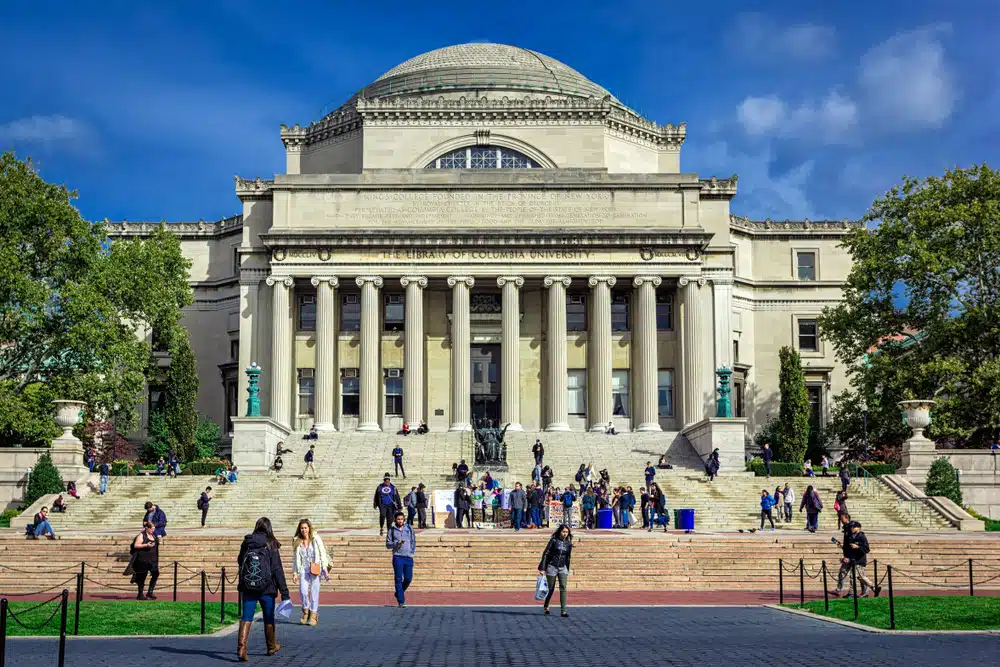
Thinking about spending your summer at Columbia University? You might be hoping to study college-level courses, soak up the energy of New York City, or meet other ambitious students from across the globe. A Columbia summer program will give you the chance to do all of that and more.
Columbia’s summer programs are fast-paced, inspiring experiences that push you academically while giving you a front-row seat to life in one of the world’s most iconic cities. Let’s break down what to expect.
- Columbia Summer Programs You Can Choose From
- Columbia Summer Programs Application Materials
- Are Columbia Summer Programs Worth It?
- Frequently Asked Questions
- Takeaways
Columbia Summer Programs You Can Choose From
Columbia has a bunch of summer programs that can fit what you’re looking for, no matter your goals, interests, or availability. You can live on campus in the middle of New York City, commute from home, or take your classes online if that works better for you.
Classes are led by experienced instructors who encourage critical thinking, creativity, and strong communication skills you’ll use well beyond the classroom. Some programs let you earn real college credit, while others help you sharpen specific skills like writing your college essay. Each one gives you a feel for what it’s like to be part of Columbia’s academic community and helps you get a head start on college life.
1. NYC Residential Summer
- Dates: Session A (June 30–July 18), Session B (July 22–August 8), Session AB (June 30–August 8, 2025)
- Cost: $12,764 per session
- Eligibility: Open to domestic and international students in grades 9–12 who are at least 15 years old and turn 16 by December 31 of the program year.
Spend your summer at Columbia taking college-style classes in the heart of New York City. You’ll choose from over 70 courses across a range of subjects and spend about four hours a day in class, with a two-hour break in the middle to rest, eat, or explore.
You will also live on campus, which makes it easy to stay involved. You’re right near your classes and can join daily events like faculty lectures, college prep workshops, student activities, and wellness programs.

Most students live on Morningside Campus, where you’ll have access to Columbia’s 36-acre grounds and all the excitement of NYC just steps away.
2. NYC Commuter Summer
- Dates: Session A (3 weeks: June 30–July 18), Session B (3 weeks: July 22–August 8), Session C (1 week: August 11–15, 2025)
- Cost: $2,830 (1-week session); $6,310 (3-week session)
- Eligibility: Available to students entering grades 9–12 or their first year of college.
Students can pick from 70+ courses across multiple subject areas, attending class for about four hours each weekday with a two-hour break in between. Each student selects one curricular option per session, and some options may include two or more related courses.
Students entering grades 9–12 or their first year of college can join either the 1-week or 3-week sessions as commuters. Around 40% of students commute and still get access to many on-campus resources.
3. Online Summer
- Dates: Session A (2 weeks: July 7–18), Session B (2 weeks: July 21–August 1), Session C (1 week: August 11–15, 2025)
- Cost: $2,815 (1-week session); $3,965 (2-week session)
- Eligibility: Students from the U.S. and abroad who will be in grades 9–12 this fall, including current 12th graders
Monday through Friday, you’ll log into your virtual classroom and dive into class discussions, debates, simulations, group projects, workshops, and more—all designed to help you sharpen your academic skills.
Thanks to Columbia’s online learning platform, you’ll connect with students from around the world through challenging coursework, student life activities, and events focused on college prep and success.
If you join the 2-week program, you can also take part in the Columbia Writing Academy, where you’ll work on writing and polishing a standout college application essay.
4. College Edge: Summer
- Dates: Session A (May 26–July 3, 2025), Session B (July 7–August 15, 2025)
- Cost: $2,574 per point (one course usually counts as 3 points)
- Eligibility: Students in grades 11–12
In the College Edge program, you’ll get a real taste of college life by taking actual Columbia University courses for credit—right alongside undergrads on the Morningside campus. If you’re in 11th or 12th grade, you’ll earn college credit, get academic advising, and have access to professional development opportunities.
Unlike other Columbia summer programs, you’ll register for official college courses. After you’re admitted, you’ll work with an academic advisor to choose classes that interest you. Once you’ve picked a course, your advisor will coordinate with the professor to see if you can join.
Popular departments include chemistry, economics, Germanic languages, math, psychology, and statistics. You can take up to 12 points during fall or spring, and no more than 30 total unless the department gives you special permission.
5. Columbia Writing Academy
- Dates: July 21-31, 2025 (Mondays, Tuesdays, and Thursdays)
- Cost: $3,960 per session
- Eligibility: Students in grades 9–12, including current seniors, from the U.S. and abroad
As more colleges move away from putting heavy weight on standardized test scores, your admissions essay has never been more critical. The Columbia Writing Academy is a two-week online course designed by Dr. Nancy Sommers to help you find your voice, refine your writing style, and craft a personal statement that stands out.
You’ll go through every step of the essay-writing process—brainstorming, drafting, and revising—while getting detailed feedback from instructors along the way. Since the course focuses on small-group workshops and one-on-one tutorials, it’s best suited for students who are truly motivated to perfect their college essay.
Expect to spend about 6 to 8 hours a week on readings, writing, one-on-one sessions, and three live Zoom workshops. It’s an engaging and focused experience.
By the end of the course, you’ll have a powerful essay that brings your story to life and strengthens your college application. You’re also encouraged to join online workshops like Finding the Right College for You, Putting Your Best Foot Forward on a College Application, and Insider Tips for the Common App to get even more prepared.
6. CSPA Summer Journalism Workshop
- Dates: In-person (June 22–27, 2025), Virtual (July 7–11, July 14–18, or July 21–28, 2025)
- Cost: $2,199 (residential) | $1,399 (commuter) | $999 (virtual)
- Eligibility: Open to high school students and teachers from U.S. schools and international schools with an American curriculum; middle and junior high students are not eligible.
If you’re part of a student publication team—print or online—the Columbia Scholastic Press Association invites you to join its 44th Annual Summer Journalism Workshop, available both in-person on Columbia’s campus in June and virtually in July. Each session focuses on key areas like reporting and writing, editorial leadership, or design.
This workshop is open to high school students and teachers from U.S. schools and international schools that follow an American-style curriculum. Junior high and middle school students aren’t eligible. If you qualify, you can also apply for a Greenman Leadership Grant, thanks to support from the Reckson Foundation.
Want to know more about the program? Check out our in-depth guide to the Columbia CSPA.
Columbia Summer Programs Application Materials
To apply to a Columbia Summer Program, you’ll need to submit all required materials through the online application portal. Your application won’t be reviewed until everything is complete, so be sure to gather and submit all items listed below.
1. Application fee
The application includes an $80 nonrefundable fee, payable by credit card through the online application portal.
2. Unofficial transcript
An unofficial transcript is required for your application to be reviewed. If you’re accepted, an official transcript must be submitted before enrollment. You can watch this video for a step-by-step guide on completing the Academic History section of your application.
3. Teacher recommendation
A teacher recommendation is required for all programs and must be submitted through the online system—no separate letter is needed. The recommendation must be written in English.
4. School counselor recommendation (for NYC Residential & NYC Commuter applicants only)
This recommendation must come from a counselor, advisor, principal, or headmaster at your current school and should address your academic ability, maturity, and motivation.
Homeschooled students may submit a recommendation from their primary instructor; if that instructor is a parent or guardian, the email used must match the one listed in the parent section of the application.
Important reminders
Only completed applications will be reviewed. Make sure all required materials are submitted on time for your application to be considered.
Need more help? Columbia put together a series of short videos that walk you through each part of the application. You’ll learn how to choose your program, upload your transcript, add your recommenders, apply for financial aid, and more—basically, everything you need to know to get through the process with confidence.
Are Columbia Summer Programs Worth It?
Columbia summer programs are absolutely worth it if you’re looking to challenge yourself academically, explore your interests at an Ivy League level, and boost your college application with meaningful experiences. Here are 5 reasons you should join a Columbia summer program:
1. Academic rigor at an Ivy League level
You will take real college-style courses that will push you to think critically, write clearly, and participate actively in high-level discussions. Whether you’re diving into neuroscience or international relations, you’ll build skills that go far beyond the average high school class.
With dozens of courses in areas like creative writing, STEM, philosophy, and economics, you get to choose what you actually want to study. You’ll spend your time learning about something that genuinely interests you—not just ticking off requirements.
2. College application boost
Getting into an Ivy League school is harder than ever. Just look at their Class of 2028 acceptance rates:
- Harvard University – 3.6%
- Yale University – 3.7%
- Columbia University – 3.85%
- University of Pennsylvania – 5.4%
- Princeton University – 4.6%
- Brown University – 5.2%
- Dartmouth College – 5.3%
- Cornell University – 8.4%
Columbia’s summer programs can help you stand out in meaningful ways. First, it offers academic credibility—you’ll take real college-level courses taught by Columbia faculty or subject-matter experts, which demonstrates your ability to succeed in a rigorous academic environment.
Participants also gain stronger application materials. You’ll receive a Certificate of Participation and, in many cases, a detailed evaluation letter that can add depth and distinction to your future college applications.
Perhaps most importantly, completing a Columbia program sends a powerful signal to Ivy League and other top-tier schools. It shows you’re not only ambitious but also proactive and prepared. If you’re aiming for the Ivies, this is the kind of head start that can truly make a difference.
3. Access to Columbia’s network and resources
At Columbia, you’ll take real college-style courses taught by Columbia faculty and seasoned professionals from various fields. Courses are led by experts like neuroscientist and writer Hannah Actor-Engel, finance strategist Sue A. Aguilar, Barnard professor Anamaria Alexandrescu, STEM educator Dr. Ugoo Anieto, and AI specialist Feyzi R. Bagirov.

You’ll also enjoy access to Columbia’s extensive academic resources and professional network, giving you a true taste of college life at one of the world’s top universities.
4. Personal growth and confidence
Whether you’re living in NYC or attending virtually, the experience builds independence, time management, and communication skills. You’ll leave the program not just smarter but more confident in your ability to navigate college and beyond.
Frequently Asked Questions
1. Will joining Columbia summer programs improve my chances of getting into Columbia?
Participating in Columbia’s summer programs won’t directly increase your chances of admission, as attendance alone doesn’t guarantee preferential treatment. However, it can strengthen your overall application by demonstrating academic initiative and interest, which may give you an edge not just at Columbia but at other top-tier schools as well.
2. Who can join Columbia summer programs?
High school students entering grades 9–12, including current seniors, are eligible. Some programs, like College Edge, are for 11th and 12th graders seeking college credit. International students are welcome, and teachers may join the CSPA Journalism Workshop.
3. What is the acceptance rate for Columbia’s summer programs?
While Columbia does not officially release acceptance rates for its pre-college programs, admission is selective, especially for programs like College Edge and the Columbia Writing Academy. Competitive applicants demonstrate strong academic ability, motivation, and maturity.
4. How much do Columbia Summer Programs cost?
Tuition varies by program and length, ranging from $999 to $12,764. The NYC Residential program is the most immersive option at $12,764 for three weeks, while the Online Summer Program offers flexibility at $2,815 for one week or $3,965 for two. Specialized programs like the College Edge cost $2,574 per credit (about $7,722 per course), and the CSPA Journalism Workshop starts at $999 for the virtual format, with commuter and residential options at higher rates.
5. Do Columbia Summer Programs offer financial aid?
Yes, financial aid is available for eligible students. Applicants must apply through the Columbia Summer application portal and submit relevant financial documents. Some programs, like the CSPA Workshop, also offer grants such as the Greenman Leadership Grant for qualified students. Financial aid decisions are made separately from admissions and can significantly reduce the cost of attendance.
Takeaways
- With options like Residential, Commuter, Online, College Edge, the Writing Academy, and the Journalism Workshop, there’s a Columbia summer program to fit your interests, schedule, and goals.
- Columbia Summer Programs are open to students entering grades 9–12, including graduating seniors. Programs like College Edge are geared toward 11th and 12th graders looking to earn college credit. International students can apply, and teachers are eligible for the CSPA Journalism Workshop.
- To apply, you’ll need an online application, a teacher recommendation, transcript, and (for certain programs) a school counselor recommendation.
- Participating in a Columbia summer program won’t give you a direct edge when applying to Columbia’s undergraduate school, but it can still strengthen your overall college application.
- A college admissions expert can guide you in selecting the best-fit summer program, highlight your experience in standout application essays, and strategically leverage your evaluation letter to strengthen your college applications.










