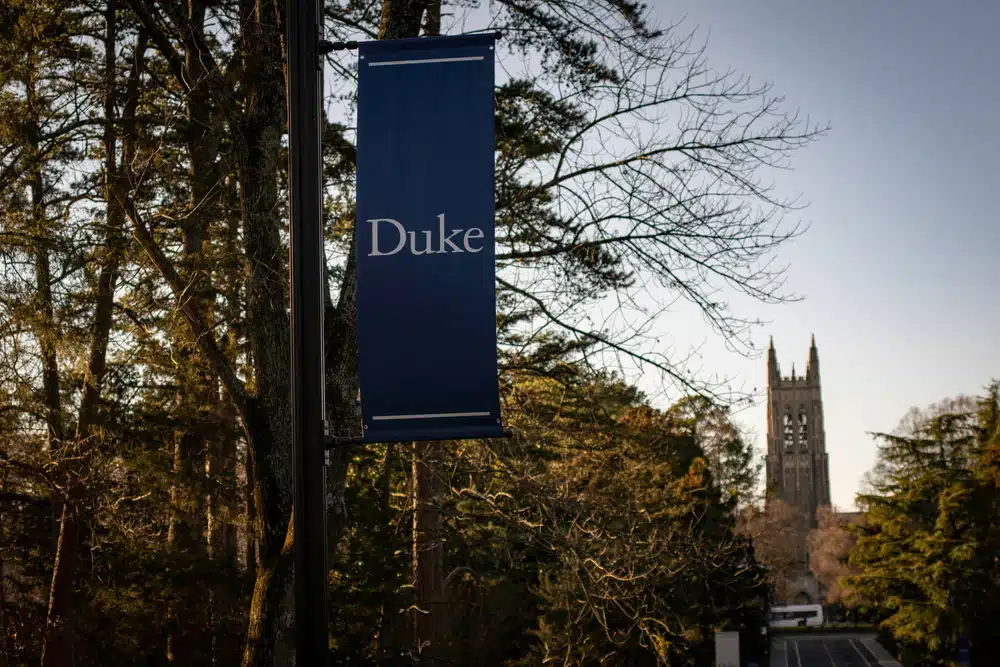
Think you know Duke University? Whether you’re a die-hard Blue Devils fan or just starting to explore colleges, there’s a lot more to this campus than meets the eye. From hidden traditions to surprising trivia, these fun facts about Duke University will give you an inside look at what makes Duke one of the most unique schools in the country.
10 Fun Facts About Duke University
Getting into Duke isn’t easy. With an acceptance rate of just 4.8% for the Class of 2029, it’s one of the most selective schools in the country, known for its unique courses, cutting-edge research, and vibrant campus culture. But beyond the prestige, Duke has a fun and fascinating side you might not expect.
Here are 10 fun facts about Duke University that’ll show you there’s more to this campus than just academics and basketball.
1. Blue Devils’ French connection
You might be surprised to learn the origin of Duke’s “Blue Devils” nickname. It has nothing to do with any sort of devilish creature. The name was inspired by a group of French soldiers from World War I nicknamed les Diables Bleus (“The Blue Devils”).
These Alpine troops, known for their distinctive blue uniforms and valiant service, impressed returning Duke students after the war, so the university adopted “Blue Devils” in their honor. Today, the Duke mascot is also known as the Blue Devil, helping rally fans at games and other campus events. So, every time you cheer on Duke’s teams, you’re actually invoking a bit of WWI history!
2. From Trinity to Duke: a gift that changed everything
Another fun fact about Duke University is its transformation from a small local college into the world-class institution it is today. Duke began as Trinity College (founded in 1838), but in 1924, tobacco magnate James B. Duke donated $40 million—an astronomical sum at the time—to expand the school and rename it “Duke University” in honor of his family.
That endowment jump-start from 1924 has grown tremendously (those funds are worth nearly $12 billion now), literally building the beautiful Gothic campus and vaulting Duke into the top rank of universities. In other words, Duke University as we know it was born from one very big philanthropic gift.
3. Lemur capital of the campus
Here’s a fun fact about Duke University for animal lovers: you can actually visit lemurs on campus! Duke is home to the Duke Lemur Center, the only university-based facility in the world devoted to studying prosimian primates (like lemurs), and it houses the world’s largest colony of endangered primates outside of Madagascar.
More than 200 lemurs, bush babies, and lorises live at this unique research center, and over 85% of them were born right there in Durham. So if you attend Duke, you might find yourself face-to-face with a fuzzy lemur between classes—a pretty wild addition to campus life.

4. Bonfire victory celebrations
If the Blue Devils win a huge game, say a national championship or a victory over archrival UNC, get ready to sprint to the quad because bench burning is how Duke celebrates in fiery style.
For nearly 40 years, students have marked big basketball wins by lighting bonfires and sacrificing campus benches to the flames, a tradition that’s become a core part of Duke’s identity (albeit one that’s occasionally made administrators a bit nervous!). Don’t worry, Duke usually keeps it safe and sanctioned these days: when a win is in the bag, the university will issue permits and set up a controlled bonfire zone on Abele Quad where you and hundreds of other jubilant fans can cheer, chant, and watch a wooden bench go up in flames.
5. Krzyzewskiville (K-Ville) camping tradition
Of course, Duke’s basketball fandom has its own legendary traditions. One fun fact about Duke University is the phenomenon of “Krzyzewskiville,” the tent city that pops up on campus each winter.
Before major home games, especially the Duke vs. UNC showdown, hundreds of undergraduates literally camp out for weeks in a grassy area outside Cameron Indoor Stadium (dubbed K-Ville, after Coach Mike Krzyzewski) to secure their spot in line for entry.
Students brave freezing January nights in dozens of tents, and the dedication is so intense that Coach K himself has been known to reward the campers with pizza deliveries and the occasional impromptu team talk to the crowd. It’s an only-at-Duke experience: you learn that at Duke, camping skills and school spirit go hand-in-hand during basketball season!
6. Coach K: the infamous coach in NCAA history
Speaking of sports legends, you should know that one fun fact about Duke University involves its iconic men’s basketball coach, Mike “Coach K” Krzyzewski. When Coach K retired in 2022, he had spent 42 seasons at Duke and finished as the winningest coach in college basketball history, with a record 1,202 career wins and five NCAA national titles to his name.
Under his leadership, Duke became a perennial powerhouse: the Blue Devils won championships in 1991, 1992, 2001, 2010 and 2015, and appeared in 13 Final Fours.
The home arena, Cameron Indoor Stadium, is revered as one of basketball’s most electric venues thanks in large part to the program Coach K built. If you’ve ever heard of Duke University in the sports world, it’s likely because of Coach K’s extraordinary legacy.

7. Sky-high selectivity
On the academic side, you might be stunned by this one: how greatly selective Duke’s admissions have become. For the incoming Class of 2029 (students starting in Fall 2025), Duke received a record 58,600+ applications, and for the first time ever, the overall acceptance rate fell below 5%.
In fact, landing a spot at Duke nowadays is tougher than ever. To put that in perspective, at the turn of the millennium, Duke’s acceptance rate was around 25%, and it has since plunged to Ivy-League levels of selectivity. If you get into Duke today, you have serious bragging rights given how sky-high the competition is!
8. Nobel Prize talent
Another fun fact about Duke University is that at least 16 Nobel laureates have been affiliated with Duke as alumni or faculty over the years. This elite group includes scientists like Dr. Robert Lefkowitz and Dr. Paul Modrich, beloved Duke professors who each won the Nobel Prize in Chemistry (Lefkowitz in 2012 and Modrich in 2015) for their groundbreaking medical research.
Whether they studied or taught at Duke, these Nobel laureates prove the university’s status as a research powerhouse. Who knows, walking around campus, you just might bump into a Nobel Prize winner on their way to teach a class!
9. Alumni tech titans and business moguls
Duke’s alumni network is seriously impressive, and one of the fun facts about Duke University is how many tech and business leaders got their start there. For example, Apple CEO Tim Cook earned his MBA at Duke’s Fuqua School of Business back in 1988.
Likewise, Melinda French Gates, co-founder of the Bill & Melinda Gates Foundation and one of the world’s most influential philanthropists, is a proud “Double Dukie” who completed both her bachelor’s degree (1986) and her MBA (1987) at Duke.
These famous alums show the breadth of Duke’s impact: from leading Fortune 500 companies to driving global charitable initiatives, Duke graduates are making their mark. If you end up at Duke, you’re in pretty good company!
10. A U.S. President in Duke’s ranks
Finally, you might not realize that one of the fun facts about Duke University is that it counts a U.S. President among its graduates. Richard Nixon, the 37th President of the United States, attended Duke University’s School of Law in the 1930s on a scholarship and graduated third in his class in 1937.
In fact, Nixon remains the only U.S. President to hold a degree from Duke. It’s a unique distinction for the university. While Duke is often celebrated for its athletes and scholars, it also played a chapter in the story of a future president. Love him or loathe him, Nixon’s Duke connection is a remarkable piece of Duke’s history and legacy.
Famous Duke Traditions
Duke is also home to some legendary traditions that bring students together year after year. Here are some famous Duke traditions that are a big part of what makes campus life unforgettable.
1. Krzyzewskiville (K-Ville) and the Cameron Crazies
As a Duke student, you’ll quickly find yourself drawn into Krzyzewskiville, or “K-Ville,” where you and your friends camp out in tents for weeks just to snag prime seats at a basketball game. This makeshift tent city outside Cameron Indoor Stadium is home to the Cameron Crazies, the famously passionate Duke student section and surviving its middle-of-the-night tent checks, winter storms, and sleep deprivation is almost a rite of passage.
Tenting can be grueling, but it’s also ridiculously fun: you’ll bond over trivia contests about Duke basketball lore, share midnight pizza, and even enjoy new perks like a “Wellness Week” break to catch up on sleep.

2. Duke Chapel Tower climb
One of the most breathtaking traditions awaits you in your senior year: the Duke Chapel tower climb. As you approach graduation, you’ll get the chance to ascend the iconic Duke Chapel’s tower, all 239 steps up a tight spiral staircase, roughly 210 feet above campus.
It’s a bit of a workout (you might be winded and dizzy by the top!), but stepping out onto the chapel roof is absolutely worth it. You’ll be greeted with a stunning 360° view of the campus you’ve called home, from the gothic spires of West Campus to the wooded acres beyond—a perfect moment to reflect on your four years.
3. Bricks to Stone
As a Duke first-year, you’ll start your college life on East Campus (known for its historic red-brick residence halls), but by sophomore year you move to West Campus with its iconic Gothic stone architecture. Duke now marks this big transition with a new tradition called “Bricks to Stone.”
Launched recently as part of the QuadEx living-learning system, Bricks to Stone is an annual spring ceremony that celebrates you and your entire first-year class moving from the “bricks” of East to the “stone” of West.
Frequently Asked Questions
1. What are some famous Duke traditions?
Duke University is known for its rich traditions, including celebrating the end of classes with lively concerts, burning benches in honor of big victories, and camping out for coveted basketball game tickets.
Other cherished customs at Duke involve Midnight Breakfast, where students gather for a late-night meal, painting the East Campus bridge with vibrant designs, and the symbolic transition from East to West Campus, famously called “Bricks to Stone.”
2. Why is Duke called Duke?
Duke University is named after Washington Duke, a wealthy tobacco and electric power magnate from North Carolina. He made significant contributions to the university, particularly in the early 20th century. In 1924, following his death, his son, James Buchanan Duke, honored his father’s legacy by making a generous endowment to the university. In recognition of the Dukes’ support, the university was renamed from Trinity College to Duke University.
3. Which celebrities went to Duke?
Duke University has produced several renowned celebrities across various fields. Notable alumni include actors like Daveed Diggs, known for Hamilton, and Elizabeth Banks, famous for her roles in The Hunger Games and Pitch Perfect. Renee Elise Goldsberry also gained fame for her portrayal of Angelica Schuyler in Hamilton.
Comedians and actors like Ken Jeong, from Community and The Hangover, and Kerry Washington, known for Scandal, also graduated from Duke. The university is also known for being home to top athletes, including NBA stars Zion Williamson, Grant Hill, and Kyrie Irving.
Takeaways
- Fun facts about Duke University include its on-campus lemur sanctuary, fiery bonfire celebrations after big wins, and the legendary K-Ville camping tradition before rivalry basketball games.
- Some beloved Duke traditions are K-Ville, Duke Chapel Tower Climb, and the Bricks to Stone march.
- Dreaming of studying at Duke? Working with a college admissions consultant can help sharpen your application strategy and increase your chances of being accepted.