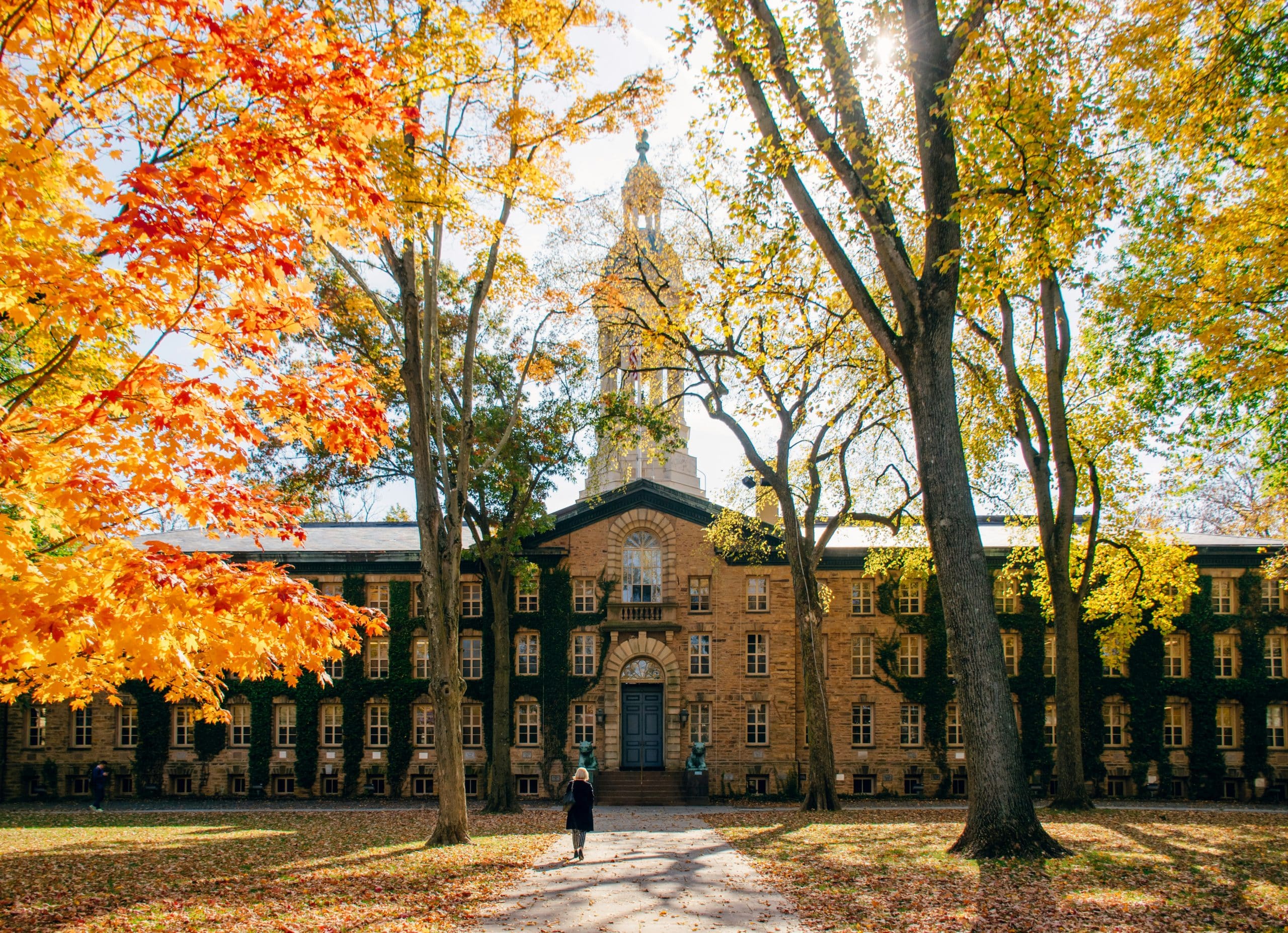
Princeton’s traditions go back centuries. First-years run through FitzRandolph Gate during the Pre-rade and then avoid walking back through it for four years, out of respect for a superstition that says doing so will keep them from graduating. Each graduating class leaves a stone with its year carved into it near Nassau Hall, a practice that started in 1879.
These facts are fun to know, but they matter for your application for a more practical reason. Princeton’s admissions committee reads thousands of essays every year, and a large share of them mention the same handful of traditions in the same shallow way. If you know these details only as trivia, your essay will read like everyone else’s. But if you know how one tradition connects to something real about you, it becomes compelling evidence.
In this guide, you’ll read about traditions you should know about. Then, we’ll walk you through how to put that knowledge to work in your Princeton application.
- Top 10 Princeton Traditions
- How to Use Princeton Traditions in Your Application
- Take the Next Step in Your Princeton Application
- Frequently Asked Questions
- Takeaways
Top 10 Princeton Traditions
As an applicant, what you’ll most probably pay heavy attention to are the acceptance rates, requirements, and program offered by the school. However, Princeton also wants students who will fit in with their community.
Learning about Princeton University’s unique traditions can help you gauge how at-home you’ll feel on campus. So, here are ten of the ones you should look forward to:

1. The Pre-rade
The Pre-rade is your official welcome to Princeton. After convocation, you’ll run through FitzRandolph Gate while upperclassmen, alumni, and the student band cheer you on. It’s loud, fast, and full of Tiger pride. In short, it’s your first big moment as a Princeton student!
That’s not all, though! According to campus legend, if you walk out of FitzRandolph Gate before graduation, you won’t make it to commencement. That’s why students go out of their way to avoid stepping through it for four years. Only seniors walk through the gate again at graduation.
Many students take this superstition seriously. Some don’t believe it, but they’re unwilling to test it. Better safe than sorry, right?
The Pre-rade begins after Opening Exercises at the chapel. You’ll follow a route past East Pyne and Chancellor Green, march through FitzRandolph Gate, and end at Blair Arch for the “Step Sing,” where you’ll learn “Old Nassau,” Princeton’s alma mater, alongside classmates and alumni.
2. Princeton Reunions
Every year, more than 25,000 alumni, family, and guests return to campus for Princeton Reunions. It’s one of the biggest alumni gatherings in the country, filled with music, lectures, campus tours, and class parties. For many graduates, it’s the best excuse to tour old stomping grounds and reconnect with friends.
These reunions are a huge part of what keeps Princeton’s alumni community strong and involved. Graduates fly in from across the country and around the world to see familiar faces, meet current students, and celebrate how far they’ve come since their own days at Princeton.
One of the biggest highlights is the “P-rade,” a campus-wide parade where alumni march with their class year, often joined by family members. Each graduating class designs its own class jacket, which students wear for the first time during Reunions weekend. Over the years, classes have made the P-rade even more lively with elaborate costumes, signs, and stunts.
If the Pre-rade welcomes first-years, the P-rade honors alumni and gives seniors one final walk through campus before graduation.
3. Cane Spree
Cane Spree is one of Princeton’s oldest and most unusual traditions. Every fall, first-year and sophomore students face off in an intramural competition filled with relay races, obstacle courses, and the main event: cane wrestling. Each match features a freshman and a sophomore grappling to control a wooden cane, all in good fun.
This tradition actually comes from a pretty intense history. Back in the 1860s, it was fashionable for men to carry fancy canes. When freshmen strutted around campus with them, sophomores weren’t impressed. They started stealing the canes and sometimes used them as weapons! What began as chaotic class brawls eventually became a safer, school-run tradition.
Today’s Cane Spree is much more controlled but still carries that same competitive energy. The event takes place in the football stadium and ends with a casual barbecue for everyone involved. It’s no longer about winning or losing but class spirit and bragging rights.
4. The Big Three Bonfire
The Big Three Bonfire is a super rare tradition. It only happens when the football team finishes the season with the best record among the Big Three: Harvard, Yale, and Princeton. In short, Princeton has to beat both Harvard and Yale, which doesn’t happen every year. Many students go all four years without seeing one. But when it does happen, it’s unforgettable!
The bonfire takes place on Cannon Green, in the heart of campus. Students help build a huge wooden structure, decorated with Yale and Harvard signs and sometimes even effigies. Each class gets a chance during the day to add something to the pile. By nightfall, the whole campus gathers to watch it burn.
This tradition goes back to the 1800s, when bonfires were used to celebrate wins in college baseball. Today, it brings out students, alumni, faculty, and even local residents, all cheering together as flames light up the night sky.
The most recent bonfire happened in 2021, and students still talk about it. If you’re lucky enough to see one during your time at Princeton, it’s sure to be the kind of memory that stays with you long after graduation.
5. The “Locomotive”
Did you know that Princeton played an important role in the history of college cheering? As early as the mid-1800s, students were already shouting organized cheers at sports games and other campus events. In fact, the term “cheer-leader” was used at Princeton as early as 1897, with appointed students leading chants at football practices and games.
Today, Princeton’s most famous cheer is called the Locomotive. It dates back to at least 1894 and goes like this:
Rah rah rah
Tiger, tiger, tiger
Sis, sis, sis
Boom, boom, boom, ah!
Princeton! Princeton! Princeton!
The cheer is called the “Locomotive” because it mimics the sound of a train starting slow and gaining speed. You’ll hear it at major events, football games, and even Reunions. It’s loud, it’s old-school, and it’s a tradition every Princeton student learns to chant with pride.

6. Eating club culture
Are you a foodie or someone who enjoys a good meal with friends? At Princeton, upperclassmen don’t just eat in dining halls but join “eating clubs,” which are private social and dining clubs located along Prospect Avenue. These clubs are a big part of Princeton culture, combining shared meals with parties, events, and a strong sense of community.
There are 11 active eating clubs, and most juniors and seniors join one. Six use a selective interview process called “bicker,” including Cap, Ivy, and Tower. Meanwhile, others like Terrace and Cloister use a sign-in lottery, while Charter Club uses a points system to select members.
Each club has its own vibe, traditions, and type of food. Some are more laid-back and artsy, while others are known for their parties or strong alumni ties. No matter which one you choose, the clubs offer a way to make your college life more personal and connected in your junior and senior years.
7. Ivy stones
One quiet but meaningful Princeton tradition is the Ivy stone. Since 1879, each graduating class has placed a stone engraved with its class year on the side of a campus building, most often Nassau Hall. For many years, these stones were paired with sprigs of ivy, which gave the tradition its name.
The idea was simple: leave a visible mark on campus that would last for generations. As you walked past, you could trace Princeton’s history just by reading the stones. But after nearly 150 years, there’s no more room in the building. Starting with the Class of 2018, new stones are now placed in the ground along the walkways leading to Nassau Hall.
Even with this change, the tradition continues. Wherever they’re placed, class stones still represent legacy, community, and your lasting connection to Princeton.
8. The “Holder Howl”
Every semester, on the night before Dean’s Date, Princeton students let out a collective scream at midnight. Outside Holder Hall, it’s called the “Holder Howl,” a full minute of howling from windows, balconies, and courtyards to release all the stress built up during reading period.
Dean’s Date is when final papers and projects are due, so the days leading up to it are intense. The midnight scream reminds you that you’re not alone. Other dorms have their own names for it, like the “Whitman Wail,” but the meaning is the same: shared pressure, shared relief.
Earlier that night, dining halls also host a free late-night breakfast to keep everyone going. Between the waffles and the howling, Princeton definitely makes space for both hard work and small moments of community during finals.
9. Forbes Garden and Sunday Brunch
Forbes College is a little farther from the central campus but is home to two of Princeton’s best-kept traditions: the Forbes Garden and Sunday Brunch. The garden is run by students through the Princeton Garden Project. You can volunteer to help weed, harvest, and learn about sustainable growing right in your own backyard!
But what really draws students to Forbes is the legendary Sunday Brunch. It’s one of the most talked-about meals on campus, with shrimp cocktail, baked brie, bagels, a cheese board, and yes, a chocolate fountain! Some students joke that it’s the only thing that gets people out of bed early on a Sunday. And honestly, who could blame them?
10. Outdoorsy activities
With a scenic New Jersey campus and easy access to nearby trails, forests, and the Delaware and Raritan Canal, Princeton is a great place to enjoy the outdoors. If you like nature, you’ll find plenty of chances to get outside and explore during the school year.
Princeton’s Outdoor Action (OA) program is best known for its pre-orientation backpacking trips for incoming first-years, but it also hosts hikes, climbing trips, and other adventures throughout the year. Whether you’re up for rock climbing or want a peaceful nature walk, there’s something for everyone.
OA also runs events like OA Day, where students can try new outdoor activities and meet people from across campus. You don’t need experience, just curiosity—and maybe a pair of hiking shoes.
How to Use Princeton Traditions in Your Application
Princeton doesn’t have a general “Why Princeton” prompt where you can drop in a tradition and call it done. That absence trips up a lot of applicants, because the temptation to name-drop a tradition doesn’t go away just because there’s no obvious place for it. The traditions still work, but only if you follow a few steps in order:
1. Match the tradition to the right prompt.
Princeton’s current supplemental essays give you two places where a tradition might fit, and they ask for different things.
The first is the community and lived-experience prompt:
- Princeton values community and encourages students, faculty, staff and leadership to engage in respectful conversations that can expand their perspectives and challenge their ideas and beliefs. As a prospective member of this community, reflect on how your lived experiences will impact the conversations you will have in the classroom, the dining hall or other campus spaces. What lessons have you learned in life thus far? What will your classmates learn from you? In short, how has your lived experience shaped you? (500 words or fewer.)
This prompt rewards traditions built around shared spaces and daily contact, such as the Pre-rade, the Holder Howl, Cane Spree, eating clubs, or Sunday brunch in Forbes College. These are moments where students show up next to each other, so they connect naturally to a question about how you’ll show up in Princeton’s classrooms and dining halls.
The second is the service and civic engagement prompt:
- Princeton has a longstanding commitment to understanding our responsibility to society through service and civic engagement. How does your own story intersect with these ideals? (250 words or fewer.)
Fewer Princeton traditions map directly onto this one, so don’t force a fit that isn’t there. Outdoor Action is an example of a candidate, since upperclassmen train to lead first-years on multi-day backpacking trips before classes even start, which is a real commitment of time and responsibility to people they haven’t met yet. If your own story involves mentoring, tutoring, or looking out for people younger or less experienced than you, that tradition gives you a concrete Princeton parallel to point to.
The mistake to watch for is treating either prompt like a generic “Why This College?” essay and reaching for whatever tradition you remember, regardless of what the prompt is actually asking. If a tradition doesn’t serve the specific question in front of you, leave it out.
2. Relate the tradition to your own interest or experience.
Once you’ve matched a tradition to the right prompt, the next question is whether it connects to something true about you. Choose a tradition because it maps onto an actual interest, value, or experience you have, not because it’s the one every admissions guide mentions first.
This is where a lot of applicants stumble. Big Three Bonfire, the P-rade, and the Pre-rade are the traditions that show up in nearly every “Princeton traditions” article, which makes them the ones applicants choose by default.
But if you’ve never run a leg of a relay, organized an event, or felt strongly about school spirit and pageantry, writing about the P-rade won’t ring true. A tradition that actually matches your life, like the Ivy stones for a student interested in history and legacy, or the Forbes Garden for someone who’s spent time growing food, will read as more honest and specific, even though it’s less famous.
3. Lean into one detail.
A common mistake is naming several traditions in a row, but it only shows you did your research. One tradition, described with a specific personal detail, does more work than three traditions mentioned in passing.
Here’s what that looks like done well, in a response to the 250-word service and civic engagement prompt:
- During Outdoor Action, upperclassmen spend four days leading first-years they’ve never met through the woods, carrying extra weight so no one falls behind. I want to be one of those leaders, the same way my cross-country coach ran beside our slowest teammate at every meet so nobody finished alone.
And here’s the same idea done poorly:
- Princeton has so many traditions that build community, like the Pre-rade, Cane Spree, the Locomotive cheer, and Reunions. These traditions show how much Princeton students care about each other, and I would love to take part in all of them.
The first passage ties one tradition to one specific action the writer already takes. The second lists facts about Princeton without saying anything about the writer at all. Readers can tell the difference between a tradition doing work in an essay and a tradition used as decoration, and the second version reads like it could have been written by any applicant who searched “Princeton traditions” the night before the deadline.
For more guidance on how to approach every prompt Princeton asks, along with word-by-word breakdowns of what each one is really testing for, read our Princeton Supplemental Essays Guide.
Take the Next Step in Your Princeton Application
Knowing Princeton’s traditions is one piece of a much larger application. If you’re ready to move from campus research to full application strategy, our How to Get into Princeton Guide covers admissions requirements, academic expectations, and what the university looks for beyond test scores and grades.
If you want hands-on support turning a tradition, or any other detail about your life, into a strong essay, AdmissionSight’s Standard College Counseling Program pairs you with an advisor who works through your essays and full application with you.
Frequently Asked Questions
1. Do I need to mention a Princeton tradition in my essay to get in?
No. Traditions can add specificity to an essay, but they’re not a requirement, and a strong essay built around a tradition you have no real connection to will read worse than a strong essay that never mentions one.
2. Which Princeton traditions do most applicants write about?
Most applicants default to the Pre-rade, Reunions, and Big Three Bonfire, since these show up first in nearly every “Princeton traditions” article online. That popularity is exactly why they’re harder to write about in a way that stands out.
3. What are Princeton’s supplemental essay prompts?
Princeton currently asks a 500-word prompt about how your lived experience shapes classroom and community conversations, and a 250-word prompt about your connection to service and civic engagement. Both prompts change occasionally, so confirm the current wording on Princeton’s admission website before you write.
4. Can I write about the same Princeton tradition in more than one essay?
You can, but it’s rarely a good idea. Reusing a tradition across essays usually signals that you’re repeating a talking point rather than drawing on different parts of your experience for each specific question.
5. Is it better to write about a well-known tradition or an obscure one?
Neither is inherently better. What matters is whether the tradition connects to something specific about you. An obscure tradition described with a real personal detail will always beat a famous tradition described in general terms.
Takeaways
- Used well, Princeton’s traditions give your supplemental essays specific, lived-in detail instead of the generic references admissions officers see thousands of times over.
- Examples of Princeton’s traditions include the Pre-rade through FitzRandolph Gate, the “Locomotive” cheer, Cane Spree, eating club culture, Ivy stones, the Holder Howl, and Outdoor Action’s pre-orientation backpacking trips.
- Match the tradition to the prompt first, then to your own experience. A tradition only strengthens an essay when it fits both the specific question being asked and something true about you, not just the one every applicant already knows.
- One tradition described in detail beats three traditions listed in passing. Depth signals a real connection to Princeton, while a list signals research done the night before the deadline.
- Turning a detail like this into a strong essay takes more than knowing the right facts. AdmissionSight’s Private Consulting Program pairs you with an advisor for one-on-one guidance across your entire application, not just your essays.